Unrelated Google results hit over 57% of keywords overnight: What our study found
Since September 2026, SEO teams and rank-tracking providers have been noticing something strange in Google ranking data. Websites suddenly disappear from the results, and previously unseen pages show up in their place. The ranking check itself goes through without an obvious error, but the results Google sends back don’t match the search.
Behind this may be a problem Google is trying to solve: bots scraping its search results at scale. As its policies explain, automated queries consume resources and can interfere with its ability to serve users.
Some in the SEO community suspect Google is specifically trying to disrupt AI scraping, with rank trackers (which also collect results automatically) getting caught in the same defenses.
At SE Ranking, our team has been actively responding to these changes from the start.

Note: You can follow the latest updates on our status page. If you notice any issues with your ranking data, please contact our support team at [email protected] with the project name and a few example keywords so we can investigate.
Alongside this ongoing work, we wanted to understand how widespread these unrelated results were and what patterns they followed. We studied 10,000 keywords from our research index (a keyword set maintained specifically for research, separate from customer projects and accounts).
We analyzed their Google US desktop results collected in September and October 2026 to understand how often unrelated listings appeared, what they showed, and where they began in the results.
Here’s what we found.
-
Unrelated Google results affected 57.3% of keywords overnight, up from 0.09% the day before.
The jump happened on September 17 in our 10,000-keyword sample.
-
By September 24, the share of affected keywords reached 67.2%.
This was the highest rate observed during the study period.
-
In 84% of cases, Google returned results about just one word from the search query.
For example, “business bank line of credit” brought back results for the word “line”: the Line messenger app, The Line Hotel, and Florida Georgia Line, rather than business financing.
-
Unrelated Google results almost always started outside the top eight.
96.5% of blocks with unrelated results began at position 9 or lower, 3.5% at positions 6–8, and none in the top five.
What are unrelated SERPs?
An unrelated SERP, sometimes called a “poisoned SERP,” is a search results page returned to an automated check that appears valid but contains misleading results.
For example, one query in our study was “business bank line of credit.” The first nine results were the banks and lenders you’d expect, such as Chase, US Bank, PNC, and LendingTree.
Page 2 had nothing about business credit. It showed music videos, the LINE messaging app, and The LINE Hotel. These results shared the word “line” with the query, but none of them answered it, and none appeared for the same query in our reference checks.
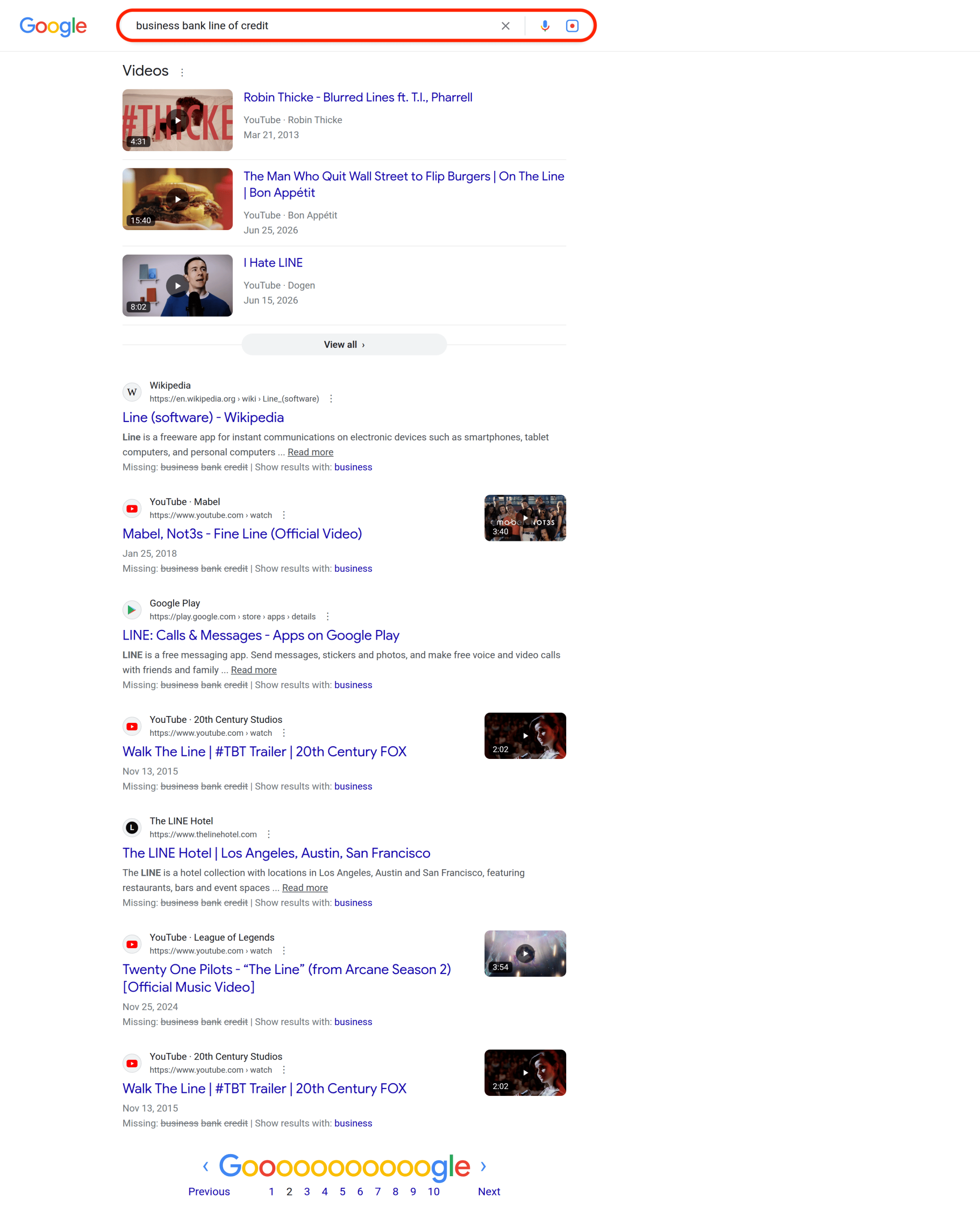
From the perspective of rank tracking tools, the check appears to have worked: Google returned what seems to be a valid page with results.
But if a website is missing from those listings, the tool can record a ranking drop even though its actual position hasn’t changed. There’s no obvious error message to flag. The problem only becomes clear when you look at what the results are about.
What the SEO community has been noticing
By early October, SEO practitioners were sharing concerns about ranking data that didn’t seem to match what they saw in Google. Barry Schwartz brought together many of these observations in his Search Engine Roundtable coverage, including the comments below.
On October 9, Lily Ray described how the uncertainty was getting in the way of sharing her analysis:
That same day, Alex Wolk said he was manually checking queries in an incognito window before trusting the movements reported by tracking tools.
Others were discussing what might explain the mismatch.
For example, Antony Deroshan suggested that Google was identifying automated traffic and returning junk results instead of blocking requests outright. This was his interpretation, not a confirmed explanation from Google.
On October 10, Marty Eigner summed up his experience more bluntly:
Those observations helped flag the issue. Provider investigations then put numbers behind it:
- Nozzle, October 21: Its study classified 22.6% of assessed SERPs since September 13 as “poisoned,” with a daily peak of 43.5% on September 30.
- Keyword.com, November 1: Its analysis classified 13.1% of SERPs from September 13 to October 14 as “poisoned,” compared with 0.3% in August.
The numbers vary because each provider looked at different keywords, dates, and collection methods. Still, they point to a shared problem: Google was returning unreliable results to multiple providers.
Why might Google be returning these results?
One theory, put forward by Nozzle’s Derek Perkins, is that Google is trying to disrupt AI scraping by returning misleading results instead of blocking automated requests outright. Since rank trackers collect results automatically too, they could be getting caught in the same defenses.
Cloro’s Ricardo Batista offers a related explanation: Google appears to direct some automated traffic to a lower-quality set of results. He argues that plausible but incorrect answers can be harder for scrapers to detect than an explicit block.
Note: These explanations remain unconfirmed. Google has not publicly explained the misleading results.
How the issue played out across 10,000 Google searches
We studied 10,000 Google US desktop keywords, saving up to 50 organic results per keyword. The September data covers September 14–24, followed by four additional checks on October 14–15.
Across the eight-day test period of September 17–24, that gave us 80,000 cases: one keyword checked on one day counts as one case. We validated the findings in several stages, including manual checks of disputed cases.
For more details on how we collected and validated the data, see the research methodology section.
Unrelated Google results jumped from 0.09% to 57.3% overnight
For the first three days, the estimated share of affected keywords stayed below 0.1%. Then it changed sharply. On September 16, it was 0.09%; on September 17, it reached 57.3%.
The rate stayed between 56.9% and 60.2% through September 23.
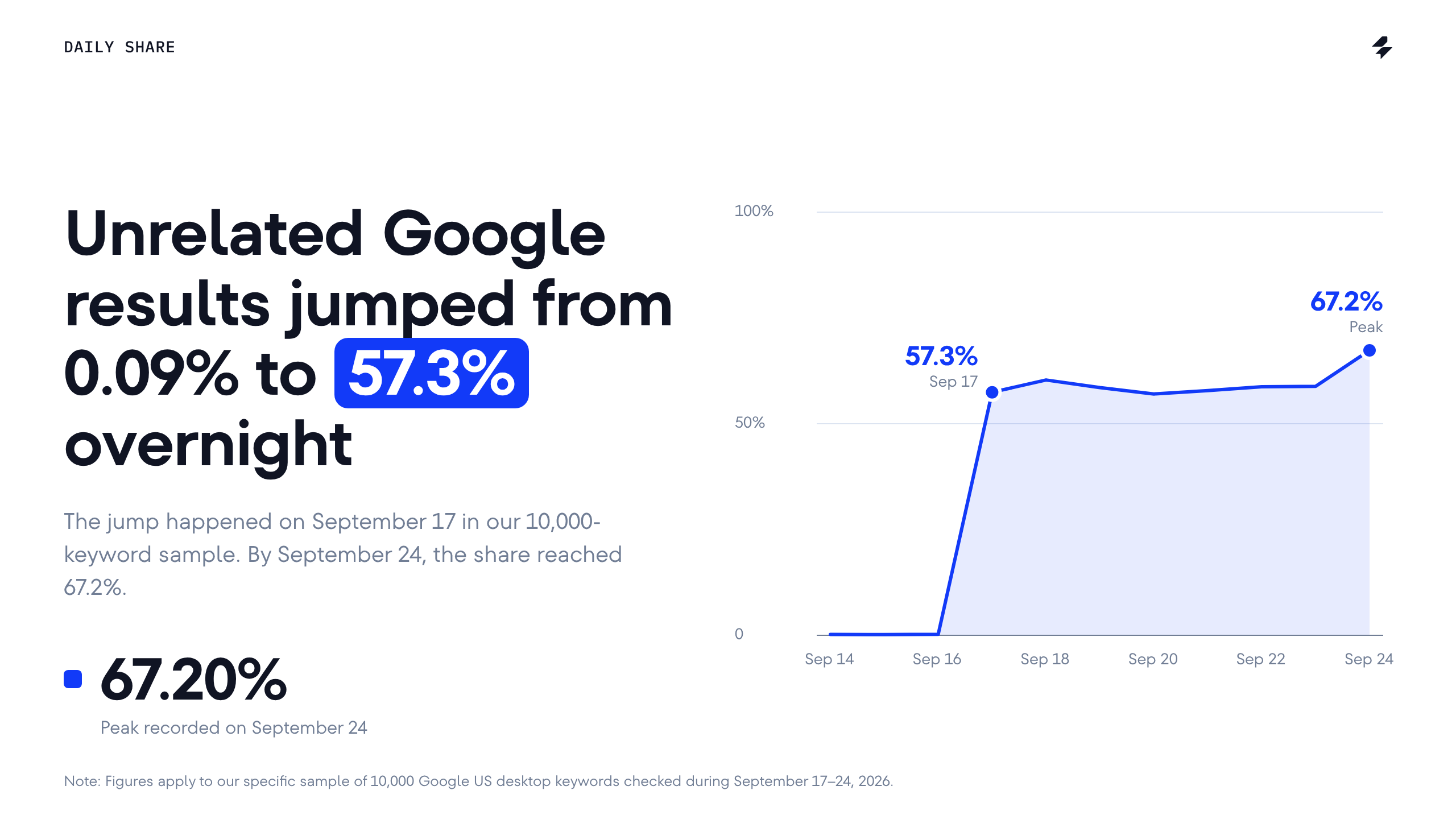
This wasn’t a single unusual check. The pattern continued across all eight test days. September 24 had the highest rate we observed, with 67.2% of keywords in our sample returning unrelated results.
In 84% of cases, results matched a single word instead of the full search
The unrelated listings often had something in common: they were about one word taken from the query. The rest of the phrase (and what the person actually wanted to find) seemed to get lost.
For example, “business bank line of credit” should return information about business financing. Instead, part of the results included the Line messenger app, The Line Hotel, the High Line, and the band Florida Georgia Line. They all connected to “line,” but none answered the full search.
We saw the same thing with other searches:
Word the unrelated results were about
line
Examples of results returned
Line messenger app, The Line Hotel, the High Line, Florida Georgia Line
Word the unrelated results were about
into
Examples of results returned
intostudy.com, into.org, intoglobal.com, into-tampere.org
Word the unrelated results were about
own
Examples of results returned
Oprah’s OWN network, “In Their Own Words,” “Mind Your Own” podcast
Word the unrelated results were about
pot
Examples of results returned
The Melting Pot, Lobster Pot restaurants, Petit Pot, Dogipot
Word the unrelated results were about
dry
Examples of results returned
Dry January, dry cleaner regulations, Dry Creek Vineyard, dry roasted peanuts
line
Line messenger app, The Line Hotel, the High Line, Florida Georgia Line
into
intostudy.com, into.org, intoglobal.com, into-tampere.org
own
Oprah’s OWN network, “In Their Own Words,” “Mind Your Own” podcast
pot
The Melting Pot, Lobster Pot restaurants, Petit Pot, Dogipot
dry
Dry January, dry cleaner regulations, Dry Creek Vineyard, dry roasted peanuts
In 84% of cases, the unrelated listings were associated with one word from the original search. In the other 16%, successive groups of results related to two or more words.
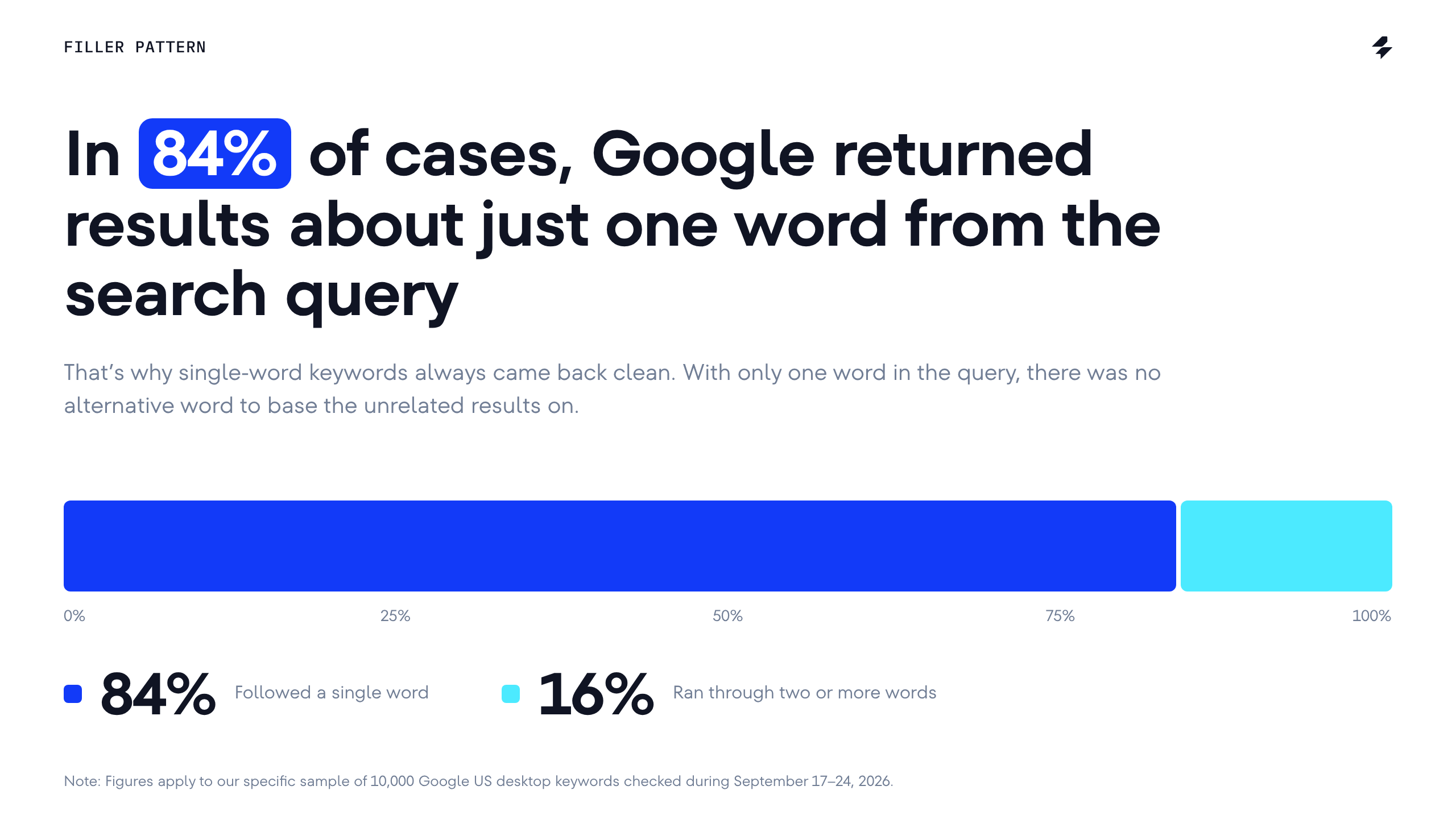
Results for one word of a query share its vocabulary and often its type of site. Even the cosine similarity between those pages and the original query is far from zero.
In plain terms, an automated check could still see some similarity because the results matched part of the search, even though they didn’t answer what the person was actually looking for.
This could explain why single-word keywords in our dataset always came back clean. With only one word in the query, there was no alternative word to base the unrelated results on.
The first five results could look normal
The unrelated listings didn’t always start at the top. A page could begin with relevant results, then switch partway through.
In our sample, the unrelated results started at positions 6–8 in 3.5% of affected result sets. In the remaining 96.5% of cases, the switch happened further down the list (at position 9 or lower).
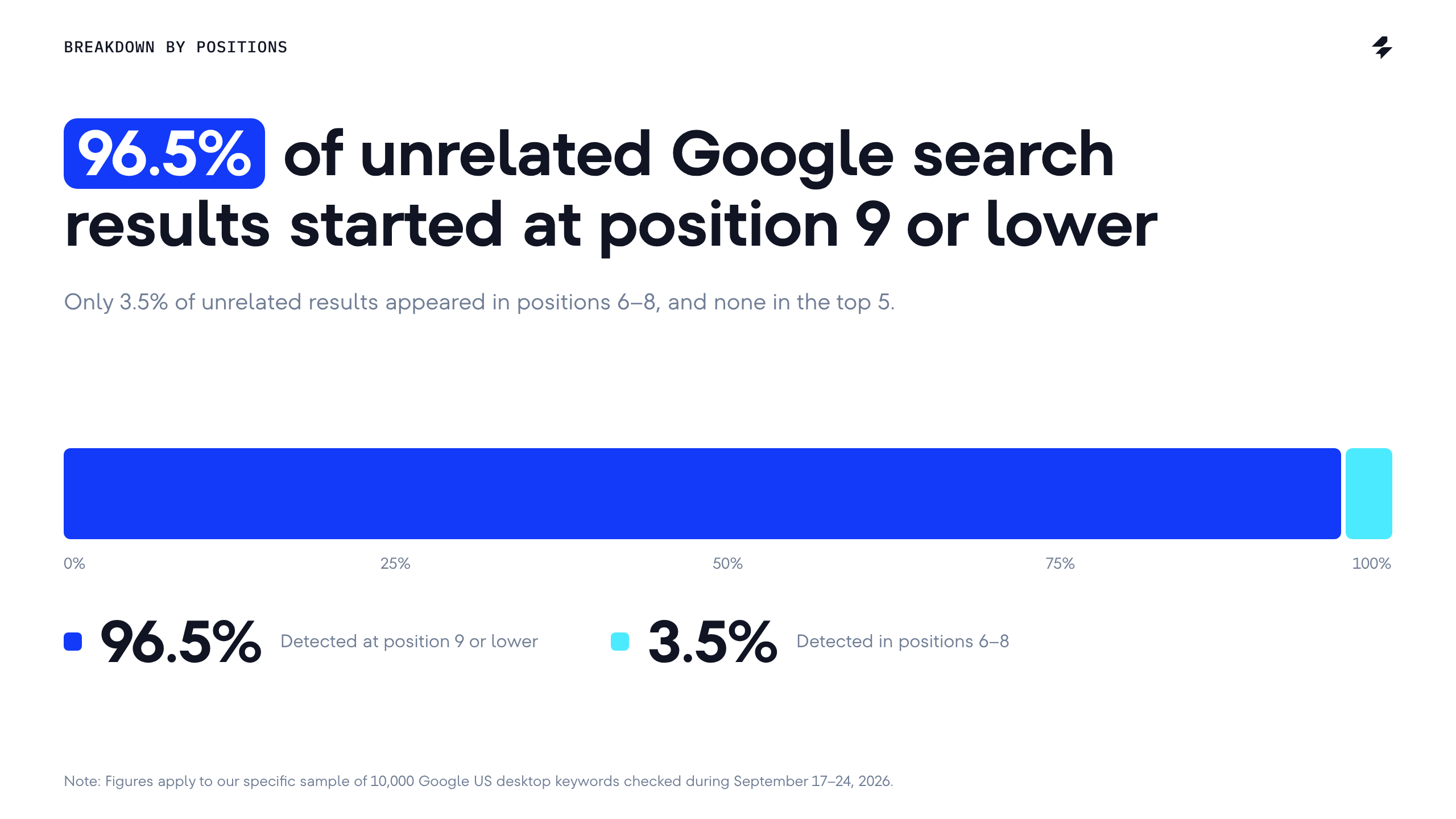
A quick look at the top results could make everything seem fine. Scroll further down, though, and the SERP might have little to do with the query.
So if a website is usually ranked in that part of the list, unrelated pages could take its place in the collected results. The tool might then report the site as missing or losing positions, even though this doesn’t necessarily mean its ranking changed for people searching on Google.
Facebook appeared in 45.2% of unrelated Google results, followed by Reddit and Instagram
The unrelated results often came from large platforms. Facebook appeared in 45.2% of flagged cases, Reddit in 41.3%, and Instagram in 31.6%.
Still, the list went well beyond social platforms. News sites, dictionaries, app stores, and research databases appeared too.
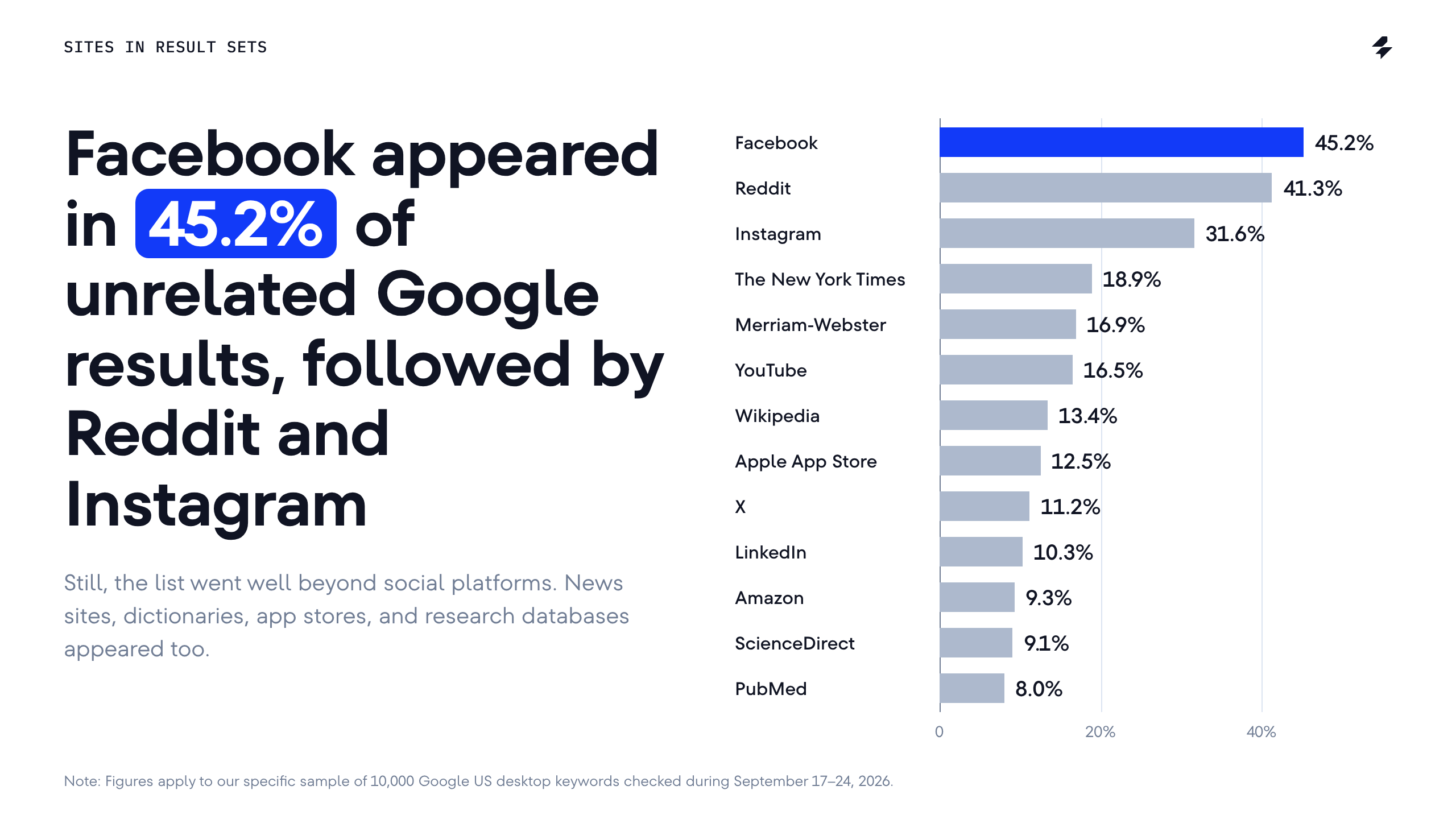
Merriam-Webster is a particularly telling example. It appeared in roughly one in six flagged cases, with dictionary definitions of the word the unrelated results were about. The definition itself could be accurate and still have little to do with what the person was searching for.
That same distinction applies to the other websites in the list. A dictionary entry, a Facebook post, or a news article can look credible on its own. To spot the problem, you have to check whether it answers the full query.
What to do if a ranking looks wrong
If a position looks unexpected, start by running a recheck. Before treating it as a confirmed ranking loss, take a moment to compare it with the keyword’s recent history.
- Look at the pattern. Did one keyword drop, or did several change at once? Check more than just the previous day to see whether the movement persists.
- Check supporting data. Look for changes in Google Search Console impressions and clicks for the relevant query and page. Keep differences in dates, country, and device in mind. A single comparison won’t settle the cause.
If you’re preparing a client report, verify an isolated, sudden drop before presenting it as a loss of visibility. At the same time, don’t assume every unexpected change is a data issue: a persistent decline supported by other signals deserves a closer SEO investigation.
Research methodology
We analyzed 10,000 Google US desktop keywords, recording up to 50 organic results per keyword, including their positions, URLs, and domains. The data covers September 14–24, with four additional checks on October 14–15. The September 17–24 test period included 80,000 keyword-day cases.
We checked the results in three stages:
- Built a reference for each keyword. For every keyword, we collected all the results Google returned during seven reference checks outside the affected period: three in September and four in October. Together, these made up the keyword’s normal results. We then compared each test day against this reference at two levels. First, at the domain level, a site that had never appeared for the keyword on a reference day counted as unfamiliar. That alone wasn’t enough, because many unrelated pages sat on domains that appear for almost any query, such as Facebook, Reddit, YouTube, and The New York Times. A domain check would have treated them as normal. So for domains already in the reference, we also checked whether the specific page had appeared for that keyword. For example, a Facebook post about Deadpool (“the fans got Deadpool off the ground so many years ago”) showed up for “how many calories do Americans eat on Thanksgiving.” facebook.com passes the domain check, but the post fails the page check: it matched the query only on the word “many.”
- Separated suspicious changes from normal ranking movement. A page that fails the reference check isn’t necessarily unrelated. Rankings shift, new pages appear, and lower positions move more than higher ones. So for each case, we calculated the share of results that were unfamiliar at either level and flagged the case when that share reached 50%. We also reviewed cases below this threshold to catch shorter runs of unrelated listings.
- Validated the findings. We took 750 cases with unfamiliar results, plus 150 reference-day cases as a control, and reviewed their page titles and descriptions. Two AI reviewers assessed each case independently, without seeing the date or the algorithm’s result. Where they disagreed, we reviewed 40 cases manually and used them to set a tie-break rule. None of the control cases was judged unrelated. The daily figures in this article are weighted by these review results, so they account for both false positives among flagged cases and unrelated results the algorithm missed.
Disclaimer: These findings apply to this specific sample. Collection settings for the October checks differed from those used in September. We examined organic listings only (not AI Overviews, ads, or other search features). The data cannot establish Google’s intent, how long the issue persisted within a day, or what people searching directly saw. SE Ranking is not affiliated with Google.