AI Visibility API
Query how brands show up across ChatGPT, Gemini, Perplexity, AI Overviews, and AI Mode, and get structured data pulled straight into your own stack.
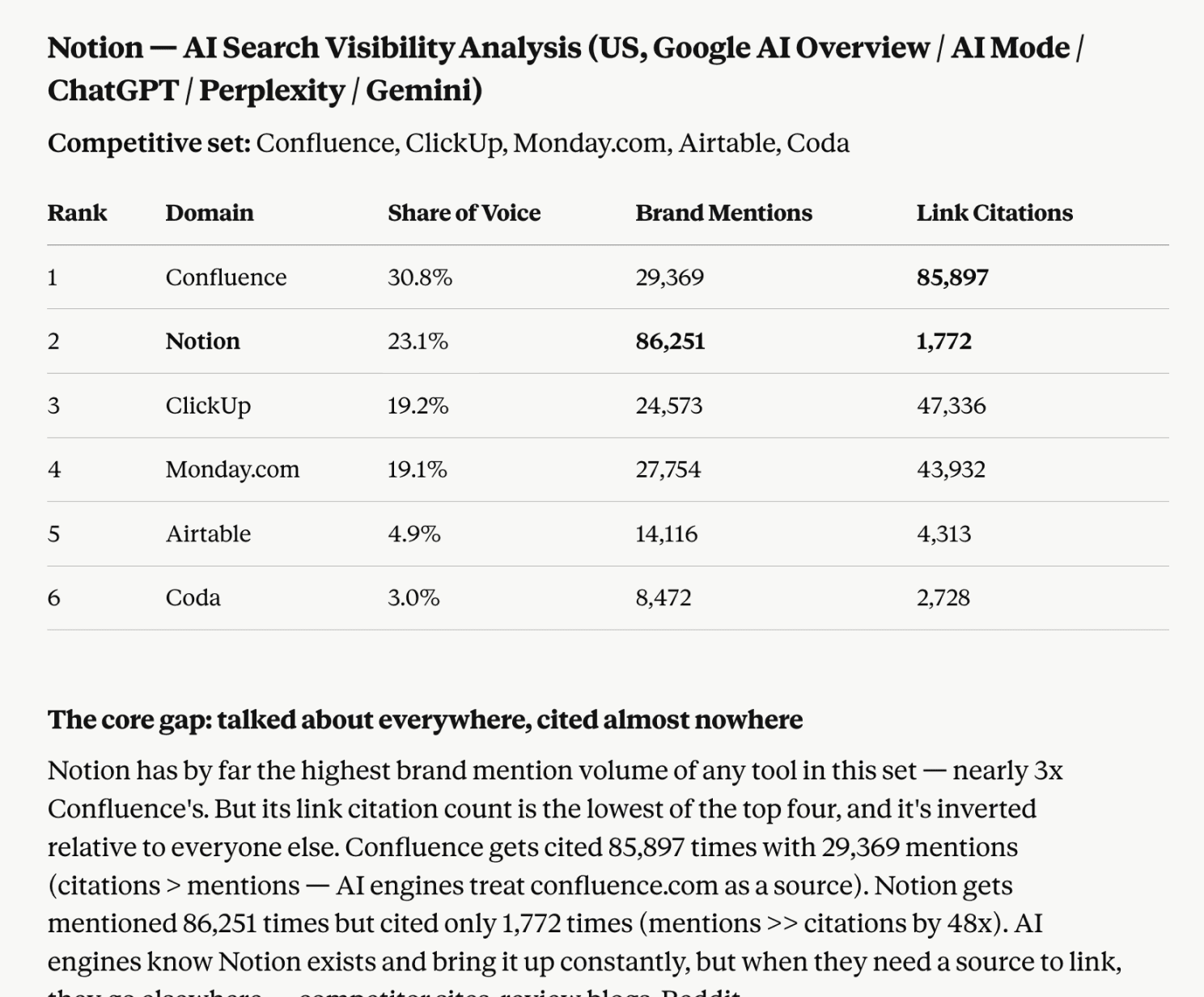
Ask Claude who’s showing up in AI answers
Connect Claude or another assistant to SE Ranking’s MCP server and query the same endpoints in plain language. Ask about brand presence, prompts, and share of voice without writing requests.
One MCP, same endpoints
Brand presence, citations, prompt lists, and leaderboards run on the same AI Search Visibility API you’d query directly.
Answers in the flow of work
Pull AI-visibility data mid-conversation or inside a pipeline, without writing request-handling code.
Skip the integration work
Point your agent at the MCP server and skip the auth, filter syntax, and response parsing a direct build needs.
AI visibility you can query, benchmark, and track over time
Brand-level AI visibility data for any domain
The LLM Visibility API returns how brands appear in AI-generated answers: who gets mentioned, who gets cited with a link, and which prompts trigger it. Query your own brand or any competitor’s. No project setup required.

AI visibility overview:
Brand & link presence, average position, and AI traffic estimates for any domain, engine by engine, with monthly history

Share-of-voice leaderboard:
Benchmark your domain against up to 10 competitors you name, ranked by share of voice across the engines you choose

Prompts and full answers:
Every prompt where a brand or domain appears, with its search volume, the full LLM answer text, and its links

Linked vs unlinked mentions:
Citations that carry a link and name-only mentions, reported separately because they mean different things

Brand discovery:
Resolve any URL to its brand name to start analyzing a competitor from nothing but their domain
AI search data that lands next to what you track
AI visibility is only useful when it sits beside your search data, not in a separate tab. The research endpoints return structured responses built to merge with what you already report on.

Structured JSON that drops into the dashboards and pipelines where your organic data already lives

Query per engine and market, then filter prompts by search volume, length, and included or excluded keywords

Ready-made time series from the overview endpoint for charting movement month over month

Monthly refresh on research data:
a fixed update cadence you can schedule reporting pulls around, with stable snapshots for month-over-month trends
Daily tracking for the prompts and groups you choose
Run scheduled tracking for the prompts that matter to your brand, organized into the groups you report on. Get fresh mention, citation, and ranking data every day.

Set up tracking programmatically:
Add prompts and assign AI engines per market and language, across your projects

Organize prompts into groups:
Group by topic, content pillar, or goal (a brand mention vs. a citation), and track presence per group

Daily rankings:
Your brand’s mention and link positions inside AI answers, plus top-3 presence rates

Presence and overlap trends:
Mention and link presence over any date range, plus how much AI Overviews overlap with your organic results

The evidence behind the number:
Full answer text, cited sources, and detected brands for any tracked prompt

Query SE Ranking from inside any AI assistant
Connect via MCP and work with your SEO and GEO data inside Claude, ChatGPT, Cursor, or any other AI tool. 1-minute setup, no exports, no code, no workflow interruption.
Use cases for the AI Visibility API
Report on AI share of voice to stakeholders
Your client and stakeholders are asking what AI search means for their brand, and not having the answer won’t hold for long. Pull a share-of-voice leaderboard that ranks your client’s brand against the competitors you name. Show where the brand stands, and how that position is moving.
Find the prompts your competitors own
Query a competitor’s brand to see the prompts where they appear and you don’t, and which of their pages get cited. That prompt-by-prompt gap list with the full answers as evidence is a GEO content roadmap grounded in what the AI engines actually return.

Feed AI data into your SEO reporting
Rankings alone no longer explain traffic. Put AI mentions and citations next to organic positions in the same dashboard, so when a page dips you can tell whether it's a ranking problem or an AI answer absorbing the clicks.
Plug SE Ranking data into tools you already use
Connect SE Ranking to the tools your team already works in, without custom development or tearing up existing workflows.
n8n
Open-source automation with a visual workflow builder.
Wire SE Ranking into your stack to trigger reports, sync keyword metrics on a schedule, and hand off routine research — all from n8n's visual builder.
Data Studio
Live dashboards that blend SEO, GEO, GA4, and GSC.
Feed keyword and trend data straight into Data Studio, so clients and stakeholders open an always-current dashboard instead of waiting on an export.
Make
Visual, no-code automation across your stack.
Use Make to push keyword data into CRMs, project management tools, Slack, and more — connected with clicks, not code.
What SEO pros say about building on SE Ranking’s API

We use SE Ranking to build winning SEO strategies for our clients. Their suite of tools allows for robust market research, competitive analysis, and website audits—all of which serve to inform our SEO campaign roadmaps.

We use SE Ranking to overcome many SEO-related challenges, from researching keywords to conducting granular analyses of various client-related issues that ultimately help us save a significant amount of time and streamline processes.

Because SEO is time-consuming, SE Ranking’s tools are a great help here. We use it for detailed audits, keyword research, performance monitoring, and reporting. But apart from the actual SEO workflow we do for clients, we also use SE Ranking for our sales process. It helps us build trust with current and potential customers as we can give them a comprehensive overview of the current situation and advise on the next steps.
Explore more SE Ranking tools built for SEO pros
Flexible, usage-based pricing
Try it free with 100K credits and scale credits as you grow. Only pay for what you use
From
- Backlinks API
- Domain Research API
- Keyword Research API
- Website Audit API
- AI Search API
- Project Management API
What is an AI visibility API?
An AI visibility API, or LLM visibility API, gives you programmatic access to data about how brands appear in AI-generated answers with mentions, citation links, positions within responses, and the prompts that trigger them. Instead of manually querying ChatGPT or Gemini and screenshotting results, you pull structured data into your own reports, dashboards, and tools.
Which AI engines does the AI Search API cover?
SE Ranking’s AI Visibility API covers Google’s AI Overviews, AI Mode, and Gemini, as well as ChatGPT and Perplexity. Results are reported per engine, so you can compare how differently each one treats your brand.
What metrics can I get for a brand?
Brand mentions (with and without links), citation links, average position within AI answers, AI traffic estimates, a share-of-voice leaderboard against up to 10 competitors, and the full text of the AI answers behind each data point. Linked and unlinked mentions are reported separately, since a citation that sends traffic and a passing name-drop carry different value.
Can I track competitors’ AI visibility?
Yes. The research endpoints work for any brand or domain, not just your own. Use the discover-brand endpoint to resolve a competitor’s URL to its brand entity, then pull their prompts, mentions, and citations the same way you would for your own brand.
Can I monitor specific prompts over time?
Yes. Through the AI Result Tracker endpoints, you add your own prompt lists, assign engines, and retrieve scheduled results: daily mention and link rankings, top-3 presence, and historical statistics.
How is this different from the Domain Analysis API?
The Domain Analysis API covers a domain’s full search footprint with keywords, traffic, competitors, and LLM presence as one dimension. The AI Visibility API is the dedicated deep layer: engine-by-engine brand metrics, prompt-level detail, leaderboards, and full answer texts.
What are the rate limits for the AI Visibility API?
It depends on the layer. The research endpoints allow up to 10 requests per second and draw credits per request; the prompt-tracking endpoints allow up to 5 requests per second and run on your subscription limits instead of credits.
Can I use API data without writing code?
Yes. A Postman collection covers every endpoint for no-code testing, and SE Ranking’s MCP server lets you query AI visibility data from inside Claude, Codex, Cursor, or another AI assistant in plain language.