AI Overviews just launched in France, and they already appear on more than 52% of searches
France was one of the last major European markets still waiting for AI Overviews. But on July 22, the wait was over.
And Google didn’t exactly start small.
We analyzed 100,000 keywords across 20 niches in France and found AI Overviews on 52.63% of searches.
That’s a very different starting point from what we saw in other European markets. When AI Overviews launched in Germany, Spain, and the Netherlands in March 2025, first-month coverage was no higher than 33%.
France joined more than a year later, after Google had already had plenty of time to test, refine, and expand the feature elsewhere. And it shows.
But how often they appear is only part of the story.
We also looked at which queries trigger them most often, which sources Google relies on, how frequently social platforms show up, and how closely AI Overview citations overlap with traditional organic rankings.
Here’s what stood out.
-
Google deployed AI Overviews in France at scale from day one: 52.63% of keywords trigger AI answers.
That is nearly twice the first-month rate we previously recorded after the rollout in Germany, Spain, and the Netherlands.
-
YouTube is by far Google’s most-cited source in French AI Overviews.
It appears in 51.31% of answers and accounts for 14.33% of all citations. This is more than the other nine domains in the top 10 combined.
-
Social and video platforms make up half of the 10 most-cited domains.
Facebook, Instagram, TikTok, and Dailymotion all appear in the top 10 alongside YouTube, which shows that Google often pulls from platform-based content, not just traditional websites.
-
Business and Relationships topics trigger AI Overviews on more than 86% of searches.
And even the lowest-ranking niches sit at around 20%.
-
Nearly one in three AI Overviews in France appears further down the SERP.
32.93% are not placed at the top of the page, so they are not the first thing a searcher sees.
-
A typical French AI Overview includes around seven citations.
In total, over 57% of AI Overviews cite between five and eight sources.
-
89.34% of sources cited in local AI Overviews are in French.
In Legal, Finance, Real Estate, and Insurance, French-language sources account for roughly 97% of citations.
-
Official French sources have a strong presence in Google’s AI answers.
For example, ameli.fr appears in 34.56% of Healthcare AI Overviews, while service-public.gouv.fr appears in 32.32% of Legal answers.
-
Organic rankings heavily overlap with AI Overviews in France.
60.46% of cited pages come from the organic top 10, while 76.33% of cited URLs appear somewhere in the organic top 50.
AI Overviews already appear on 52.63% of searches in France
Of the 100,000 keywords we analyzed, 52,628 returned an AI Overview, giving France an overall AIO rate of 52.63%.
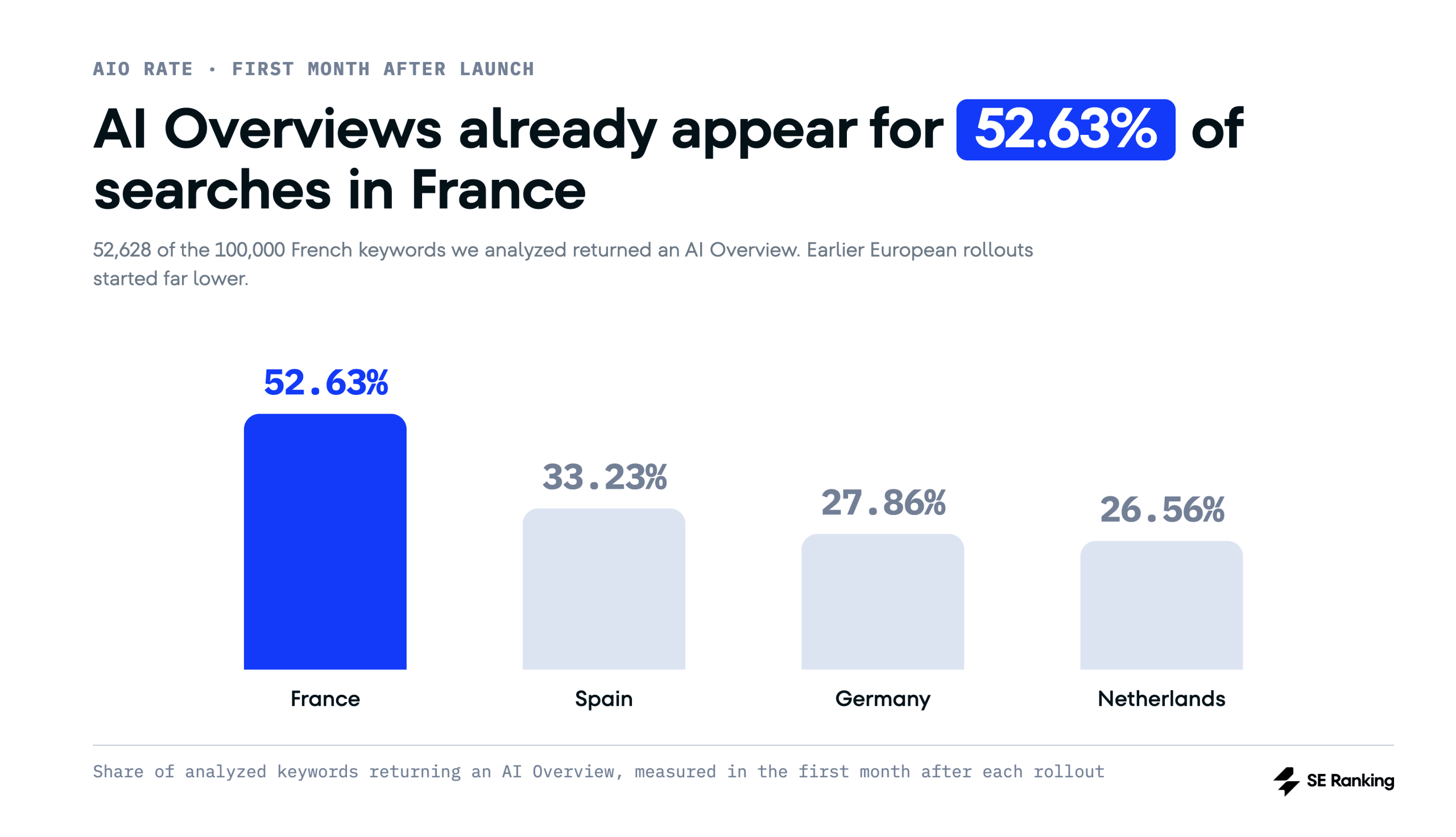
That number becomes much more interesting when you compare it with Google’s earlier European rollouts.
During the first month after AI Overviews launched in other European markets, we recorded:
- Germany: 27.86%
- Spain: 33.23%
- Netherlands: 26.56%
- France: 52.63%
France entered at almost twice the rate of Germany and the Netherlands.
Last year’s rollout looked very different. AI Overviews expanded gradually across European SERPs, with coverage only passing 50% after months of growth. Today, it stands at around 53% in Germany and 56% in Spain.
France appears to have skipped much of that warm-up phase.
That said, rather than treating 52.63% as something uniquely French, it may be more useful to see it as a sign of how much Google’s AI search product has matured. By the time AI Overviews reached France, Google had already spent more than a year testing how and where to show them in other markets.
There is one more detail worth noting.
Not every AI Overview sits at the very top of the SERP. 17,328 of the 52,628 AI Overviews we found, or 32.93%, appeared further down the page.
So while AI Overviews now cover more than half of our French keyword set, roughly one in three is not the first result a searcher encounters.
Business and Relationships topics trigger AI Overviews on more than 86% of searches
AI Overview coverage varies enormously by niche.
At the top sit Business at 87.1% and Relationships at 86.04%.
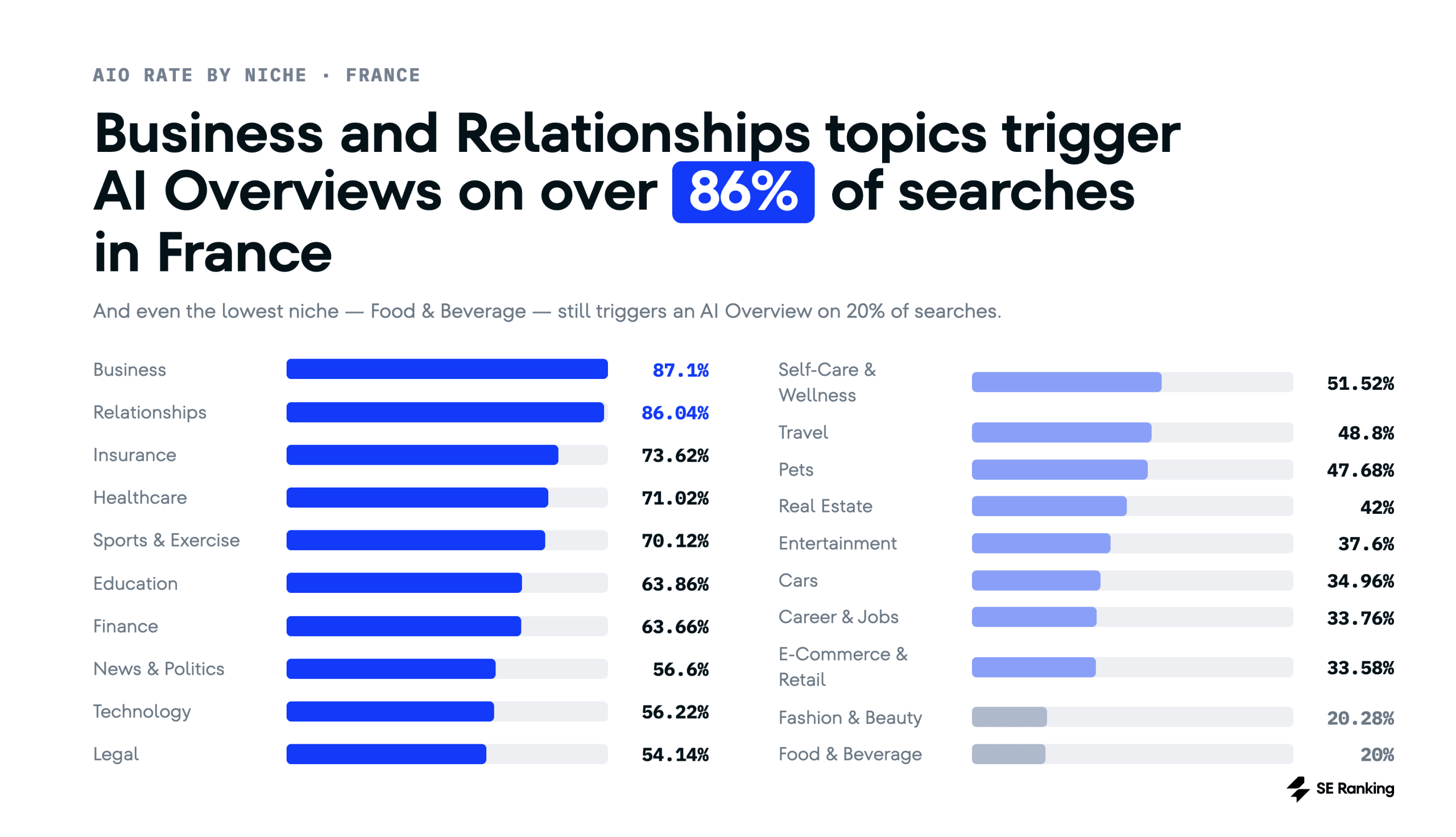
That means close to nine out of ten queries in those categories generated an AI Overview.
They are followed by:
- Insurance: 73.62%
- Healthcare: 71.02%
- Sports and Exercise: 70.12%
- Education: 63.86%
- Finance: 63.66%
At the other end of the ranking are:
- E-Commerce and Retail: 33.58%
- Fashion and Beauty: 20.28%
- Food and Beverage: 20%
The difference between the highest and lowest niches is more than 67 percentage points.
Yet, even the least AIO-heavy niche in our dataset still triggered an AI Overview on one in five searches.
So there is no category in this study where AI Overviews are genuinely rare.
Business and Relationships leading the ranking is also familiar. Both have ranked among the most AIO-heavy categories in our previous studies.
That shows Google’s tendency to generate AI answers for these types of queries is not specific to the French language. The same categories repeatedly surface near the top across markets.
YouTube appears in every second French AI Overview
Nothing in the source data comes close to YouTube.
YouTube appears in 51.31% of all AI Overviews we analyzed and accounts for 14.33% of all citations in the dataset.
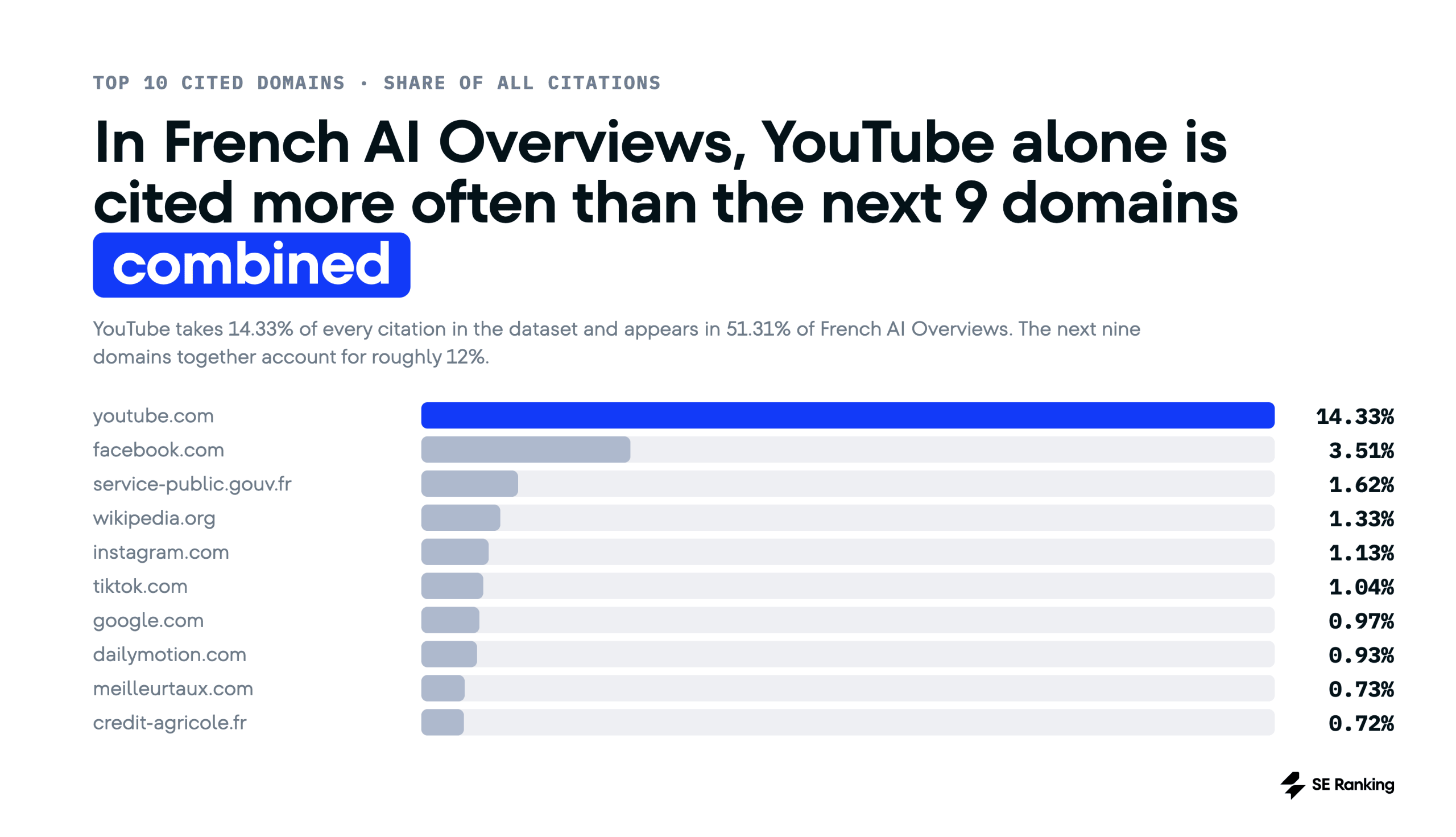
YouTube alone generates more citations than the other nine domains in the top 10 combined: 14.33% versus roughly 12%.
The overall top 10 includes:
- YouTube: 14.33% of citations
- Facebook: 3.51%
- Service-public.gouv.fr: 1.62%
- Wikipedia: 1.33%
- Instagram: 1.13%
- TikTok: 1.04%
- Google.com: 0.97%
- Dailymotion: 0.93%
- Meilleurtaux.com: 0.73%
- Credit-agricole.fr: 0.72%
Five of these ten are social or video platforms. That means AI Overview visibility in France is not limited to traditional websites.
On top of that, YouTube’s overall lead is not coming from one or two particularly video-heavy categories.
It ranks first in every one of the 20 niches we analyzed.
Its highest coverage appears in:
- Sports and Exercise: 72.9%
- Technology: 70.3%
- Business: 68.62%
Even in its weakest niche, Travel, YouTube still appears in 32.96% of AI Overviews.
So, regardless of whether someone is researching a workout, a business question, a piece of technology, or a holiday, video is deeply embedded in Google’s source selection.
Once we move past YouTube, though, each niche begins to develop its own source profile.
And that is where the French SERP becomes much more local.
Facebook appears among the top-5 sources in 16 of 20 niches
YouTube is the obvious social-platform story, but it is not the only one.
Facebook appears in the top five sources in 16 of the 20 niches we analyzed.
Its role is usually less dominant than YouTube’s, but remarkably consistent.
Coverage (meaning the share of AI Overview responses where the domain appears among the sources) ranges from 8.48% in E-Commerce & Retail to 30.43% in Food and Beverage.
Instagram and TikTok also move into the leading positions in more visual and lifestyle-oriented categories, including Fashion and Beauty, Food and Beverage, Travel, and Self-Care and Wellness.
Fashion and Beauty is the clearest example.
There, YouTube, Facebook, Instagram, and TikTok occupy four of the five leading source positions.
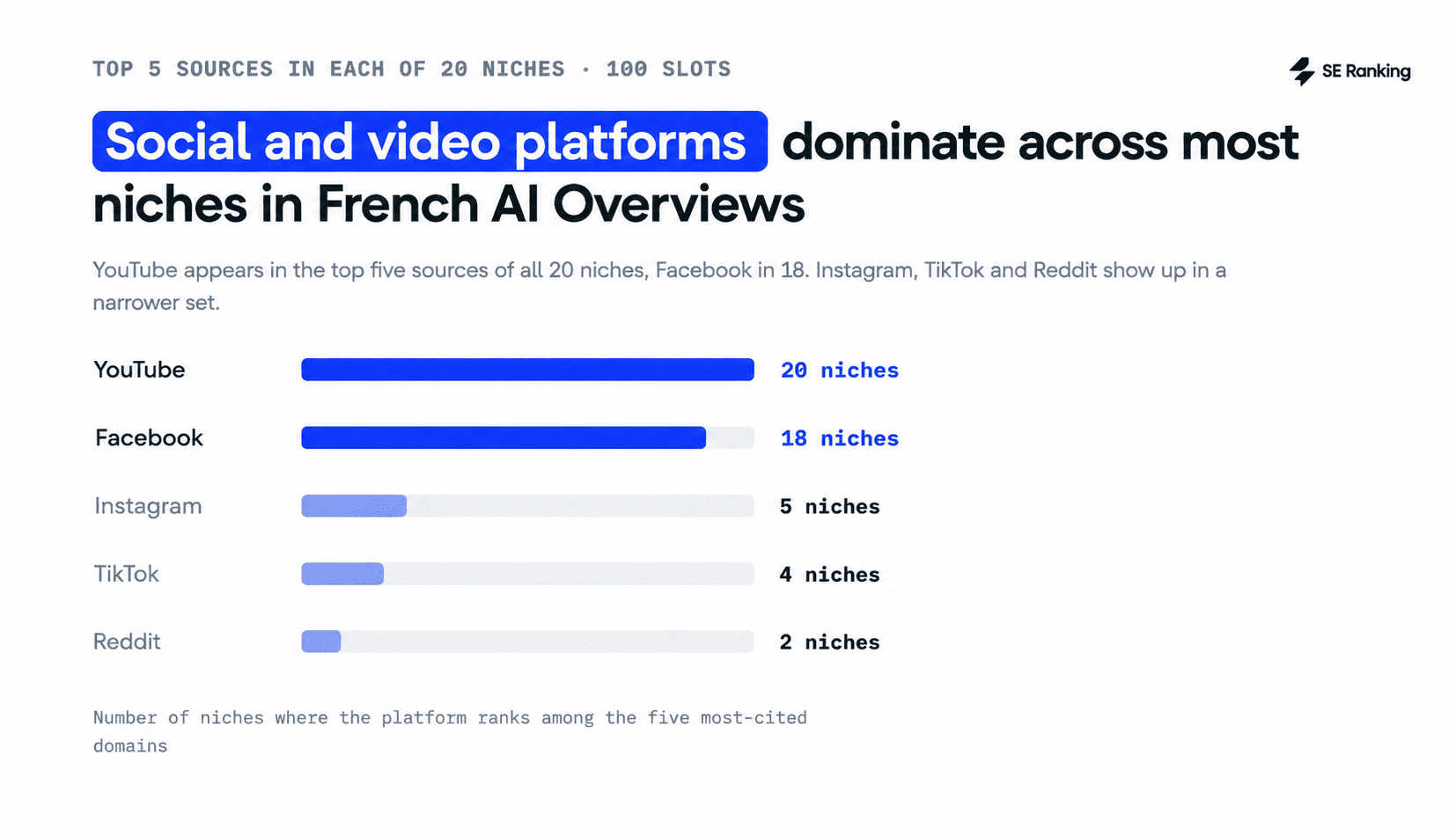
So while websites still make up most of the broader citation pool, certain topics show Google leaning heavily on content created and distributed through social platforms.
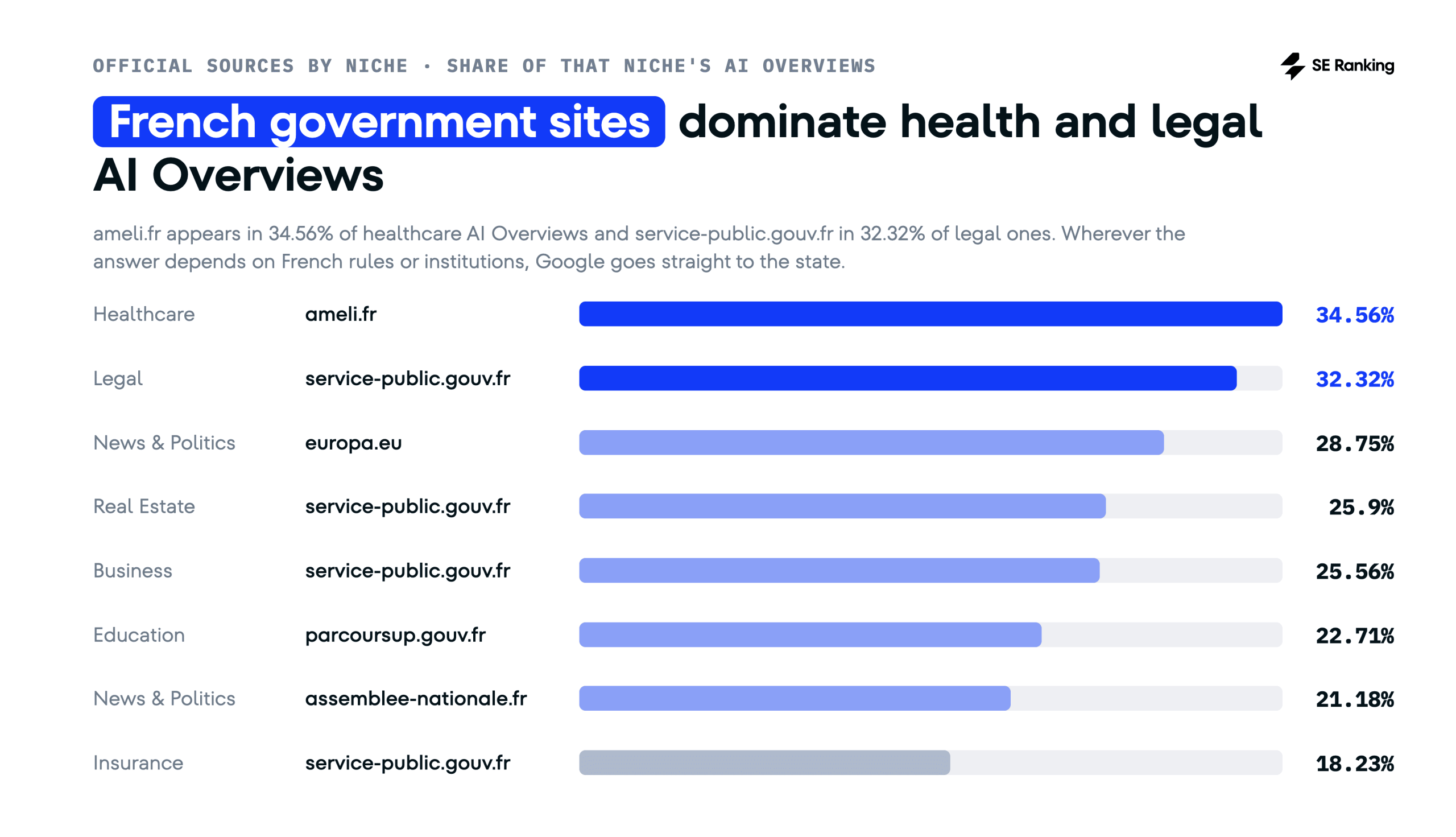
French government sites dominate health and legal AI Overviews
Official sources appear repeatedly across French AI Overviews, especially in topics where accuracy depends heavily on local rules or institutions.
In Healthcare, ameli.fr, the French national health insurance website, appears in 34.56% of AI Overviews.
That means roughly one in three health-related AI answers in our dataset links back to the country’s official health insurance service.
The pattern continues elsewhere.
service-public.gouv.fr appears in:
- 32.32% of Legal AI Overviews
- 25.9% of Real Estate AI Overviews
It also appears among the leading sources in Cars and Travel.
In Education, Parcoursup, France’s national higher-education admission platform, appears in 22.71% of answers.
News and Politics shows the same tendency. Wikipedia leads the non-video sources there, but europa.eu appears in 28.75% of answers and assemblee-nationale.fr in 21.18%.
Across all niches combined, service-public.gouv.fr is the highest-ranked conventional website in the dataset, appearing in 9.81% of all French AI Overviews.
For queries involving healthcare, law, education, public administration, or other highly localized information, Google appears especially willing to go directly to authoritative institutions.
A typical French AI Overview includes 7 citations
Across 52,564 AI Overviews with source data, the average answer included 6.91 citations.
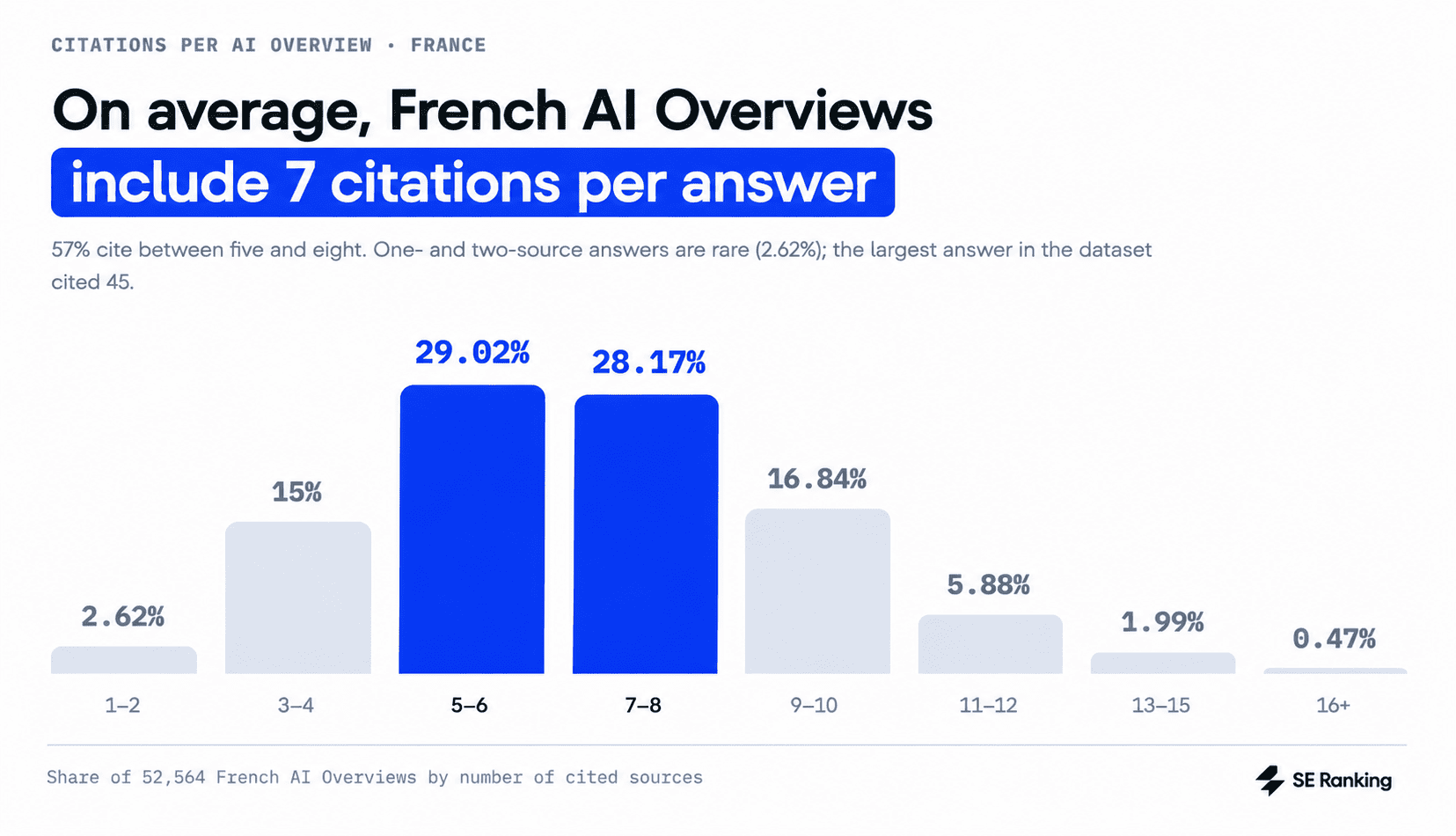
57.19% of answers cite between five and eight sources.
Answers with only one or two citations account for just 2.62%, while those with more than 16 sources make up only 0.47%.
The largest AI Overview in our dataset cited 45 sources.
But seven citations do not necessarily mean seven different websites.
The average answer draws from 5.6 unique domains, and 60.14% of AI Overviews cite at least one domain more than once.
So Google often goes back to the same website for multiple supporting pages, posts, or videos inside a single answer.
Across the dataset, that added up to 363,330 citations from 30,383 unique domains.
And that source pool is much less evenly distributed than the 30,000-domain figure might suggest.
Just nine domains account for 25% of all citations.
At the same time, 49.2% of all domains were cited exactly once.
In other words, Google’s source pool is both very broad and very concentrated: tens of thousands of sites appear somewhere, but a relatively small group captures a disproportionate share of the visibility.
Around 90% of AI Overview sources in France provide content in French
Despite relying heavily on global platforms such as YouTube, Facebook, and Wikipedia, Google overwhelmingly cites French-language content when building AI Overviews in France.
Across the dataset, 89.34% of classified sources are in French.
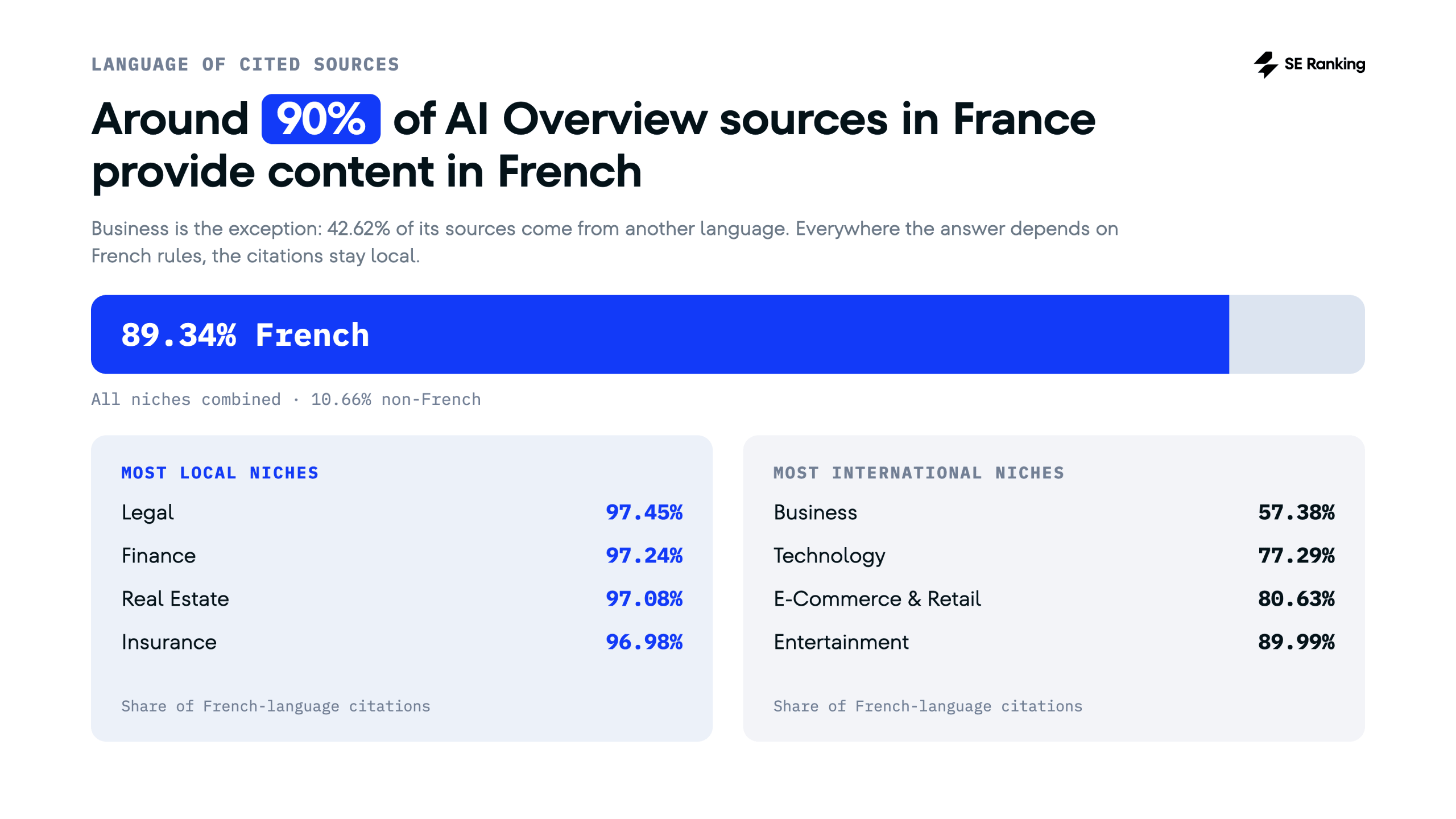
Only around one in ten comes from another language.
At the same time, the overall 89.34% French-language share hides major differences between categories. Some niches are almost entirely local.
In Legal, Finance, Real Estate, and Insurance, French-language content accounts for roughly 97% of citations. And that absolutely makes sense.
Questions about French law, mortgages, insurance, taxes, and property frequently require answers specific to the French market. International sources may simply not contain the right information.
Technology is more international, with French sources accounting for 77.29% of citations.
E-Commerce and Retail stands at 80.63%.
Then there is one major outlier: Business. Only 57.38% of Business citations are French, while 42.62% come from other languages. So while local relevance dominates much of Google’s source selection in France, Business appears to operate within a much more international information ecosystem.
Note: This finding is more likely related to how Google detects query language than to how AI Overviews work specifically in France. Queries interpreted as English may naturally produce more English-language sources.
60.46% of AI Overview sources rank in Google’s organic top 10
AI Overviews have changed the way search results look.
But the sites powering those answers are not coming from an entirely separate web.
For every AI Overview source, we checked whether the same page appeared among the organic results for the same query.
On average:
- 26.04% of cited URLs come from the organic top 3
- 60.46% come from the top 10
- 69.66% come from the top 20
- 76.33% come from the top 50
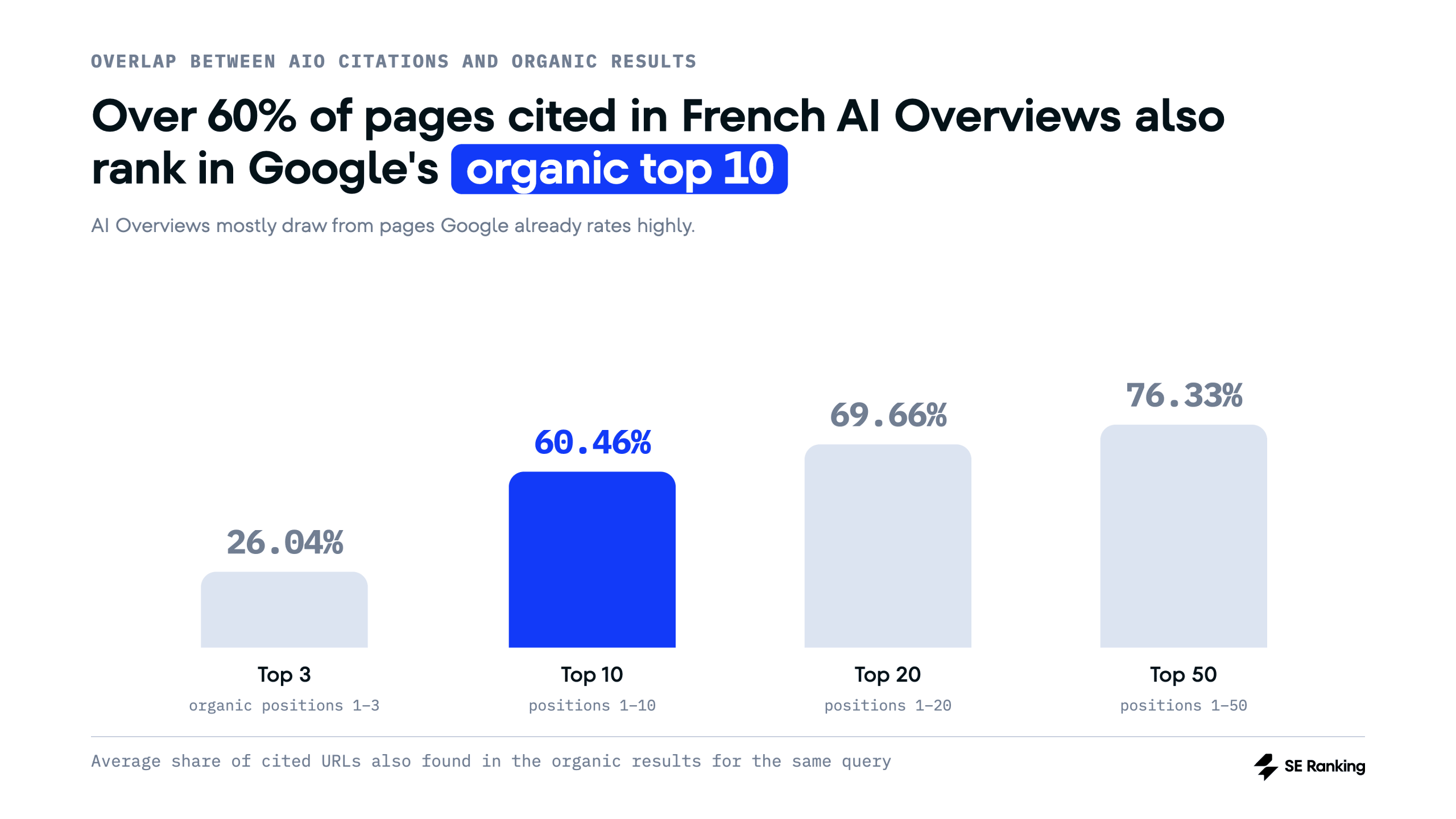
So roughly six in ten citations come from pages that already rank on Google’s first page.
And extending the comparison from the top 20 all the way to the top 50 only adds around seven percentage points.
What this shows is that Google may generate an entirely new answer at the top of (or within) the SERP, but most of the material behind that answer still comes from pages it already considers strong organic results.
So, ranking well does not guarantee a citation. But it clearly puts a page much closer to the pool Google draws from.
Nine-word queries trigger AI Overviews on more than 70% of searches
Query length remains one of the clearest signals associated with AI Overview presence.
For short queries, the rate stays below 50%:
- 1 word: 49.48%
- 2 words: 41.59%
- 3 words: 42.97%
- 4 words: 46.48%
Then the pattern begins to change.
At six words, the rate reaches 54.27%. At seven, it rises to 59.76%. Eight-word searches trigger AI Overviews 66.25% of the time.
And for nine-word queries, the rate reaches 71.32%. Ten-word queries sit at a very similar 70.5%.
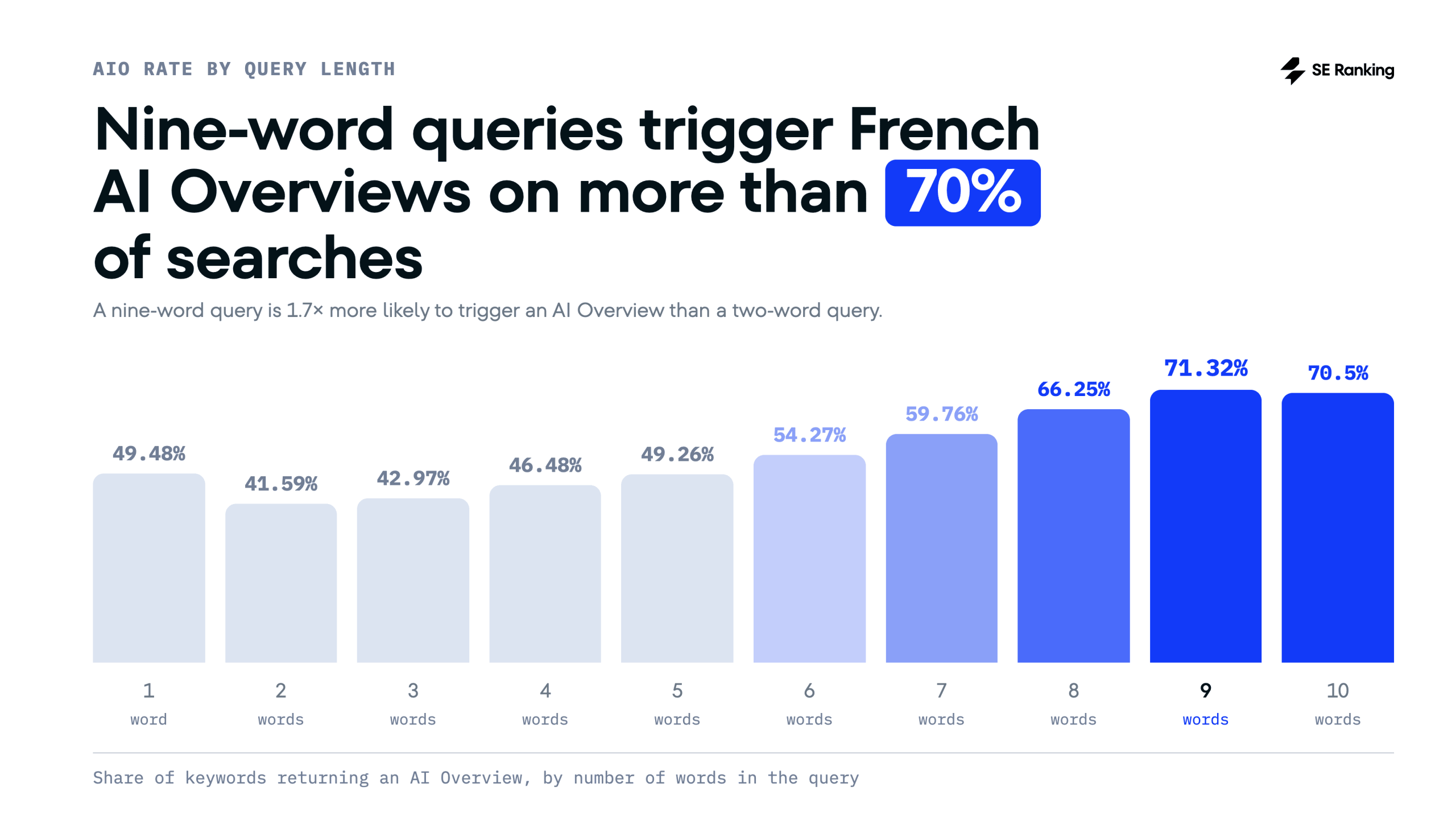
In other words, a nine-word query in our dataset was around 1.4 times more likely to return an AI Overview than a single-word query and around 1.7 times more likely than a two-word query.
This is one of the most consistent patterns we have seen across our AI Overview research.
The more context a user gives Google, the more likely Google is to generate an answer rather than simply return a list of links.
Low-volume keywords trigger AI Overviews twice as often as keywords with 1,000+ monthly searches
Search volume shows another clear relationship with AI Overview presence, although the pattern is not perfectly linear.
Keywords with 0–10 monthly searches had the highest AIO rate at 64.62%.
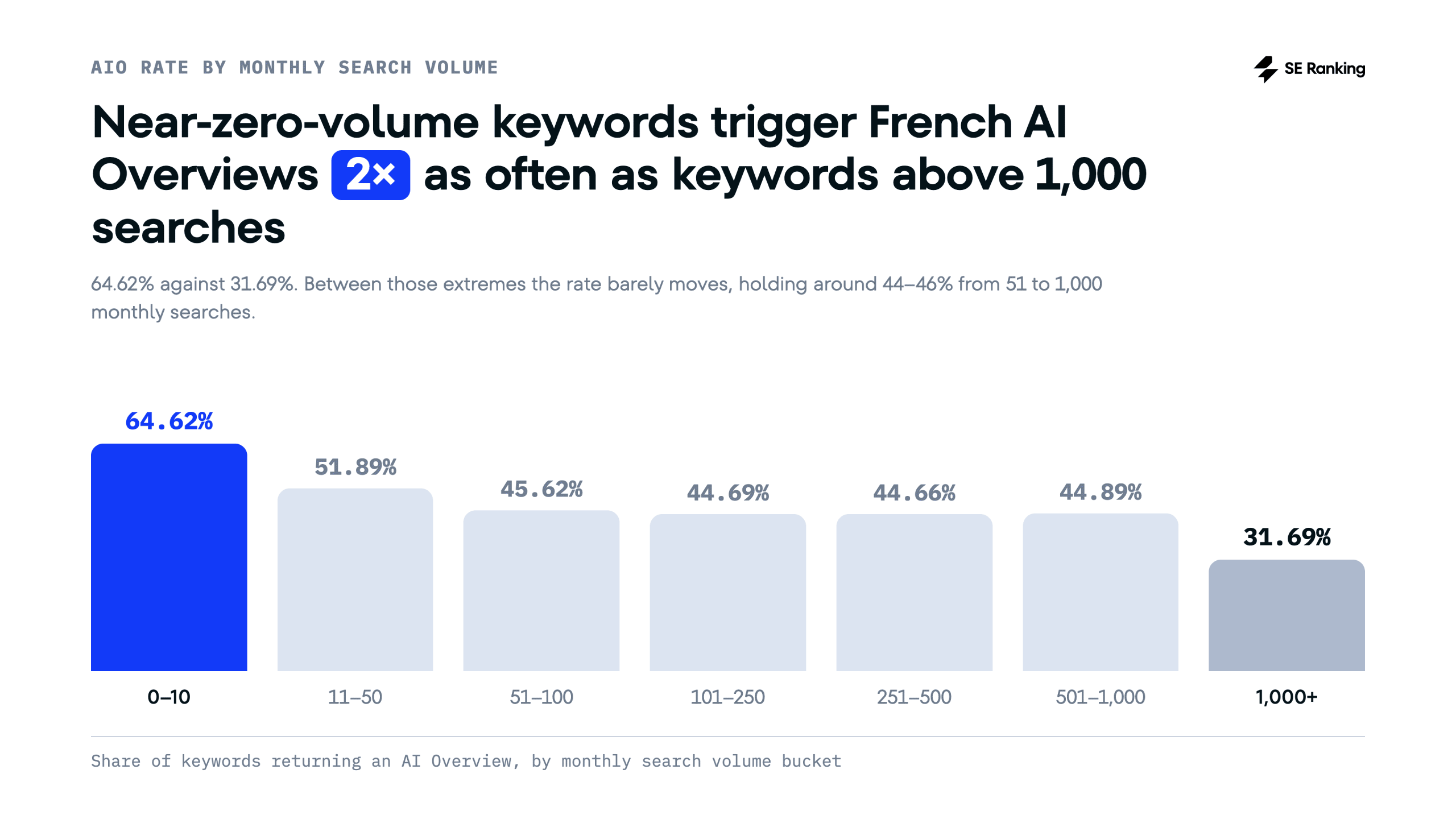
The rate then fell to:
- 51.89% for 11–50 searches
- 45.62% for 51–100
- 44.69% for 101–250
- 44.66% for 251–500
- 44.89% for 501–1,000
Then it drops again.
Keywords with more than 1,000 monthly searches triggered an AI Overview 31.69% of the time.
So, overall, AI Overviews clearly lean toward lower-volume and long-tail searches.
But the middle of the distribution is surprisingly stable.
Between 51 and 1,000 monthly searches, AIO presence barely moves at all, staying around 44–46%. Search volume seems to matter most at the extremes: very low-volume keywords trigger AI Overviews particularly often, while high-volume keywords are substantially less likely to do so.
Still, “less likely” does not mean uncommon.
Even among keywords with more than 1,000 monthly searches, almost one in three returned an AI Overview.
AI Overview presence does not have a clear correlation with CPC
CPC produces a very different curve.
You might expect AI Overviews to become progressively less common as commercial value increases. That is not what happens.
Keywords with practically no CPC (below €0.01) have the highest initial AIO rate at 65.14%.
From there, presence falls sharply:
- €0.01–€0.10: 37.02%
- €0.10–€0.25: 29.22%
But after reaching that low point, the trend reverses.
AI Overview presence rises to:
- 37.81% at €0.25–€0.50
- 46.62% at €0.50–€1
- 58.22% above €1
So keywords at both ends of the commercial spectrum are highly represented.
The lowest-priced queries generate AI Overviews frequently, but so do the most expensive ones.
That makes CPC a much less straightforward predictor of AI Overview presence than search volume or query length.
Mid-difficulty keywords are most likely to trigger AI Overviews
Keyword difficulty does not produce a simple “higher difficulty, more AI Overviews” relationship either.
Instead, the rate peaks in the middle.
The highest AIO rate appears among keywords with KD 50–60, at 60.18%.
Nearby buckets are almost as high:
- KD 30–40: 59.17%
- KD 40–50: 58.65%
- KD 60–70: 57.24%
Both ends of the spectrum are lower.
Keywords with KD 0–10 trigger AI Overviews at a 50.69% rate, while the most difficult keywords (KD 90–100) sit at 44.14%.
So difficulty alone does not explain whether Google generates an AI Overview.
The sweet spot in our dataset sits around moderately to highly competitive queries rather than either the easiest or hardest terms.
What this means for SEO teams
AI Overviews are already too common in France to treat as a side feature. They appear on more than half of the searches in our dataset, and even the least AIO-heavy niches still trigger them regularly.
For SEO teams, a few priorities stand out:
- Do not separate AI visibility from traditional SEO. Around 60% of cited pages already rank in Google’s organic top 10. Strong rankings do not guarantee an AI Overview citation, but they clearly increase your chances of entering the source pool Google relies on.
- Think beyond traditional web pages. YouTube ranks first across all 20 niches, while Facebook, Instagram, and TikTok also appear among leading sources in multiple categories. For topics that lend themselves to video or social content, those formats can become another path to AI visibility.
- Track AI visibility systematically. SE Ranking’s Competitive Research has a dedicated AI search section that lets you see how your site, a client’s site, or a competitor is actually showing up across AI Overviews and other major LLMs in your country.
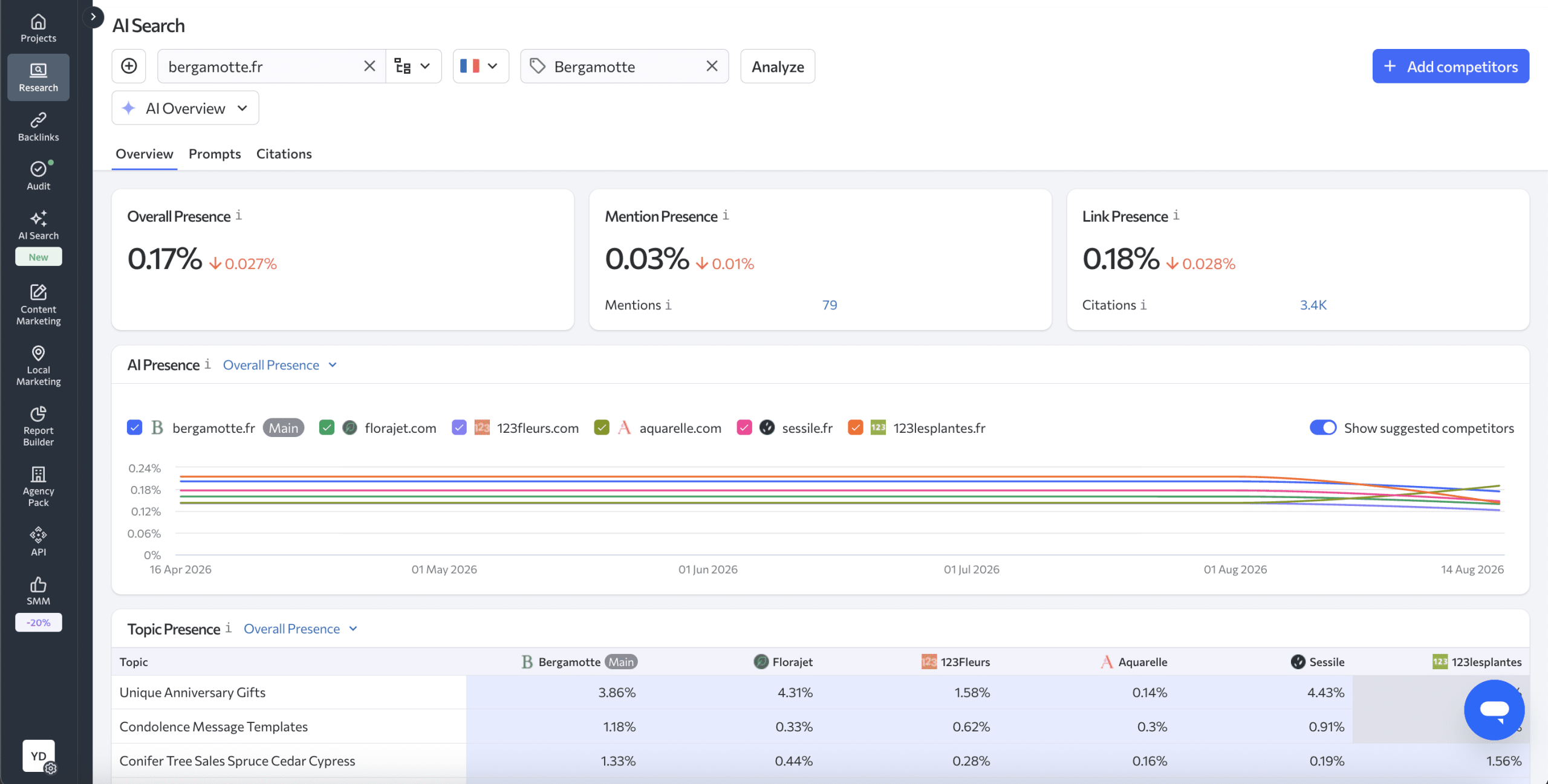
You can check where your brand gets mentioned or cited, open the prompts and AI answers behind those appearances, and compare your visibility with your direct competitors.
That’s where it gets especially useful: you can spot topics where competitors are being picked up and you are not, see which brands are gaining ground, and follow those changes over time.
Research methodology
Our dataset, collected on August 7–8, 2026, included 100,000 keywords across 20 niches in France (with 5,000 keywords assigned to each niche).
For each keyword, we analyzed whether an AI Overview appeared and, where available, its position in the SERP.
We also compared AIO presence against several keyword characteristics, including:
- search volume;
- CPC;
- keyword difficulty;
- query word count.
For the source analysis, 64 AI Overviews that contained no sources were excluded, leaving 52,564 answers.
Across those answers, we analyzed 363,330 citations from 30,383 unique domains, including:
- number of citations per answer;
- unique domains per answer;
- source concentration;
- leading domains overall and by niche;
- source language;
- domain zones;
- overlap between AI Overview sources and organic search results.
For source coverage figures, we count the share of AI Overview answers in which a particular domain appeared at least once. Citation-share figures, by contrast, count every individual citation from that domain.
Disclaimer: As with any point-in-time SERP study, these findings describe the patterns observed within this dataset. AI Overview presence and source selection can change as Google continues updating the feature.
Conclusion
France did not get the gradual AI Overview rollout we saw elsewhere in Europe.
Google arrived with the feature already appearing on 52.63% of the 100,000 searches we analyzed.
But the more important finding is what sits underneath those answers.
YouTube is now a source in every second AI Overview. French content accounts for almost 90% of citations. Government portals and local specialists dominate many of the niches where local expertise matters most. And despite the new AI layer on top of the SERP, the overwhelming majority of cited domains are still sites Google already ranks organically.
So AI Overviews are changing how search visibility is distributed, but they have not made traditional SEO irrelevant.
They simply added another layer to compete for.