10+ best Ahrefs alternatives for 2027 (free & paid tools tested)
Ahrefs built its reputation on backlink data and keyword research, and that reputation is still well deserved. The database is large, the rank tracking is reliable, and for teams focused on search performance, it covers a lot of ground.
But choosing a platform in 2027 is no longer just about who has the biggest database or the longest feature list.
Search now happens in different places, including SERPs and AI answers. Most SEO suites, Ahrefs included, have responded by adding AI tracking to the same platform, often as a paid extra.
I think both deserve more than that. Strong SEO still depends on deep keyword, backlink, and technical data. AI visibility needs its own kind of analysis: which sources AI engines cite, and what shapes those answers.
So I judged each alternative on how well it handles the SEO work first, and how seriously it takes AI search second. Let’s explore them.
Why you can trust this review
I’ve been working in SEO for over eight years, across a range of industries, and spent the last three years in management. Right now, I focus on growing revenue through organic traffic, helping shape SEO product development at SE Ranking, and leading our SEO and outreach teams.
Over the last few years, my work has also expanded into GEO and AI search visibility, where understanding how brands appear across LLMs has become just as important as traditional rankings. t’s taught me that SEO and AI search are closely connected, but they aren’t the same job. AI answers often draw on the same pages and signals SEO has always worked with. But understanding how a brand shows up in those answers takes different data and a different kind of analysis. That’s why I looked at both sides separately for every tool on this list.
I also launched a new SEO industry research function within our marketing team, so staying on top of the latest tools and trends is literally part of my job. Plus, I’ve been an Ahrefs power user since 2018, so I’ve seen firsthand how the platform has evolved over the years.
And yes, I work at SE Ranking. I’ve tried to hold it to the same standard as every other tool here, which is why you’ll find its cons in this review too.
Everything in this review comes from hands-on experience, not theory.
Best Ahrefs alternatives to try in 2026
To hand-pick the best alternatives to Ahrefs, I evaluated multiple popular SEO tools, paying attention to their functional capabilities, user feedback on popular review platforms, and pricing plans. Here come the winners.
- SE Ranking
- SpyFu
- Semrush
- Majestic
- Similarweb
- Search Atlas
- Moz
- Mangools
- Buzzsumo
- Surfer AI
Among the free tools, I think the ones below should also be considered:
- Google Tools
- Screaming Frog
- SEO Powersuite
Each tool offers a different set of features and pricing, so you can find the one that best fits your SEO needs.
Ahrefs
$29/month
SE Ranking
$129/month
SpyFu
$39/month
Semrush
$139/month for SEO-only plan; SEO + AI Search plans from $199/month
Majestic
$49.99/month
Similarweb
$199/month
Search Atlas
$99/month
Moz Pro
$49/month
Mangools
$61/month
BuzzSumo
$199/month
Surfer SEO
$119/month
Google Tools
Free
Screaming Frog
Free
SEO Powersuite
Free
Ahrefs
Backlink analysis and keyword research
SE Ranking
All-in-one SEO with daily rank tracking for agencies and in-house teams. SE Visible for AI search tracking
SpyFu
Competitor analysis and PPC insights
Semrush
Comprehensive SEO and marketing management
Majestic
Backlink analysis and link building campaigns
Similarweb
Website traffic analysis and market intelligence
Search Atlas
SEO task automation
Moz Pro
Keyword research and backlink analysis
Mangools
Keyword research and SERP analysis
BuzzSumo
Content discovery, trend analysis, influencer research
Surfer SEO
Content creation and optimization, plus AI Visibility tracking
Google Tools
Keyword research and website performance analysis
Screaming Frog
Technical SEO audits and site crawling
SEO Powersuite
Website audit and link building
Ahrefs
☑️ limited free version for users granting access to their sites
SE Ranking
✅ 14 days
SpyFu
⛔
Semrush
✅ 7 days
Majestic
⛔ (7-day money-back guarantee on Lite and Pro)
Similarweb
✅ 7 days
Search Atlas
✅ 7 days
Moz Pro
✅ 7 days
Mangools
☑️ limited free version
BuzzSumo
✅ 7 days
Surfer SEO
✅ 7 days
Google Tools
✅ Free
Screaming Frog
✅ Free
SEO Powersuite
✅ Free
$29/month
$129/month
$39/month
$139/month for SEO-only plan; SEO + AI Search plans from $199/month
$49.99/month
$199/month
$99/month
$49/month
$61/month
$199/month
$119/month
Free
Free
Free
Backlink analysis and keyword research
All-in-one SEO with daily rank tracking for agencies and in-house teams. SE Visible for AI search tracking
Competitor analysis and PPC insights
Comprehensive SEO and marketing management
Backlink analysis and link building campaigns
Website traffic analysis and market intelligence
SEO task automation
Keyword research and backlink analysis
Keyword research and SERP analysis
Content discovery, trend analysis, influencer research
Content creation and optimization, plus AI Visibility tracking
Keyword research and website performance analysis
Technical SEO audits and site crawling
Website audit and link building
☑️ limited free version for users granting access to their sites
✅ 14 days
⛔
✅ 7 days
⛔ (7-day money-back guarantee on Lite and Pro)
✅ 7 days
✅ 7 days
✅ 7 days
☑️ limited free version
✅ 7 days
✅ 7 days
✅ Free
✅ Free
✅ Free
1. SE Ranking
As someone who regularly evaluates SEO suites, I consider SE Ranking the strongest Ahrefs alternative for teams that need SEO data they can trust and actually act on. It covers the ground most people come to Ahrefs for (keyword and competitor research, backlinks, rank tracking, and site audits), then adds the reporting and AI-assistant workflows that make that data easier to use every day.
It also takes a different route on AI search. Instead of folding AI tracking into the SEO suite, the same team built a dedicated platform for it: SE Visible by SE Ranking.
Key features
Here are the parts of SE Ranking I lean on most when I’d otherwise reach for Ahrefs:
- Keyword and competitor research. Research is unlimited on every plan, across 188 regional databases and 5.5B+ keywords. I use it to map a competitor’s organic and paid footprint, find keyword gaps, and pull long-tail and question keywords for content planning.
- Backlink analysis. The backlink index covers 2.7T+ links, with referring domains, anchors, Domain Trust, and new and lost links over time. It’s my go-to for link gap analysis and for monitoring links we’ve already earned.
- Rank tracking. Daily tracking of the Google top 100, plus Bing and YouTube, with share of voice and competitor positions. Historical data across the project’s lifetime comes with the Growth plan.
- Website audit. 115+ checks covering crawlability, indexing, Core Web Vitals, and on-page issues, with up to 2M pages per month on Growth. Page changes monitoring flags edits that might explain a ranking drop.
- Reporting and integrations. I can pull in GA4, Search Console, Data Studio, and Matomo data, so rankings sit next to traffic and engagement in one client-ready report.
- API and MCP access on every plan. SE Ranking’s MCP server connects its SEO data directly to AI assistants like Claude, ChatGPT, and Gemini. This has changed how I work more than any single report. For example, you can ask Claude to show how changes in keyword rankings align with shifts in AI Overview mentions and GA4 traffic trends, or identify which backlink sources correlate with improved visibility across both search and AI results. This approach is especially useful because SE Ranking’s MCP provides access to 180+ tools, which means you can look at the same data from different angles.

For repeatable tasks, I also use SE Ranking’s pre-built Skills for Claude. These ready-made workflows cover content audits, backlink gap analysis, keyword clustering, content briefs, and more.
AI visibility features (with SE Visible)
This is where SE Ranking differs from most tools on this list. AI visibility has its own dedicated platform, SE Visible by SE Ranking, built by the same team that has spent 13+ years on search data.
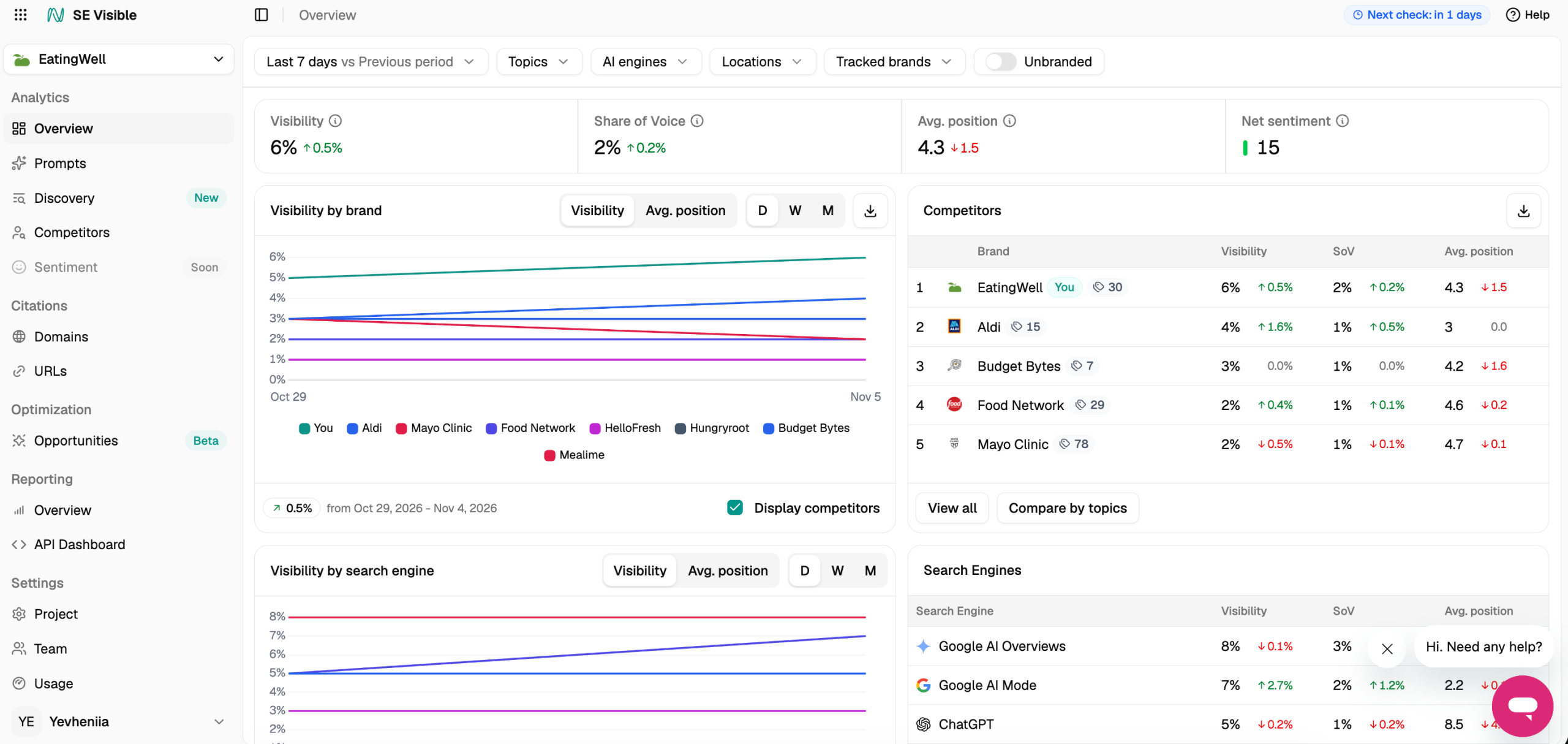
I moved our own AI search tracking there, and what I value most is that it doesn’t stop at the mention:
- The actual AI answer behind every number. Any visibility metric opens into the response it came from. When a stakeholder asks why our share of voice dipped, I can show them exactly what the AI said.
- SEO data on every cited source. For each domain AI engines cite, I see its traffic, Domain Trust, backlinks, and referring domains. For cited URLs, I can also see whether the page already links to us. That tells me which sources are realistic outreach targets.
- Gap analysis. The Gap score and the “Is my brand mentioned?” filter surface cited pages where competitors appear and we don’t. The AIO organic overlap column shows where AI Overview visibility lines up with organic rankings.
- Agents (Beta). Gaps turn into two kinds of tasks: creating content to close the gap, or earning a third-party mention.
- MCP, API, and a Data Studio connector. SE Visible data can sit next to SE Ranking data in the same AI assistant, which is where I do most of my cross-channel analysis.
Pre-built claude skills also apply here. This is an example of the output I get from the AI Search Skill: a share-of-voice comparison for a target domain and its competitors across ChatGPT, Perplexity, Gemini, AI Overviews, and AI Mode.
If you’re on an SE Ranking plan, you already get starter SE Visible limits: 25 prompts a day across five AI engines for one project. That’s enough to see where you stand before deciding how much AI tracking you need.
Pricing
SE Ranking has several plans:
- Core ($129/month): 10 projects, one manager seat, 2,000 keywords tracked daily, 250K audited pages per month, unlimited keyword, competitor, and backlink research, and 25K API credits with MCP access.
- Growth ($279/month): 30 projects, three manager seats, 5,000 tracked keywords, and 2M audited pages per month. It adds full historical data, guest links, page changes monitoring, dedicated support, and personalized onboarding.
Both plans include starter SE Visible limits for AI visibility tracking.
There’s also an Enterprise plan with custom limits, and an Agency Pack (+$69/month, annual billing) for white-label reporting and client seats.
Annual billing offers up to 20% savings (Ahrefs provides only 17%), and unlike Ahrefs, 1-3 user seats are included rather than billed as add-ons. You can add more for $20. Ahrefs also includes one user on every plan and charges $40 to $80/month for each extra user.
SE Ranking also offers a 14-day free trial (something Ahrefs doesn’t provide at all).
To its credit, Ahrefs does offer a free account. On paper it includes six tools, but three of them (Site Explorer, Site Audit, and Web Analytics) require you to verify ownership of your website first. Without that, you’re limited to Social Media Manager, AI Content Helper, and the SEO Toolbar. None of those are the core competitive research or backlink tools most people come to Ahrefs for.
Ahrefs’ AI visibility tracking tool, Brand Radar, is included in every plan bit with a very small limits. The full version is available as a paid add-on. Pricing starts at $199 per month for each AI system you track, so costs can rise quickly if you need coverage across multiple platforms ($1,194 per month for six AI systems).
Who it’s for
In my experience, SE Ranking fits established agencies and mid-market or in-house SEO teams that need reliable data across the whole workflow: research, tracking, audits, and client-ready reporting. I’d especially recommend it to teams that already work with data in AI assistants, since API and MCP access come with every plan. Teams that also own AI search visibility can add SE Visible for a dedicated view, and Planable if social content is part of the same brief. And since they all have MCPs, you can combine SEO, AI visibility data and social analytics inside AI workflows to explore broader brand visibility patterns.
User reviews
SE Ranking’s user ratings are consistently high, with an overall score of 4.8/5 on G2 and 4.7/5 on Capterra. Users praise the platform for its comprehensive feature set, data accuracy, and fair pricing.
And here’s what people are saying about SE Ranking on Reddit:


Pros
✅ Full SEO toolkit: keyword, competitor, and backlink research, top-100 rank tracking, audits, local and content tools
✅ API credits and MCP access on every plan, plus ready-made Skills for Claude
✅ Integrations with Google Analytics, Search Console, Data Studio, Google Business Profile, and more
✅ Social analytics data available via Planable
✅ Starter AI visibility tracking through SE Visible, included in every plan. Full AI Visibility platform inside SE Visible.
✅ Continuously expanding databases covering keywords, backlinks, and competitors
✅ AI-powered data processing algorithms for faster, smarter insights
✅ Agency-level functionality: multi-client management and white label reporting
✅ Responsive support and frequent feature updates
Cons
❌ Steeper learning curve for advanced features
❌ Extra fees for advanced agency tools
❌ Compared with Ahrefs, you might find fewer links, slower index refresh or less coverage for some niche domains
2. SpyFu
Launched in 2005 as a competitor ‘spy’ tool, SpyFu has progressively evolved into a comprehensive platform for keyword research and competitor analysis for SEO and PPC specialists. It’s a budget-conscious Ahrefs alternative with a user-friendly interface.
Key features
SpyFu stands out for its advanced competitor analysis capabilities, especially its Ad History tool, which gives detailed insights into competitors’ PPC strategies. It’s particularly helpful for tracking competitors’ evolving strategies. Many users would call SpyFu a top contender when it comes to ranking the best competitor research tools. Another noteworthy SpyFu feature is Rival Flow AI, which helps you analyze and rewrite top-performing content for better SEO results.
Another advantage of SpyFu is its ability to show the top 100 results for tracking, making it a solid Ahrefs rank tracker alternative.
But in my opinion, SpyFu isn’t the greatest option for SEO-focused users. SpyFu recently added a Site Audit with AI fixes, and its backlink database is limited compared to Ahrefs’. While it does offer basic rank tracking and solid keyword research, it may not cover all your SEO needs.

AI visibility features
SpyGPT allows you to track how your brand appears in ChatGPT-generated responses across millions of queries. You can review both the prompts and answers your brand is mentioned in, uncover the questions people are asking, and identify opportunities to improve how ChatGPT references or recommends your brand.

Moreover, SpyFu offers its GPT plug-in, which lets you pull real keyword, ranking, and PPC data directly into your ChatGPT session.
While these features are promising, in my tests, they feel more “early stage” than mature. They provide valuable insights, but I wouldn’t call them a substitute for full-scale visibility tracking.
Pricing
Here’s a pricing breakdown of SpyFu, one of the more budget-friendly Ahrefs alternatives.
- Basic ($39/month): Includes 10,000 rows of search results and exports, 1 tracking project, 5,000 weekly tracked keywords, and Site Audit for 50,000 pages a month. Ranking and ad history aren’t included.
- Pro + AI ($119/month): Includes unlimited results and exports, 10 projects, 10+ years of history, 15,000 weekly tracked keywords, RivalFlow, the ChatGPT integration, AI Brand Monitoring, white-label reports, and API access.
- Team/Agency ($249/month): Includes unlimited projects, 50,000 weekly tracked keywords, and 5 users.
Annual billing offers up to 25% in savings.
From my experience, the value here is excellent. Compared to Ahrefs, SpyFu delivers key competitive-intelligence features at a significantly lower cost.
Who it’s for
I’d say SpyFu is well-suited to freelancers or small agencies on a budget that need solid competitor intelligence and PPC insights. It also fits brands or consultants looking for quick snapshots of how competitors are performing in organic and paid search, without the heavy lift or cost of enterprise tools.
User reviews
SpyFu, while not as widely recognized as Ahrefs, is praised highly by its dedicated user base. SpyFu has a 4.5 out of 5 stars on Capterra. It also has 4.6 out of 5-stars on G2. One reviewer shared, “Every year our team reviews similar applications and every year they demand to keep using SpyFu.”
Users often praise its affordability and strong competitive and keyword data.


Pros
✅ Access to 10+ years of historical data with the Pro + AI and Team plans
✅ Extensive insights on competitors (both organic and paid strategies)
✅ Low price tag, which makes it a good option for startups and small businesses
✅ User-friendly interface that is easy to navigate
✅ 30-day money-back guarantee
Cons
❌ Its SEO features, including deep site audits and extensive backlink datasets, lag behind Ahrefs’
❌ Lacks on-page optimization tools
❌ Data accuracy and update frequency can vary. In my tests, some ranking and tracking results weren’t as fresh or granular
3. Semrush
Being one of the long-established SEO software suites, Semrush has a similarly rich set of features to Ahrefs. Still, these tools appeal to different people: users tend to choose Ahrefs because of its excellent backlink indexing feature, whereas Semrush is mostly valued for its extensive functionality.
Key features
Semrush offers one of the most comprehensive feature sets in the digital marketing space, with over 55 tools designed to cover every aspect of SEO and beyond.
It starts with a powerful keyword research toolkit that helps you uncover new search terms, assess ranking potential, and identify long-tail opportunities. The competitor analysis tools go even deeper, providing traffic estimates, keyword rankings, and historical data to track how rivals perform over time.

The Site Audit feature keeps your technical SEO in check by detecting crawl issues, Core Web Vitals problems, and indexing errors. On the content side, tools like the SEO Writing Assistant, Topic Research, and Content Distribution features help you plan, optimize, and promote high-performing content. For off-page SEO, Semrush offers Backlink Analytics, Backlink Audit, Backlink Gap, Bulk Backlink Analysis, Listing Management, and Link Building tools.
My take: You can rely on Semrush when you need a single, comprehensive platform that covers everything from technical SEO to content strategy.
AI visibility features
I’ve also been testing Semrush’s AI SEO toolkit, which shows how clients’ brands are represented across AI platforms like Google’s AI Mode, Gemini, ChatGPT, and Perplexity.
The tool tracks your AI visibility, showing where your brand is mentioned, what type of content earns citations, and how that changes over time. It also provides actionable recommendations to make your content more likely to appear in AI-generated answers. You can track key prompts, audit your site for AI crawlability, and even compare your AI market share and sentiment against competitors.

Pricing
Semrush has simplified its line-up pricing.
- The SEO plan costs $139/month ($117.33/month billed annually) for 5 websites and 500 keywords tracked daily, and it already includes basic AI search tracking, AI sentiment, and custom prompt monitoring.
- SEO + AI Search plans add more AI tracking: Starter is $199/month with 50 prompts tracked daily, Pro+ is $299/month with 15 websites and 100 prompts, and Advanced is priced on request.
There’s also a free plan with 10 reports per day, and extra users start at $45/month.
There is also a standalone AI Visibility Toolkit available from $99/month per domain, but it is separate from the core SEO Toolkit plans. For teams that need both traditional SEO data and AI visibility tracking, this can raise the total monthly cost and may push users on a tighter budget to look for Semrush alternatives.
Who it’s for
In my experience, Semrush is best suited for agencies and in-house teams that need an all-in-one platform to manage every part of their digital strategy. It’s a great fit for those who want to go beyond basic keyword research and dive into competitive intelligence, backlink monitoring, PPC insights, and content optimization, all in one place.
For solo freelancers or very small teams focused on just a few websites, Semrush might feel a bit heavy both in features and cost.
User reviews
Semrush holds its own with strong user ratings across major review platforms: 4.5 out of 5 stars on G2, 4.6 out of 5 on Capterra, and an 8.7 out of 10 on TrustRadius.
Many users on Reddit also praise Semrush for its comprehensive features and reliability.


One reviewer even noted, “It’s the only tool I’ve stayed with throughout all the phases of my career from corporate roles to marketing agency founder.”
Both Ahrefs and Semrush are appreciated for being reliable datasets, though many users still question their data accuracy. Nonetheless, Semrush has plenty of loyal advocates.
However, it’s worth noting that a significant number of reviews mention the platform’s steep learning curve and lack of user-friendliness. Many users find the interface complex and difficult to navigate. Unsurprisingly, Ahrefs tends to outperform Semrush in this area, earning an 8.8 rating versus Semrush’s 8.3 on G2.
Pros
✅ Advanced SEO capabilities
✅ Large dataset of keywords and backlinks
✅ Powerful Social Media Toolkit
✅ Effective PPC advertising tools
Cons
❌ Data accuracy issues
❌ Steep learning curve for navigation
❌ Expensive pricing plans
❌ Additional payment for extra users
4. Majestic
Established in 2004, Majestic has since become a powerful tool for backlink analysis. Its database spans over 21.7 trillion URLs from 4.5 trillion crawled pages, providing a highly comprehensive resource with records dating back to 2006.
Key features
Majestic is known for being a backlink checker tool used primarily to identify referring domains, track new and removed backlinks, and detect broken backlinks. Unique metrics like Trust Flow and Citation Flow are crucial to Majestic’s offering. Trust Flow measures link quality, while Citation Flow focuses on link quantity. Another key feature is the Link Graph, a visual map of your backlink profile. It’s created by analyzing links from the Fresh Index to show how sites connect and interact. It helps identify valuable backlinks and flag potential issues like spammy links from specific networks. So, for link building alone, Majestic is definitely a solid alternative to Ahrefs.
The Keyword Checker lets users search Majestic’s database for specific keywords, providing a search volume metric and other key details. The Keyword Generator allows users to enter a keyword along with a subdomain or root domain to generate top keyword suggestions for SEO campaigns.
Note that Majestic lacks tools for AI visibility, technical SEO, and content creation. Its Pro plan adds a Rank Tracker that pulls data from Google Search Console.

In my opinion, although it’s not an all-in-one SEO solution, Majestic is a strong alternative to Ahrefs’ Backlinks Report in Site Explorer.
Pricing
Majestic offers three pricing tiers:
- Lite ($49.99/month): Includes limited access to the site explorer, 1 million analysis units, and one user seat.
- Pro ($99.99/month): Offers 20 million analysis units, access to historical data, and raw data export.
- API ($399.99/month): 100 million analysis units, full API access, and 5 user seats.
All plans include access to Majestic’s Trust Flow and Citation Flow metrics, which are crucial to evaluating link quality and relevance.
Majestic offers a 17% discount off of annual subscriptions, providing even more value for long-term users.
Who it’s for
Majestic is a fantastic tool for anyone serious about backlink analysis and link building. It gives you the deep insights you need around link quality and how your competitors are building their backlink profiles. For content marketers, it’s a great way to find opportunities to earn high-quality backlinks.
User reviews
Although Majestic isn’t as well-known as Ahrefs, it still receives solid user feedback. On platforms like G2, it has an average rating of 4.3 out of 5 stars, and on Capterra, it scores 4.4 out of 5 stars.

Common drawbacks mentioned by users include a less intuitive interface and its focus primarily on backlink-related features. Some users also mentioned that the interface can be slow to load.
Pros
✅ Huge backlink index (21.7 trillion URLs from 4.5 trillion crawled pages)
✅ The historic index provides a long-term view of data, going back to 2006
✅ Advanced backlink analysis features
✅ Unique metrics like Trust and Citation Flow
✅ Link Graph feature providing a visual map of the backlinks in the network
Cons
❌ Lacks a free trial option
❌ The cost of some plans may not justify the value
❌ Outdated interface that may be challenging to navigate
❌ Does not offer a comprehensive suite of SEO tools
❌ Lacks AI visibility tools
5. Similarweb
If you’re looking for an Ahrefs alternative that goes beyond traditional SEO metrics, Similarweb is worth a look. Similarweb is one of the most powerful digital intelligence platforms available, offering visibility into how users search, browse, and interact across industries.
Key features
What impressed me most was the Keyword Research tool. It draws from a massive database of over five billion keywords, updated daily, and spans Google, YouTube, and Amazon. You can analyze how competitors perform, uncover keyword gaps, and evaluate opportunities using advanced metrics like search intent, zero-click rates, and keyword difficulty.

For performance monitoring, the Rank Tracker delivers daily updates on keyword positions, SERP features, and competitor rankings. The tool displays the top 100 results for a keyword, which is an undeniable advantage. The Backlink Analytics tool is equally robust, drawing from a database of 360 trillion links, refreshed daily. Lastly, its Site Audit feature dives into over 300 performance and SEO factors, flagging issues with indexability, crawlability, and user experience, while offering prioritized recommendations to help you fix them quickly.
Overall, Similarweb feels like a blend of SEO analytics and strategic market intelligence. It’s a tool that not only shows you your performance in search but reveals where your audience is coming from and how you compare to the broader market.
AI visibility features
While Similarweb isn’t an AI-first SEO tool, it’s starting to integrate AI-driven insights into its reporting offerings.
One of the most interesting is AI Brand Visibility, which tracks how often your brand appears in AI-generated answers across AI platforms like ChatGPT and Perplexity. You can benchmark your presence against up to 30 competitors to get a clear sense of how your brand performs in this new AI-driven search landscape.

Meanwhile, the AI Traffic tool shows you how much of your website traffic originates from AI assistants, which queries drive that traffic, and how your performance compares to competitors.
Pricing
Pricing is where Similarweb clearly positions itself as an enterprise-level platform.
- Competitive Intelligence ($199/month): Includes 1 user, 3 months of historical data, and insights into traffic and engagement. SEO tools are not included at this level.
- Competitive Intel & SEO & AEO ($399/month): adds rank tracking, site audits, and backlinks, plus AI Brand Visibility with 150 tracked prompts, sentiment and citation analysis, and AI Traffic.
- Competitive Intel, SEO & AEO & Ads ($649/month): adds ad intelligence.
- AI Brand Visibility is included from the $399 plan.
All plans come with a 7-day free trial, allowing users to explore the platform before committing.
Who it’s for
I’d say that Similarweb is best suited to marketing teams, digital strategists, and agencies that need a big-picture view of their online performance (not just SEO metrics). It’s perfect for companies that operate across multiple channels or countries and want to understand where their traffic truly comes from and how they compare to competitors.
If your work revolves around backlinks or keyword rankings, Ahrefs might still serve you better. But if you’re focused on market research, traffic share, and competitive intelligence, Similarweb delivers exceptional value.
User reviews
Similarweb holds strong ratings, averaging around 4.5 on G2 and 4.6 on Capterra. Users often praise its accurate traffic estimates, clean dashboards, and competitor benchmarking features.
But I’ve also seen mixed feedback about its pricing transparency and data precision for smaller sites. Results tend to be most reliable for high-traffic domains.
Reddit users frequently mention that it’s best for gauging market positioning.

Pros
✅ Comprehensive market and traffic intelligence across multiple digital channels
✅ Excellent for competitor benchmarking and audience analysis
✅ Easy-to-understand data visualizations and dashboards
Cons
❌ Expensive, especially for smaller teams or solo marketers
❌ Some data estimates can be less reliable for niche or low-traffic sites
❌ Not as focused on backlink or keyword rank tracking as Ahrefs
❌ Many advanced features are locked behind custom or enterprise plans
6. Search Atlas
Launched in 2022, Search Atlas is an AI-powered SEO platform that combines local SEO, content optimization, technical audits, and link building into one system. Even though it’s relatively new, it’s already gaining traction with SEO specialists.
Key features
From my experience, the platform’s strength lies in its AI automation. OTTO SEO quickly handles technical fixes, content tweaks, backlinks, and Google Business Profile updates.
Content Genius v3 is another highlight. I was genuinely impressed watching it generate a publication-ready article in under 15 minutes, complete with semantic SEO grading. It doesn’t replace a human writer, but it’s a huge time-saver for brainstorming and first drafts.
Other useful features I’ve found include the Site Auditor & On-Page Audit, which gives clear “how-to-fix” guidance, and its Link Building Software, which streamlines prospect discovery and outreach with a massive backlink database. And for agencies, the platform’s white label reporting is a lifesaver.

AI visibility features
Search Atlas LLM Visibility is a powerful tool for monitoring and improving brand presence in AI-generated search results across platforms like ChatGPT, Gemini, and Perplexity. Unlike traditional SEO tools, it provides clear insights into brand representation in AI-driven content.
The platform tracks visibility across multiple AI models, analyzes sentiment in AI-generated responses, and benchmarks your share of voice against competitors. It also identifies the source documents influencing AI answers, offering practical insights to help you optimize your content and maintain a strong presence in the evolving AI search landscape.

Another tool, the Quest Tool, helps you see how ChatGPT generates answers. It uncovers the sources used and what content influences those results. This makes it easier for you to understand how your brand appears in AI-generated answers and how to improve its visibility.
Pricing
Compared to Ahrefs, Search Atlas offers plans by Universal Credits, a monthly budget shared across every tool.
- Starter ($99/month): 1 project, 1 seat, 50,000 credits, and 2,000 tracked keywords, without LLM visibility queries.
- Growth ($199/month): 2 projects, 3 seats, 120,000 credits, and AI visibility in ChatGPT, Gemini, and Google AI Mode.
- Pro ($399/month): 4 projects, 5 seats, 400,000 credits, white-label reporting, and AI visibility across six platforms including Perplexity and Claude.
- Agency (from $999/month): 10 projects and 10 seats.
Starter and Growth come with a 7-day trial.
Who it’s for
Search Atlas is ideal for agencies, SEO specialists, and businesses managing multiple sites. Personally, I’ve found it to be most useful when juggling multiple clients. It scales SEO tasks without the need for extra hands. Smaller teams might feel a bit overwhelmed at first, but once you get used to the interface, it’s surprisingly intuitive for managing complex workflows.
User reviews
Search Atlas has earned impressive user ratings, with 4.7 stars on G2 and 4.8 on Capterra.
On Reddit, users often praise its automation capabilities for technical SEO, specifically its OTTO tool, which handles complex tasks with minimal effort. Many reviewers also note that the platform is easy to use and backed by responsive, helpful customer support.


However, some users mention that the platform can be buggy at times and doesn’t offer strong mobile accessibility.
Pros
✅ Comprehensive suite of SEO tools
✅ AI-driven automation for content and technical SEO
✅ Integration with Google Search Console and Google Business Profile
✅ White-label options for agencies
Cons
❌ Mixed user experiences with customer support
❌ Some users have reported technical issues that affect site performance
❌ Pricing may be a consideration for smaller businesses
7. Moz Pro
Moz Pro has been around longer than most tools on this list, and some SEOs find its interface dated. It has kept shipping, though, most visibly in AI search tracking.
Key features
Moz Pro offers every essential SEO tool, from keyword research and rank tracking to website audits and even custom reporting. Reporting features are not standard in the SEO suites, so if you’re on the hunt for the best SEO report tool for keeping your clients in the loop, your options will be quite limited here.
Moz Pro’s keyword database is not that big compared to some other tools, however it reports a link index of over 44 trillion links, though many users still prefer Ahrefs’ data because its crawler refreshes it so actively.
Finally, many users admit that Moz Pro’s tech auditing capabilities are rather basic. Many users tend to use other, more advanced website audit tools instead.

AI visibility features
Moz Pro has recently entered the AI visibility space with its AI Overviews Tracking tool. This feature tracks how often your target keywords appear in Google’s AI Overviews and whether your site is featured in those summaries. It also lets you benchmark competitor visibility in AIOs.
Every Moz Pro plan now also includes AI Visibility Dashboards. They track prompts weekly in ChatGPT, Gemini, and Google AI Mode (150 prompts on Standard, up to 600 on Large), with sentiment and citation data. Perplexity isn’t covered, and updates are weekly rather than daily.
Pricing
Moz Pro’s pricing is tiered to suit different usage levels:
- Starter ($49/month): One user, one tracked site, 50 keywords to monitor, and a set of essential SEO tools.
- Standard ($99/month): One user, three tracked sites, 300 keywords to monitor, and basic site crawls.
- Medium ($179/month): Two users, ten tracked sites, 1,500 keywords to monitor, and expanded crawl limits.
- Large ($299/month): Three users, 25 tracked sites, 3,000 keywords to monitor, and advanced reporting.
AI Overviews by Keyword and AI Visibility Dashboards come with every plan, while Ahrefs Lite includes 5 tracked prompts and charges from $199/month for the AI Visibility Index.
All plans come with a 7-day free trial.
Who it’s for
Moz Pro is perfect for small to mid-sized businesses that want easy-to-use SEO tools. It’s great for improving on-page SEO and building links, especially if you don’t need advanced AI features or huge data sets.
User reviews
While Moz Pro has received plenty of user reviews over the years, it doesn’t top the charts compared to some other Ahrefs alternatives. On G2, it scores 4.3 out of 5 stars. On Gartner, it’s rated 3.7 out of 5 stars. TrustRadius gives it a score of 7.8 out of 10.
Users consistently praise Moz Pro for its educational content and helpful customer support. On the downside, some note that it can feel a bit dated compared to competitors like Ahrefs.
Reddit feedback is mixed. Some users say the platform meets their SEO needs, while others feel it’s too outdated to justify the cost. My own testing reflected these patterns: the workflow was smooth, but I did encounter limits on keywords and data depth. This made me question its value at higher tiers.


Pros
✅ Comprehensive set of SEO tools
✅ Large database of keywords, indexed links, and analyzed SERPs
✅ AI-powered search intent analysis and domain overview
✅ AI Overviews feature included in every plan
✅ MozBar SEO Chrome extension
Cons
❌ Complex navigation structure
❌ Generous data limits come at an additional cost
❌ Only weekly ranking updates are available, with no option for daily updates at an additional cost
8. Mangools
If both Ahrefs and Semrush are too complex and costly for your needs, I have an affordable alternative for you. Mangools is tailored primarily to small businesses, evidenced by its friendlier pricing structure.
Key features
From my experience, Mangools covers all the essential SEO bases. It includes SERPChecker for SERP analysis, SERPWatcher for rank tracking (weekly updates on Basic and Premium, daily on Agency), LinkMiner for backlink research (pulling off-page SEO data from Moz and Majestic), and SiteProfiler for domain SEO metrics and insights.
One of my favorite tools in the suite is KWFinder. It’s intuitive and great for uncovering hidden keyword opportunities. Mangools is consistently listed among the best keyword research tools, and with its database of over 2.5 billion related keywords, it stands out as a strong, budget-friendly alternative to Ahrefs’ Keywords Explorer.
That said, the platform does have some limitations. Even the top Agency plan includes only about 1,200 keyword lookups per day, and the database size can feel modest compared to Ahrefs. Also, Mangools doesn’t currently offer tools for crawl analysis, site speed, or technical audits, which might be a dealbreaker if you’re after a more comprehensive, all-in-one SEO platform.

AI visibility features
AI Search Watcher PRO, included in every plan, monitors up to 500 prompts across 8 LLMs, including ChatGPT, Claude, and Google AI Overviews. It lets you explore how often your brand or your competitors’ brands appear in AI-generated answers.
You can also view your brand’s average position when it’s featured in the top 20 results. Plus, its AI Search Score reflects overall visibility and ranking performance across supported models, weighted by each model’s market share.

Mangools also offers a free, lighter version of this tool: the AI Search Grader, which you can try directly on their website.
Pricing
When it comes to pricing, Mangools stands out as a much more affordable option compared to Ahrefs. Mangools currently offers three main plans:
- Basic ($61/month): Tracks up to 200 keywords, retrieves 100K backlinks, and performs 100 keyword searches per day.
- Premium ($81/month): Includes 3 extra user seats, 700 tracked keywords, 500K backlinks, and 500 keyword searches per day.
- Agency ($141/month): Includes 5 extra user seats, 1,500 tracked keywords, 1.2M backlinks, and 1,200 keyword searches per day.
A 35% discount is available with annual billing.
AI Search Watcher PRO, with 500 monitored prompts, is included in every plan; Ahrefs plans include 5 to 20 tracked prompts before add-ons.
Who it’s for
From my experience, Mangools is perfect for bloggers, small business owners, and freelance marketers who want solid SEO insights without overpaying or getting lost in complexity. It’s simple, intuitive, and gives you all the essentials: keyword research, rank tracking, and backlink data.
If you’re running an agency or managing several sites, it’s still powerful enough to handle everyday SEO tasks without blowing your budget. But if you need deep technical audits, massive data sets, or enterprise-level reporting, you’ll eventually outgrow it.
User reviews
While Mangools is not as popular as Ahrefs, it doesn’t lag behind in quality. It boasts a 4.7/5 star rating on G2 and a 4.8/5 on Capterra. Its user interface and customer service elements continue to receive a good chunk of praise from its users.
Its “comprehensive range of features and user-friendly interface truly set it apart” according to most user comments about Mangools. Users often laud it for its simplicity and accessibility for beginners.

Mangools stands at a remarkable 9.7 out of 10 for its ease of use on the G2 platform.
Pros
✅ Five basic SEO tools in one package
✅ AI Search tool included in every subscription plan
✅ SEO extension for quick website analysis
✅ Affordable pricing that makes it a great fit for freelancers and SEO newbies
✅ User-friendly interface with data presented in an easy-to-understand format
✅ 48-hour money-back guarantee
Cons
❌ A narrow range of SEO capabilities (e.g., lacking features for technical SEO audits, content optimization, local marketing strategies, etc.)
❌ Limited internal data with dependence on external sources (e.g., Moz, Majestic)
9. BuzzSumo
I believe BuzzSumo is one of the best Ahrefs alternatives for content creation. It’s well known for its powerful content analysis capabilities. Let’s take a closer look.
Key features
BuzzSumo allows you to discover trending topics, see which content is performing best across the web, and track engagement on social media. One of its strengths is influencer identification, helping you find the right people to amplify your message and reach a wider audience. You can also monitor competitors’ content strategies and set up alerts to see what they’re publishing and get insights to refine your own approach.

Additionally, BuzzSumo offers backlink analysis, showing which links are driving traffic to top-performing content so you can improve your own link-building strategy. That said, if you’re after the most extensive backlink database, Ahrefs still takes the lead. BuzzSumo’s backlinks are more focused on content popularity and social shares rather than a full SEO picture.
Moreover, BuzzSumo doesn’t provide in-depth keyword research, technical SEO audits, or comprehensive competitor analysis at an SEO level. It also lacks AI-driven visibility tools, so if those are critical to your workflow, you might need to combine it with another tool.
As for my SEO work processes, there are not enough tools.
Pricing
BuzzSumo offers a range of plans designed to meet different needs. Here’s a breakdown:
- Content Creation ($199/month): Includes 1 user, unlimited searches, two custom alerts, and access to tools like the Content Analyzer and Trending Feeds.
- PR & Comms ($299/month): Builds on the Content Creation plan by adding media outreach, coverage reports, and Slack integration. Includes 5 users, unlimited searches, and 5 alerts.
- Suite ($499/month): Supports 10 users and 10 alerts, with unlimited searches and additional features like the YouTube Analyzer and advanced Chrome extension.
- Enterprise ($999/month): Designed for large teams, with up to 30 users, 50 alerts, unlimited searches, and advanced features such as RSS feed sync and early access to new tools.
Paying annually saves you 20%, but keep in mind that BuzzSumo plans are more expensive than Ahrefs.
Who it’s for
BuzzSumo is perfect for anyone who creates content with a purpose. If you’re a content marketer or SEO specialist looking to plan posts that genuinely engage readers and earn backlinks, this tool gives you insights that help you make smarter decisions. Teams focused on influencer marketing can easily identify the right people to amplify their content, while PR professionals can keep an eye on competitors and monitor brand mentions in real time.
User reviews
BuzzSumo holds a 4.5-star rating on both G2 and Capterra.
Users praise BuzzSumo’s intuitive interface and actionable insights. Many love how easy it is to track trends and find influencers. The main complaint? Price. It can feel steep for smaller teams. But for those who rely on content strategy, most agree it’s worth the investment.


Pros
✅ Deep insights into what content works
✅ Easy-to-use interface
✅ Powerful influencer discovery
✅ Detailed social media analytics
✅ AI tools for trend prediction and content optimization
Cons
❌ On the pricey side for small teams
❌ Limited SEO features compared to Ahrefs
❌ No site audit or technical SEO tools
10. Surfer AI
Surfer is another Ahrefs alternative for content-focused teams, and it’s a more complete content tool than BuzzSumo. It has also changed more than any other tool on this list. It started out as an on-page optimization tool, and today it presents itself as an AI search visibility platform. In October 2025, it was acquired by Positive, a European marketing software group. That shift is now visible in the product. Surfer dropped “SEO” from its name, and rebuilt its plans around AI visibility tracking.
Key features
The content workflow is still Surfer’s core. You can plan clusters with Topical Map and Keyword Research, then write or refresh pages in the Content Editor, where guidelines update in real time as you type. One-click optimization and internal linking speed up the edits. Content Audit flags pages that are losing rankings and suggests quick-win refreshes, and a Cannibalization Report shows where your own pages compete with each other. The SERP Analyzer lets you dig into what makes competing pages rank. All of these are included from the cheapest plan.

I still find Surfer one of the most practical tools for bridging creativity and data, and it remains a solid alternative to Ahrefs’ Content Explorer.
AI visibility features
AI Tracker monitors your content’s visibility across various AI platforms, including ChatGPT, Google’s AI Overviews, AI Mode, and Perplexity. It tracks how often your content is referenced in AI-generated responses, helping you understand and improve your content’s presence in AI-driven search results.
The tracker provides metrics such as mention rate, visibility score, and average position, offering a clear view of your presence within AI-driven search results. You can also see which domains are being cited by AI tools, compare performance with competitors, and identify opportunities to strengthen your visibility.
For me, this tool turned out to be quite easy to use and provided a lot of valuable insights.
Pricing
Surfer’s plans are priced for yearly billing:
- Discovery ($49/month): 120 documents to create or optimize, 10 tracked pages, and 1 seat. No AI tracking.
- Standard ($99/month): 360 documents, 50 tracked pages, 3 seats, and 25 ChatGPT prompts refreshed weekly.
- Pro ($182/month): 200 tracked pages, 5 seats, 5 brand workspaces, MCP access, and 50 prompts tracked daily across five AI engines.
- Peace of Mind ($299/month): unlimited documents (fair use applies), 500 tracked pages, 10 seats, 100 daily prompts, API access, and a dedicated success manager.
- AI Search Analytics ($82/month): AI tracking only, with 50 prompts tracked daily across five engines.
- Enterprise (custom): SSO, white label, and custom limits.
Monthly billing costs up to 17% more, and annual plans are charged upfront for the full year. Every plan can be started with a free trial, which Ahrefs doesn’t offer.
My take: Surfer gives you more AI prompt tracking than Ahrefs at a similar budget. Pro tracks 50 prompts a day across five engines, while Ahrefs Lite includes 5. The trade-off is rank tracking. Ahrefs includes its Rank Tracker even on the $29 Starter plan, while Surfer now only alerts you when tracked pages lose rankings.
Who it’s for
Surfer suits content teams and agencies whose main job is creating and refreshing content and who want AI visibility tracking in the same tool. For daily tracking across all five AI engines, you’ll need Pro or the standalone AI Search Analytics plan. If your work depends on rank tracking or backlink research, you’ll need an SEO platform alongside it.
User reviews
Surfer AI has one of the highest ratings among all Ahrefs alternatives, with a 4.8 out of 5 on G2 and 4.9 on Capterra.
Users praise Surfer SEO for its comprehensive content tools and ease of use. Many highlight how effective the Content Editor and SERP Analyzer are in improving their website’s SEO performance.

However, some users have mentioned that the platform can be quite expensive.
Pros
✅ Content Editor with real-time guidelines based on competing pages
✅ AI Tracker covering ChatGPT, Perplexity, Gemini, AI Mode, and AI Overviews (Pro and up)
✅ Free trial on every plan
✅ Topical Map, Content Audit, and SERP Analyzer included from the cheapest plan
Cons
❌ Daily tracking across all AI engines starts at $182/month billed yearly
❌ No dedicated rank tracker, only rank drop alerts
❌ Keyword research isn’t as deep as Ahrefs
❌ Annual plans are charged upfront
Want a free alternative to Ahrefs? Here are the best options
Ahrefs is powerful, but it can be tough on your budget. Based on my experience, these free alternatives cover the essentials for ranking, auditing, and keyword research.
Google Tools
When it comes to free SEO tools, nothing beats the reliability and accuracy of Google’s own toolkit. While it doesn’t offer the same depth of data as Ahrefs, combining Google Search Console and Google Keyword Planner gives you powerful, firsthand insights straight from the source; Google itself.
Google Search Console is the foundation of any solid SEO strategy. It helps you monitor website performance, identify indexing issues, analyze search queries, and track clicks, impressions, and rankings for your target keywords. I rely on it daily to catch crawl errors, spot sudden ranking drops, and see which pages are getting the most attention from searchers.
Meanwhile, Google Keyword Planner is an essential tool for keyword research. It provides accurate search volume data, CPC estimates, and keyword variations directly from Google Ads. While it’s designed for advertisers, SEOs can easily use it to discover keyword opportunities and plan content around real search demand.
These tools might not replace Ahrefs’ all-in-one functionality or backlink insights, but they’re indispensable for anyone starting out or managing SEO on a budget.


My take: Google Search Console and Keyword Planner should always be part of your SEO toolkit. They may not have all of Ahrefs’ bells and whistles, but when it comes to accurate, first-party SEO data, nothing comes closer.
Screaming Frog
If you’re focused on technical SEO and site health, Screaming Frog is hands down one of the best free alternatives to Ahrefs. This desktop-based crawler is a favorite among SEOs for one simple reason, it’s fast, detailed, and efficient at uncovering technical issues.
Once installed, Screaming Frog scans your website just like a search engine bot would, collecting data on everything from broken links and redirects to duplicate content, missing tags, and crawl errors. It’s perfect for identifying optimization opportunities that even the most expensive cloud tools overlook. In my own SEO workflow, I often use Screaming Frog before running audits in SE Ranking. It gives me a clean, detailed picture of what’s really happening under the hood.
The interface isn’t flashy, but it’s practical and built for professionals. You can filter and export massive datasets, and even analyze XML sitemaps. That said, it’s not the best tool for keyword research, backlink analysis, or content optimization, because its main focus is technical SEO.
The best part? Screaming Frog offers a free version that crawls up to 500 URLs, which is more than enough for small websites or quick audits. If you need unlimited crawling, scheduling, and advanced integrations, the paid license costs just $279 per year. That’s still far cheaper than Ahrefs.

My take: Screaming Frog isn’t a full Ahrefs replacement, but when it comes to finding crawl errors, fixing site structure, and ensuring your website is search engine-ready, it’s a great Ahrefs’ Site Audit tool alternative.
SEO PowerSuite
If you’re looking for a solid Ahrefs alternative that won’t cost you a cent, SEO PowerSuite deserves a serious look. It’s an all-in-one desktop SEO toolkit that consistently ranks among G2’s (4.5/5), TrustRadius (9.9/10) and Capterra (4.5/5) leaders in SEO software. While most SEO tools run entirely in the cloud, SEO PowerSuite gives you powerful software you install locally.
Inside, you’ll find four main tools: Rank Tracker for keyword tracking, Website Auditor for technical SEO and site health, SEO SpyGlass for backlink analysis, and LinkAssistant for managing link-building campaigns. It also offers helpful content optimization tools, white label reporting, and Google Analytics integration, features that many free tools don’t provide.
However, it does fall short in some areas. Its data analysis and actionable recommendations aren’t as deep or intuitive as what you’d find in Ahrefs or SE Ranking. And while it’s powerful, the interface can feel a bit old-school. Its AI coverage is narrow: every license, including the free one, tracks Google AI Overviews, but ChatGPT and other AI assistants aren’t covered.
Still, for something that’s free, it’s impressively capable. The forever-free version gives you the ability to crawl and audit up to 500 URLs, and track over 1,100 backlinks (enough to handle most small projects). You’ll miss out on scheduled reports, project saving, and exports, but that’s expected at this price point. If you decide to upgrade, annual plans start at $349 and go up to $899, which is still far cheaper than Ahrefs.
My take: SEO PowerSuite is a fantastic option if you want a powerful, free desktop SEO toolkit without monthly fees. It’s not as sleek or AI-driven as newer platforms, but it’s reliable, feature-rich, and gets the job done.

For competitor and PPC analysis, I’d use SpyFu, while Semrush and Similarweb are better suited for large teams needing enterprise-level marketing and traffic data.
What’s the best Ahrefs alternative?
After comparing all of these platforms, SE Ranking stands out to me as the strongest Ahrefs alternative for teams that want a full SEO platform. Research, rank tracking, audits, and client-ready reporting all run on data I can trust, and API and MCP access come with every plan, so that data works inside my AI workflows too.
On the AI search side, these tools take very different approaches. Some include basic AI tracking in every plan (SpyFu, Mangools, or Moz for AI Overviews only). Others reserve it for higher tiers or separate plans (Semrush, Similarweb, Surfer SEO), and Ahrefs prices Brand Radar per AI system. SE Ranking’s team built a dedicated platform for it, SE Visible, so AI visibility gets its own depth rather than a module inside the SEO suite.
That said, the best choice still depends on what you need most. If backlinks are your main focus, Majestic and Moz remain solid choices. Majestic’s link index is impressive, while Moz brings a large backlink database of its own.
When it comes to content optimization, Surfer AI and BuzzSumo shine. Surfer helps you fine-tune content to rank and BuzzSumo uncovers trending topics.
Search Atlas is best for automating SEO processes.
For technical SEO, nothing beats Screaming Frog for quick crawls or SEO PowerSuite for full-scale audits. If you’re just starting out, Mangools is simple yet effective. And of course, you should always keep Google Search Console and Keyword Planner in your SEO toolbox. They’re absolute essentials.
FAQs
Most platforms treat AI visibility as an add-on. Ahrefs requires a separate Brand Radar subscription, priced per AI system. Moz Pro and Mangools include AI tracking in every plan, though Moz covers only Google’s AI Overviews. SE Ranking plans include starter limits in SE Visible by SE Ranking, its dedicated AI visibility platform: 25 prompts a day across five AI engines.
Ahrefs’ main plans start at $129/month for Lite and go up to $449/month for Advanced. SE Ranking also starts at $129/month and goes up to $279/month, depending on your projects, tracked keywords, and update frequency.
Note: although Ahrefs offers a Starter plan for $29, it’s very limited. You’ll probably get more features and limits with SE Ranking’s 14-day free trial than with Ahrefs’ Starter plan.
The ideal Ahrefs alternatives will vary based on your specific goals and budget. For teams replacing Ahrefs with a full SEO platform, SE Ranking covers research, tracking, audits, and reporting, with API and MCP access on every plan. With its companion products for AI search (SE Visible) and social analytics (Planable), you can cover more surfaces where search happens now. Semrush is a better fit for users who don’t mind paying extra for the platform’s name and status in the industry. If your focus is on content creation and optimization, Surfer SEO is the best choice.
For those with a limited budget, options such as SpyFu, Majestic, Mangools, and MozPro offer excellent alternatives. They may lack some of Ahrefs’ advanced features, but they still get the job done and are ideal for newcomers.
Yes. SEO PowerSuite offers a forever-free plan with limited access. You can also use Screaming Frog and various Google tools for free, though their functionality is quite limited. Another option is to try free trials of other SEO software, ones that provide a full set of tools. For example, SE Ranking offers a 14-day free trial with all core features for website optimization.
No, Ahrefs currently doesn’t offer a free trial for its paid plans. It does, however, provide a free account with limited functionality. If you verify ownership of your website, you can access tools like Site Explorer, Site Audit, and Web Analytics for your own site only. Compared with paid plans, the available data and usage limits are much more restricted. Without a verified website, access is limited to Social Media Manager, AI Content Helper, and the SEO Toolbar.