Google’s AI Overviews: Updates and changes from SGE to now
We’ve put together a hub article with everything about AI Overviews including how they work, how they’ve changed over time, and more. We’ll keep it updated with the latest changes, so bookmark it and stay in the loop!
What are AI Overviews?
AI Overviews (AIOs) are AI-generated summaries that appear at the top of Google search results and provide direct answers to user queries. They present key information in a clear summary that may include short explanations, bullet points, and source links.
These summaries are generated by Gemini, Google’s large language model (LLM). As of April 2026, Gemini 3 is the current default model powering AI Overviews globally, replacing the earlier Gemini models used at launch.
The goal of AIOs is to make search faster, easier, and more conversational by combining traditional search results with AI-generated understanding.
They generally appear like this:
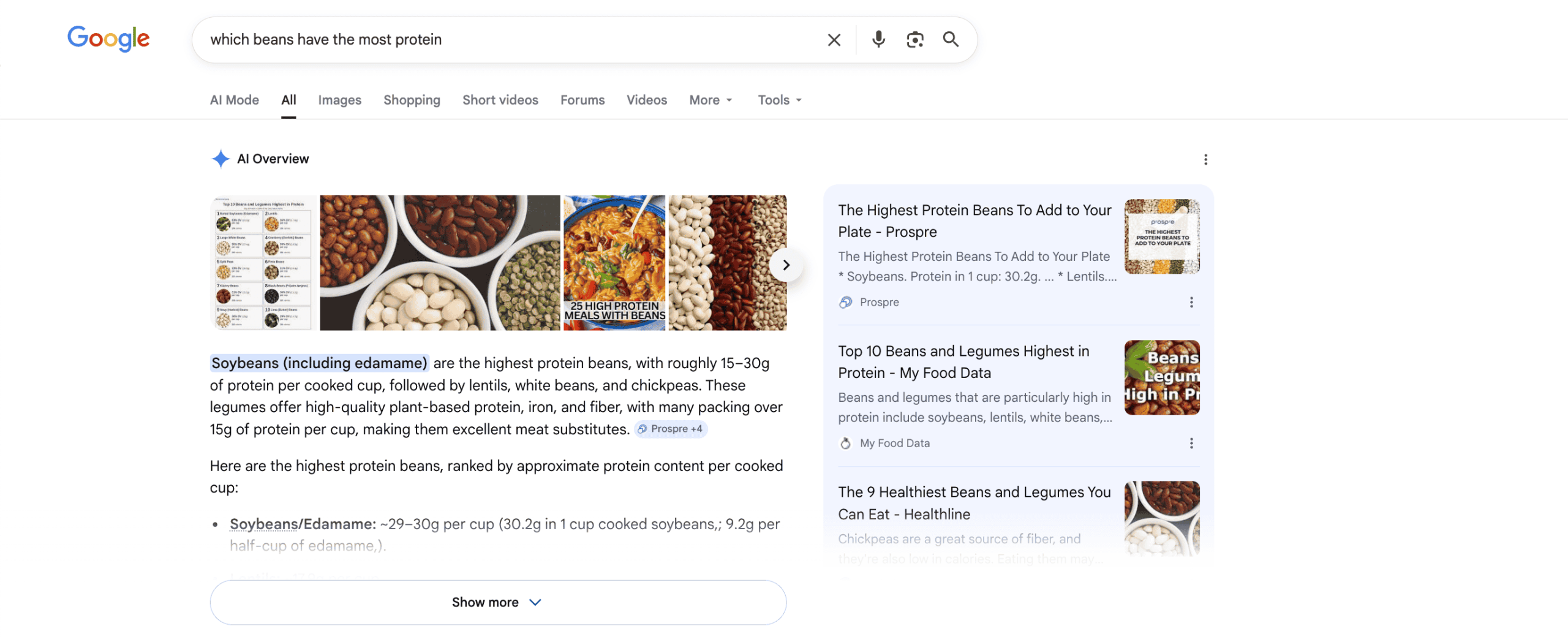
On the left, most of the screen is occupied by the answer, displayed on a white or semi-transparent blue background. The response is often presented as formatted text, including paragraphs, bullet points, headings, and more.
Google highlights the key information in blue (as shown in the screenshot above).
To the right of the answer is a list of sources from which the response was generated. Both the answer and sources are often partially hidden to save space in the search results for users who want to explore other results.
If a user is interested in the AI-generated answer, they can expand it by clicking “Show more.”
On mobile, tapping this button now opens the AI Mode chat interface, allowing users to continue reading and quickly ask follow-up questions. This change rolled out globally in January 2026.
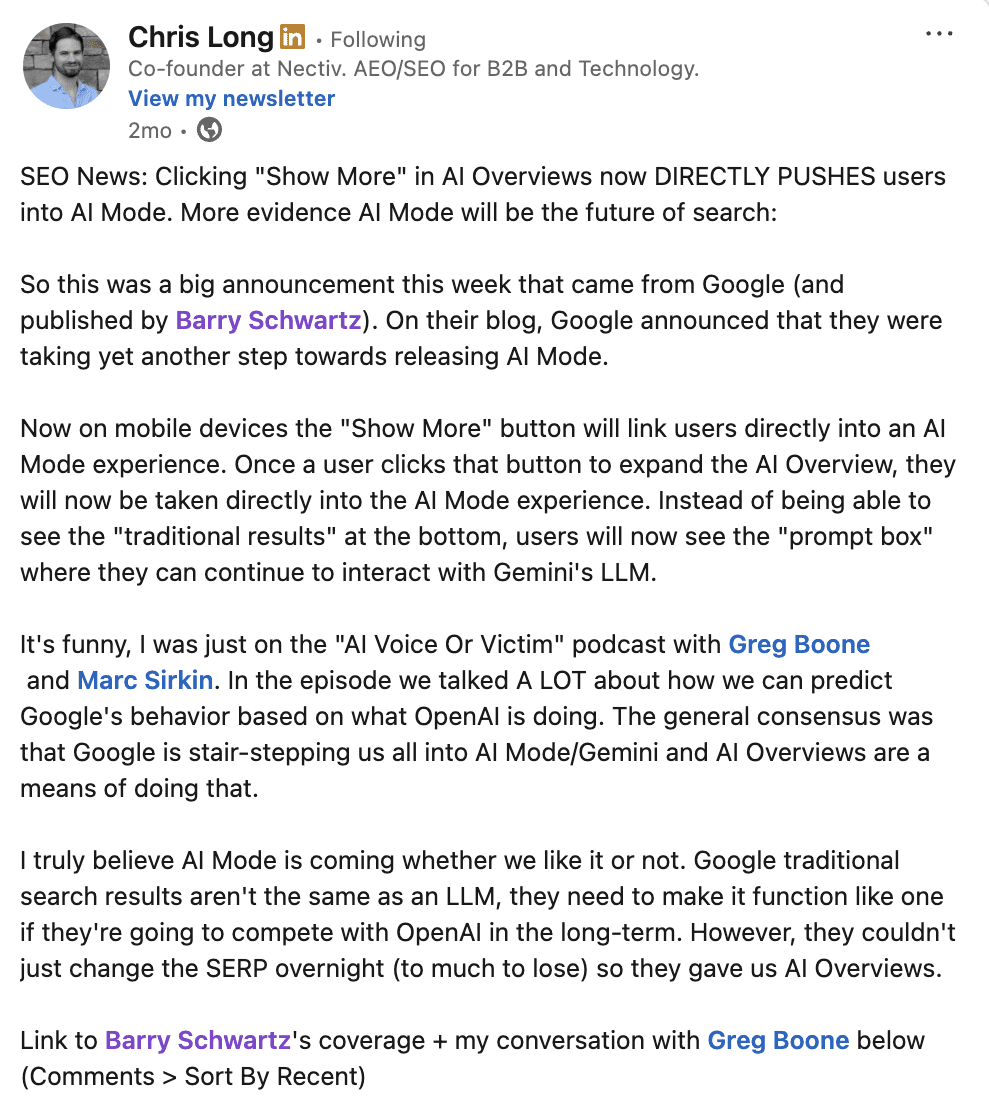
As of April 2026, Google is testing the same behavior on desktop, where clicking “Show more” transitions the page into an AI Mode-style experience, though this has not yet been officially announced or broadly rolled out.
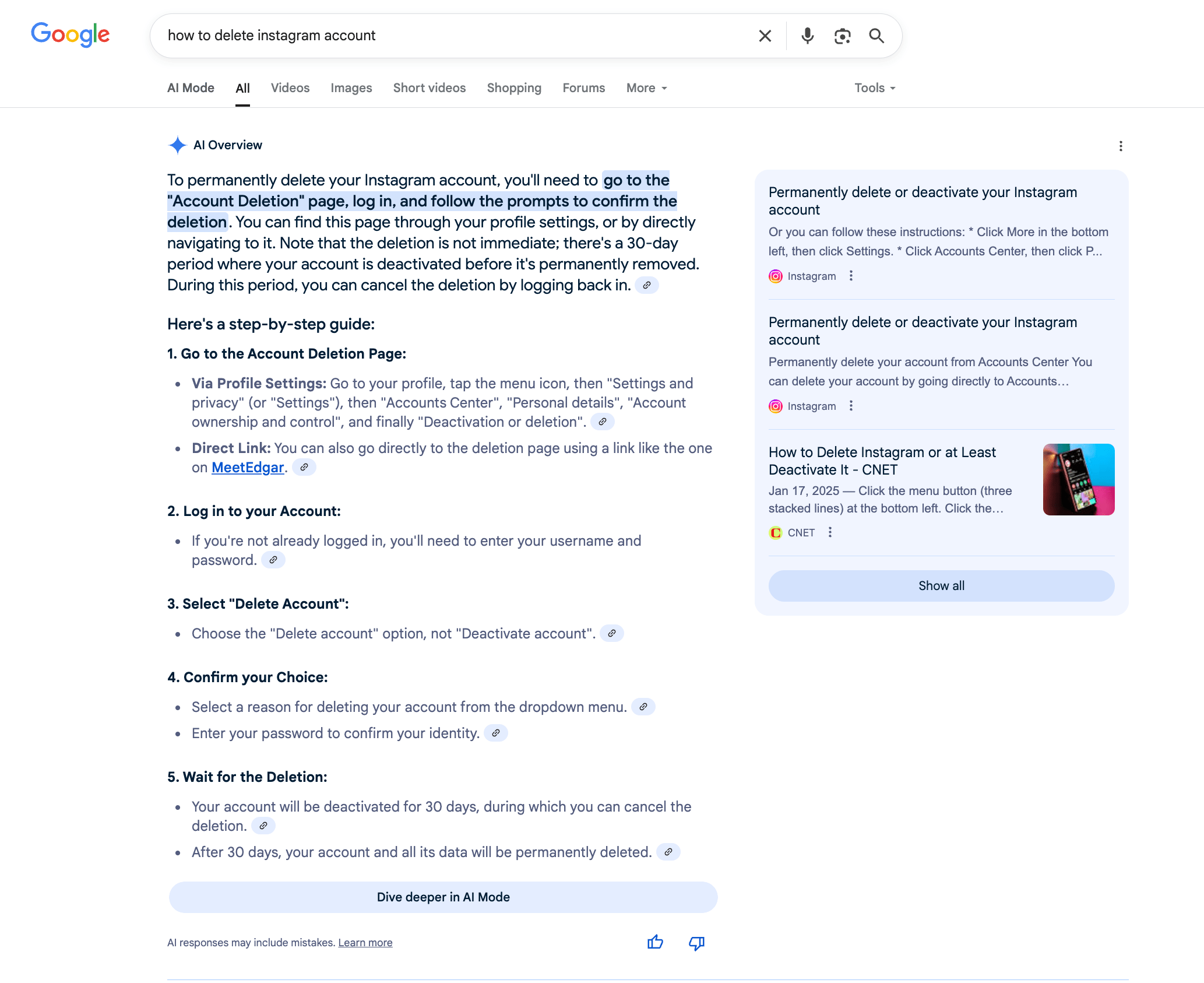
As of now, on the desktop, you’ll most often see a “Dive deeper in AI Mode” button below the answer. By clicking on it, you can keep the conversation in AI Mode.
We break down what AI Mode is and how it works in our article.
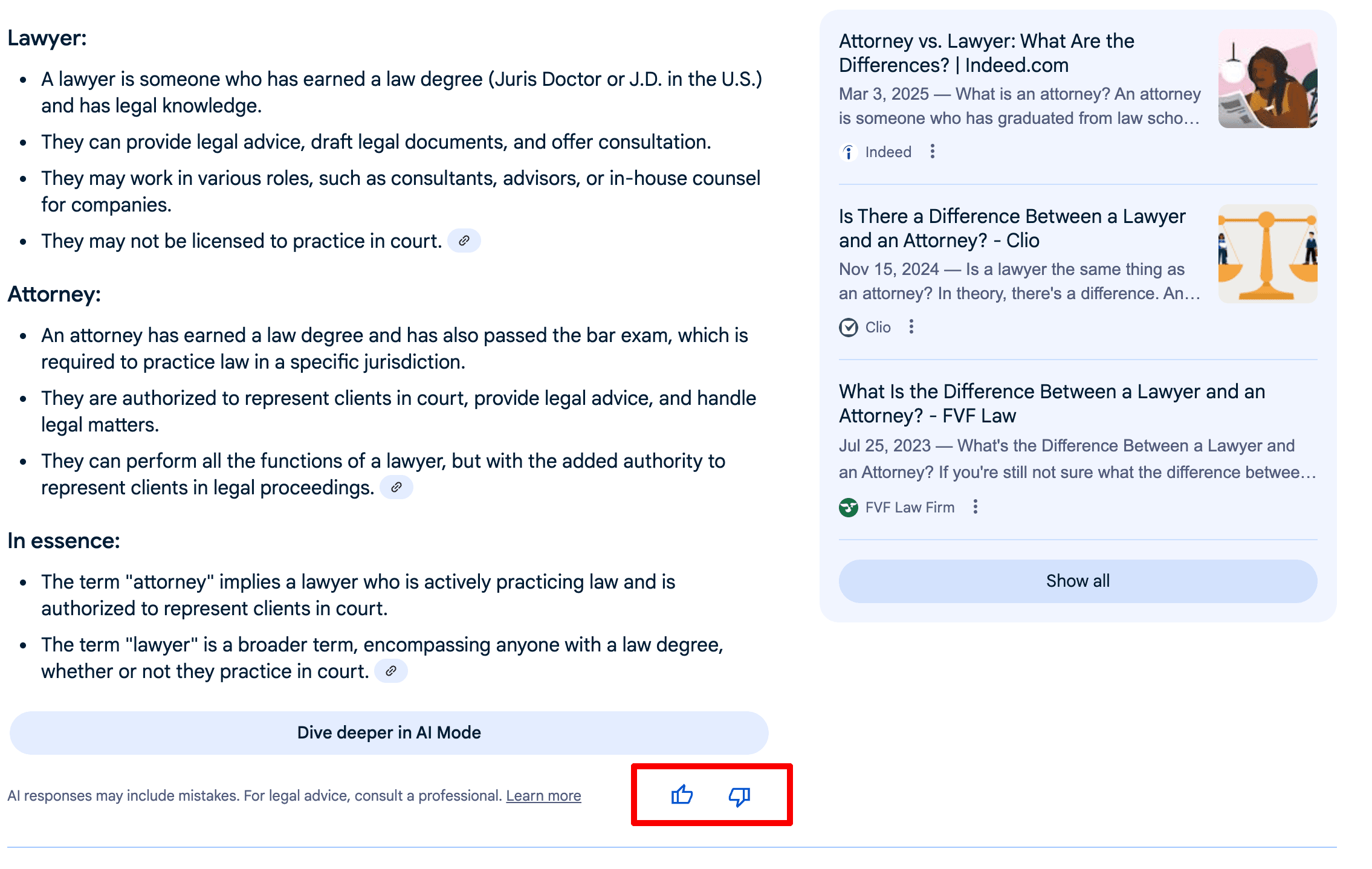
For YMYL (Your Money or Your Life) queries, disclaimers are included, encouraging users to seek professional advice. For example:
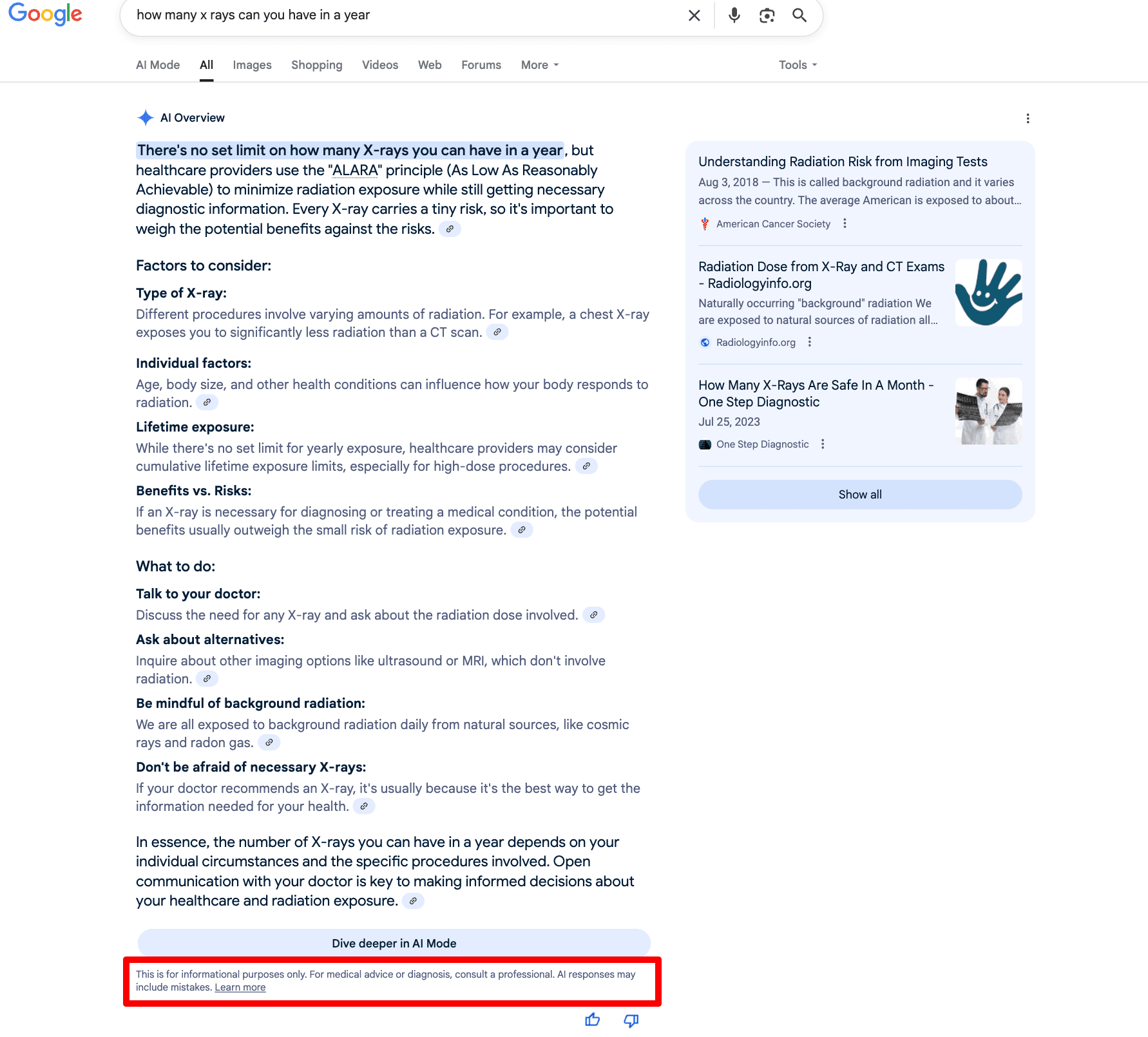
To the right of the disclaimer, users can also rate the generated response.
Locations where you can see AIOs
In late May, at Google I/O 2025, the company announced the expansion of AI Overviews to new countries and languages. With this rollout, AI Overviews are now available in over 200 countries and territories, and in more than 40 languages.
Find the latest list of countries where AI Overviews are available here.
Typical AIOs layouts
There are countless AI Overviews layouts, depending on the query and niche. Here are a few examples:
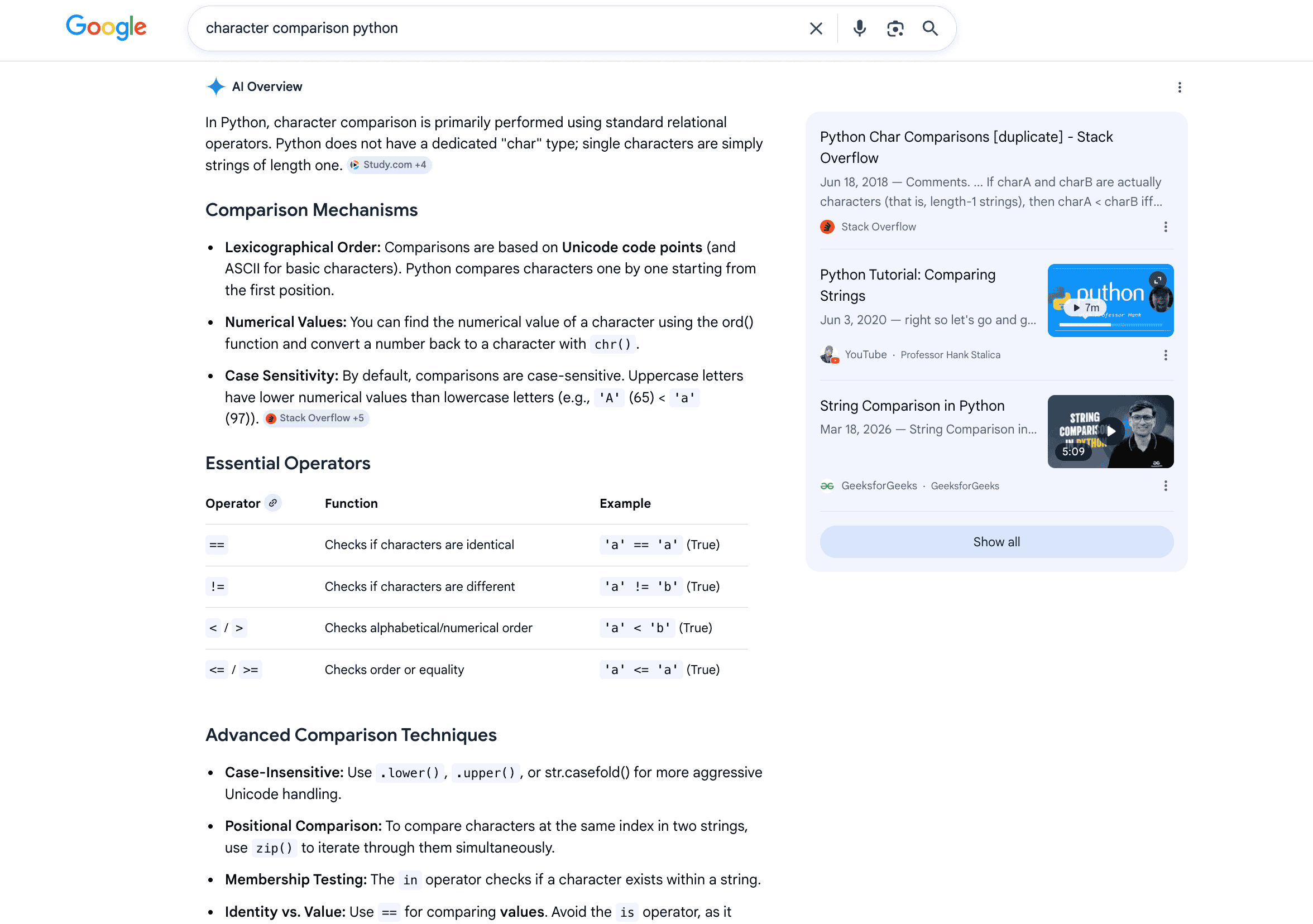
Structured summary layout (answer cards). The answer can appear as either a concise summary or a more detailed response. It is typically organized into paragraphs, headings, bullets, or sections, includes source links, and may cover multiple related subtopics in one overview.
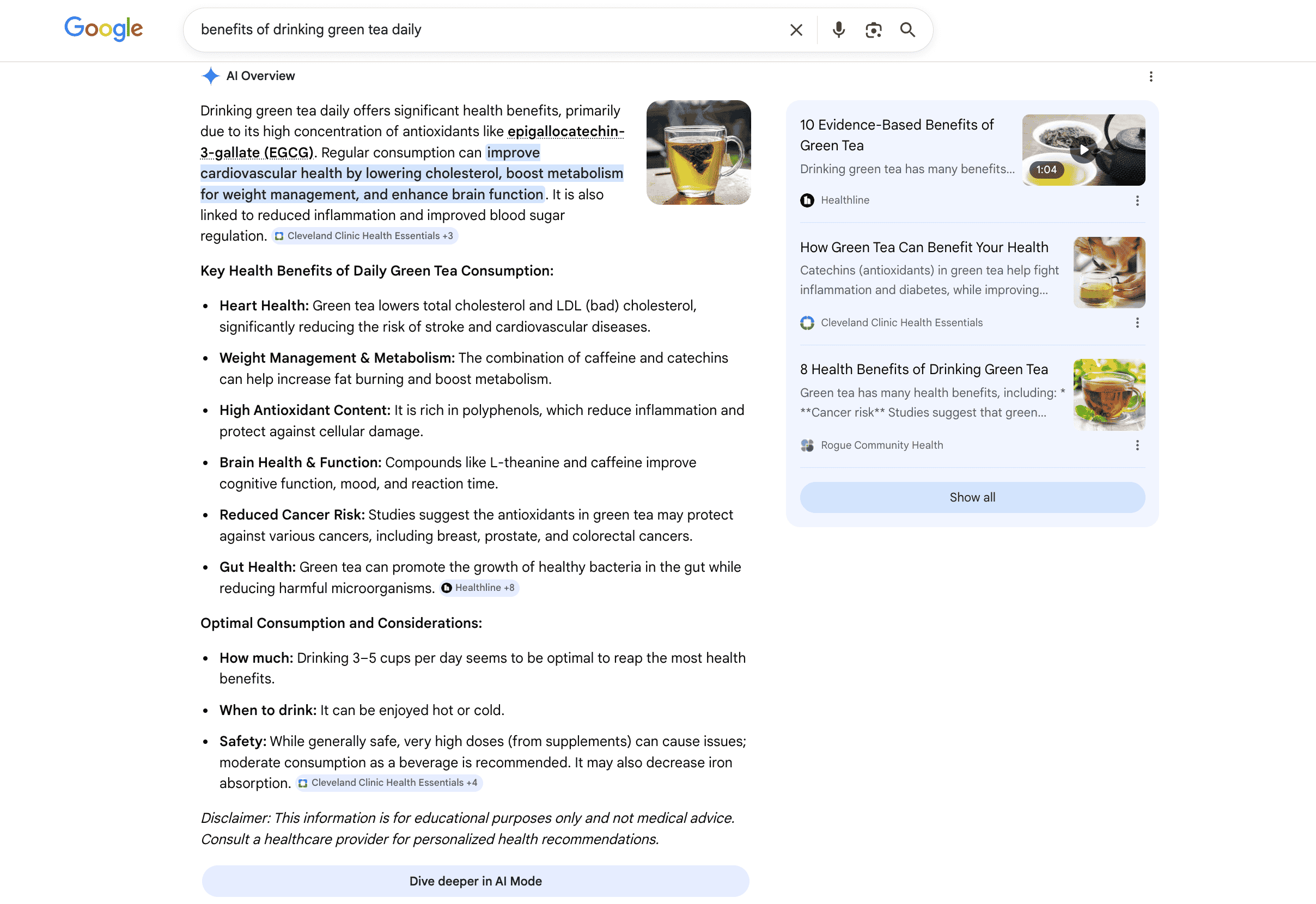
Step-by-step layout. Designed for “how-to” searches. Information is organized into numbered steps or clear sequential instructions.
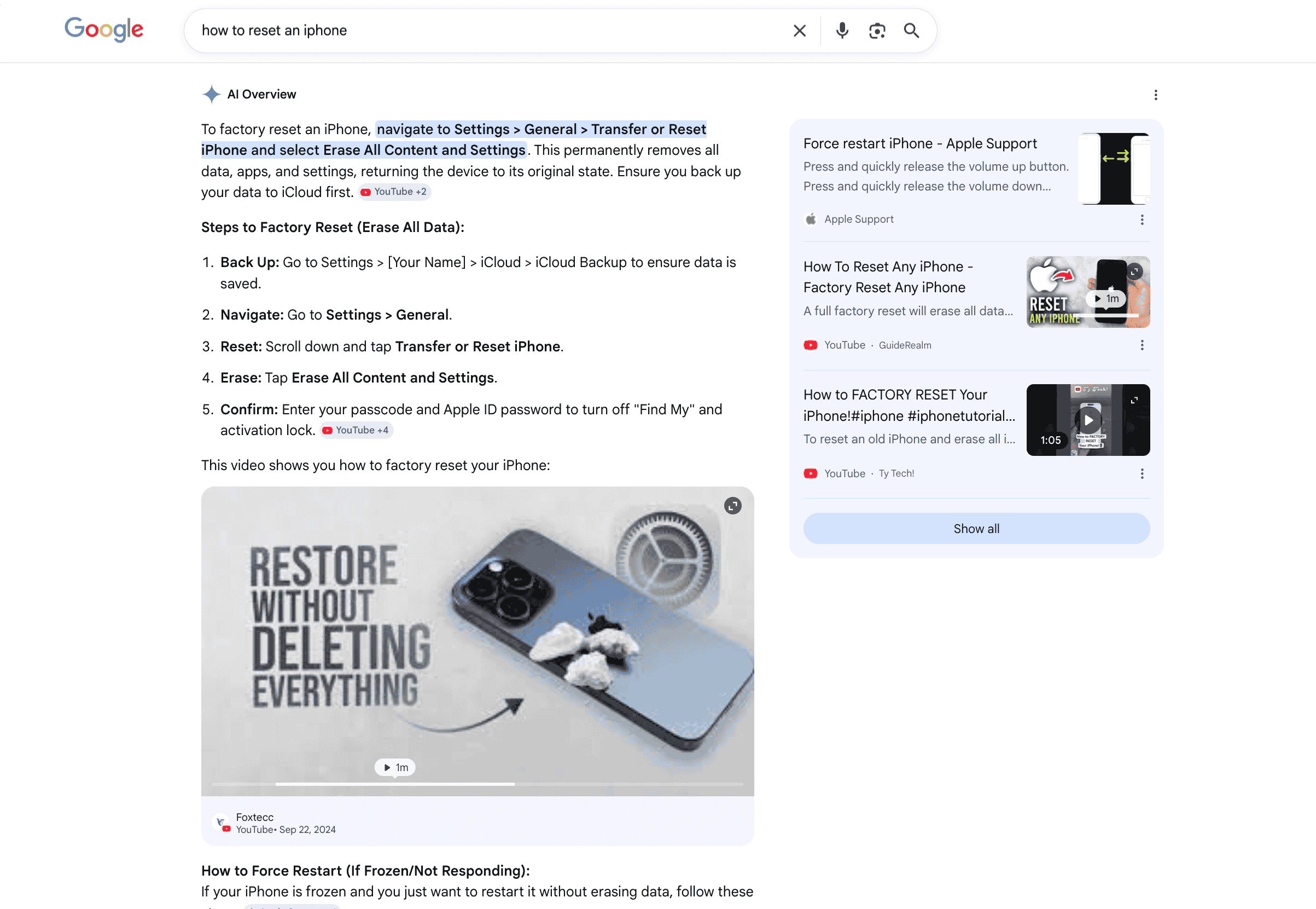
Comparison layout. Used when users compare options, products, or ideas. It often shows differences side by side or in grouped sections highlighting pros, cons, and key features.
Local results layout. Combines an AI summary with maps, nearby businesses, ratings, and hours. Usually appears for searches about restaurants, services, or places nearby.
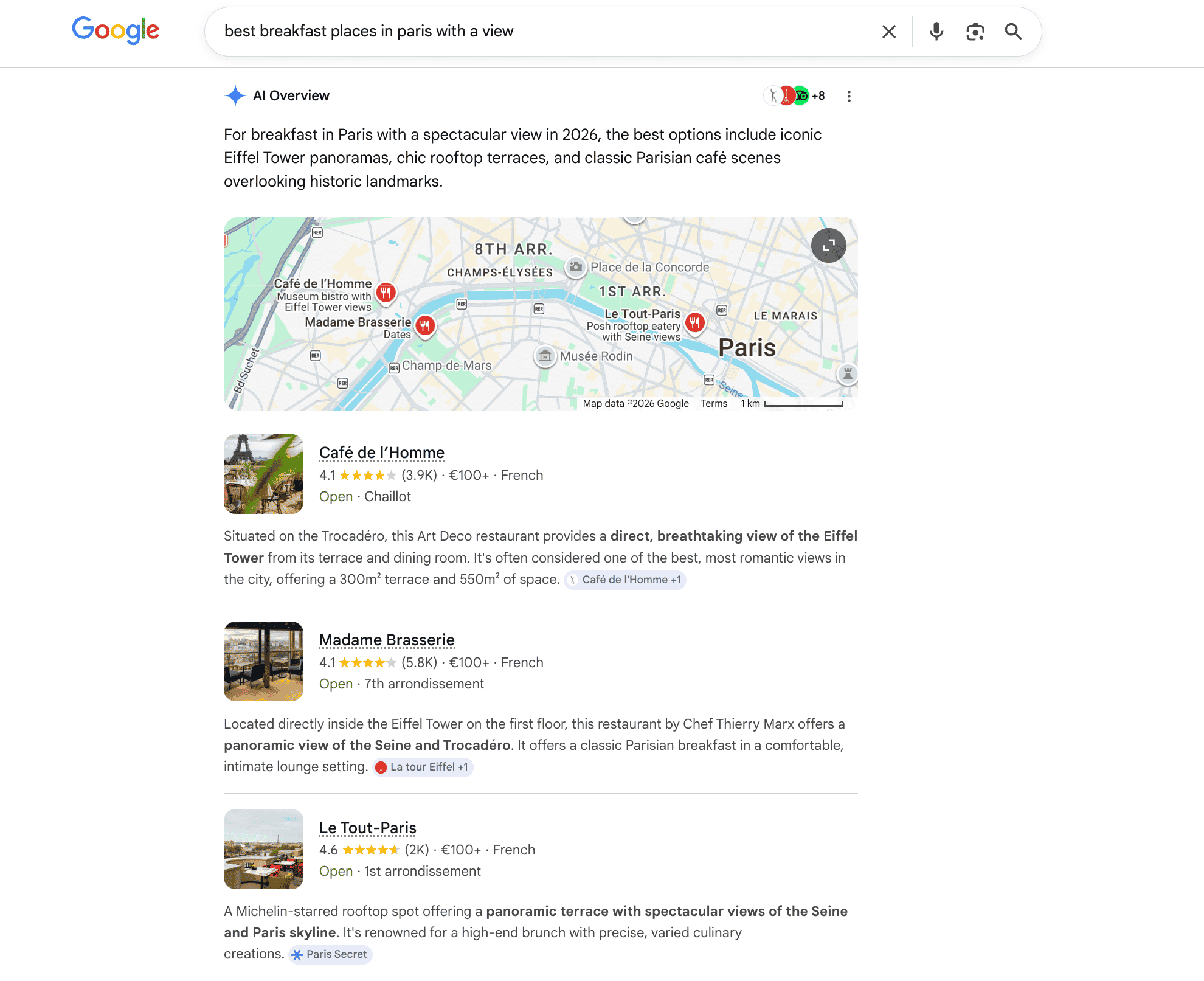
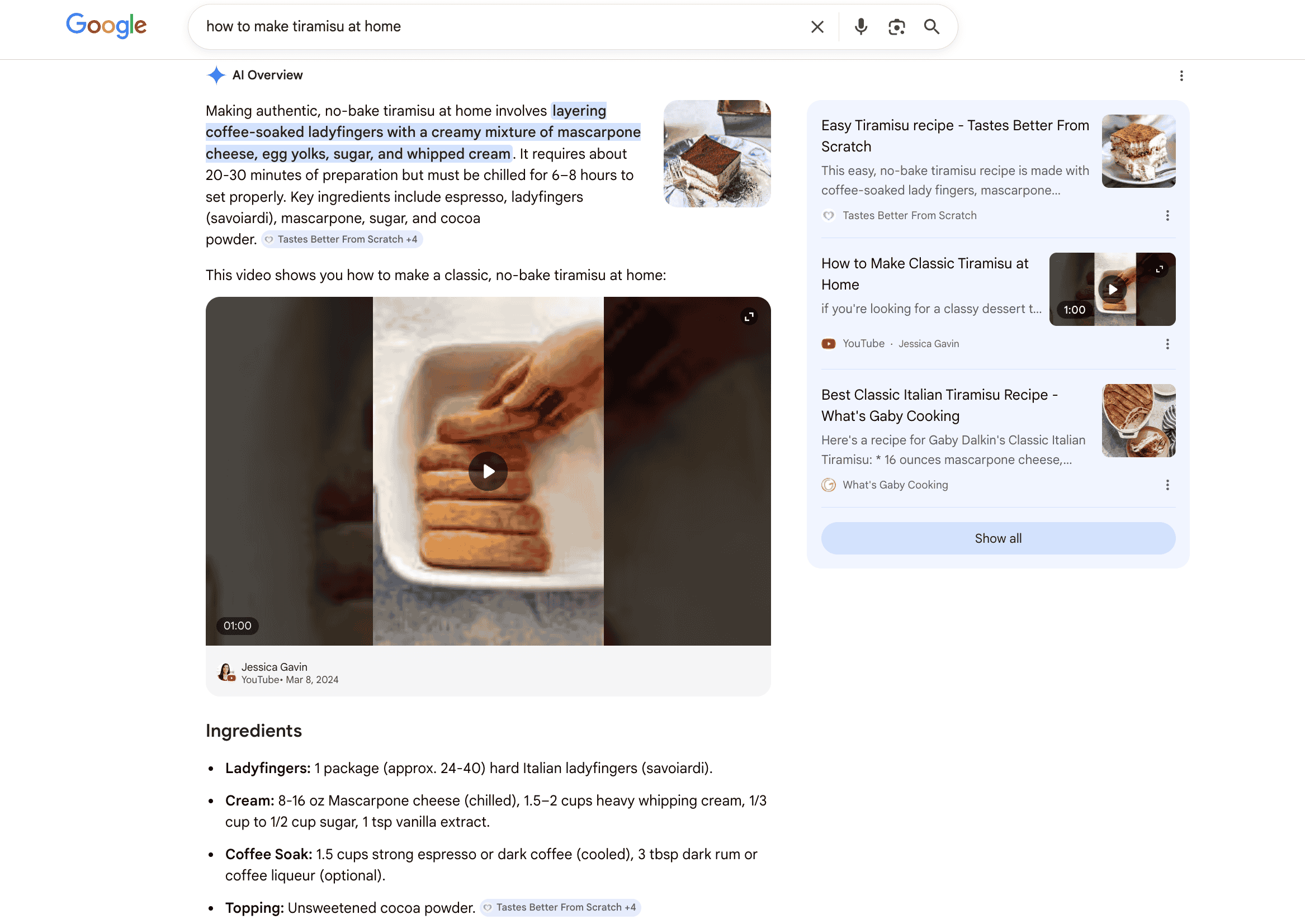
Visual/media layout. Includes images or videos alongside the written summary. Used when visuals help explain the topic, such as travel, recipes, repairs, or design ideas.
Links in AIOs: placement, number, and sources
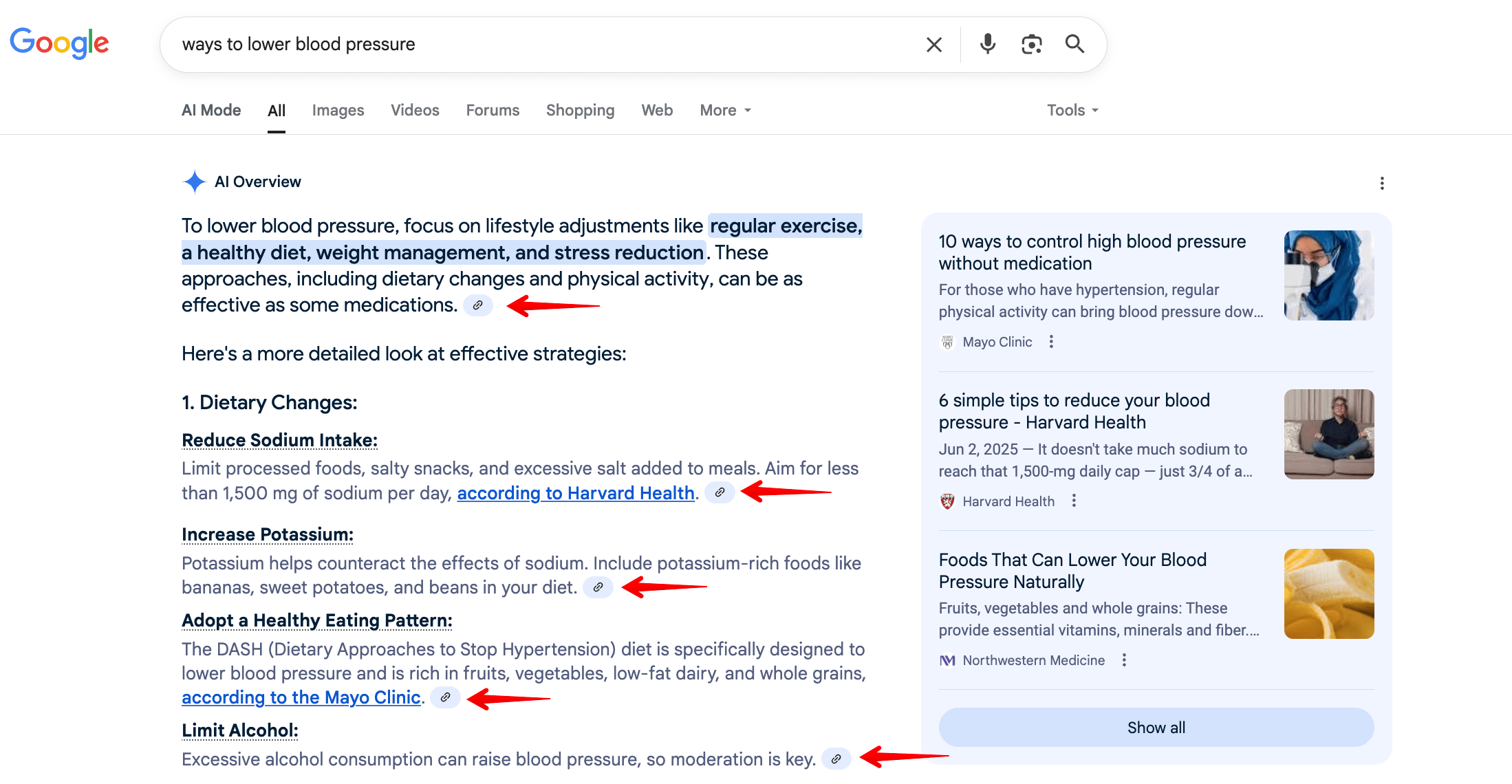
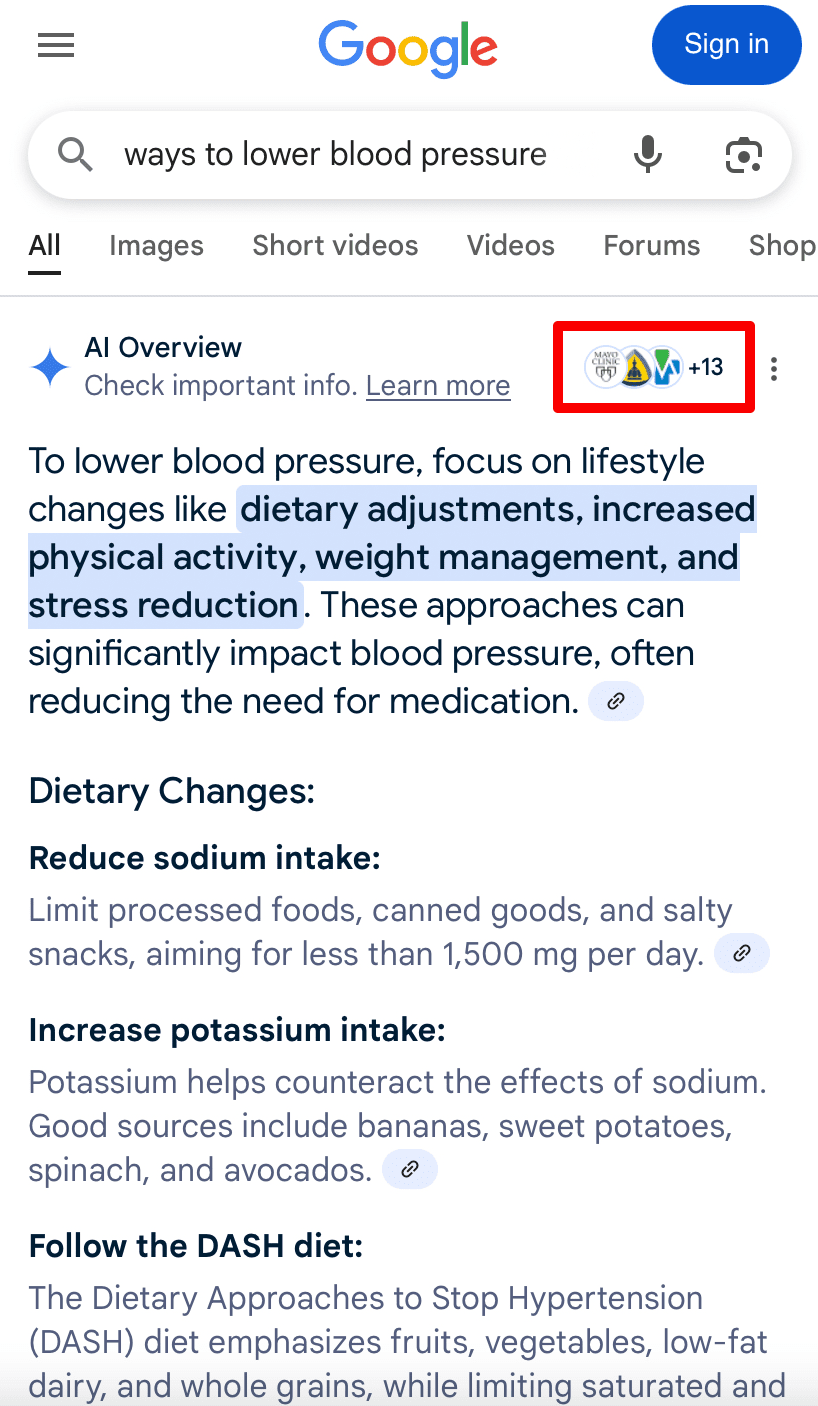
In addition to the list of sources shown on the right, you can also see small favicons within the response opposite to every bullet. When tapping the icon, users will see links which used to generate that part of the answer.
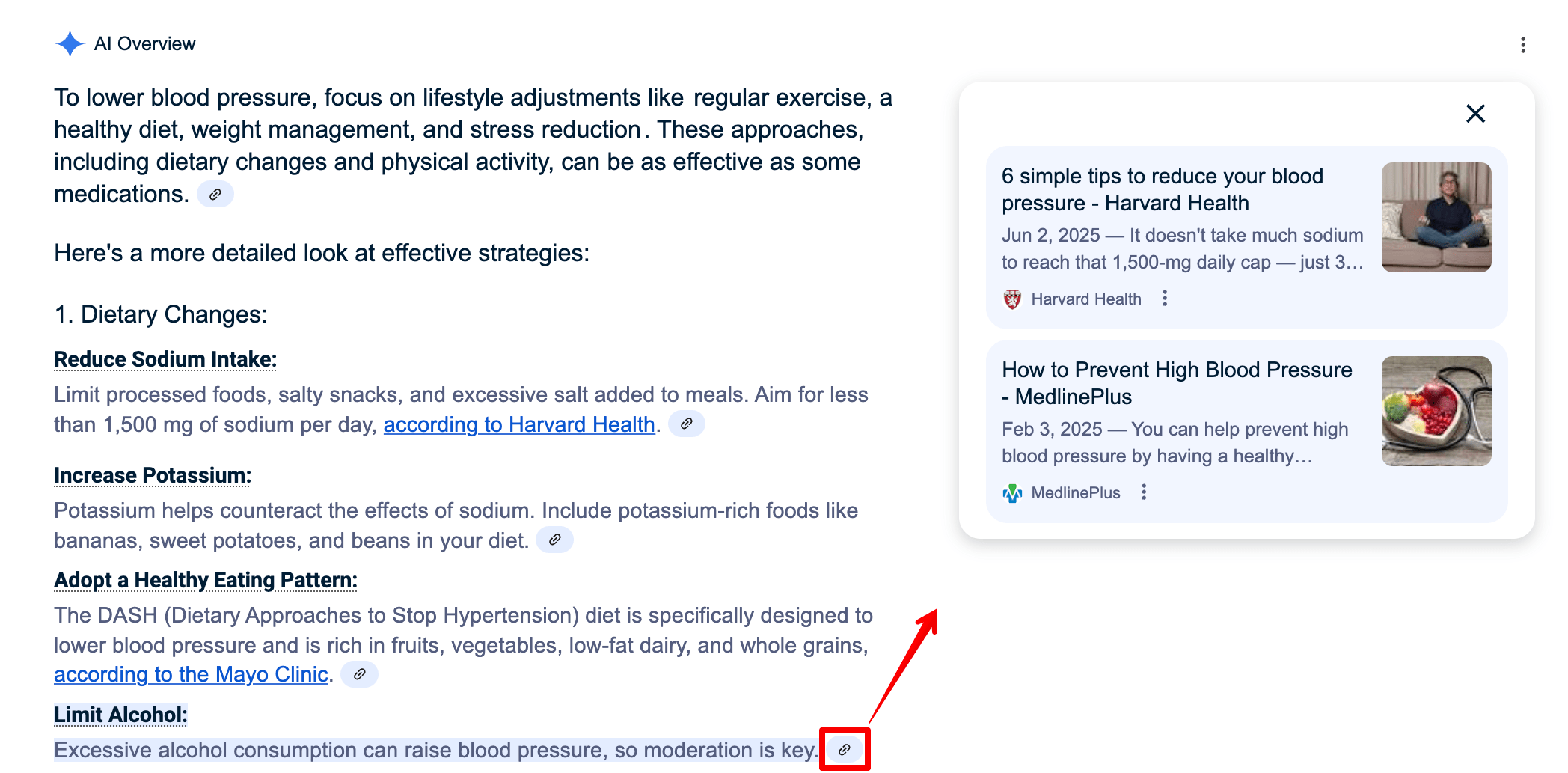
Here’s how it looks on mobile devices: all links are accessed through site icons. You can tap a group of favicons to see pages where the AI sourced the answer from.
To give users reliable information, Google’s AIOs include blue anchor text hyperlinks to specific pages.
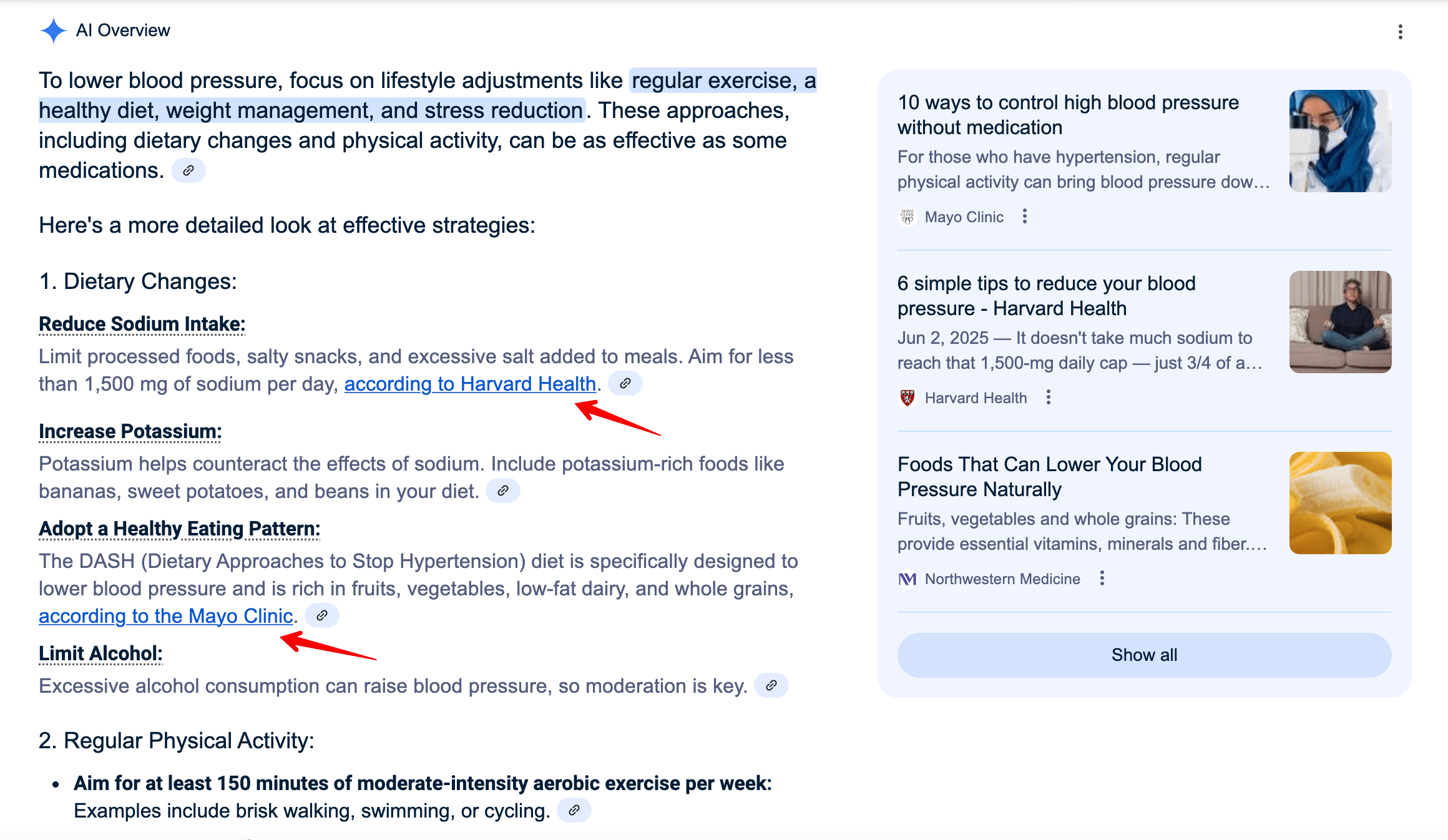
AI-generated snippets also include hyperlinks that guide users to additional Google Search results. Our data analysis shows that 43.42% of AI Overview responses contain links to Google organic results.
According to our in February 2026 findings, the average number of links in AI Overviews is 15.22. Back in November 2024, the average was just 6.82 links. That’s over 2x growth in the number of cited links.
AIOs shopping results
Another AI Overviews feature with the potential to transform the e-commerce industry is Google Shopping results/products integration into the AI Overviews results for e-commerce queries. It looks like Google is actively building an e-commerce search ecosystem where generated information is combined with products users can buy directly.
For commercial queries, you’ll most often see an AI-generated response that includes product carousels.
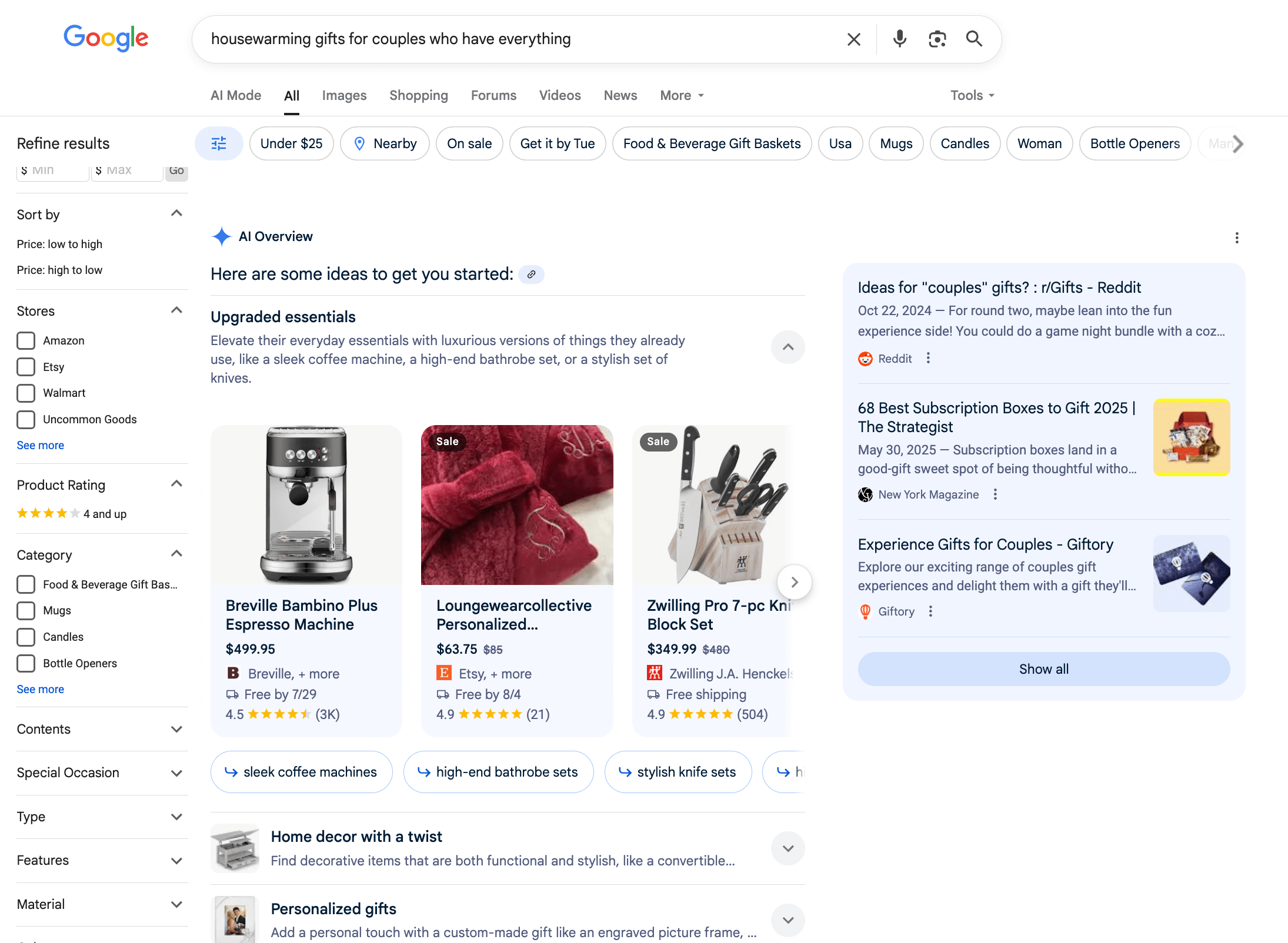
The AI Overview generates a browsable list that, when opened, displays clickable product carousels. Every product card includes info about rating, the number of reviews, price and URLs.
When clicking the product card, you will see a bigger, more detailed one on the right side with the product description, photos, descriptions, reviews, etc. Here, you can choose the website where you want to buy a product.
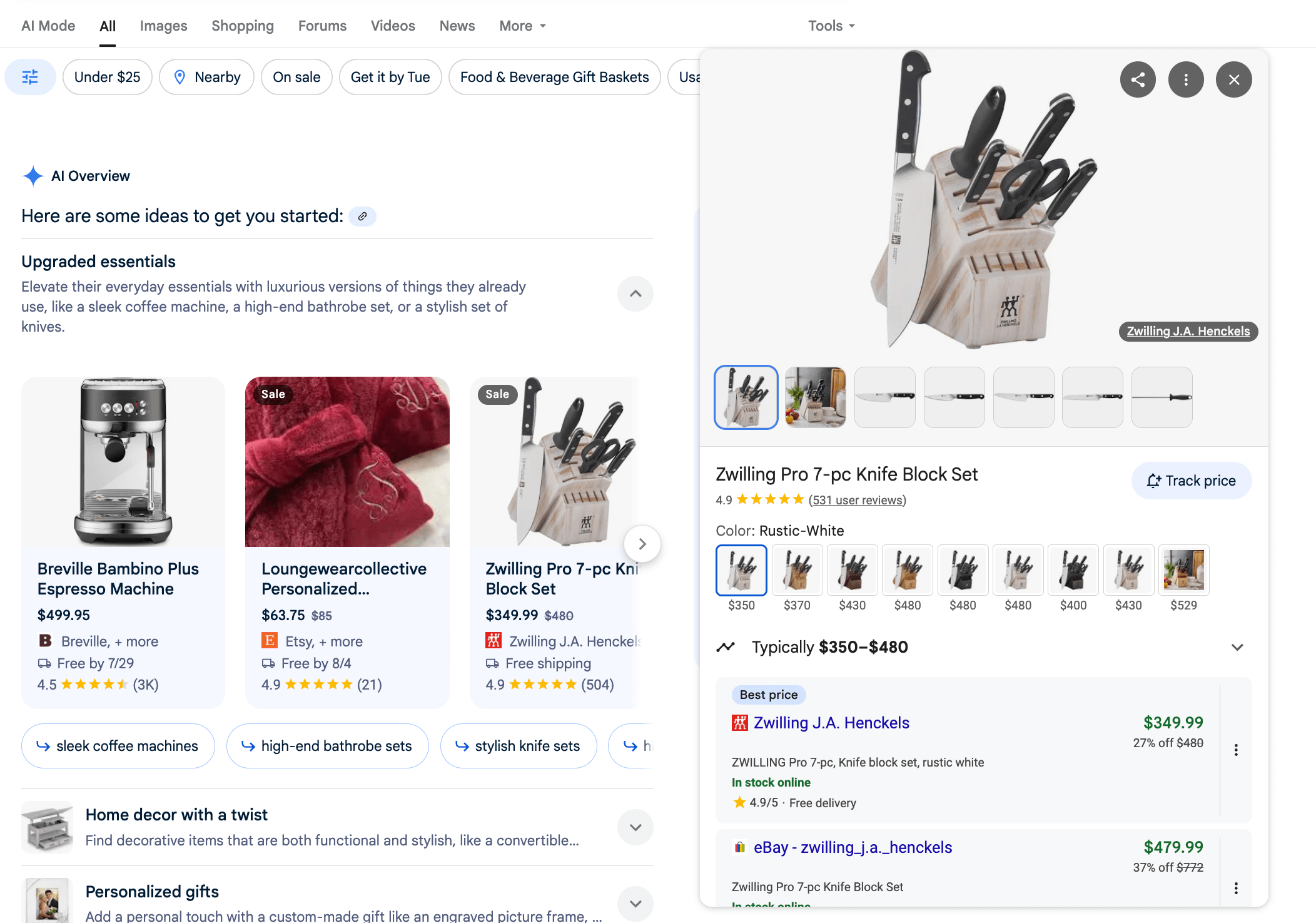
Google also provides query suggestions below the carousel. Clicking on them takes you to a new search results page for the selected query.
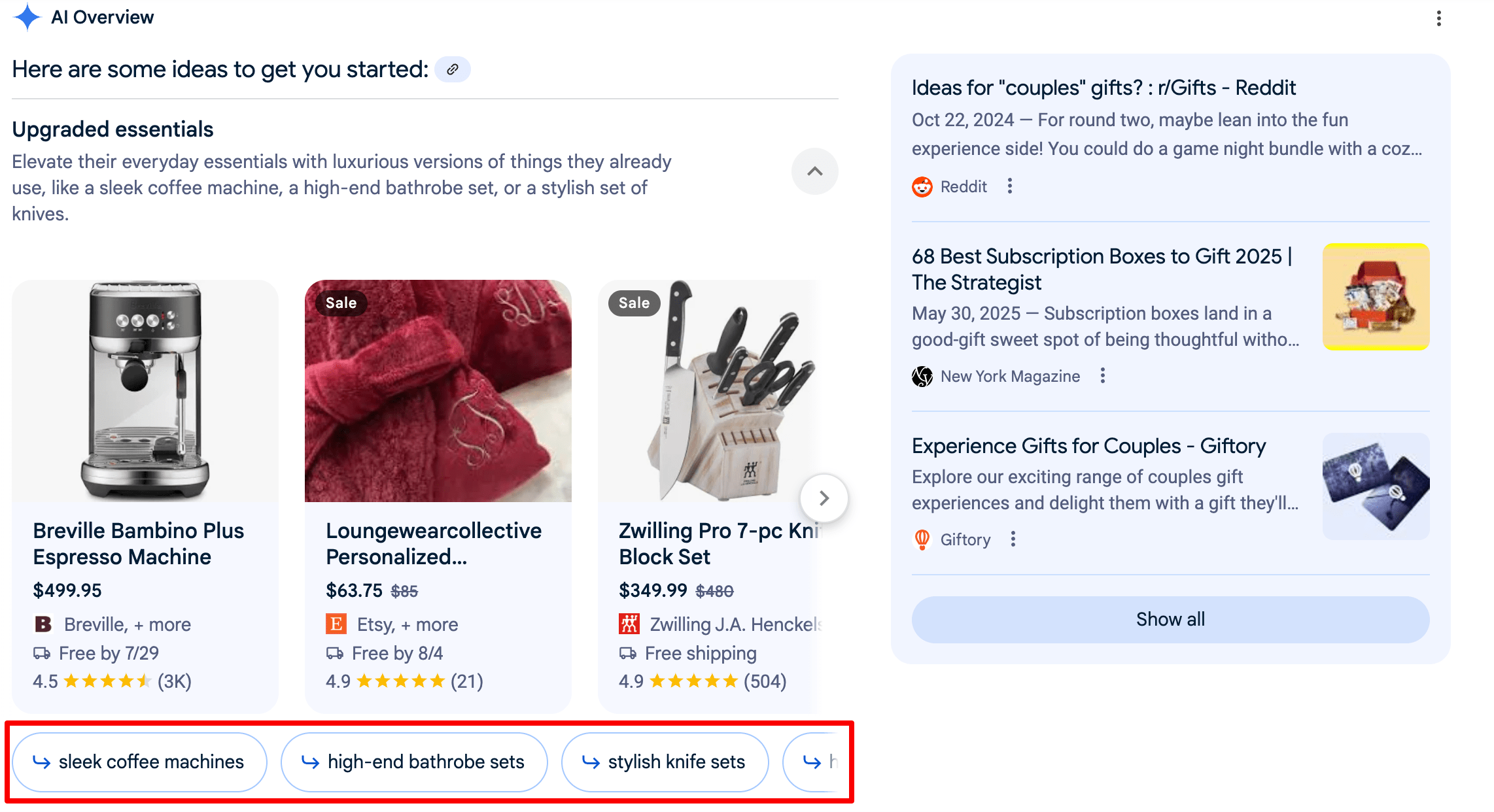
That’s because this new generative AI shopping experience is built on Google’s Shopping Graph, which has more than 50 billion product listings (2 billion of which are updated every hour).
Additionally, Google Shopping includes an AI Overview feature called Researched with AI. It resembles product selection tips, with sources listed below and on the right side.
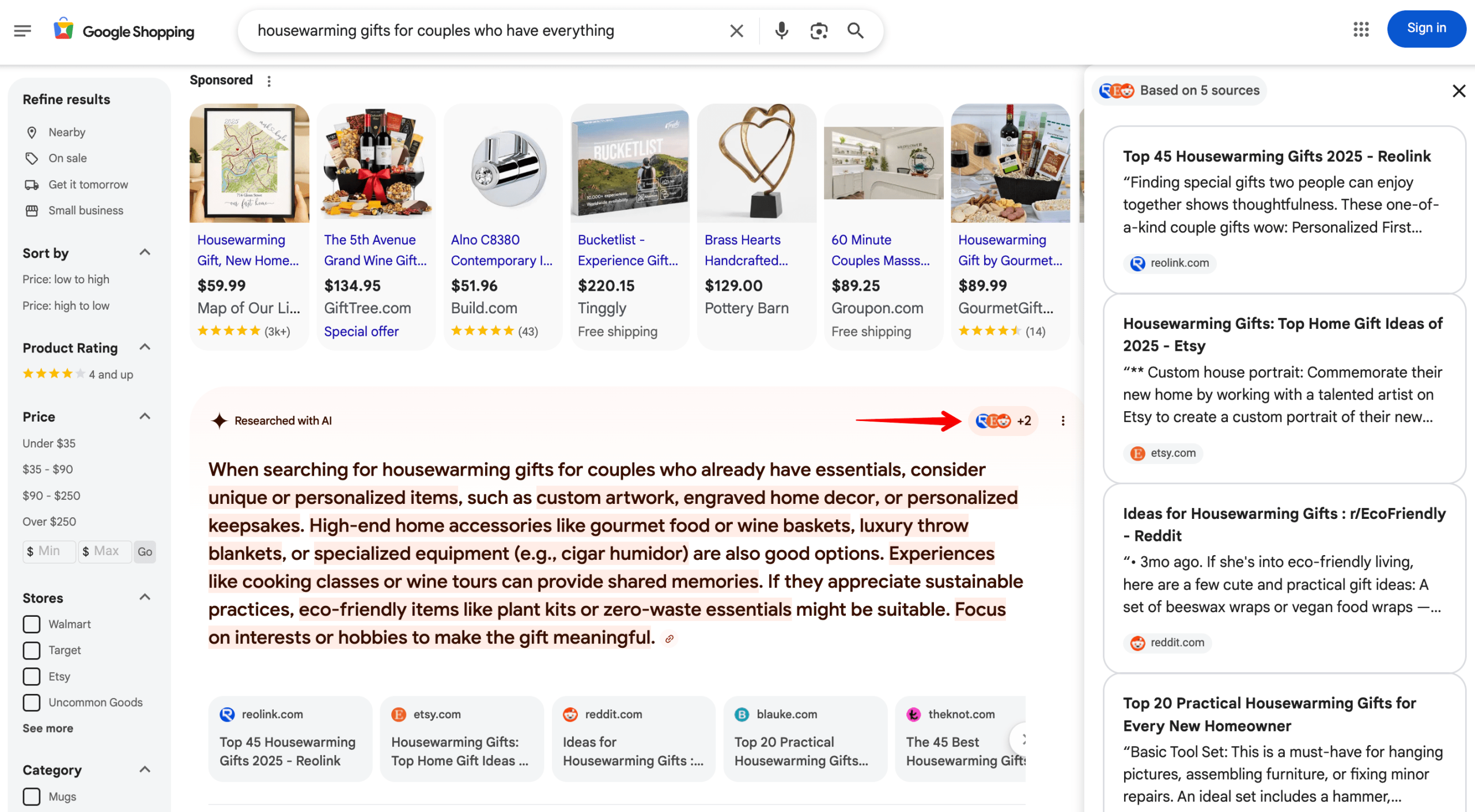
By March 2026, AI Overviews appeared on 14% of shopping queries, which is a 5.6x increase from November 2024. If this expansion continues, AI may become a standard part of the online shopping journey.
Ads in AIOs
Before the launch of AI Overviews in May 2024, there were no ads at all. Following the launch, testing began, and reports started emerging that ads would soon appear in AIOs.
- May 2024
In May, the first mention appeared that Google had been testing ads in AI Overviews. It stated that the company is moving forward with a full rollout because it helps people “quickly connect with relevant businesses, products, and services to take the next step at the exact moment they need them.”
- July 2024
Google said it again, that it will soon test ads within its AI Overviews.
- September 2024
The Verge shared news about ads in AI Overviews. The article explained AI-generated responses will include tips and suggest products to help.
- October – November 2024
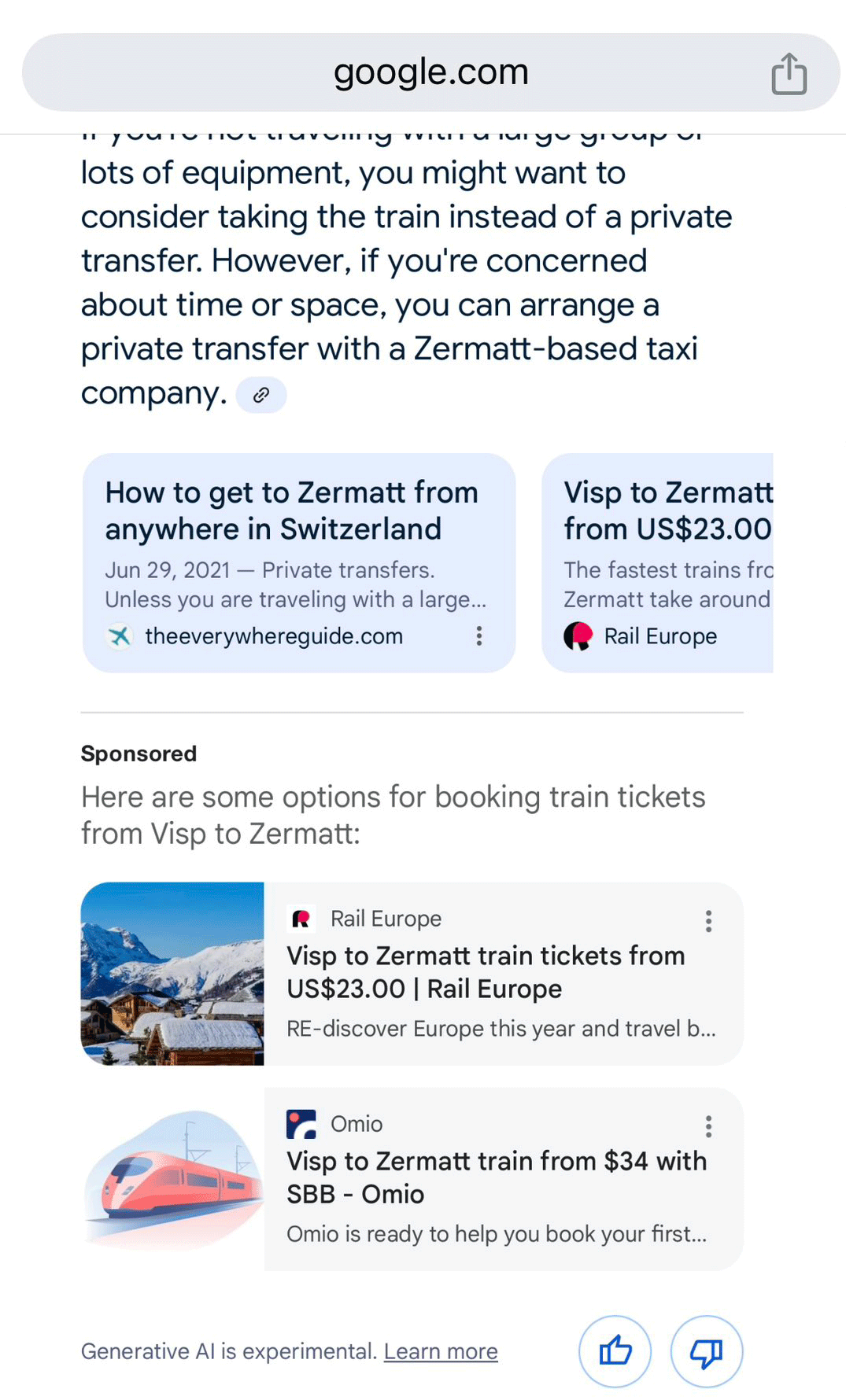
After several months of testing, Google began rolling out the first ads inside AI Overviews in late 2024. These early placements were initially limited to mobile users in the United States.
The first live examples were widely spotted in November 2024. Ads labeled Sponsored appeared below the AI-generated summary, showing that ads were present but visually separated from the main answer.
- May 2025
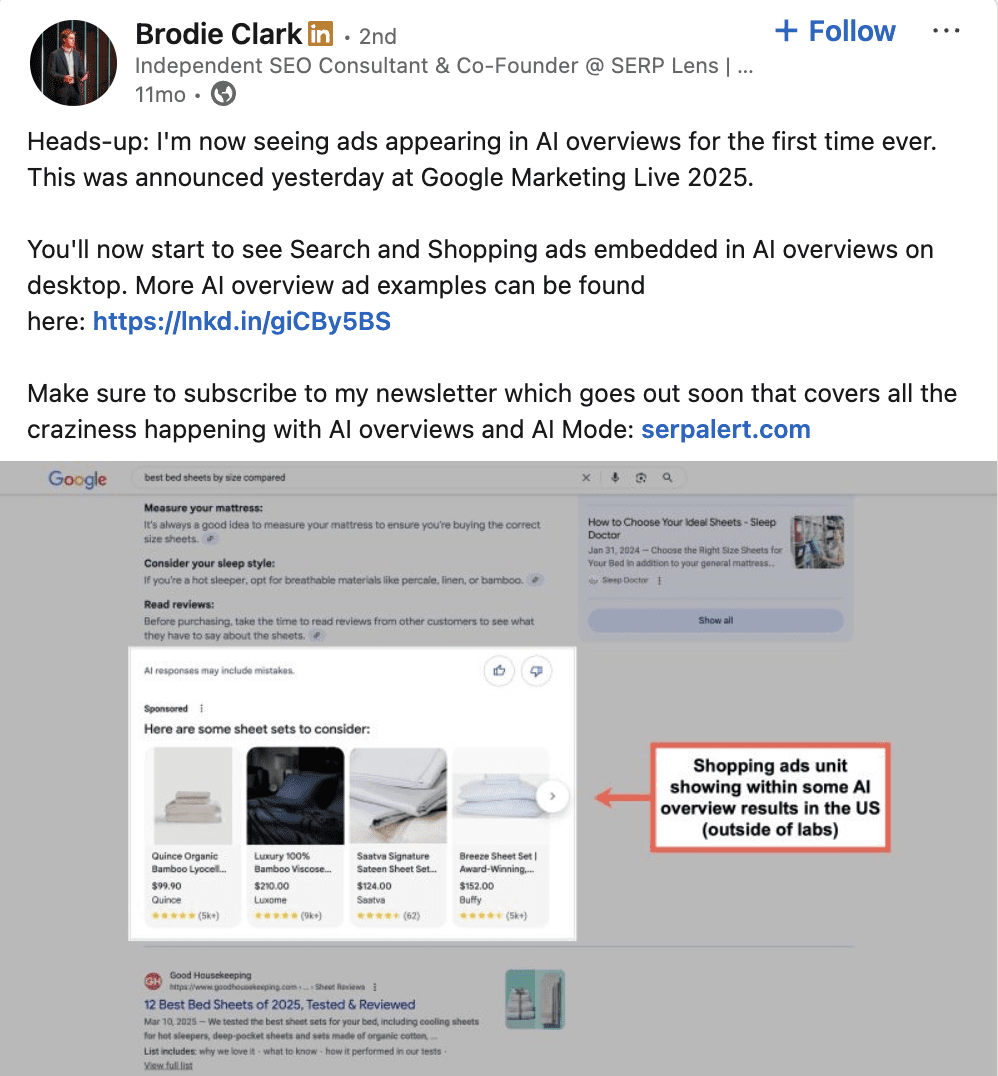
Google expanded ads in AI Overviews to desktop search for U.S. users. This was the first time advertisers could appear directly inside AI-generated results on desktop devices. Google also said expansion to select countries would follow.
- June 2025
By June 2025, Google officially documented that ads in AI Overviews were available across eligible mobile and desktop experiences. Google explained that ads may appear above or below the AI Overview depending on relevance and auction signals, but not in both places simultaneously.
- Late 2025
By late 2025, ads in AI Overviews were no longer a small U.S. test. Google stated it had expanded the format to more countries globally, signaling that AI-generated search ads were becoming a standard part of its monetization strategy.
- New updates in 2026
In January 2026, Dan Taylor, Google VP of Global Ads, said AI Overview ads were seeing click and engagement rates about the same as traditional Search ads. In other words, users were already interacting with ads inside AI search experiences in a familiar way.
Another important 2026 update was Google’s redesign of links and sources inside AI results.
In February 2026, Robby Stein, VP of Google Search, announced more prominent source links and richer source panels in AI Overviews and AI Mode. While not an ad launch directly, it matters because it changes how users choose between sponsored placements, organic sources, and cited websites inside AI results.
How AI Overviews behave in search: data and trends from 2025-2026
We’ve been tracking AI Overviews behavior since 2024, running regular analyses across 100,000 keywords spanning 20 niches. Here’s what the data shows.
Overall AIO presence in search
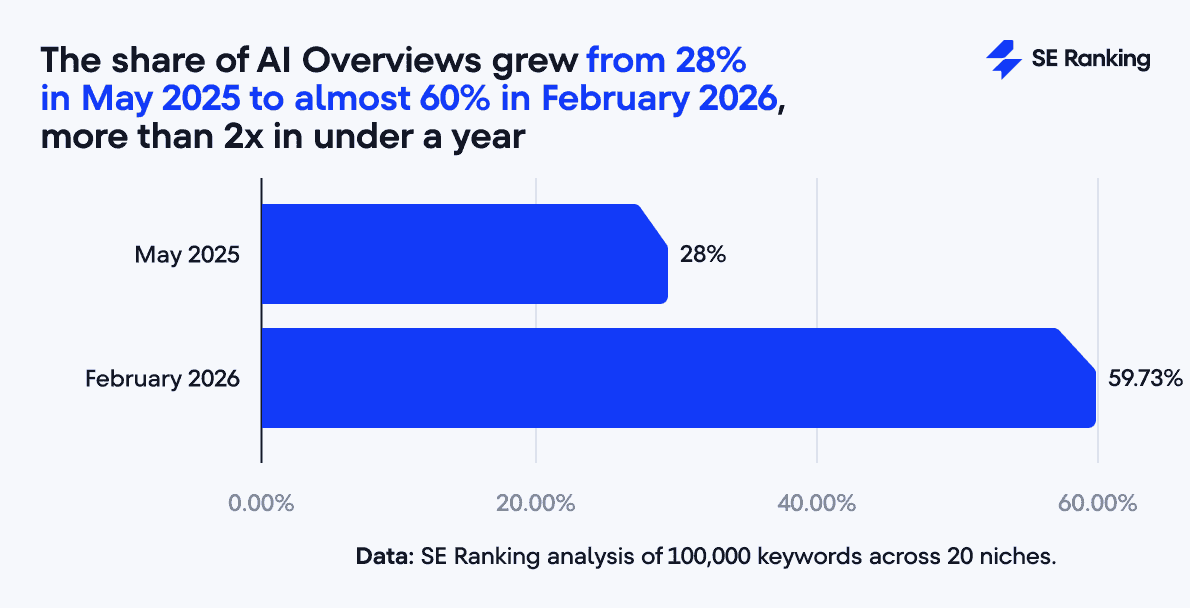
In May 2025, our research showed AI Overviews appearing for approximately 28% of queries. By February 2026, that number reached 59.73% — more than a 2x increase in less than a year.
On January 27, 2026, Google announced that Gemini 3 would become the default model powering AI Overviews globally. To understand what that meant for Google’s AI search, we analyzed the state of AI Overviews before and after Gemini 3.
And as you can see on the graph below, barely anything changed.
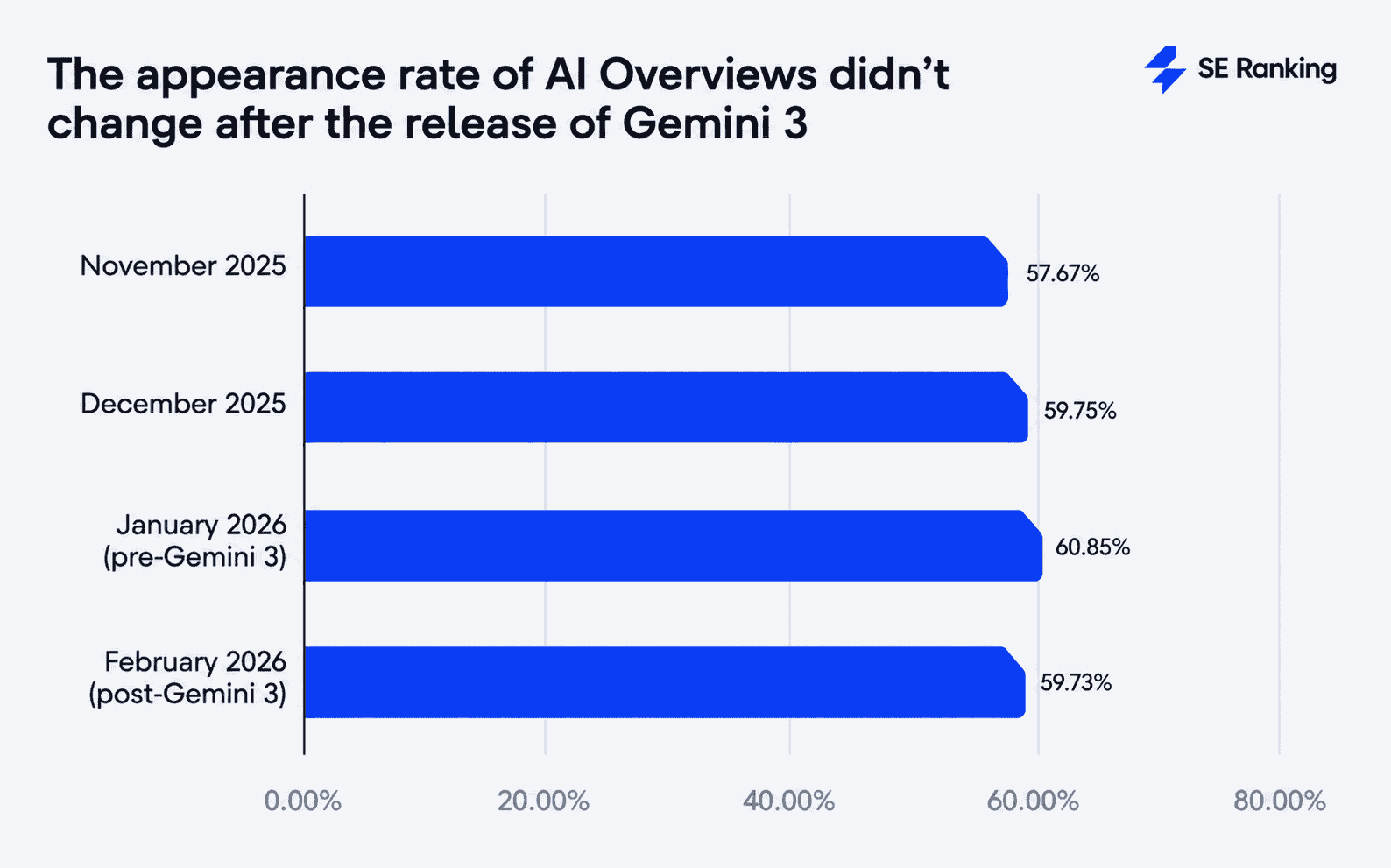
Before Gemini 3 (January 2026), 60.85% of queries triggered AI Overviews. In February 2026 (after Gemini 3), that number settled at 59.73% — a difference of less than one percentage point.
The numbers looked noticeably different in 2024. As shown in the chart, the share of AI Overviews across the US was around 19% in November 2024. This is nearly the same share as January of that year. In June and July 2024, the share was roughly half of what it was in November. By August 2024, AI Overviews appeared in about 12.5% of desktop searches.
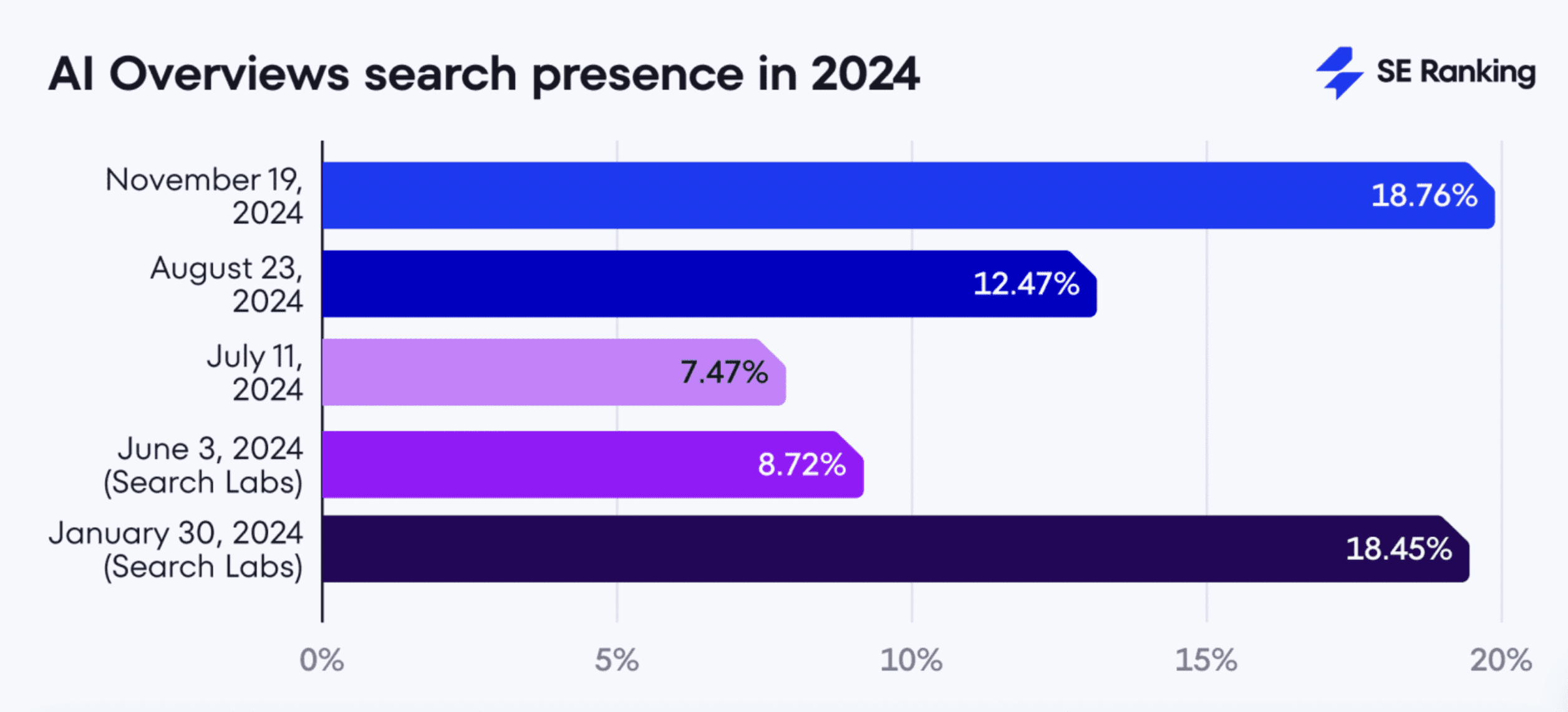
As the data shows, AI Overviews are becoming a regular part of Google search. Because of this, understanding how your brand appears in AI-generated search results is becoming essential for businesses that want to stay visible, competitive, and relevant online.
That’s where SE Ranking’s AI Search Toolkit comes in. It gives you the data to understand where your brand actually stands in AI search, along with the context needed to turn those insights into action.
Beyond AI Overviews, it also shows how your brand and competitors appear in LLMs such as Google’s AI Mode, Gemini, Perplexity, and ChatGPT.
Its key capabilities include:
- Brand mentions and link tracking. Track when, where, and how your brand is mentioned, cited, or linked across AI platforms. You can also see whether your brand appears in the top three results, which is especially valuable for stronger visibility.
- Top-cited sources analysis. Discover which websites AI platforms cite most often for your target prompts. This helps you identify valuable sites for outreach, PR, and partnership opportunities.
- Competitor benchmarking. Compare your brand with competitors side by side. Measure mentions, links, and citation trends so you can see your true position in the market.
- Daily ranking updates and historical trends. Spot real changes in visibility over time instead of reacting to random fluctuations.
SE Ranking directly integrates with GA4, so that you can connect changes in AI visibility with actual website traffic to find the correlations in how one channel may be affecting the other.
What’s more, social performance data is available through Planable, SE Ranking’s sister platform, adding another layer of data to the picture.
Connecting insights across all three data sources (AI visibility, traffic, and social) still requires some manual analysis for now, but having them within one ecosystem gives SE Ranking a major advantage over similar platforms.
Automating analysis across these channels is the direction we’re heading, so stay tuned for more updates and even easier brand visibility tracking.
AIO share by niche
Based on findings from our May 2025 research study study, the niches with the highest percentage of AI Overviews were Relationships (61%), Business (57%), Education (50%), Food & Beverage (46%), and Legal (42%).
By February 2026, the ranking changed. AI Overviews appeared most often for Finance (78%), Business (77%), Career and Jobs (76%), Relationships (74%), and Sports and Exercise (72%).
May 2025
Relationships (61%)
February 2026
Finance (78%)
May 2025
Business (57%)
February 2026
Business (77%)
May 2025
Education (50%)
February 2026
Career and Jobs (76%)
May 2025
Food & Beverage (46%)
February 2026
Relationships (74%)
May 2025
Legal (42%)
February 2026
Sports and Exercise (72%)
Relationships (61%)
Finance (78%)
Business (57%)
Business (77%)
Education (50%)
Career and Jobs (76%)
Food & Beverage (46%)
Relationships (74%)
Legal (42%)
Sports and Exercise (72%)
As you can see, the niche picture looks very different from where it stood in May 2025. Three niches stand out for the scale of their movement:
- Finance showed the most significant shift. In May 2025, it appeared near the bottom of our niche ranking at 11% AIO appearance rate. By February 2026, Finance had reached 78%. That’s roughly a 7x increase in less than a year.
- Career and Jobs followed a similar arc (from 22% in May 2025 to 76% in February 2026).
- The Relationships category ranked #1 in May 2025, with AI Overviews appearing for about 61% of queries. By February 2026, AI Overviews appeared even more often (74% of queries), but this niche still dropped to 4th place because other categories grew faster.
What this shows is that Google expanded AI Overviews beyond informational lifestyle topics into areas with stronger practical intent, such as money, work, and decision-making.
Queries triggering AIOs
AI Overviews show up for longer, more informational searches. According to our May 2025 study, 10-word queries trigger AI Overviews over five times more often than single-word searches (69.21% vs. 12.78%).
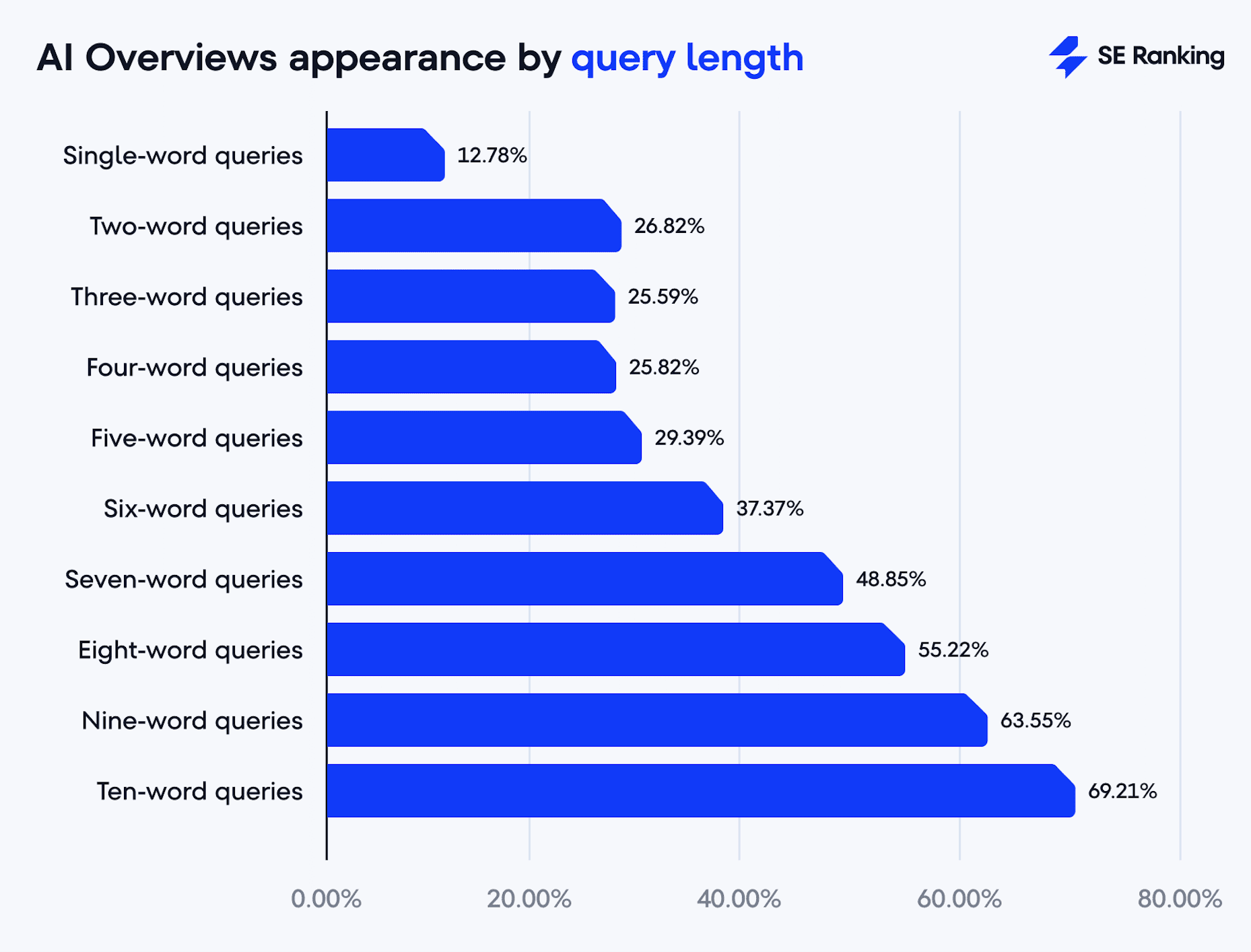
AI Overviews are reserved to answer complex questions, where Google feels it can add value beyond the search results.
According to seoClarity Research, over 96% of AIOs are triggered by informational user intent, while they appear in transactional queries only 1.2% of the time.
Our recent study spanning 5 states across the US confirms that as search volume increases, the frequency of AI Overview appearances drops significantly. For keywords with a search volume between 0 and 10, AI Overviews appear at a rate of 30–31% across the board. This is because highly specific long-tail keywords, which are more likely to trigger AIOs, typically have low search volumes.
Top domains cited in AIOs
The citation picture also shows which sources Google tends to rely on most often inside AI Overviews.
In our February 2026 dataset, YouTube was the most-cited domain by a wide margin, accounting for 10.74% of all citations analyzed. Reddit followed with 4.01%.
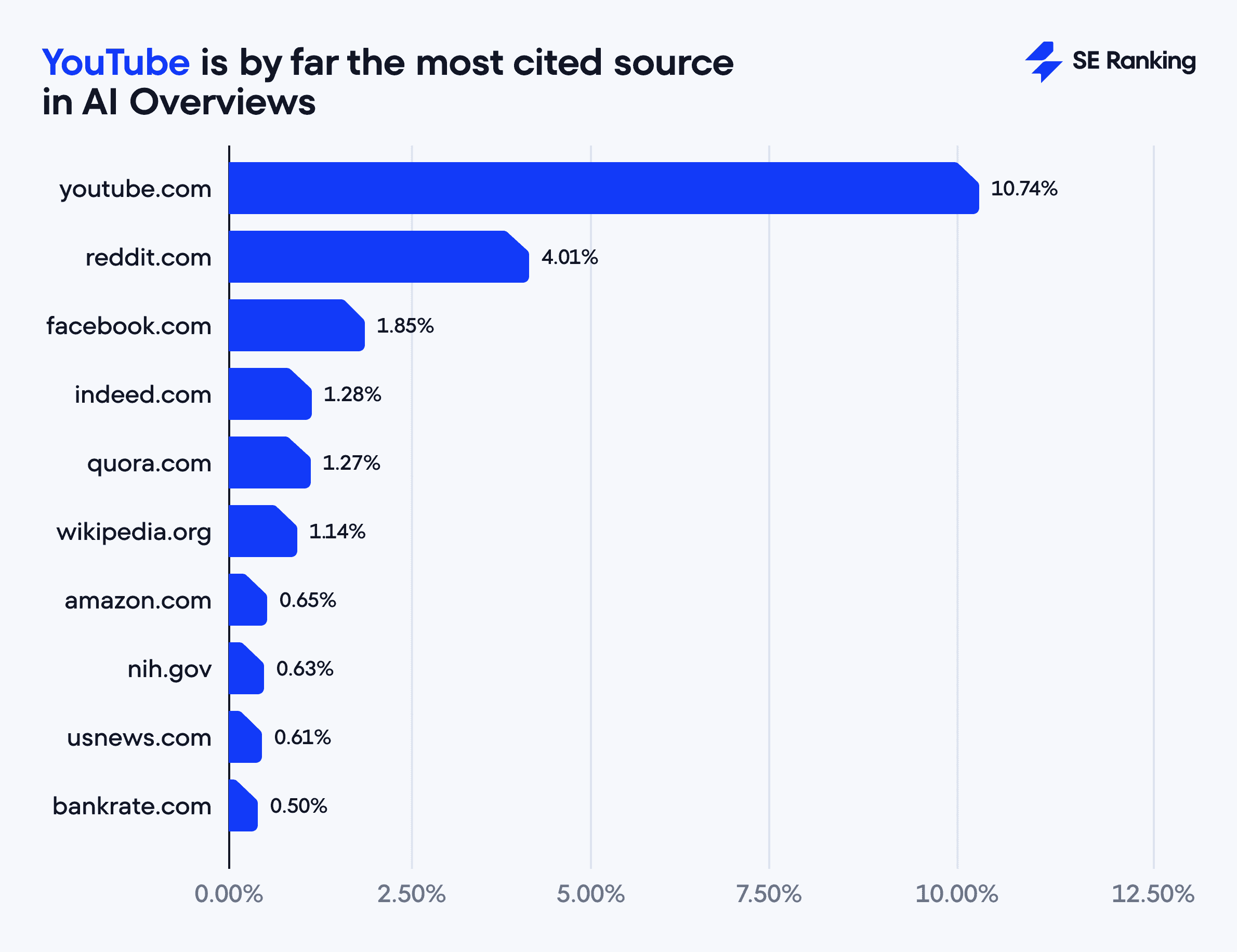
The rest of the top 10 included Facebook, Indeed, Quora, Wikipedia, Amazon, NIH, U.S. News, and Bankrate.
What stands out here is the mix of source types. Google is not only citing traditional informational websites. It is also pulling heavily from video platforms, community-led discussions, social networks, job sites, marketplaces, government/medical resources, and finance publishers.
AI Overviews: a full history of updates
- May 2023 – May 2024
On May 10, 2023, Google announced the launch of Search Generative Experience (SGE) — an experimental AI-powered layer on top of Search — during Google I/O. On May 25, 2023, Google opened access to SGE for users who signed up for the waitlist.
From launch until August 2023, SGE was available exclusively in the US and only to Search Labs users. In August 2023, it expanded to India and Japan. By November 2023, it had been rolled out to more than 120 additional countries and territories — still Search Labs only.
May 2024
Google officially launched AI Overviews in search for all users in the U.S. The company said hundreds of millions of people would get access that week, with a goal of reaching more than 1 billion users by the end of 2024. Google also announced new Search Labs capabilities tied to AI Overviews, including multi-step reasoning, meal and trip planning, and video-based search for troubleshooting.
August 2024
Google expanded AI Overviews beyond the U.S. and introduced new Search Labs features around them. One of the biggest additions was the ability to save specific AI Overviews for later, alongside a simplified display that showed pages directly within the overview. Google also said the experiment would support six new countries: the U.K., India, Japan, Indonesia, Mexico, and Brazil.
October 2024
Google rolled out AI Overviews to more than 100 countries and territories, saying the product would now reach more than 1 billion monthly users. At the same time, it expanded language support and highlighted a series of link-display changes designed to send people to the web more easily, including a right-hand source panel on desktop, a similar source access pattern on mobile, and inline links directly in the AI Overview text.
November 2024
Google began bringing ads into AI Overviews for mobile users in the U.S. According to Google Ads documentation, this let Search and Shopping ads appear directly inside AI-generated responses when relevant to the user’s query.
January 2025
Google expanded AI Overviews to more kinds of visual search results for places, trending images, unique objects and more. Google later referenced this January expansion when describing subsequent visual-search improvements.
March 2025
Google upgraded AI Overviews with Gemini 2.0 and expanded access for teens, while also removing the sign-in requirement for many users. Google specifically said the update would help with harder questions, including coding, advanced math, and multimodal queries.
Also in March, Google said it was improving health-related AI Overviews, including broader coverage for thousands more health topics.
Yet, as our 2026 research shows, health-related AI Overviews still turn to YouTube 2–3x more than trusted medical sites.
April 2025
Google made it official that some terms inside AI Overviews could link to additional Google Search results, not just external websites. Google described this as a way to help people explore topics more easily and discover more relevant content.
May 2025
At Google I/O, the company announced a major expansion: AI Overviews became available in more than 200 countries and territories and in more than 40 languages, including newly added support for languages such as Arabic, Chinese, Malay, and Urdu. Google also said AI Overviews were now reaching 1.5 billion users per month.
Google also began bringing a custom version of Gemini 2.5 into both AI Mode and AI Overviews in the U.S., signaling a broader quality upgrade across Search’s AI responses.
At the same time, Google expanded ads in AI Overviews to desktop in the U.S. and said it would later extend them to additional English-language markets on mobile and desktop.
July 2025
Google added the new “Dive deeper with AI Mode” button inside AI Overviews specifically for visual searches within Circle to Search.
By July, Google also said AI Overviews had grown to more than 2 billion monthly users across more than 200 countries and territories and 40 languages.
December 2025
Google has integrated “Dive deeper in AI Mode” (or simply “AI Mode”) as a central feature of its AI Overviews, moving away from experimental Labs-only access to a standard, power-user feature available on mobile.
January 2026
Google upgraded AI Overviews to Gemini 3 and said this new model would become the default globally. It also introduced a new flow where users could tap “Show more” in an AI Overview, ask a follow-up question, and continue directly in AI Mode.
Google later said it had shipped more than 250 product launches across AI Mode and AI Overviews in the previous quarter, which suggests the pace of AI Overview iteration accelerated sharply at the end of 2025.
February 2026
Google officially rolled out hover pop-up link cards in AI Overviews and AI Mode.
On desktop, groups of source links now automatically appear in a pop-up when users hover over them, letting them jump directly to a website without extra clicks.
Alongside this, Google made link icons more descriptive and prominent across both desktop and mobile. Google stated that internal testing showed the new UI is “more engaging, making it easier to get to great content across the web.”
Wrapping up
As you may have noticed, AI Overviews are constantly evolving. Google adds new elements, changes the design, removes unnecessary features, expands locations, and more. To keep optimizing your content effectively, stay on top of these updates.
To do so, simply revisit this article periodically. It will always have the latest updates.