How to find and choose the right prompts to track for AI search visibility
There’s a question that comes up every time someone starts thinking seriously about prompt tracking: If everyone interacts with ChatGPT differently, how do I know which prompts to actually track?
Fair question. And one that doesn’t have the kind of clean answer SEOs are used to.
With keywords, you have volume data, ranking positions, and competitor visibility. Prompt tracking gives you none of that. No reliable query volume, no positions, and technically infinite prompt variations. On top of that, the same question can get different brand recommendations based on the user’s session context, location, or history.
Most teams respond to this by defaulting to “best [category] tool” or “top [product type] software” prompts and calling it a strategy. But that covers one thin slice of how buyers interact with AI.
In this guide, I’ll walk you through a practical framework for finding, filtering, and prioritizing the prompts worth tracking.
-
Prompt tracking has no volume data, no ranking positions, and no static results. That’s why choosing the right prompts matters more than tracking more of them.
-
There are five core prompt types to cover: informational, comparative, instructional, brand-specific, and transactional. Most brands over-index on comparative prompts and ignore the rest.
-
Map prompts to the buyer journey across three stages: awareness, consideration, and purchase. Track brand comparison prompts separately, as they skew category metrics if mixed in.
-
Use different sourcing methods to build your list: converting existing SEO keywords, mining PAA and AI Overviews, analyzing Reddit and community forums, and reverse-engineering competitor websites give you the most grounded starting points.
-
Filter your prompt list against competitive relevance, influenceability, business intent alignment, and scope. A shorter, well-filtered list outperforms a long, unfocused one.
-
Start with 20-40 prompts, run across 2-3 AI models, and track for at least 30 days before drawing conclusions. Prompt tracking costs scale with volume, so keep it intentional.
Why prompt tracking is not the same as keyword tracking
I can understand why treating prompts like keywords can sound like a valid idea. Both are the queries your audience uses to find information. But the mechanics behind them are quite different, and that’s why this approach doesn’t work in practice.
Here’s what actually makes them different:
- There’s no volume, no positions, no clear signal. In traditional search, the strategy is relatively legible. Volume tells you how much demand exists, rankings tell you where you stand, competitor data tells you who you’re up against. Prompt tracking strips all of that away.
- LLMs break down one prompt into multiple sub-queries. When someone types a prompt into an AI chatbot, the model runs query fan-out. One prompt is divided into many retrieval tasks, which means prompt selection requires more strategic thinking than keyword selection.
- Responses are personalized. Two users asking the same prompt can get different brand recommendations based on session context, location, and conversation history. You’re not tracking a static SERP, but sampling from a system that produces variable outputs.
- Citations shift over time. Run the same prompt twice, and you may get different sources cited, different brands mentioned, or a different framing altogether. Our research on local queries in AI Mode showed that only 35% of domains repeat in AI answers, and two-thirds vanish between runs. This is sometimes called citation drift, and it means your tracking data is directional, not definitive.
None of this makes prompt tracking less valuable. It makes choosing the right prompts more consequential. Tracking more prompts doesn’t compensate for tracking the wrong ones. So, the quality over quantity approach wins here.
Step 1: Understand the prompt categories you need to cover
People interact with AI differently depending on where they are in the decision process, and the prompts they use reflect that. Before you start building your tracking list, you need to know which intent types you’re trying to cover, or you’ll end up with a list that’s heavy in one area and blind in others.
There are five core prompt types that map to how people interact with LLMs:
- Informational prompts like “What causes high churn in SaaS?” or “Is CRM software worth it for a small team?”. The user is learning about a problem, not looking for a solution yet. These prompts matter because appearing here means shaping how your audience understands a problem before they start evaluating vendors.
- Comparative prompts like “Best accounting software for freelancers,” “Shopify vs WooCommerce for a small store,” “top project management tools for remote teams.” The user is weighing options. This is where most brands concentrate their tracking, and where competition for AI visibility is already heaviest.
- Instructional prompts like “How to set up email automation for an ecommerce store,” “How to reduce customer acquisition costs for a SaaS product.” The user wants a process, not a recommendation. These are often overlooked, but they’re high-intent and citation-rich.
- Brand-specific prompts like “Is [Brand] worth it?”, “What are people saying about [Brand]?”. The user is asking directly about you or a competitor. Track these separately because when your brand name is in the prompt, the visibility is nearly guaranteed, and this can skew your broader metrics if mixed with category prompts.
- Transactional prompts like “Best running shoes under $100 near me,” “Where to buy organic coffee beans in Austin.” The user knows what they want and is deciding where to act. Such prompts are more relevant for ecommerce and local services; most B2B SaaS teams can deprioritize this category.
There are also generative prompts where users ask AI to create or execute something, for example, “Write me a content brief for a blog post about X” or “Build me a 3-month SEO plan for a new site.” This is a relatively new intent category, but it’s growing fast and worth keeping an eye on.
In practice, most brands over-rely on comparative prompts and ignore the rest. Instead, I suggest a balanced approach to tracking that covers all five categories, ideally with a few prompts per type before you start adding volume.
Step 2: Map prompts to the buyer journey
The same category of prompt can mean different things depending on the buyer’s stage, and tracking without this context means you’re measuring visibility without knowing what it influences.
There are three stages to map against:
- Awareness: The user is exploring a problem. They have doubts, fears, and open questions about a category. Here are some examples of prompts that illustrate this stage:
“Are electric cars expensive to maintain?”
“Is CRM software worth it for a 5-person team?”
“What are the downsides of hiring a marketing agency?”
“Why is my ecommerce store getting traffic but no sales?”
Appearing at this stage means pre-positioning your brand before the user has formed a shortlist.
To find awareness prompts, talk to your sales team about common objections, check Reddit for category-level doubts, or ask ChatGPT directly about the concerns people have about your target category.
- Consideration: The user is building a shortlist. This is where most tracking lists live, and for good reason, because this is where AI recommendations directly influence vendor selection.
Track both broad prompts, for example:
“Best project management tools for remote teams”
“Best project management tool for a remote marketing team of 10”
And persona-specific variations:
“Accounting software for freelancers with international clients”
“Email marketing platform for a Shopify store under 10k subscribers”
The second type, what’s sometimes called persona injection, means overlaying user context (team size, industry, budget, use case) onto a base prompt. This is how AI personalizes its responses, and your tracking set should reflect that.
- Purchase: The user knows what they want and is deciding where to act. This stage is most relevant for ecommerce and local services. Here are some prompt examples:
“Where can I buy [product] near me?”
“Best price for [product] in [city]”
“Plumber available today in [neighborhood]”
If you’re in B2B SaaS, you can skip this stage in most cases and focus more on awareness and consideration stages instead.
One thing that applies across all three stages: AI responses vary by location. The same prompt can return different brand recommendations in different markets. If you operate across multiple regions, replicate your core prompts across geos rather than assuming one market’s data represents the rest. For local businesses, add city or neighborhood modifiers to your base prompts.
Add a brand evaluation layer
Brand comparison prompts like “Brand A vs Brand B,” “Is [Brand] worth it?,” “What do people say about [Brand]?” need their own tracking group, separate from your category prompts. The reason is that when your brand name is in the prompt, AI visibility is nearly guaranteed, which inflates your numbers if these get mixed in with category-level tracking.
Tracking brand prompts separately lets you monitor things like:
- How AI positions you against specific competitors
- Whether it surfaces negative sentiment or outdated information about your brand
- Which new competitors does the AI consistently pair you with
- Whether misspellings of your brand name still trigger accurate responses
Step 3: 7 practical methods to source prompt ideas
1. Convert your SEO keywords into prompts
Start with what you already have. Export your top 50-100 non-branded keywords from Google Search Console or SE Ranking’s Keyword Rank Tracker and convert them into natural-language questions.
Edward Strum, SEO & Marketer and host of the Edward Show, supports the idea of starting from your existing keyword list:

Many search queries translate almost directly. You can then add persona modifiers like team size, industry, budget, and use case to increase specificity. This is the fastest starting point if you already have a mature keyword strategy.
Prompt
What’s the best CRM for a small business?
Prompt
How do I set up email automation for my ecommerce store?
Prompt
What project management tool works best for remote teams?
Prompt
What accounting software do most freelancers use?
What’s the best CRM for a small business?
How do I set up email automation for my ecommerce store?
What project management tool works best for remote teams?
What accounting software do most freelancers use?
2. Mine People Also Ask and AI Overviews
Type your high-impact keywords into Google and extract the People Also Ask questions. These are already in question format and closely mirror how people prompt LLMs.
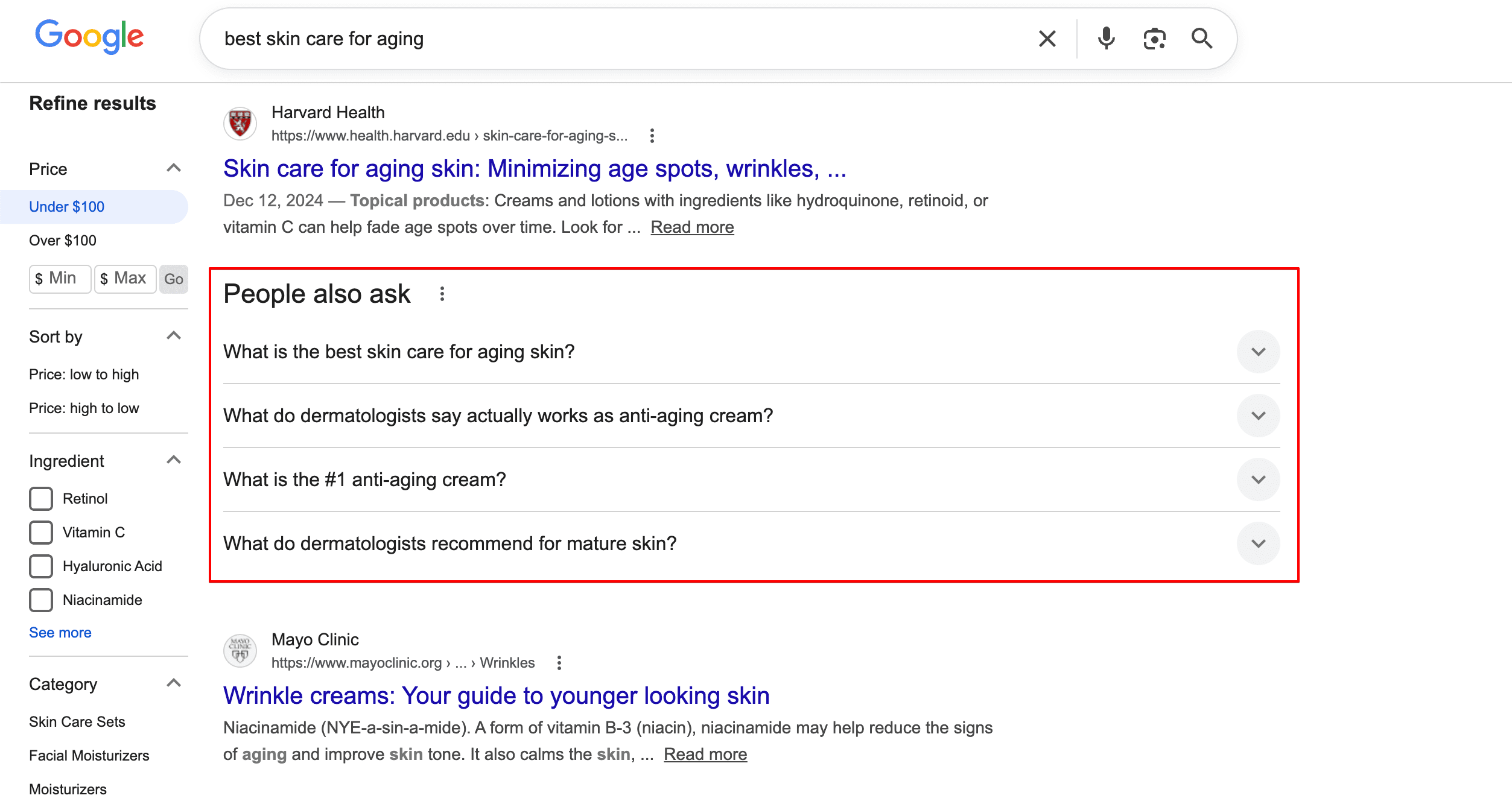
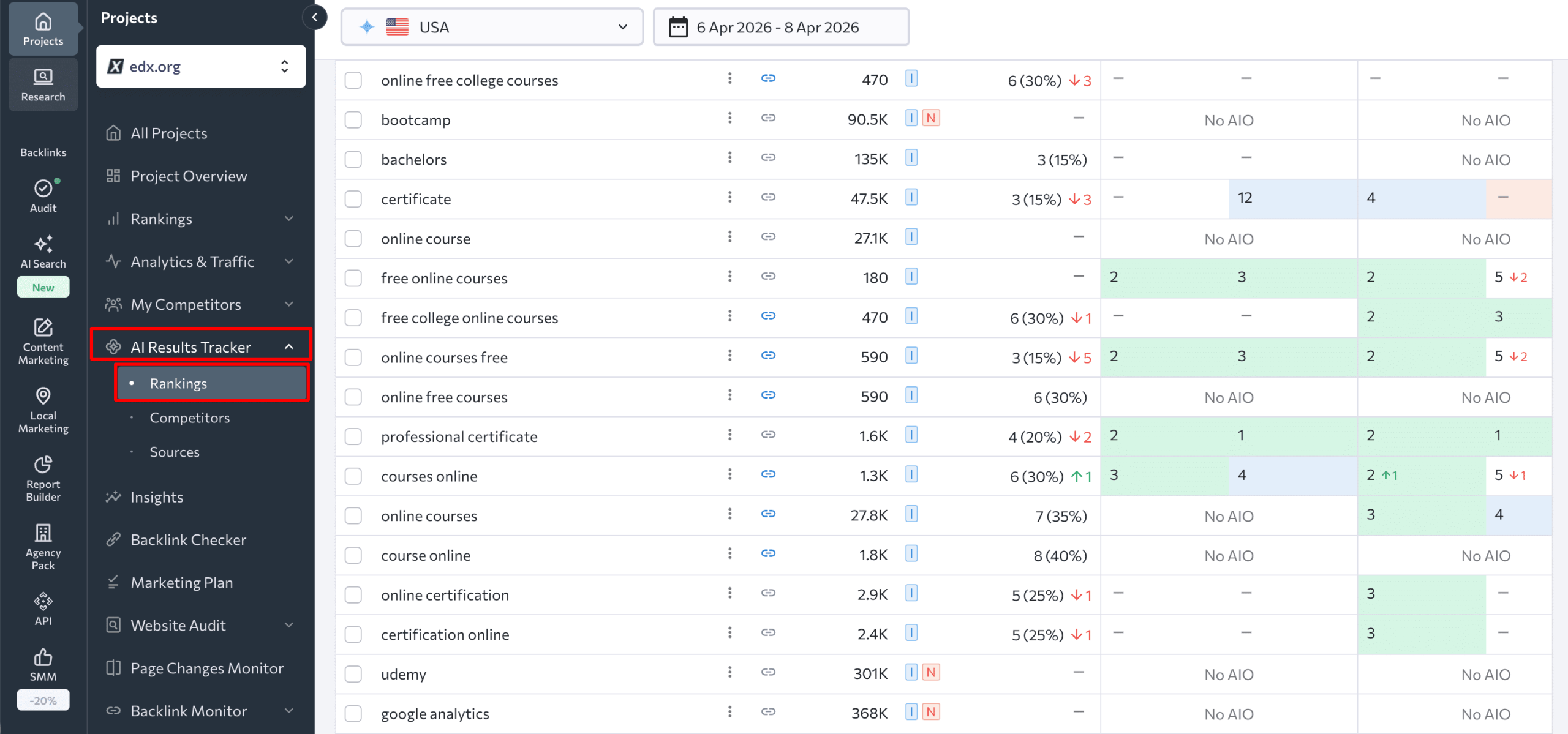
Let’s take one of these questions, “What do dermatologists recommend for mature skin?”, and run it in ChatGPT as-is:
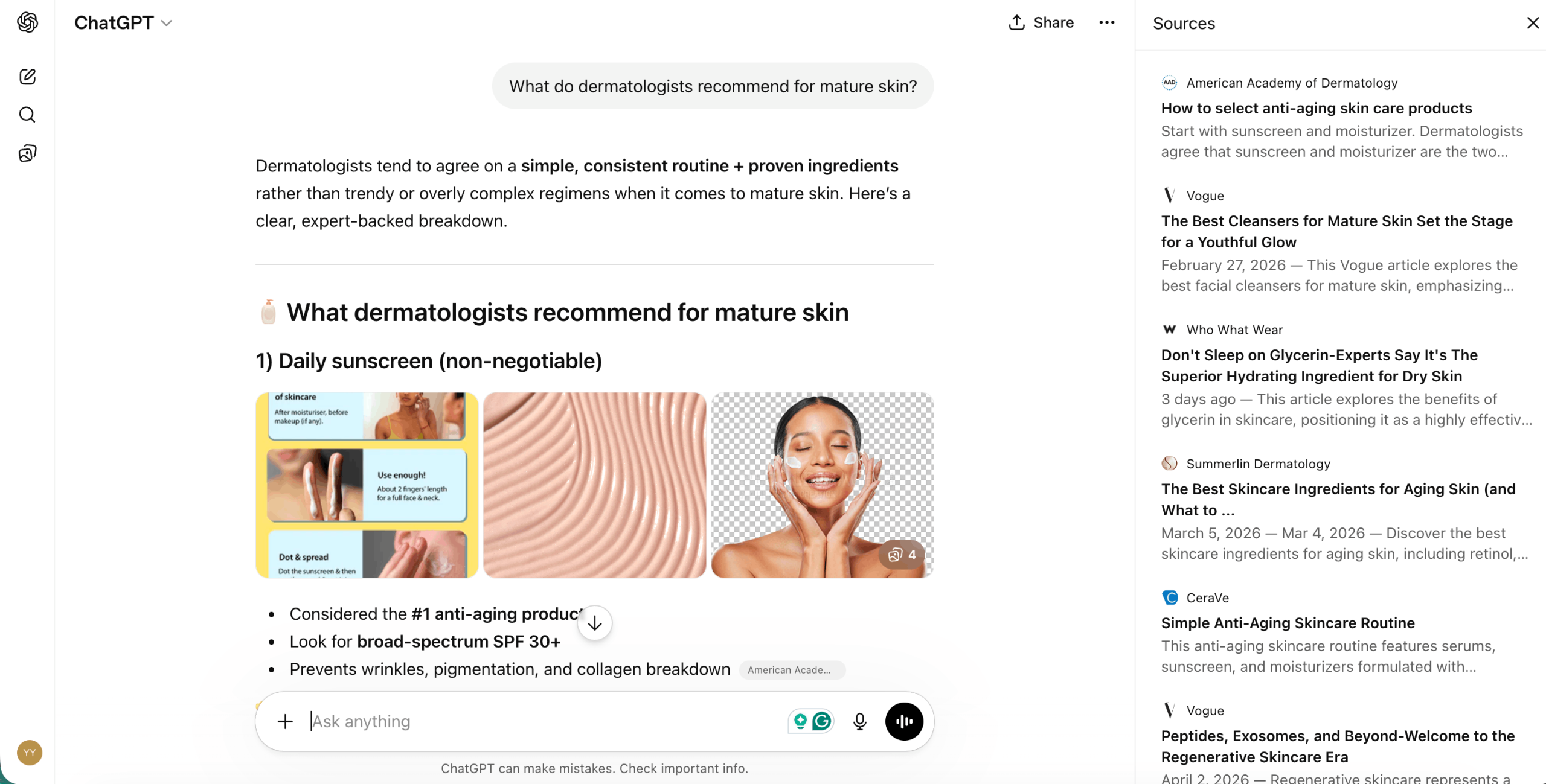
ChatGPT included recommendations and pulled in sources from the American Academy of Dermatology, Vogue, Who What Wear, and CeraVe. This is a mix of media and brand content. If you’re a skincare brand targeting mature skin, you might want to add this prompt to your tracking list to see if your content appears and how consistently.
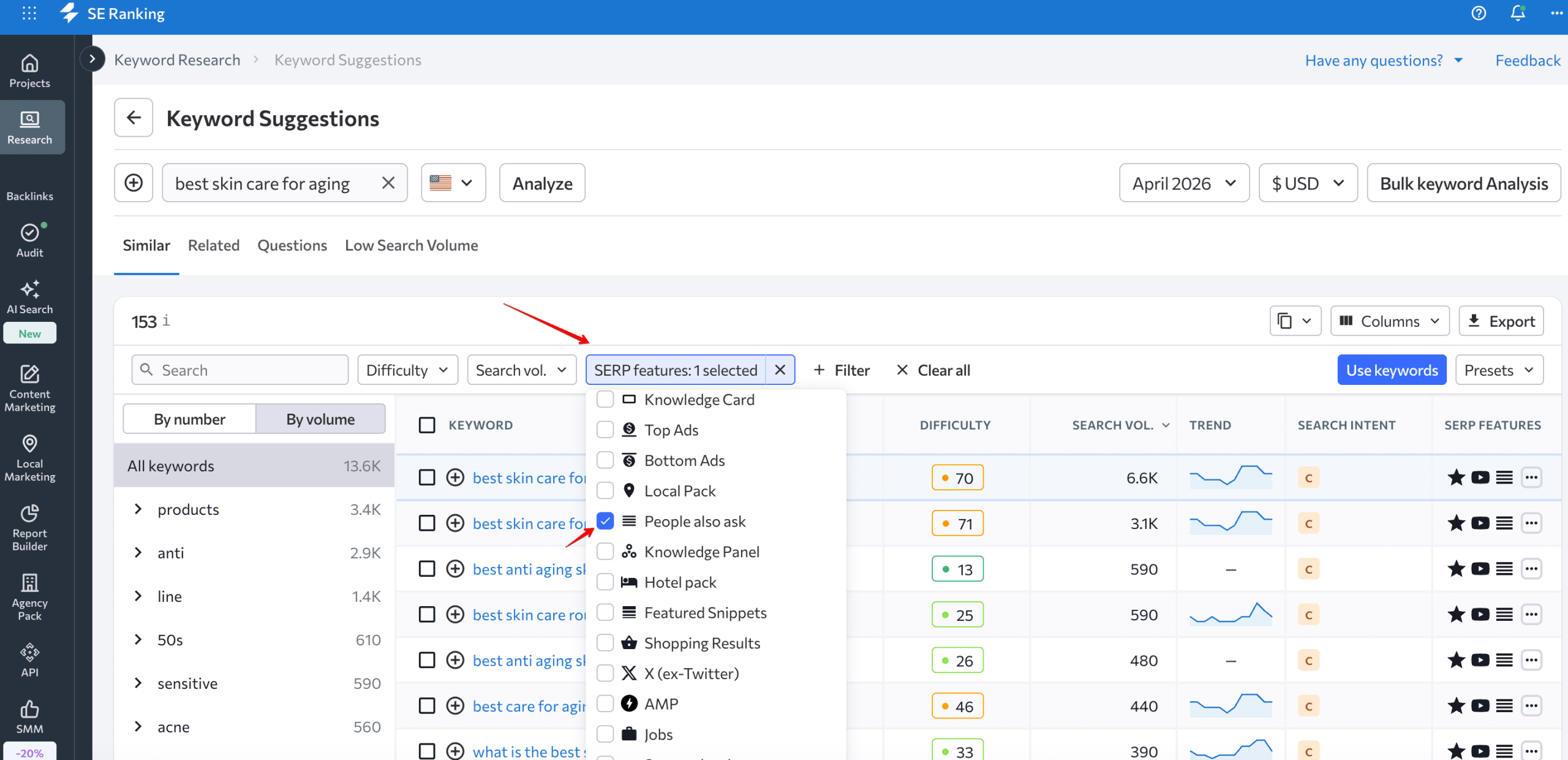
You can also use SE Ranking’s free People Also Ask tool or Keyword Research tool to pull these at scale. Add your query to the Keyword Research tool, go to the Keyword Suggestions tab, and set a filter to see queries triggering the PAA SEPR feature.
Also, check which of your keywords trigger AI Overviews. This signals that Google already considers the query AI-answer-worthy, making it a strong candidate for prompt tracking. You can use SE Ranking’s AI Overviews Tracker to see such queries and sources that get cited.
3. Ask the LLMs themselves
I like this one because it’s pretty straightforward. Go directly to the source. Prompt ChatGPT, Gemini, or Perplexity with something like:
- “What questions do people ask when researching [your topic]?”
- “Suggest 10 prompts someone might use when evaluating [product category]”
- “What concerns do people have about [category] before making a decision?”
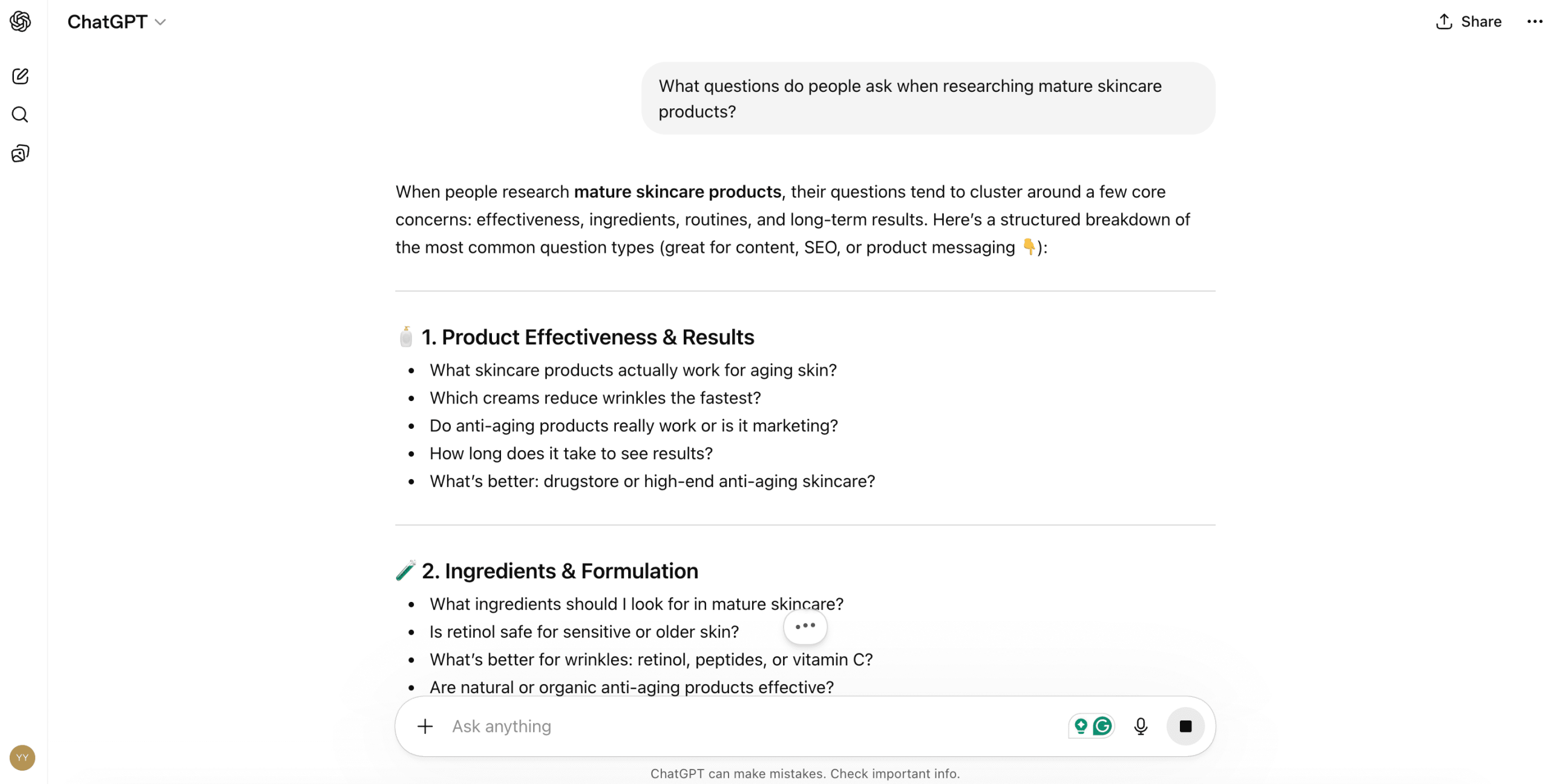
You’ll get a list of naturally phrased, conversational prompts that reflect how people talk to AI.
In Perplexity, you can also see the follow-up suggestions that it surfaces after each response. These are algorithmically generated based on what users typically ask next, which makes them surprisingly accurate as prompt ideas.
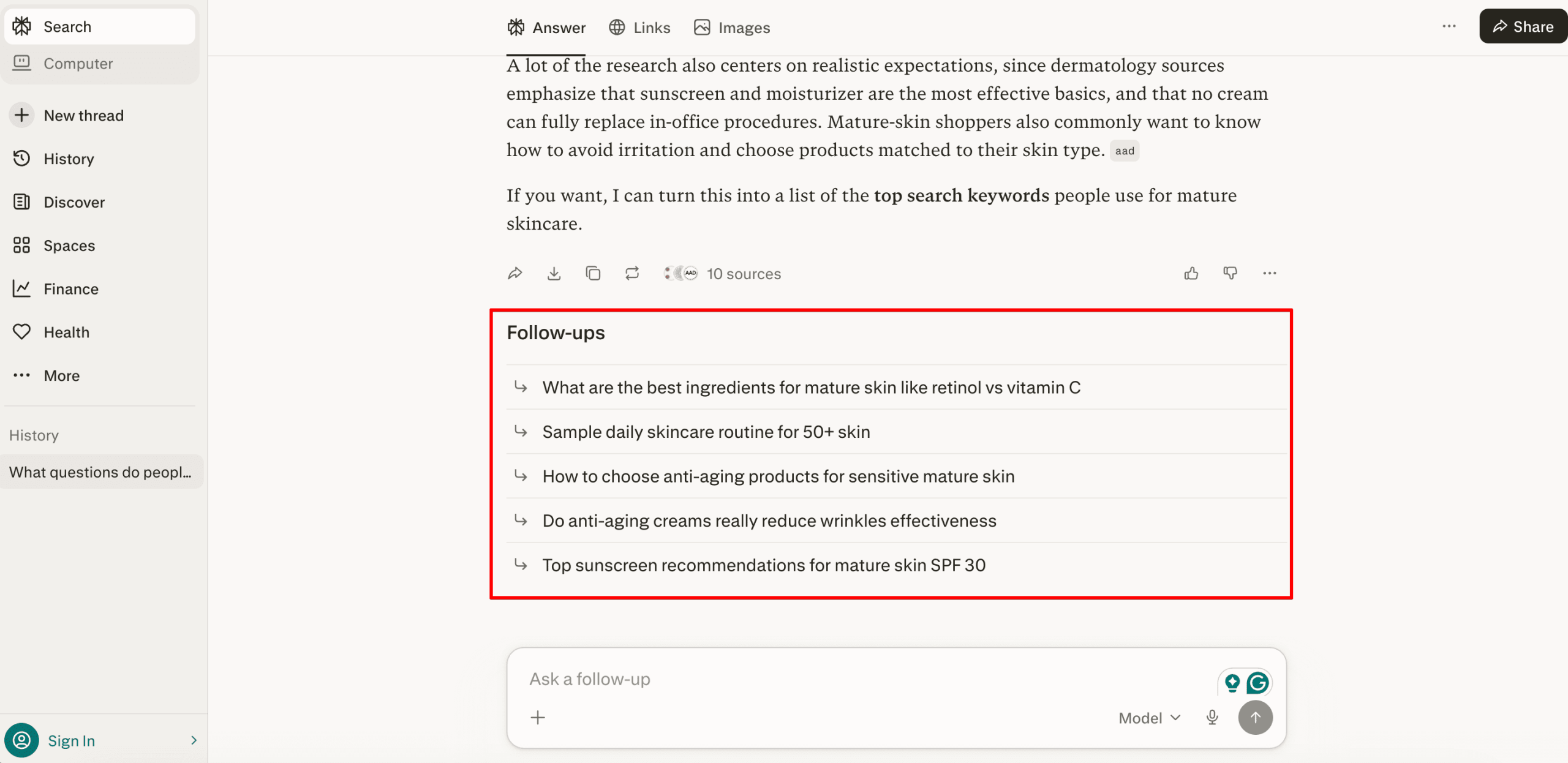
Treat everything from this method as a starting point, not a final list. LLMs generate plausible-sounding questions, but they don’t know your specific audience. Cross-reference against what you hear from sales, support tickets, or community forums before adding anything to your tracking set.
4. Analyze Reddit, Quora, and community forums
Reddit and Quora questions naturally mirror prompt-style language. People describe real problems in their own words like:
“I’m struggling with…”
“Does anyone know how to…”
“Can anyone recommend…”
Look for recurring themes, common complaints, and comparison requests. These are high-intent and real-world prompts. Here’s how that translates in practice:
Prompt
Why do small teams stop using CRM software after a month of trial?
Prompt
How do I improve email deliverability for my Shopify store?
Prompt
What’s the best client reporting tool for agency owners and freelancers?
Why do small teams stop using CRM software after a month of trial?
How do I improve email deliverability for my Shopify store?
What’s the best client reporting tool for agency owners and freelancers?
There’s also a structural reason why this source is worth prioritizing. Reddit content is heavily weighted in LLM training data. Our research studies show that it’s one of the most-cited domains in AI engines. So Reddit-style questions are disproportionately represented in AI responses. The way people phrase problems on Reddit is closer to how LLMs expect to be prompted.
5. Use paid search data as a signal
If someone is actively bidding on a keyword, this means the underlying topic drives conversions, or at least that a competitor believes it does.
Start with the keywords your competitors are paying for, especially three-word-plus terms with clear commercial intent. These make strong prompt seeds because they’re already validated by someone’s ad budget. A competitor bidding on “CRM for construction companies” is telling you that query converts, which makes “What’s the best CRM for construction companies?” a reasonable prompt to track.
You can pull competitor paid keywords from SE Ranking’s Competitive Research tool. Enter the competitive domain to run analysis, go to the Google Search tab, and choose Paid traffic. Proceed to the Keywords tab and use the Word count filter to find queries with 3+ words.
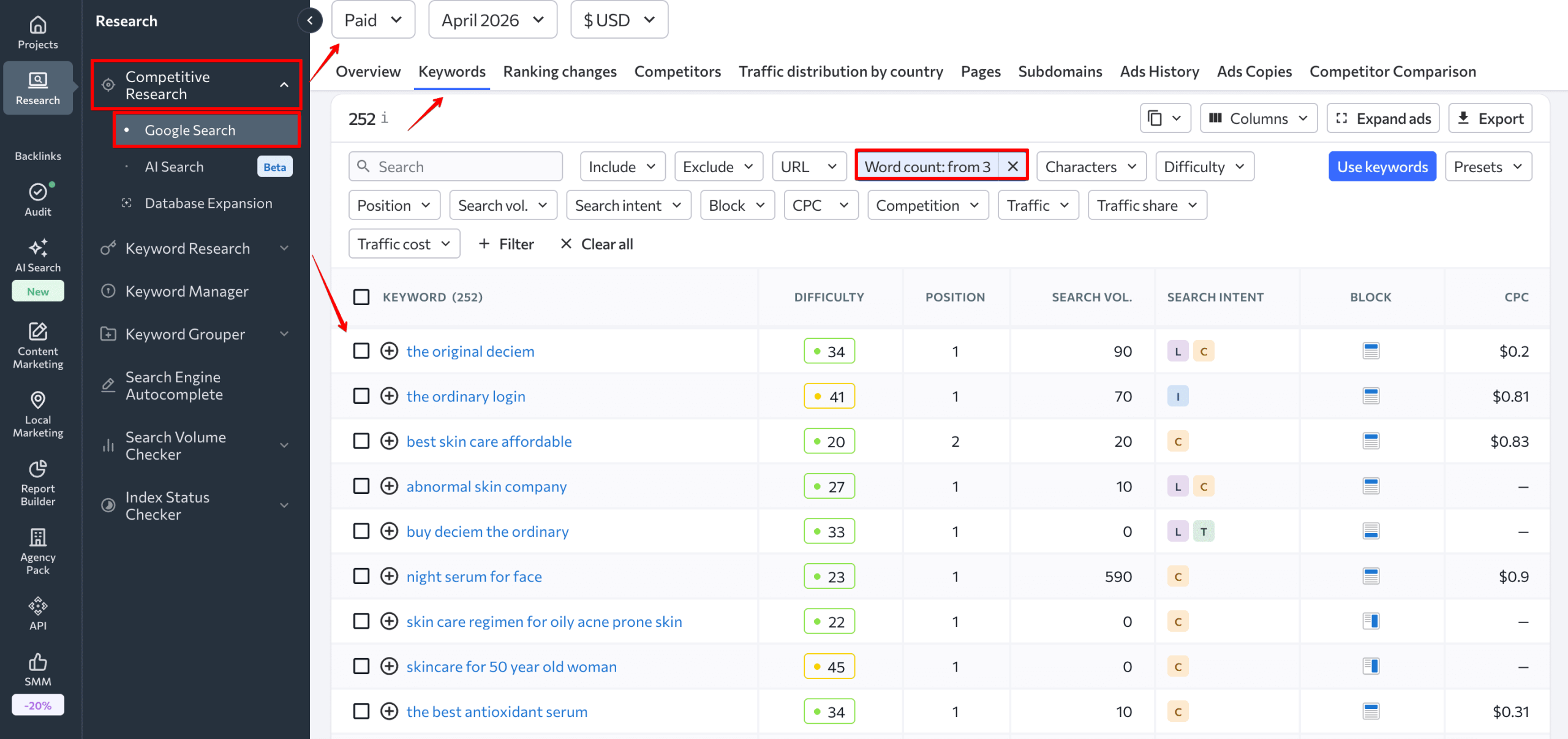
Again, use it as a directional signal and cross-reference with the other methods before committing to tracking.
6. Reverse-engineer the company website
This method is particularly useful for agencies building prompt tracking sets for clients. It’s faster than starting from scratch and more grounded than guessing.
Spend 15 minutes on the website before you touch any research tool.
Look for two things:
- How do they segment customers?
Check the navigation, pricing page, and homepage hero screen. Do they divide users by team size, industry, use case, or customer type?
Take Hubstaff as an example. Their Solutions menu segments users in three ways:
- By industry (Agencies, Software development, Consulting)
- By workforce type (Remote, Field, Enterprise)
- By outsourcing type (BPO, Virtual assistant services, Call centers)
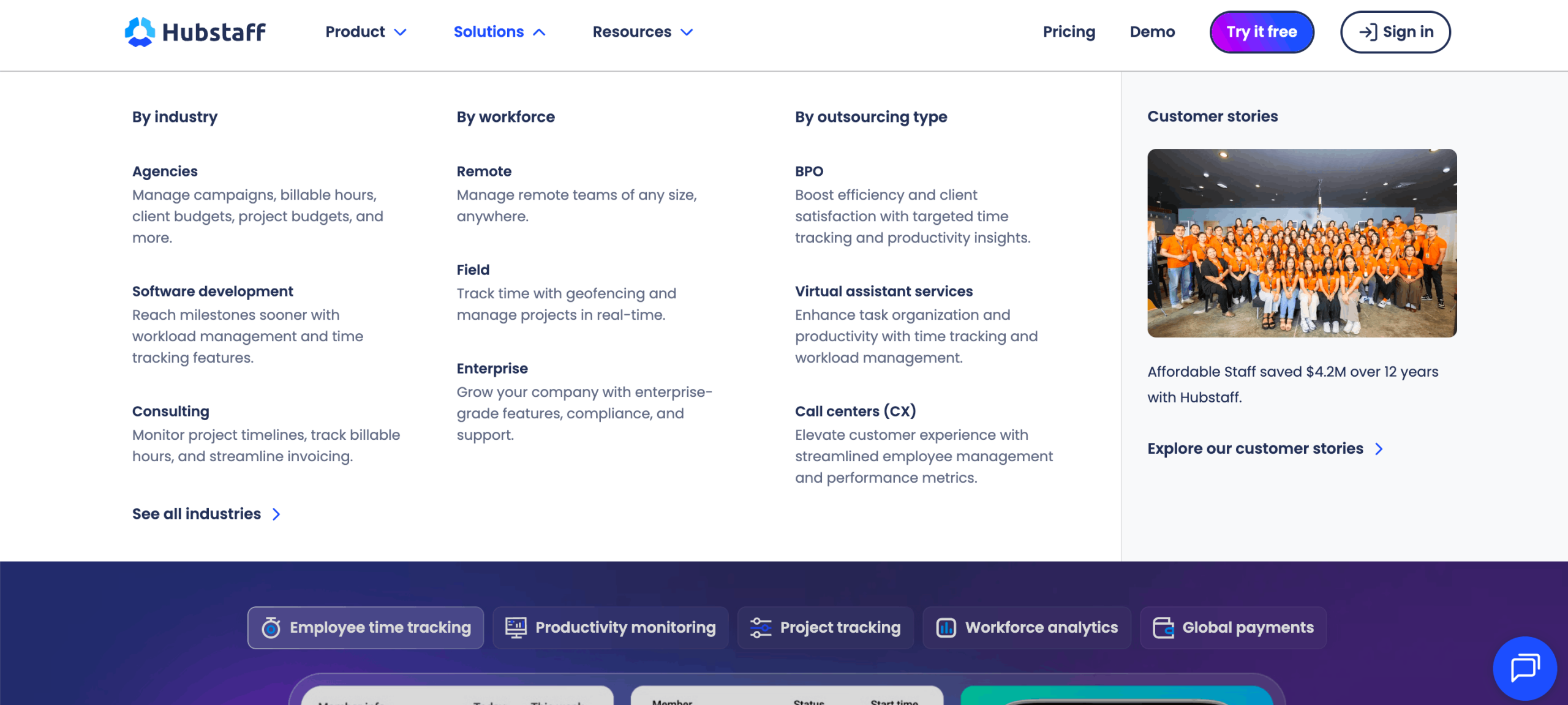
Each segment is a persona modifier you can overlay onto base prompts, for example:
- “Best time tracking tool for remote software development teams”
- “How do consulting agencies track billable hours across projects?”
- “Time tracking software for BPO companies with large field teams”
- What problems does the product solve?
Feature pages, use case pages, and case studies all contain the language customers actually use to describe their problems.
Open the Product menu, and you’ll find the specific jobs users actually hire the tool for. Here’s another example from Hubstaff:
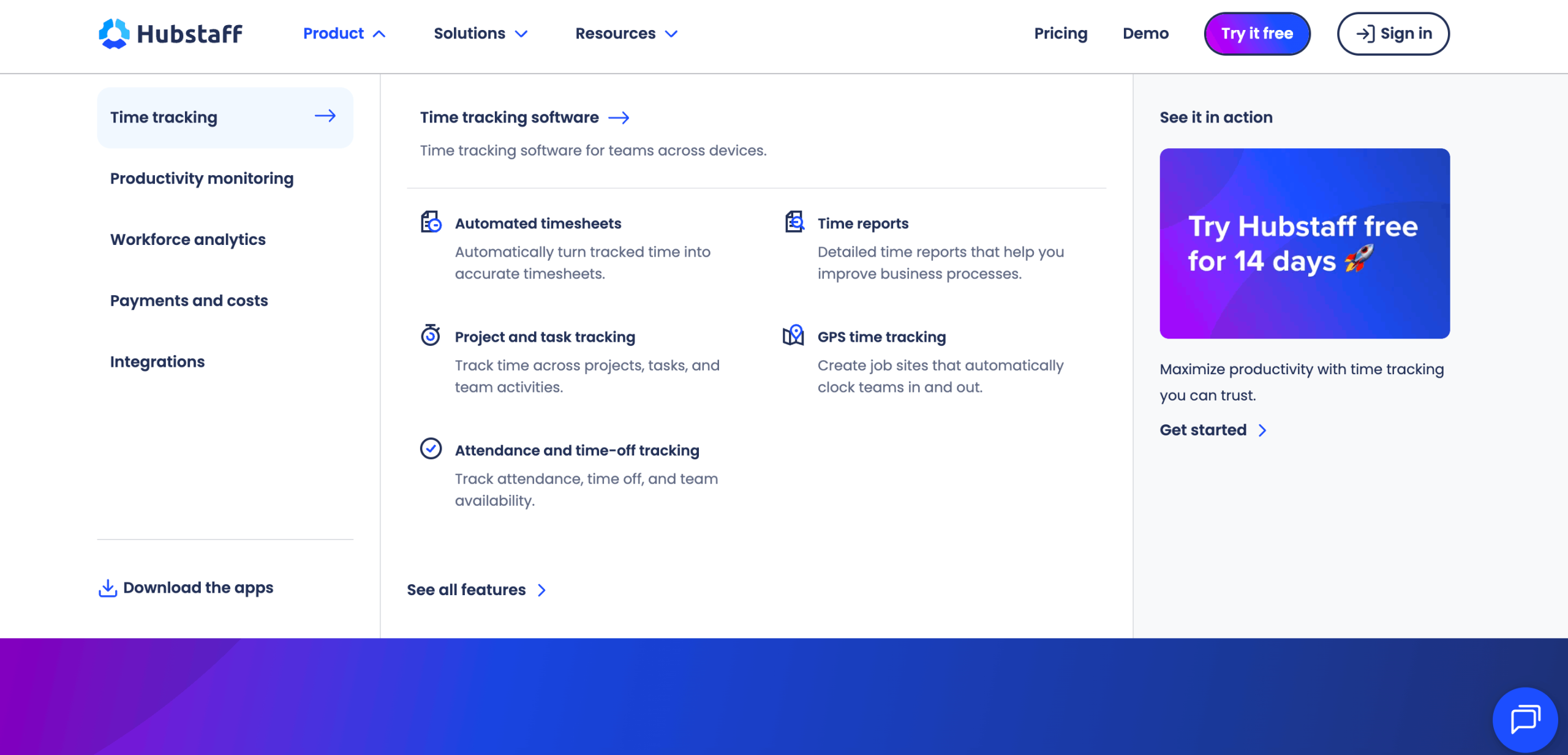
Each sub-feature (automated timesheets, time reports, project and task tracking, GPS time tracking, attendance and time-off tracking) is a real user problem, and each maps to a prompt:
- “How do agencies automate employee timesheets?”
- “What is the best tool for tracking time across multiple projects and clients?”
- “How do field service companies track employee attendance remotely?”
The more granular the feature, the more specific and trackable the prompt can be. A broad category like “time tracking” is too competitive to tell you much. “GPS time tracking for field service teams” is the kind of narrowed and intent-rich prompt you can start from.
7. Use tool-suggested prompts
If you’re working in an unfamiliar vertical, you don’t have to build your prompt list from scratch.
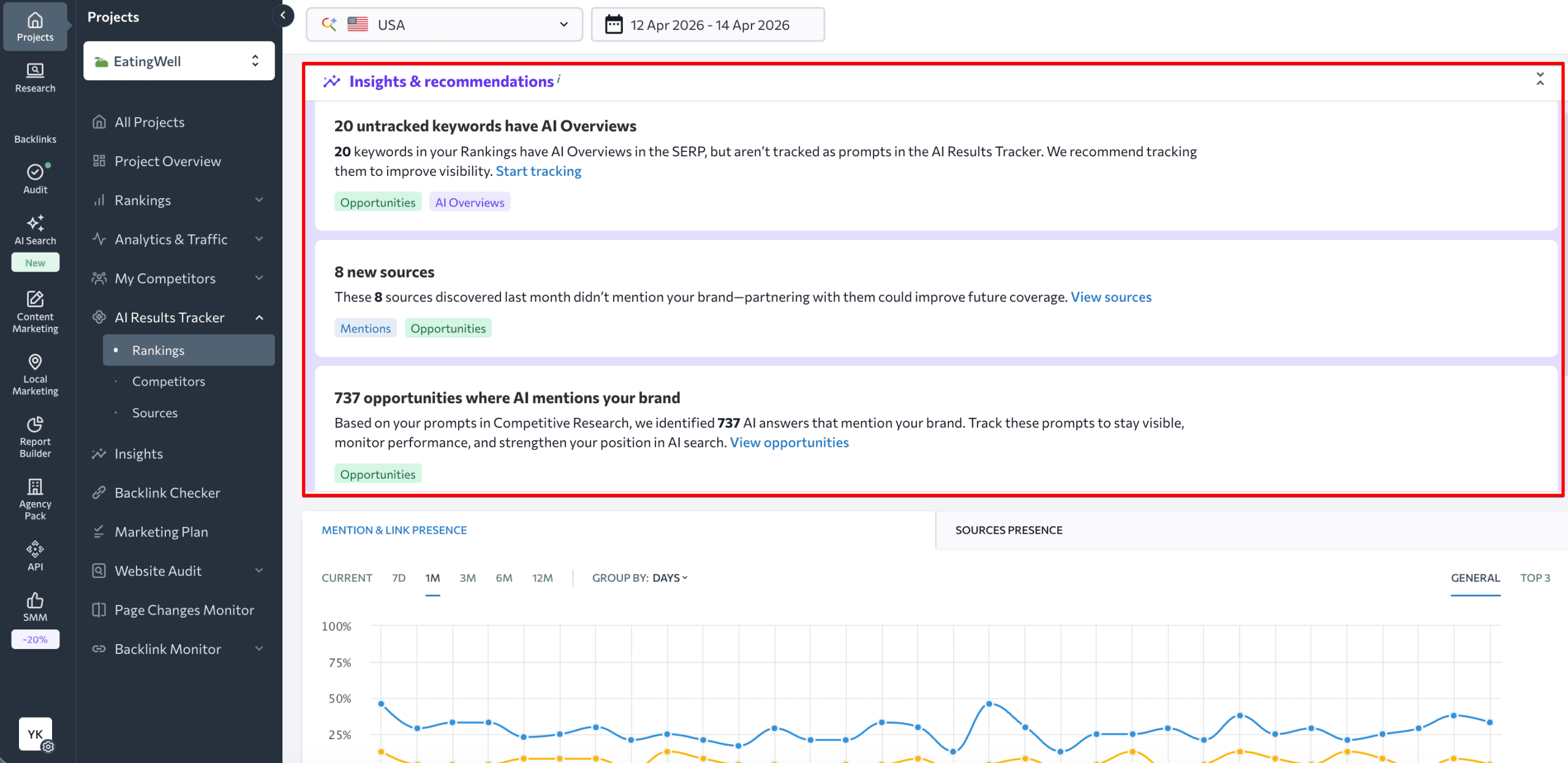
SE Ranking’s AI Results Tracker has an Insights & Recommendations section that surfaces prompt opportunities worth acting on.
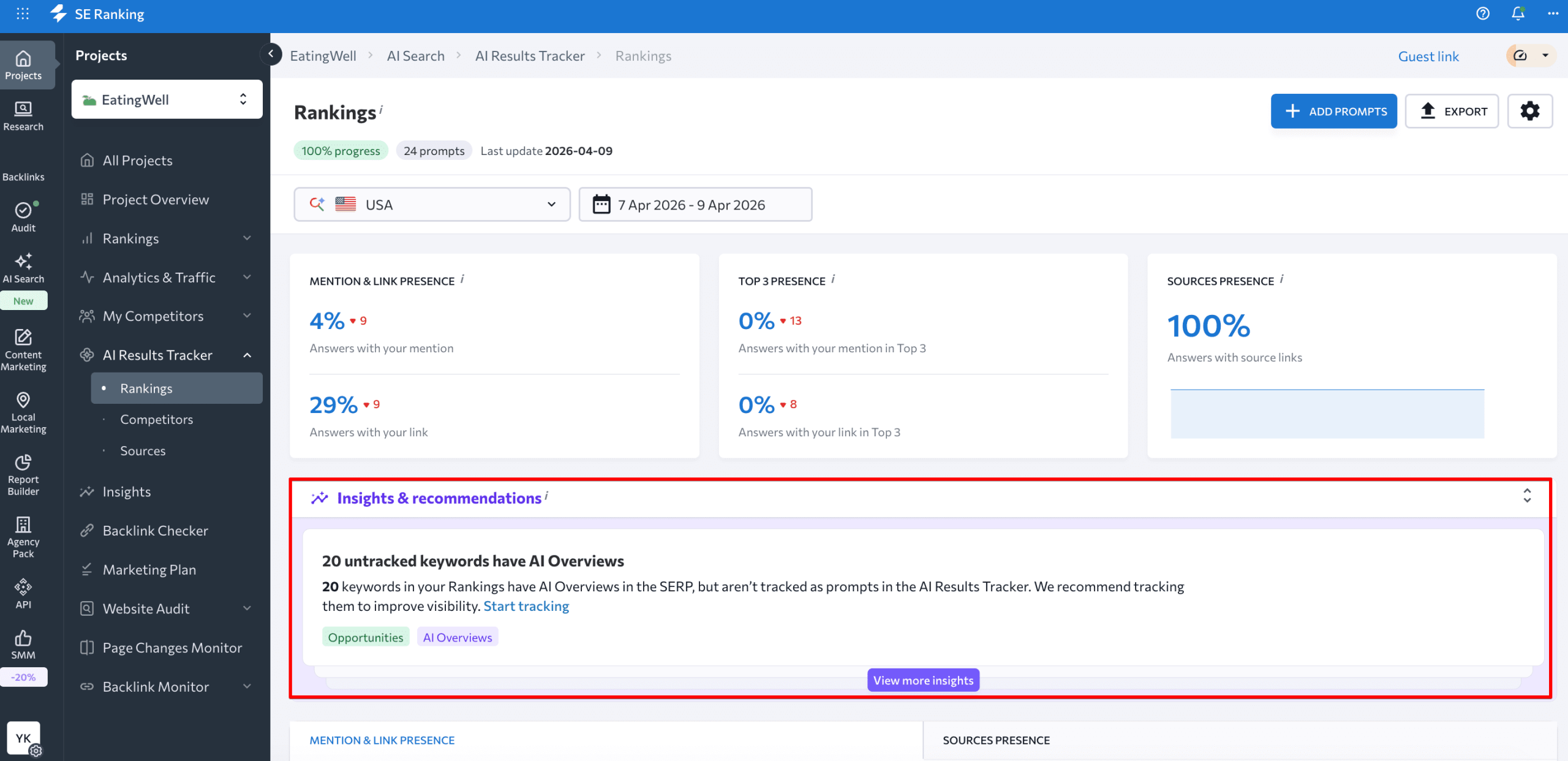
Here, you can find prompts where your brand already appears in AI answers, but you don’t track them yet. Click through, and the tool shows you the full list of untracked prompts where your brand has visibility. For EatingWell, that was 737 prompts.
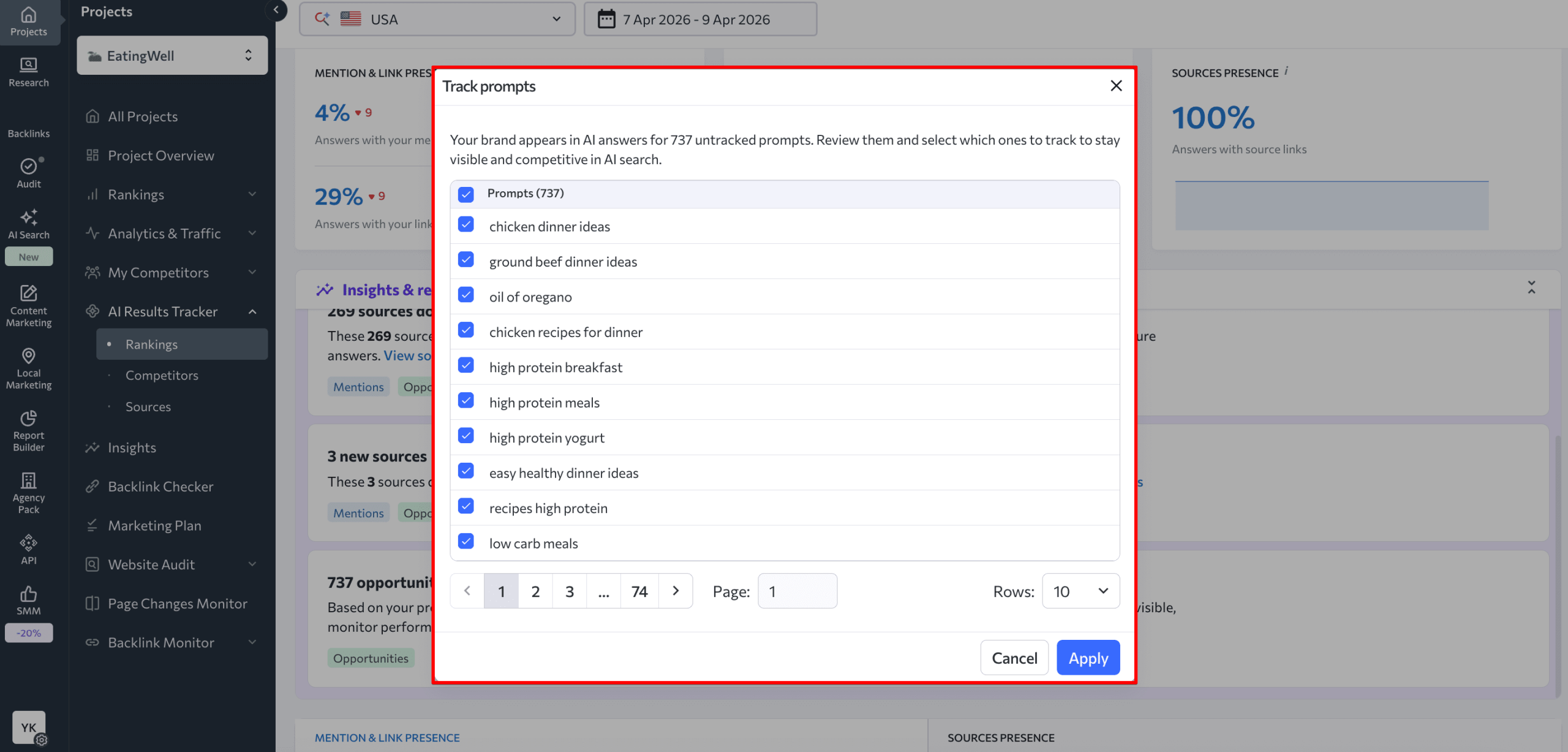
You can review the list and select which ones are worth adding to your tracking set. This is particularly useful early on, because you’re not guessing what prompts might be relevant, but see where you already exist in AI answers and decide whether those topics align with your business goals.
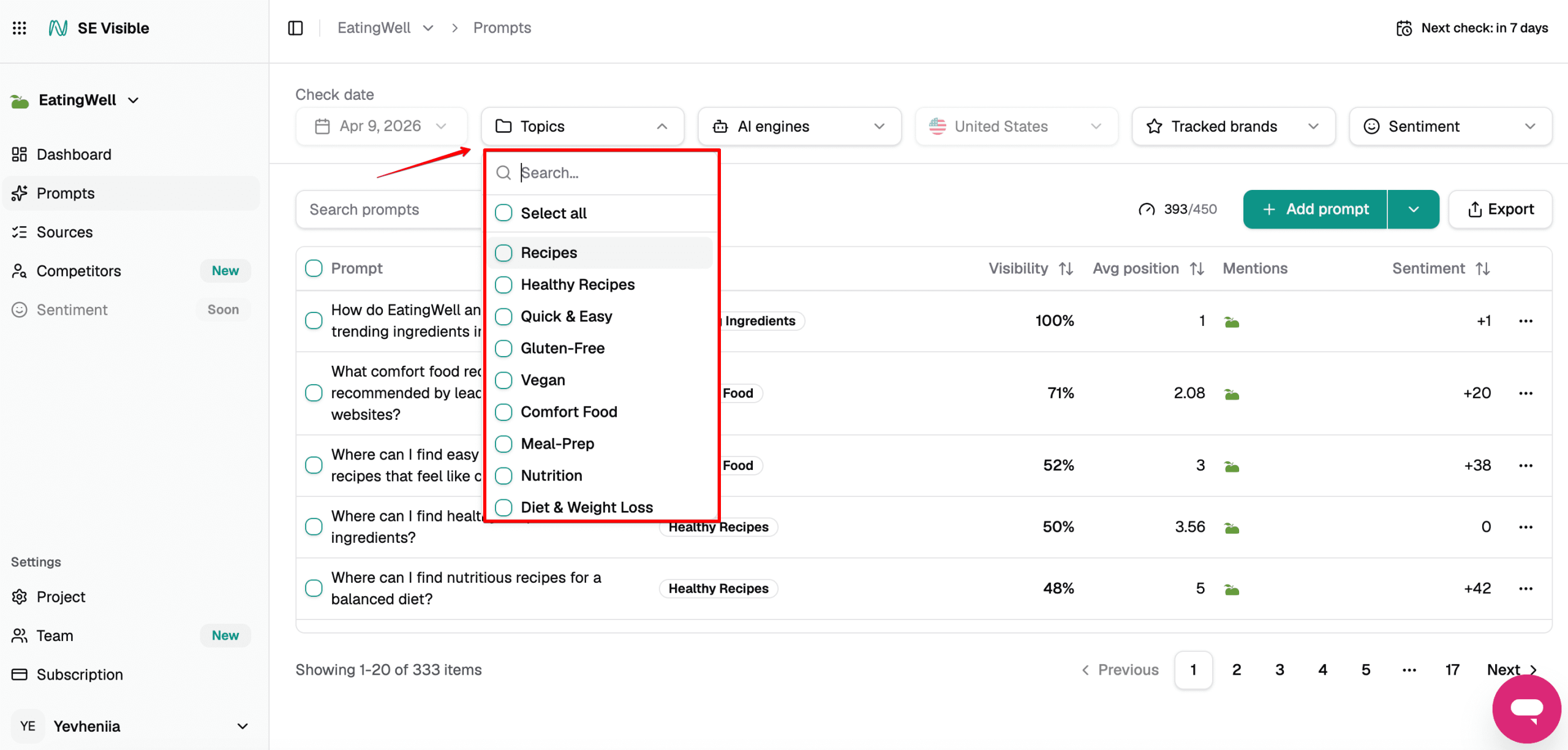
SE Visible, SE Ranking’s sister product, takes a different approach. It suggests more naturally phrased, conversational prompts that mirror how people actually talk to AI, and organizes them by topic cluster:
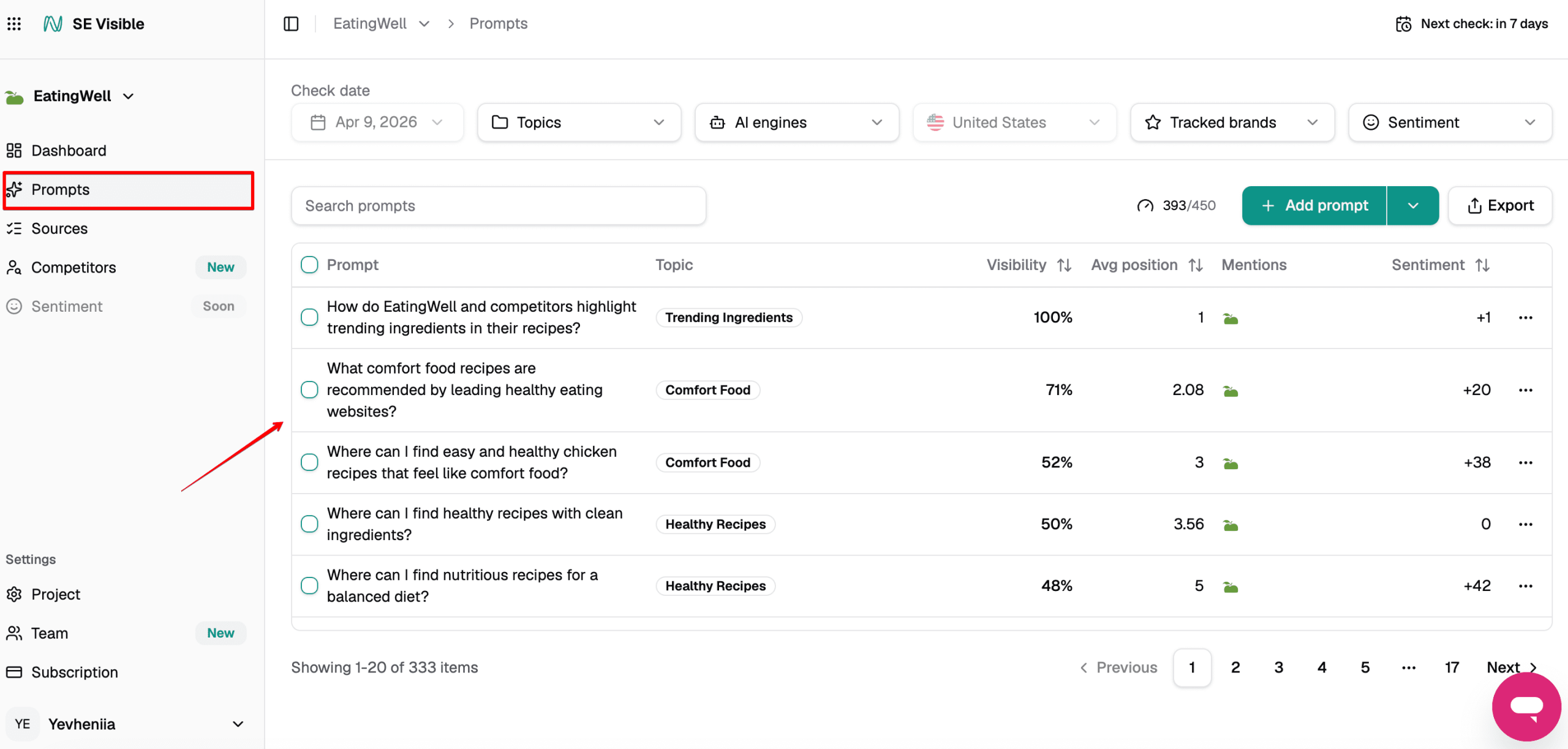
For EatingWell, that means prompts like “What comfort food recipes are recommended by leading healthy eating websites?” and “Where can I find healthy recipes with clean ingredients?” grouped under topics like Comfort Food and Healthy Recipes.
The topic grouping matters because it solves one of the core challenges of prompt research: making sure your tracking set is balanced. Without it, it’s easy to end up with 30 prompts that are all variations of the same intent. Grouping by topic shows you which areas of your category you’re covering and where you have gaps.
Step 4: Filter and prioritize your prompt list
By now, you might have ended up with quite a big list of different prompts. The next challenge is narrowing it down to the ones worth tracking. Here are four criteria I suggest using to filter against.
Criterion 1: Competitive relevance
The first question to ask yourself is, would this prompt realistically return my brand or a direct competitor in the AI response? If the answer is no because you think the prompt is too broad, too tangential, or too far from your category, it’s not worth tracking, regardless of how interesting it seems.
For example, if you offer a CRM for agencies, “What is CRM?” is too broad to surface your brand meaningfully. “Best CRM tools for marketing agencies” is the kind of prompt where your brand could realistically appear.
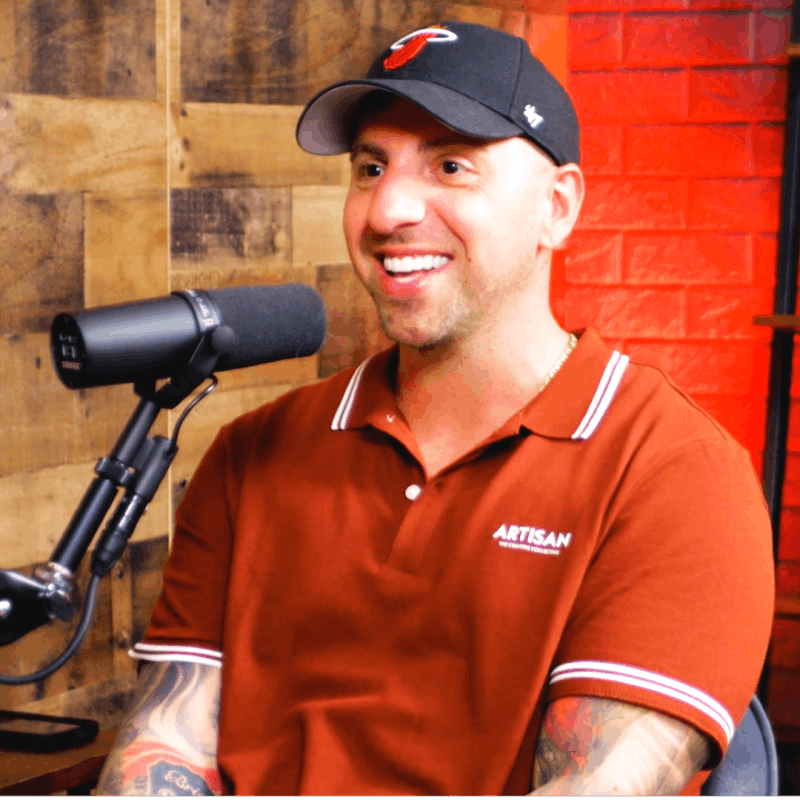
Focus on prompts where AI recommendations actually influence buying decisions in your space. As Gaetano DiNardi, Principal Consultant at Marketing Advice, puts it:
Criterion 2: Influenceability
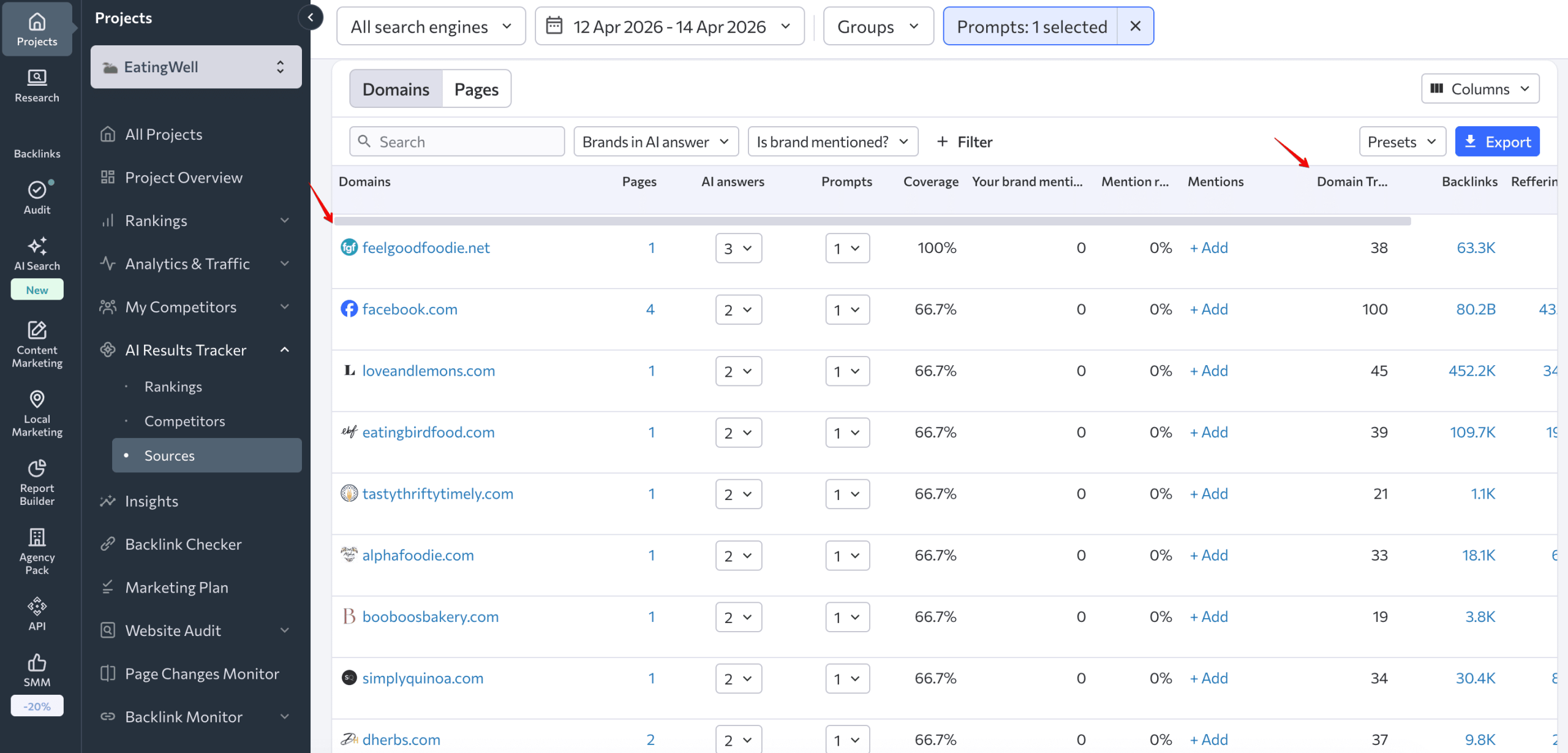
Not all prompts where you could appear are prompts where you can build visibility. Check what AI cites for your target prompt and whether you can compete with those sources.
If the citations are dominated by government sites, Wikipedia, or ultra-authoritative sources you have no path to outrank, deprioritize the prompt. Look instead for prompts where the AI cites sources with a lower domain rating (Domain Trust in SE Ranking), listicles you could get featured in, Reddit, or YouTube content. This is where you have a real chance of building your visibility.
SE Ranking’s Sources tab under AI results Tracker shows which domains and pages AI cites for your prompts. You can analyze those and sort them by Domain Trust to see who you can realistically compete against.
Criterion 3: Business intent alignment
Every prompt in your tracking set should map back to a real business outcome: a product category, an audience persona, a core use case, or a funnel stage.
Nikki Lam, Head of Earned Media at NP Digital, recommends focusing on prompts tied to revenue, demand capture, and your core categories.

Melissa Popp, VP of Content Strategy & Innovation at RicketyRoo Inc, takes it further, suggesting tracking prompts by topic cluster, not individual queries.

Both point to the same principle: Your prompt list should reflect your business priorities, not just the topics where AI happens to mention you.
Criterion 4: Scope narrowing for high-competition prompts
If your prompt is too broad, like “best CRM” or “best email marketing tool”, it’ll also be too competitive to fight for. The solution here is to narrow it by adding specific details. For example, geographic qualifiers, industry verticals, team size, budget constraints, or use case specifics. The narrower the prompt, the more it mirrors how AI actually personalizes responses, and the more useful your tracking data will be.
Narrowed version
Best CRM for UK-based startups under 20 people
Narrowed version
Best email marketing tool for Shopify stores under 10k subscribers
Narrowed version
Best project management tool for remote marketing agencies
Best CRM for UK-based startups under 20 people
Best email marketing tool for Shopify stores under 10k subscribers
Best project management tool for remote marketing agencies
Step 5: Decide how many prompts to track
The most common question at this stage is how many prompts should we actually be tracking? There’s no universal answer, but expert consensus converges on a practical starting range.
Start with 20–40 prompts total, distributed across journey stages:
- 10–20 awareness prompts
- 20–30 consideration prompts
- 5–10 brand evaluation prompts (tracked separately from category prompts)
For persona-based approaches, Kevin Indig, Growth Advisor, recommends around 15 prompts per persona:

Erika Varangouli, Head of Branded Content at Riverside, suggests organizing your tracking set by audience personas, use cases, product features, and topics, treating these as the organizing structure rather than trying to cover every possible prompt variation.

Helen Pollitt also offers a useful reframe to track topics, not individual prompts. That mental shift makes it easier to keep your list manageable without feeling like you’re missing something.

Run prompts across 2–3 priority AI models. Start with ChatGPT (largest user base), Perplexity (citation-heavy behavior), and Google AI Overviews or AI Mode (tied to traditional search intent). Don’t try to cover every model; focus on where your buyers actually search.
Track for at least 30 days before drawing conclusions. Citation patterns shift, responses vary between runs, and a single snapshot tells you very little. You need enough data to distinguish signal from noise.
Mind your budget. Prompt tracking costs scale with the number of prompts × number of AI models × rerun frequency. A bloated tracking set is hard to analyze and expensive to maintain. That budget is better spent on content optimizations once you’ve identified where your gaps actually are.
How SE Ranking helps you find and track the right prompts
Most of the methods in this guide work better when you have the right data sources behind them. SE Ranking’s ecosystem supports each stage of the process and gives you a more holistic approach to prompt research and tracking.
- AI Results Tracker is SE Ranking’s core prompt tracking tool. It monitors your brand mentions, citations, and recommendations across ChatGPT, Perplexity, Gemini, Google AI Overviews, and Google AI Mode. It lets you know whether you appear, how consistently, and in what context. It also surfaces untracked prompts where your brand already has visibility, which gives you a research shortcut.
- SE Visible is SE Ranking’s sister product for a full-spectrum AI visibility platform. It helps you discover what to track in the first place, showing naturally phrased prompt suggestions organized by topic cluster. You can also monitor sentiment across AI responses and compare your visibility against competitors. It tracks across all major AI platforms in one dashboard, with multi-market support for teams operating across regions.
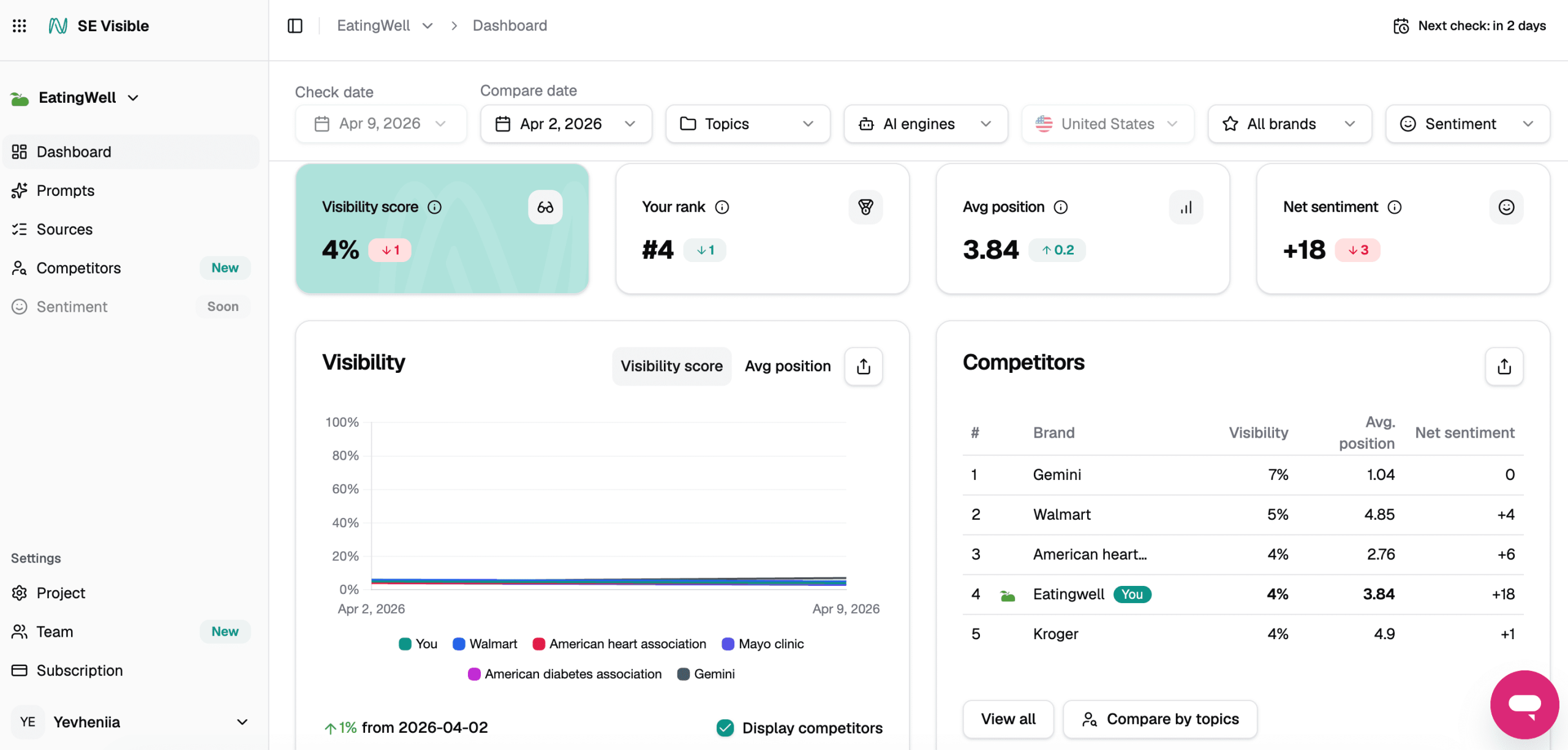
The two tools are designed to work together. AI Results Tracker gives you granular tracking data on your defined prompt set. SE Visible gives you the broader picture: where your brand stands across your category, which competitors dominate which topics, what the sentiment is, and where the gaps are. Used together, they cover both the monitoring and the strategic layer of AI visibility.
These are the two main solutions for prompt research. But you can also complement them with other tools that work specifically with some of the methods I covered. For example:
- Keyword Rank Tracker: Export top non-branded keywords and convert them into prompt seeds, as covered in Method 1.
- Keyword Research Tool: Extract PAA questions at scale for conversion into trackable prompts, as covered in Method 2.
- Competitive Research Tool: Surface competitor paid keywords as high-intent prompt seeds, as covered in Method 5.
To cover the full research flow described in this guide, SE Ranking’s Core or Growth plans give you the SEO and GEO foundation (keyword research, competitive intelligence, and monitoring across both traditional and AI search). Add the AI Search Add-on to access SE Visible and bring deeper prompt research, sentiment monitoring, and competitor visibility.
From there, you can layer in GA4 integration to connect your visibility data with actual traffic impact, so you understand whether that visibility translates into visits. Add social analytics on top of that to see the fuller picture: how your brand presence across search, AI, and social move together, and where your content investments are actually making a difference.
FAQ
How specific should prompt tracking be?
Find a balance between how specific and practical you want your prompt tracking to be. Prompts should be specific enough to mimic how your ICP phrases questions, but broad enough to avoid noise from infinite variations. Oleksii Khoroshun, SEO Specialist at SE Ranking, suggests using a topical approach.

In practice, this means tracking by topic cluster rather than every individual variation. Use persona-based modifiers (team size, industry, use case, budget) to add meaningful specificity without ending up with a list that’s impossible to manage.
Can I track prompts if everyone asks ChatGPT differently?
Yes, and this is the question the whole guide has been building toward. The key insight is that you’re not tracking exact-match strings. You’re tracking topics and intent patterns. LLMs decompose user prompts into sub-queries anyway, so slight wording differences often produce similar results.
Think of your tracking set as a representative set of 20–40 prompts that covers your core topics, personas, and journey stages. It works like a brand marketing panel, giving you directional visibility data.
What AI models should I track prompts across?
Start with ChatGPT as it has the largest user base, Perplexity because it is heavy in citations, and Google AI Overviews or AI Mode as they are tied to traditional search intent. Don’t try to track every model; instead, focus on the 2-3 platforms where your buyers actually search. If you want to see your visibility across AI systems, SE Visible tracks them in one dashboard, so you don’t have to manage separate setups per model.
Is prompt tracking worth it if there’s no volume data?
Yes, but you should think about it differently. Prompt tracking is a brand intelligence tool, not a performance marketing metric. It tells you where you appear, how you’re positioned, what competitors are out there, and where your gaps are. Those insights drive content strategy, PR priorities, and competitive positioning, all of which generate impact even without exact volume numbers.
The absence of volume data reflects how AI search works. So, instead of asking yourself how many people use this prompt, try to think whether appearing in the answers it triggers puts your brand in front of the right people at the right stage of their decision.
How often should I update my prompt list?
Review and refine every 30–60 days. As your initial data comes in, you’ll find prompts where you never appear (content gap opportunities), prompts where competitors consistently dominate (competitive threats), and new prompt ideas surfacing from AI follow-up suggestions or emerging trends in your category.
Add new prompts, retire the ones that aren’t telling you anything useful, and adjust persona modifiers based on what the data shows. Your prompt list should evolve with your understanding of the space. Treat the first 30 days as a calibration period, not a final answer.
Conclusion
Prompt tracking is still new enough and so confusing that most brands are either ignoring it or doing it poorly. Perception is the problem: prompt tracking isn’t a volume game but a signal layer. It tells you how AI represents your brand when buyers are actively looking for solutions like yours.
And since this is a signal, you don’t need to track every possible prompt. You need to track the right clusters, connect that data to the rest of your marketing ecosystem, and use it to make better decisions. This means moving deliberately.