Semrush API Alternatives: 2026’s Top SEO Data APIs Compared
A year ago, looking for an SEO data API would have been mostly a question about keyword or backlink coverage. Now teams are also asking which providers have AI search data, how credit models hold up at scale, and whether the API fits into an agentic workflow.
Semrush is still the default starting point for many. But for a growing number of teams, it’s no longer the obvious answer. This article looks at seven Semrush API alternatives worth evaluating in 2026, weighed on data coverage, technical fit, pricing structure, and AI workflow fit.
-
SE Ranking is the best overall choice.
It covers traditional SEO data and AI search visibility, tracking brand presence across AI Overviews, AI Mode, ChatGPT, Perplexity, and Gemini without a separate provider or subscription.
-
DataForSEO is the best for pure developers.
It is a dedicated pay-as-you-go infrastructure with no dashboard requirements and the lowest cost-per-request for high-volume SaaS applications.
-
SerpApi is the best for multi-engine SERP.
It offers unmatched real-time extraction across 100+ global search engines with sophisticated parsing for AI Overviews and AI Mode.
-
Ahrefs API is the best for backlink intelligence.
It provides access to the industry’s most massive backlink index and the new Brand Radar for enterprise sentiment and LLM mention monitoring.
-
Bright Data SERP API is the best for scalability & geo-targeting.
It offers industrial-scale scraping powered by 150M+ residential IPs, featuring deep integration with Claude Skills and agentic workflows.
-
HasData is the best for SERP feature parsing.
It is excellent middle-ground pricing for mid-volume users with automatic normalization of over 15 distinct Google SERP features into stable JSON.
-
Google Search Console API is the best free starting point.
It is the definitive source for first-party, unsampled data for owned properties, bypassing all web-interface row limits.
Why Look for a Semrush API Alternative?
For most teams, the primary barrier is the mandatory Advanced plan gate. To even access the API, you must commit to the top-tier Advanced subscription, which is priced at $549 per month. This high entry cost serves as a tech tax on innovation. This problem is particularly acute for startups or small agencies that only require programmatic access for limited internal tools and have no need for the broader dashboard features. Semrush API pricing excludes smaller participants who require specialized data without the full enterprise suite.
Furthermore, the Semrush API cost is exacerbated by its opaque and rigid unit-based pricing model. Units are sold in substantial blocks—typically 2 million, 5 million, 10 million, or 20 million. They are decoupled from the base subscription price. This means that the $549 monthly commitment includes zero API units. All consumption must be purchased as an additional expense. For instance, retrieving 1,000 organic keywords for 100 domains can consume 1 million units for live data and up to 5 million for historical data. This total cost of ownership far exceeds the base plan’s advertised price.
The lack of a rollover policy creates further economic inefficiency. Any API units purchased within a billing cycle expire at the end of the month if they are not used. Agencies often have fluctuating demand, for example, they perform massive audits during a client onboarding phase, followed by months of lower-intensity monitoring. This Semrush approach leads to significant wasted expenditure.
Finally, the absence of an entry-level, API-only plan forces a redundant expenditure on user interfaces and dashboards that many technical teams do not use. Developers building custom SaaS products or internal reporting pipelines often prefer raw data streams that can be integrated into proprietary logic. By bundling API access with a content marketing toolkit, site audit dashboards, and social media management features, Semrush creates a bloated cost structure for teams whose primary goal is purely data-driven automation.
Quick Comparison: Top 7 Semrush API Alternatives at a Glance
The data SEO API market is characterized by diverse pricing models and specialized endpoint coverage. Here we summarize the top Semrush API alternatives available to developers and agency owners.
Best For
Agencies & AI Tools
Starting Price
$50 Deposit
Pricing Model
Pay-as-you-go. Also included in subscriptions, available as an add-on, or a stand-alone solution
Endpoints Covered
- Backlinks
- Website audit
- Keyword research
- Domain analysis
- AI search visibility
MCP Support
Official Server
AI Search Tracking
- ChatGPT
- Gemini
- Perplexity
- AIO
- AI Mode
Best For
SaaS Builders
Starting Price
$50 Deposit
Pricing Model
Pay-as-you-go
Endpoints Covered
- SERP
- Keyword
- Backlinks
- On-page
- Domain
- AI
MCP Support

AI Search Tracking
- AI Mentions & AIO
Best For
Multi-Engine SERPs
Starting Price
$25/mo
Pricing Model
Tiered / Searches
Endpoints Covered
- 100+ Engines
- AI Overviews, AI Mode
MCP Support
Official Server
AI Search Tracking
- AIO
- AI Mode
- Search Assist
Best For
Backlink Analysis
Starting Price
$1499/mo
Pricing Model
Subscription + Units
Endpoints Covered
- Backlinks
- Keyword
- Domain
- Brand Radar
MCP Support
Hosted Server
AI Search Tracking
- Brand Radar (LLM Mentions)
Best For
Industrial Scale
Starting Price
$0 (PAYG)
Pricing Model
Units / Success
Endpoints Covered
- Multi-Engine SERP
- 40+ Websites
MCP Support
Official Server
AI Search Tracking
- Google AIO Parsing
Best For
Feature Parsing
Starting Price
$49/mo
Pricing Model
Monthly Credits
Endpoints Covered
- Google (SERP, Maps, News, Shopping, Flights)
MCP Support
AI Search Tracking
- AI Overview Detection
Best For
First-Party Data
Starting Price
$0
Pricing Model
Free
Endpoints Covered
- Search Analytics
- Sitemaps
- URL Inspection
MCP Support
Community Nodes
AI Search Tracking
N/A
Agencies & AI Tools
$50 Deposit
Pay-as-you-go. Also included in subscriptions, available as an add-on, or a stand-alone solution
- Backlinks
- Website audit
- Keyword research
- Domain analysis
- AI search visibility
Official Server
- ChatGPT
- Gemini
- Perplexity
- AIO
- AI Mode
SaaS Builders
$50 Deposit
Pay-as-you-go
- SERP
- Keyword
- Backlinks
- On-page
- Domain
- AI
- AI Mentions & AIO
Multi-Engine SERPs
$25/mo
Tiered / Searches
- 100+ Engines
- AI Overviews, AI Mode
Official Server
- AIO
- AI Mode
- Search Assist
Backlink Analysis
$1499/mo
Subscription + Units
- Backlinks
- Keyword
- Domain
- Brand Radar
Hosted Server
- Brand Radar (LLM Mentions)
Industrial Scale
$0 (PAYG)
Units / Success
- Multi-Engine SERP
- 40+ Websites
Official Server
- Google AIO Parsing
Feature Parsing
$49/mo
Monthly Credits
- Google (SERP, Maps, News, Shopping, Flights)
- AI Overview Detection
First-Party Data
$0
Free
- Search Analytics
- Sitemaps
- URL Inspection
Community Nodes
N/A
1. SE Ranking
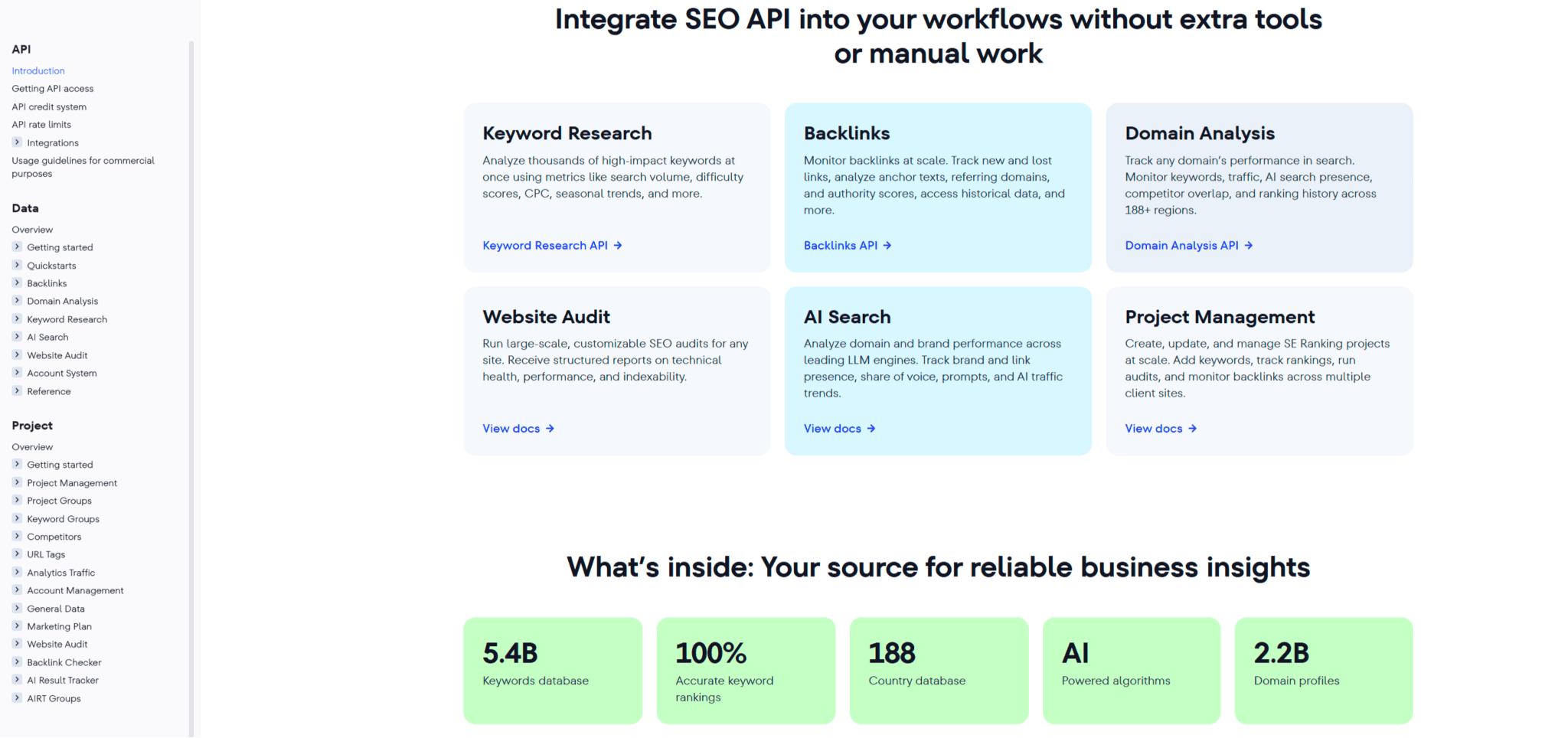
SE Ranking is a practical alternative to Semrush for teams that need both traditional SEO data and AI search visibility in a single API. It combines SEO datasets (rankings, backlinks, technical audits, and keyword research) with AI search visibility metrics across ChatGPT, Gemini, Perplexity, AIO, and AI Mode
It also provides an MCP server that allows AI agents like Gemini, Claude, and ChatGPT to query live SEO data using natural language. This removes the bottleneck of manual data exporting and re-uploading. An AI agent can independently fetch a domain’s backlink profile or its current AI visibility status to answer strategic questions without human intervention.
All these features are available as a standalone product or bundled into a full platform subscription with a free 14-day trial that includes 100K credits and full endpoint access from day one.
Key Features
- Domain Analysis. The API provides exhaustive insights into any domain’s organic performance, including traffic estimates, keyword visibility distributions, and historical ranking trends.
- Keyword Research. This endpoint goes beyond simple volume metrics, allowing developers to pull related, similar, and long-tail queries, alongside question-based keywords to fuel content strategy engines.
- Backlinks. This module delivers a complete link-profile analysis, including overall summary metrics, anchor text distribution, referring domain history, and authority scores.
- Website Audit. Technical SEO is addressed through an API that returns overall site health scores and categorizes technical issues into errors, warnings, and notices. Developers can programmatically trigger new crawls and retrieve page-level issue breakdowns.
- AI Search API. This module provides programmatic access to a domain’s performance across ChatGPT, Gemini, Perplexity, AIOs, and AI Mode with “Prompts by Brand” and “Prompts by Target” endpoints to identify exactly where a brand is cited in LLM responses. Covers 50M+ tracked prompts with support for up to 10 simultaneous competitor comparisons.
The SE Ranking ecosystem also prioritizes rapid deployment for non-developers through pre-built connectors. Official integrations for Looker Studio, n8n, and Make.com allow teams to build automated SEO workflows without writing custom scripts. For developers, a comprehensive Postman collection and ready-to-run Google Colab notebooks provide an immediate path to production for AI-driven visibility analysis.
Pricing
The SE Ranking API is included in every SE Ranking plan. This means that apart from it, you also get access to full SEO and GEO suite:
- Core Plan ($129/month): 10 projects & 1 seat, 2,000 keywords + 100 prompts daily, 5 GEO domains, 250k audit pages/month, 25k API credits with MCP access, rank tracking, unlimited keyword/backlink research, site audit, and integrations (GA, GSC, Looker Studio, Matomo).
- Growth Plan ($279/month): 30 projects & 3 seats, 5,000 keywords + 250 prompts daily, 15 GEO domains, 2M audit pages/month, 100k API credits with MCP access, all Core features plus historical data, collaboration tools, page monitoring, and dedicated support.
For more volume, you can also use the API Add-on on top of your subscription, starting from $45/month (annual). And if you only need API, without SEO and AI search platform, there’s a stand-alone option from $179/month (also annual billing).
The easiest way to start using SE Ranking API is the pay-as-you-go tier. It requires a $50.00 minimum deposit for 250,000 credits that never expire.
Pros and Cons
Pros:
- Comprehensive API including native AI search visibility tracking across major LLM engines: Gemini, Perplexity, ChatGPT, AI Mode, and AI Overviews.
- Official MCP server enables advanced AI agent workflows and natural-language querying.
- Unified SEO data coverage encompasses backlinks, keywords, technical audits, and domain research.
- Robust no-code support with official nodes for n8n, Make.com, and Looker Studio.
- Pricing structured for actual consumption: standalone API, pay-as-you-go, with bundled plan options that include platform features.
Cons:
- Response structures for complex technical audit endpoints may require additional testing to map correctly to internal databases.
- No first-party SDKs. Integration is via Postman collection and REST reference documentation, which adds setup time for teams used to library-based onboarding..
Best For
SE Ranking is best for established agencies, mid-market teams, and SaaS developers who require a unified, programmatically accessible SEO and GEO dataset and want to build automations based on live data.
2. DataForSEO
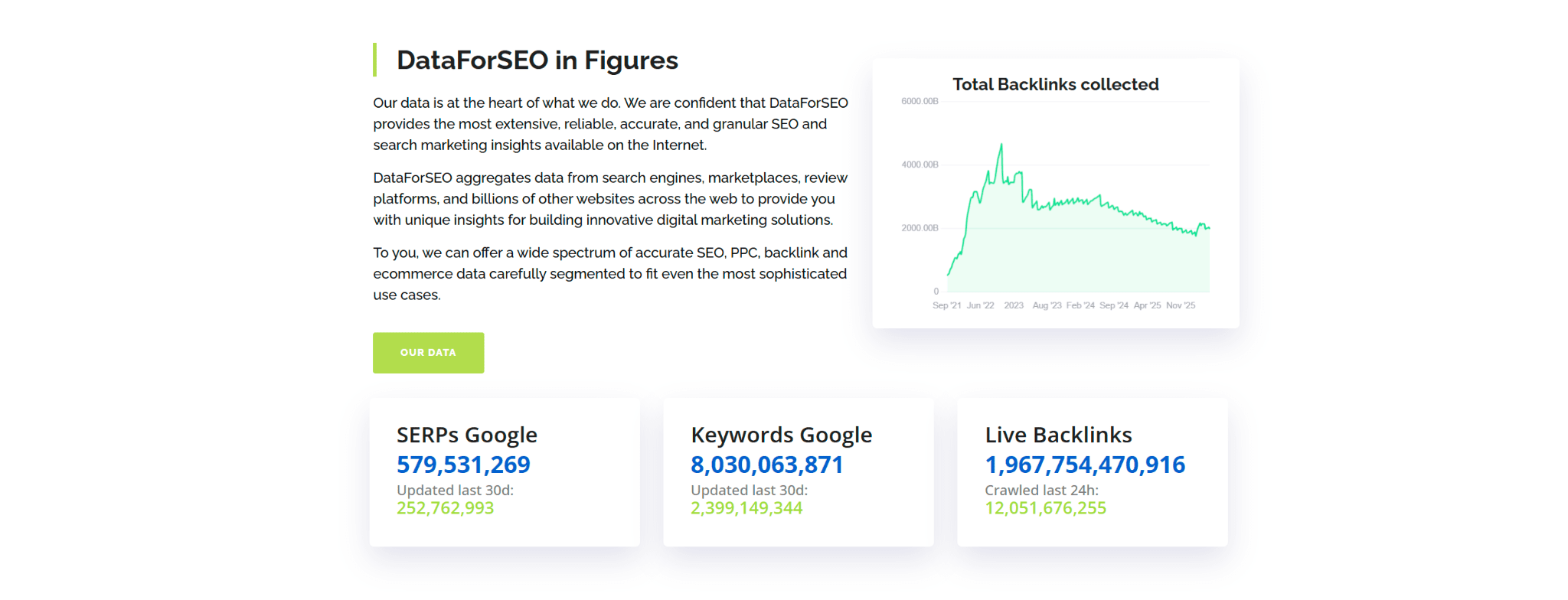
Among all the Semrush API alternatives on this list, DataForSEO is optimized for pure developers. It offers raw data that is the antithesis of the Semrush bundled subscription. There is no dashboard, no frontend reporting, and no mandatory monthly fees beyond the initial deposit of $50. This model is specifically designed for tool builders who want to pay only for the JSON data they consume to power their own proprietary applications.
The economic efficiency of DataForSEO is a significant differentiator. At a volume of 1 million monthly requests, the platform typically costs approximately $600, whereas a similar volume through other DataForSEO alternatives could reach higher. This makes it the preferred infrastructure for high-scale SaaS products where data acquisition cost is a primary factor in product margin.
G2 review from Hazem Klafla, CEO at Influencify:
“Data quality is not great, specifically search volume data. In dfs the search volume is generally average value of what you see in keywords planner. However the keyword planner estimated search volume is not for the keyword only but all keywords and phrases that has the keyword. Redukcja usually much higher search volume reported than it actually is compared to semrush or ahrefs”
Key Features
- Multi-Engine SERP API. Supports real-time and queue-based data retrieval from Google, Bing, Yahoo, Baidu, and Naver.
- Comprehensive SEO Databases. Provides access to massive keyword, backlink, and domain research databases that mirror the data parity found in major SEO platforms but at a fraction of the cost.
- On-Page and Website Audit. Programmatic site crawling and technical issue detection with flexible concurrency limits.
- AI Mentions Endpoint. While specialized, this endpoint tracks brand mentions across generative AI results, though it carries a slightly higher monthly commitment for activation.
Pricing
DataForSEO uses a true pay-as-you-go system based on per-request costs:
- SERP first page (normal priority): $0.0006 per request.
- Related keywords (100 keywords): $0.02 total ($0.01 task + $0.0001 per keyword).
- On-page crawl: varies by crawl depth and page count.
- MCP server code: free and open-source (MIT license).
- No monthly subscription or platform fee for the MCP connection itself.
The minimum deposit to activate an account is $50, which provides immediate access to all non-AI specialized endpoints.
Pros and Cons
Pros:
- The most true pay-as-you-go system in the industry for high-volume data consumers.
- Excellent documentation designed for rapid technical integration.
- Absolute pricing transparency with no hidden subscription fees or dashboard overhead.
Cons:
- Significant learning curve for non-technical users, as there is no visual dashboard.
- The specialized AI Mentions endpoint requires a $100/mo minimum commitment, which may be prohibitive for small-scale testing.
- Calculating the final cost of a multi-parameter request can be complex due to priority multipliers.
Best For
DataForSEO is best for SaaS tool builders and enterprise-level data engineers who require massive volumes of raw SEO data at the lowest possible unit cost.
3. SerpApi
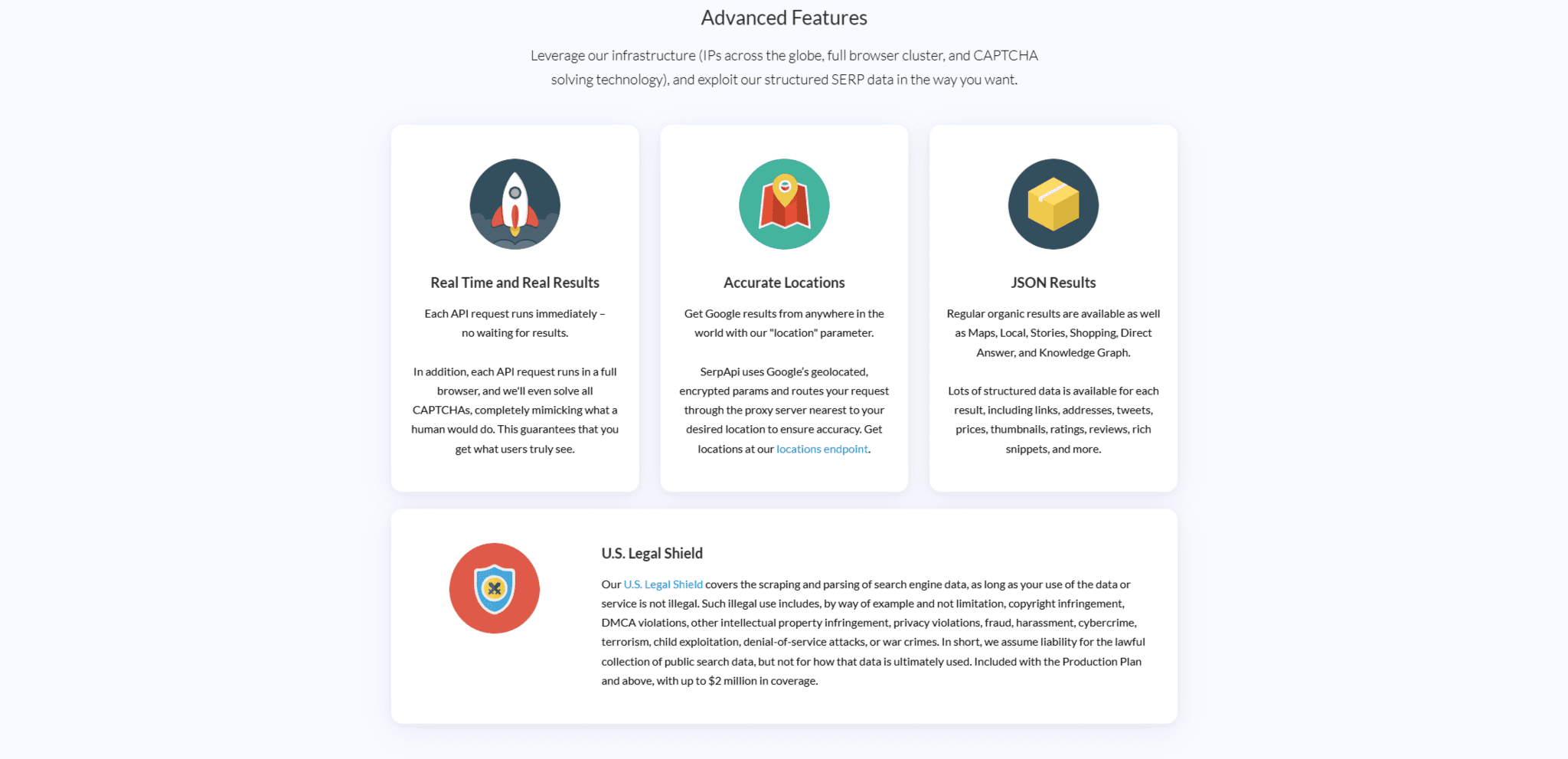
SerpApi is the industry leader for multi-engine SERP extraction. While Semrush focuses on building historical databases, SerpApi focuses on providing a perfect, structured reflection of what a user sees on a search engine results page right now. It is the gold standard for live rank tracking and localized search analysis. This Semrush API alternative handles the immense complexity of proxy rotation, browser fingerprinting, and CAPTCHA solving.
The platform is particularly valuable for developers who need to monitor search features that traditional databases often miss. SerpApi returns raw SERP data, including the full HTML if requested. SerpApi allows for the extraction of images, “People Also Ask” questions, shopping results, and local map pins with 100% accuracy.
G2 review by Arthur Wallendorff, Digital Expert at ByteBakers:
“Go SDK is not idiomatic, typing could be redone, missing some info about underlying infrastructure in the docs (e.g. viewport dimensions)”
Key Features
- 100+ Engines Supported. Coverage includes Google, Bing, Baidu, Naver, Yahoo, DuckDuckGo, YouTube, and specialized engines like Google Lens.
- AI Overview & AI Mode. Native endpoints for Google’s generative search experiences. SerpApi extracts the full summary text, cited sources, and follow-up questions from AI Overviews and AI Mode.
- Hyper-Local Targeting. Allows for the retrieval of search results from any specific GPS coordinate or zip code globally.
- U.S. Legal Shield. Provides a unique layer of legal protection for scraping public data, which is a critical consideration for enterprise-level compliance.
Pricing
SerpApi operates on a tiered monthly subscription based on search volume:
- Starter Plan ($25/month): 1,000 searches/month, 200 throughput/hour.
- Developer Plan ($75/month): 5,000 searches/month, 1,000 throughput/hour.
- Production Plan ($150/month): 15,000 searches/month, 3,000 throughput/hour.
- Big Data Plan ($275/month): 30,000 searches/month, 6,000 throughput/hour.
All subscription plans include U.S. Legal Shield.
Pros and Cons
Pros:
- Widest search engine coverage in the market, including non-English and niche platforms.
- Exceptional debugging user experience with an interactive “Playground” for rapid testing.
- Built-in handling of all technical anti-bot obstacles, guaranteeing real-time delivery.
Cons:
- The platform is limited to SERP data extraction.
- It does not maintain domain authority or backlink databases like SE Ranking or Semrush.
- Searches do not roll over month-to-month, which can lead to higher effective costs for teams with irregular usage patterns.
Best For
SerpApi is best for developers requiring hyper-accurate, real-time SERP data across a diverse range of global search engines.
4. Ahrefs API
Ahrefs is widely considered the industry benchmark for backlink intelligence. In 2026, the Ahrefs API V3 transitioned to a highly structured, enterprise-centric model. While Semrush provides a broader dataset for general digital marketing, Ahrefs focuses on providing the deepest, most comprehensive backlink index available. This fact makes this Semrush API alternative the non-negotiable choice for specialized link builders and technical SEOs.
The introduction of Brand Radar in the V3 API marks Ahrefs’ entry into the AI search visibility space. This tool tracks brand mentions and citations across major LLM platforms like ChatGPT and Gemini. Brand Radar identifies content gaps and share-of-voice trends specifically within AI-generated answers.
G2 review by Irakli Antidze, Head of SEOGoldenWeb:
“Costly additional tools, costly API. Costly API makes integration difficult.”
Key Features
- Largest Backlink Index. Access to 28T internal backlinks and 35T external backlinks with detailed metrics such as Domain Rating (DR), URL Rating (UR), and class-C network counts.
- Batch Analysis. Evaluates the SEO metrics for up to 200 URLs simultaneously, which is an essential feature for large-scale link prospecting and competitive auditing.
- Hosted MCP Server. Ahrefs provides a hosted Model Context Protocol server, allowing users to power AI agents with their API units without managing local server infrastructure.
- Site Explorer & Rank Tracker. Comprehensive endpoints for monitoring organic keyword movements and competitor traffic estimations.
Pricing
Ahrefs API usage is governed by a unit-based consumption model that factors in both request volume and data complexity:
- Lite Plan ($129/month): 5 projects, 6 months historical data, 750 tracked keywords, 5 tracked prompts, 100k crawl credits, 1,000 credits per user, 1 user (+2 at $40/mo).
- Standard Plan ($249/month): 20 projects, 2 years historical data, 2,000 tracked keywords, 10 tracked prompts, 500k crawl credits, unlimited credits per user, 1 user (+5 at $60/mo).
- Advanced Plan ($449/month): 50 projects, 5 years historical data, 5,000 tracked keywords, 20 tracked prompts, 1.5M crawl credits, unlimited credits per user, 1 user (+10 at $80/mo).
- Enterprise Plan ($1,499/month): all Advanced features plus unlimited API access, SSO & enterprise-grade security, access management & audit logs, unlimited historical data, custom limits & exports, and forecasting & trend analysis (annual commitment required).
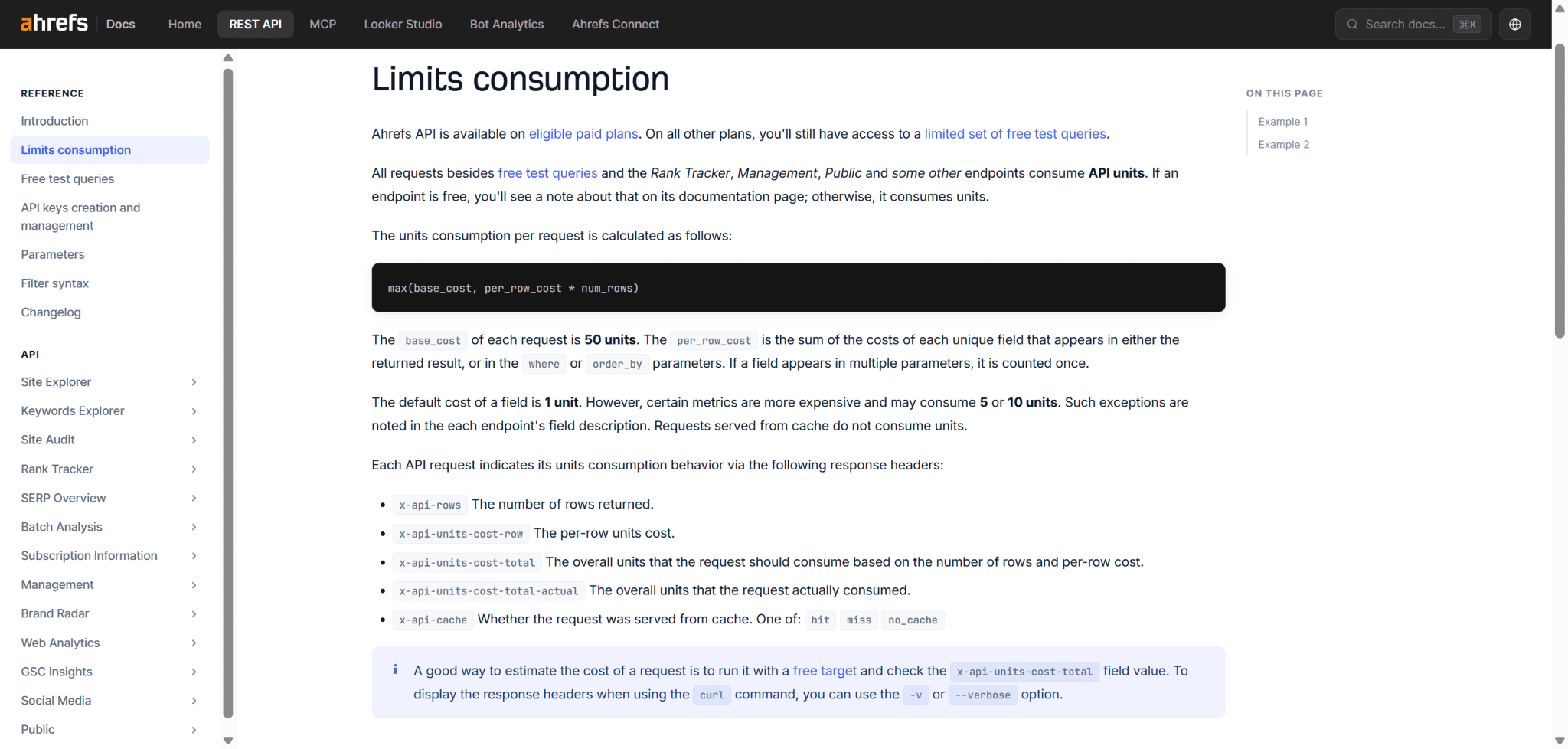
Base cost is 50 units per request. Per-row cost is 1 unit for standard fields and up to 10 units for expensive metrics like organic traffic and traffic cost.
Pros and Cons
Pros:
- Unrivaled backlink data freshness and index depth.
- Brand Radar provides AI-native visibility tracking.
- The hosted MCP server is easy to integrate with Claude Desktop for agentic analysis.
Cons:
- Full API access is largely restricted to higher-tier enterprise plans, making it expensive for smaller agencies.
- The API returns derived SEO metrics only and does not provide raw SERP data for visual verification.
- The migration from V2 to V3 has increased the technical overhead and cost for legacy users.
Best For
Ahrefs API is best for enterprise SEO teams and link-building specialists for whom the depth and freshness of backlink data are the primary operational requirements.
5. Bright Data SERP API
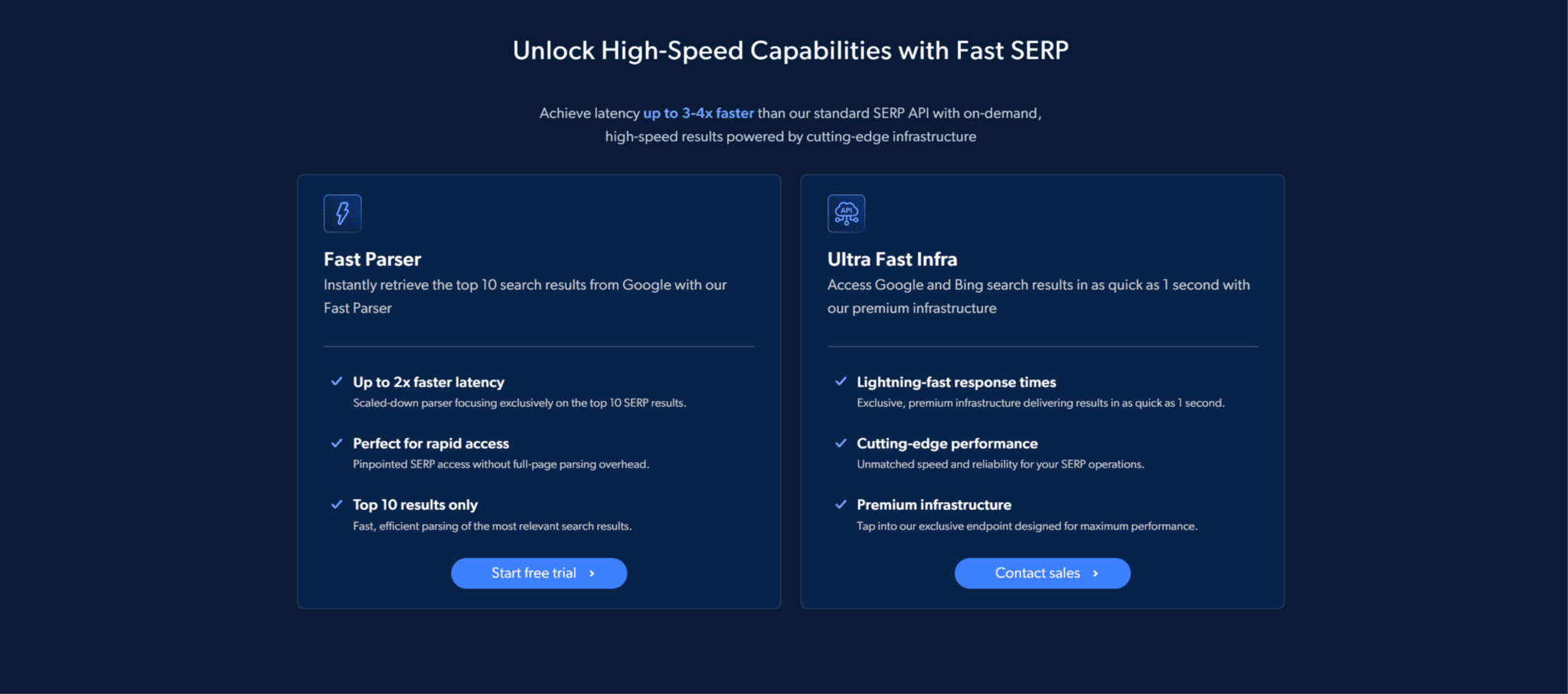
Bright Data is positioned for organizations that require industrial-scale data collection with absolute geographic precision. Unlike standard SEO providers, Bright Data is a massive web infrastructure company that uses its residential proxy network of over 150 million IPs to ensure that your requests are never blocked or throttled by search engine anti-bot systems.
In 2026, Bright Data heavily prioritized the AI agent market through its Claude Skills and MCP server. These integrations allow AI agents to use Bright Data as their “eyes and ears” on the web, scraping any page and converting it into clean, structured markdown for LLM processing. Bright Data SERP API allows AI agents to cope with even heavy JavaScript rendering or aggressive bot protection.
G2 review by Owen Burke, Sales Associate:
“I thought that the API key could be slightly more intuitive on how to use and to use your web scraping tools. Outside of this I loved bright data and the Bright initiative.”
Key Features
- 150M+ Residential IPs. Enables city-level targeting and ensures a 99.9% success rate for high-volume scraping tasks.
- Claude Skills Integration. Specialized plugins that teach the Claude AI how to optimally use Bright Data’s infrastructure for web searching, data feeds, and competitive intelligence.
- Web Unlocker. A fully managed browser environment that solves CAPTCHAs and handles cookie sessions automatically, providing a pay-per-success model.
- Pro-Mode MCP Server. Orchestrates 60+ tools, including browser automation, structured data extraction from 40+ websites (Amazon, LinkedIn, TikTok), and multi-engine SERP retrieval.
Pricing
Bright Data offers a flexible pricing structure that scales with volume and commitment:
- Pay-as-you-go ($1.5 per 1K results): no monthly commitment.
- 380K Results Plan ($499/month): $1.3 per 1K results.
- 900K Results Plan ($999/month): $1.1 per 1K results.
- 2M Results Plan ($1,999/month): $1 per 1K results.
Pros and Cons
Pros:
- Unmatched scale and reliability for enterprise-level operations.
- The most precise geographic targeting available in the industry.
- Deepest integration with AI agent frameworks (Claude Code, Claude Agent SDK).
- Natively handles anti-bot measures.
Cons:
- Premium pricing compared to standard SEO APIs.
- Steep technical learning curve.
- Users must understand proxy configurations and browser automation logic.
- There are no native SEO-specific endpoints (e.g., no “Domain Rating” or “Backlink Count” databases).
Best For
Bright Data SERP API is best for large-scale enterprise developers building AI-native research agents or high-concurrency competitive intelligence platforms that require absolute data integrity.
6. HasData
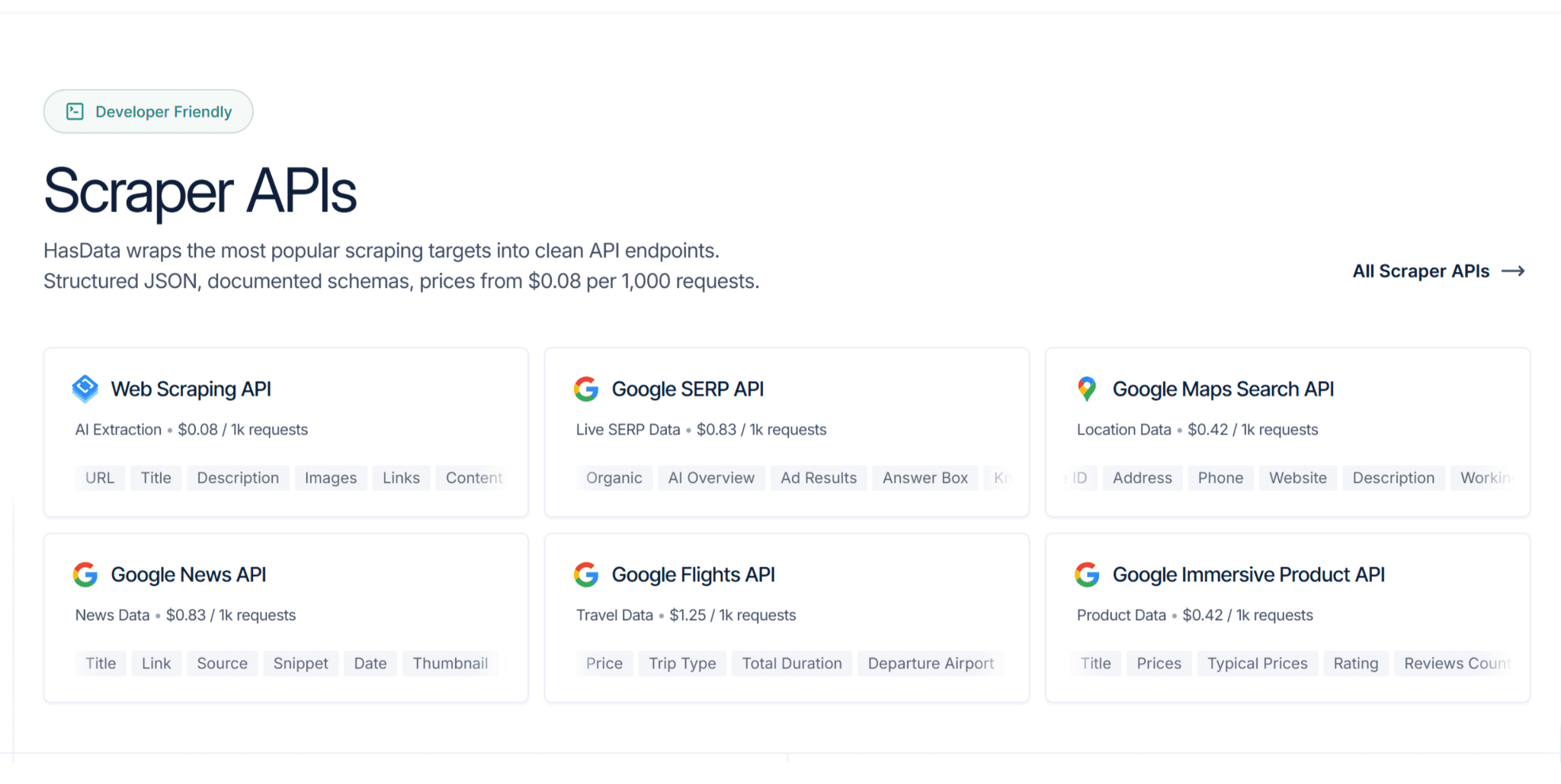
HasData serves as a mid-market Semrush API alternative that bridges the gap between raw scraping and finished SEO data. Its Google SERP API is specifically designed for developers who want to avoid the broken parser cycle. Instead of returning brittle HTML, HasData normalizes over 15 distinct Google SERP features into a consistent, stable JSON schema. It ensures that your data pipelines don’t break when Google updates its visual layout.
The platform is more affordable than premium providers like SerpApi for mid-to-high volume usage. Yet, it offers more structured features than the low-cost raw scrapers. Its ability to detect AI Overviews and extract cited sources makes it a competitive choice for teams building AI search monitors.
G2 review by JI Tech Holdings:
“The documentation was not quite specific enough and didn’t denote how to send parameters like max bed count, so that took some trial and error. Also, their support is a bit slow to respond.”
Key Features
- 15+ Parsed SERP Features. Includes organic results, featured snippets, knowledge panels, local packs, answer boxes, shopping results, and AI Overviews.
- AI Overview Extraction. Automatically identifies and parses Google’s generative AI answers, including text summaries and cited reference links.
- Google SERP Light API. A cost-efficient endpoint for high-speed rank tracking that omits rich features to provide faster response times (under 2 seconds) at half the credit cost.
- Zero-Config Anti-Bot Evasion. Built-in residential IP rotation and fingerprint management to ensure consistent 200 OK responses.
Pricing
HasData uses a monthly credit-based system that offers significant discounts as volume increases:
- Free Plan ($0/month): 1,000 credits, concurrency 1, limited free access to scraping & SERP APIs, up to 1,000 no-code scraper rows/month
- Startup Plan ($49/month): 200k credits, concurrency 15, lower API request pricing (e.g. Google SERP API at $2.45/1k, Maps at $1.23/1k), 200k no-code scraper rows/month
- Business Plan ($99/month): 1M credits, concurrency 30, discounted API pricing (Google SERP API at $0.99/1k, Maps at $0.50/1k), 1M no-code scraper rows/month
- Enterprise Plan ($249/month): 3M credits, concurrency 50, best API pricing tiers (Google SERP API at $0.83/1k, Maps at $0.42/1k), 3M no-code scraper rows/month, optimized for large-scale scraping and SERP data operations
Standard Google SERP requests cost 10 credits. Google SERP Light costs 5 credits.
Pros and Cons
Pros:
- Excellent normalization of complex SERP features into easy-to-use JSON.
- Highly competitive pricing at the Business and Enterprise tiers.
- Automatic handling of all technical scraping hurdles (CAPTCHAs, residential proxies).
- Nice AI Overview detection.
Cons:
- Currently focused almost exclusively on Google services.
- Limited support for Bing, Amazon, Yelp, Shopify, Airbnb, Zillow, etc.
- Relatively limited track record in the enterprise space compared to incumbents.
Best For
HasData is best for SEO tool builders and agencies who need robust, parsed Google search data with AI overview support at a predictable mid-range price.
7. Google Search Console API
The Google Search Console (GSC) API remains the most valuable first-party data source for any SEO professional. While every other API on this list relies on third-party scraped data, the GSC API provides actual, recorded performance data directly from Google’s internal servers. It is the only unsampled source of clicks, impressions, and exact average positions for your own verified properties.
For large-scale sites, the GSC API is a mandatory option among Semrush API alternatives. The web UI caps exports at 1,000 rows, which is insufficient for enterprise sites with thousands of pages. The API allows developers to pull 50,000 rows per request and up to 50,000 rows per day per search type. This enables the discovery of hidden search demand that the dashboard cannot show.
G2 review by Scott Walldren, Head of Organic Marketing:
“Over time, Google has deprecated numerous features including the ability to suppress sitelinks. While the Search Console API exists, its technical complexity puts deeper data analysis out of reach for most SEO practitioners who lack data engineering expertise. Customer support is non-existent. Google offers numerous ways to gain access to tracking however none of them are easy for a novice.”
Key Features
- First-Party Unsampled Data. Direct access to real search queries, clicks, and impressions from Google’s database.
- URL Inspection API. Allows for the programmatic checking of indexation status and crawl issues for any URL on your site.
- Search Analytics Endpoint. Supports complex filtering by query, page, country, and device type.
- Zero Cost. The API is free to use, making it the most cost-effective starting point for technical SEO auditing.
Pricing
Google Search Console (GSC) API is free. It is available to anyone with a Google Cloud project and verified access to a Search Console property.
Pros and Cons
Pros:
- The most accurate and authoritative data available for your own properties.
- Completely free regardless of request volume (within standard quotas).
- Bypasses the row limits and sampling of the web interface.
Cons:
- Only provides data for verified properties.
- You cannot track competitors.
- It is not a real-time monitoring tool.
- Typical 48-hour data delay.
- Requires significant technical setup via Google Cloud Console compared to third-party APIs.
Best For
Google Search Console (GSC) API is best for in-house teams and agencies that need the most accurate performance data for internal auditing and wish to eliminate third-party data costs for their own sites.
FAQ
What is the cheapest Semrush API alternative?
For developers on a strict budget, the Google Search Console API is the only fully free alternative, providing high-quality first-party data. For competitive data, SE Ranking is worth considering. SE Ranking allows for a $50 deposit with no ongoing subscription requirement.
Which Semrush API alternative tracks AI search visibility?
SE Ranking has the most complete AI Search API endpoints. It is the only provider with dedicated endpoints for ChatGPT, Perplexity, Gemini, Google AI Overviews, and AI Mode in a unified SEO API. Ahrefs tracks this through its Brand Radar tool.
Is there a free Semrush API alternative?
The Google Search Console API is the primary free choice for internal data. For testing purposes, SerpApi has a free tier of 250 searches per month. SE Ranking offers a 14-day free trial that includes 100,000 API credits for developers to prototype their integrations. DataForSEO has a free sandbox.
What is the best Semrush API alternative for agencies?
SE Ranking is the top recommendation for agencies in 2026. It combines traditional SEO depth with modern AI visibility tracking and provides official nodes for n8n, Make, and Looker Studio. A single credit balance across endpoints is another big advantage of SE Ranking. This allows agencies to build high-end automated reports and AI-driven workflows at a total cost of ownership significantly lower than the Semrush Advanced tier.
Conclusion
The dominance of the Semrush Advanced plan is effectively being challenged by a generation of APIs that prioritize modularity, AI readiness, and economic transparency. For teams building in 2026, the choice of a data API is about infrastructure flexibility.
So, SE Ranking is the best among Semrush API alternatives. It stands out as the definitive overall pick because it successfully bridges the legacy SEO world with the new AI-driven search reality. Its integration of the MCP server allows agencies to move beyond dashboards and into the era of agentic SEO. With MCP by SE Ranking, AI assistants can perform technical analysis autonomously.
Try SE Ranking 14-day free trial with 100,000 credits to experience the power of unified SEO and AI search data firsthand!