Best DataForSEO Alternatives: SEO API & Data Providers Compared for 2026
DataForSEO API has long served as the fundamental infrastructure for the SEO API ecosystem. It offers a distinctive pay-as-you-go model and a three-tiered speed architecture that allows developers to balance latency against operational costs. However, as the industry moves toward Answer Engine Optimization (AEO), the requirements for SEO data have shifted. Modern enterprises now demand deeper integration with the Model Context Protocol (MCP), higher fidelity in AI search visibility tracking, and more robust anti-detection mechanisms for scraping the increasingly complex, JavaScript-heavy search environments of 2026.
ChatGPT Search, Google AI Overviews/AI Mode, Gemini, and Perplexity have created a new frontier for data retrieval. While traditional SEO APIs focused on organic rankings and featured snippets, the DataForSEO alternatives available in 2026 must now account for citation frequency, mentions within LLM responses, and AI Share of Voice.
1. SE Ranking
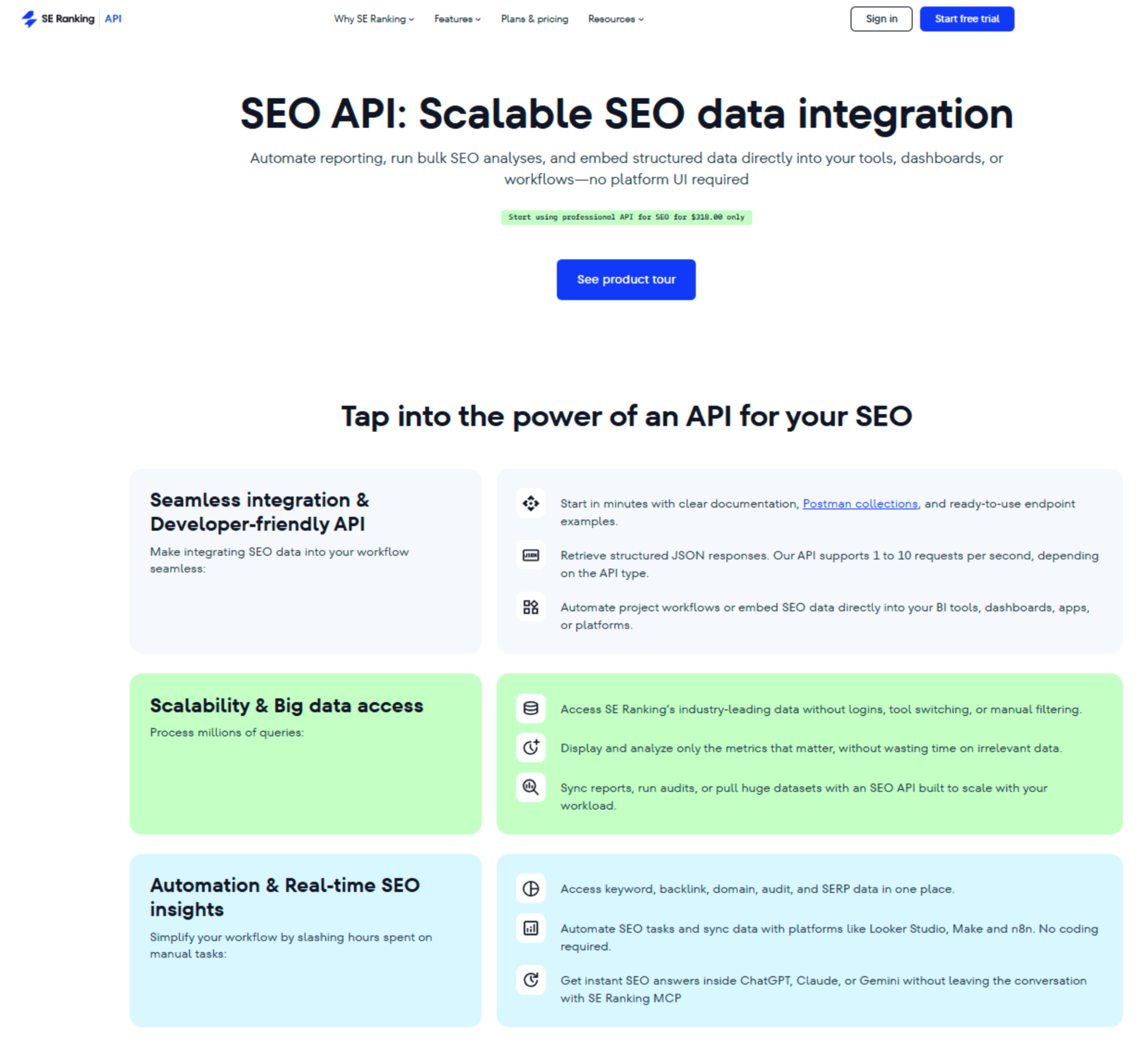
SE Ranking stands out among DataForSEO alternatives because it combines a full SEO & GEO platform interface with two distinct APIs: a Data API for large-scale data retrieval and a Project API for automating SEO workflows inside the platform.
Most tools force you to choose between a pretty dashboard and raw data access. SE Ranking bridges that gap by offering both. This makes it especially valuable for agencies that need to build custom workflows while still relying on a structured system for execution and reporting.
Another important point is that SE Ranking goes beyond traditional SEO APIs with a dedicated system for AI search visibility tracking. It lets you track how brands and domains appear across LLMs. SE Ranking also includes pre-built connectors for Make, n8n, and Looker Studio, plus an MCP server that lets you query live SEO data directly inside AI assistants like Claude or ChatGPT, without manual exports.
Key API Endpoints & Features
The Data API setup organizes functionality into several core areas:
- Domain Analysis. You get aggregated SEO metrics for domains, including estimated organic traffic, keyword visibility, and ranking distribution across different position ranges. Useful for competitive benchmarking when building client-facing dashboards.
- Keyword Research. You get keyword ideas, including related queries and variations. This helps with content gap workflows and opportunity modeling at scale.
- Backlinks. You get data on referring domains and backlinks, including key quality and authority indicators. This endpoint is used to analyze backlink profiles and assess link-building opportunities or risks.
- Website Audit. You get an overall site health score and detailed issue breakdowns for prioritization. It crawls websites to identify technical SEO issues such as broken links, indexing problems, and on-page optimization gaps.
- AI Search API. This is the most distinctive part of SE Ranking’s API offering. Endpoints here let you pull an AI search overview for a brand, retrieve the leaderboard showing Share of Voice across AI engines, discover which prompts surface a given brand, and compare brand visibility against competitors across ChatGPT, Gemini, Perplexity, AI Overviews, and AI Mode. For teams building automated GEO reporting, this is what makes SE Ranking meaningfully different from a pure data scraping provider.
The Project API enables automation of SEO workflows within SE Ranking. Users can:
- Create and manage projects, keywords, and search engines
- Retrieve ranking data and historical performance
- Organize keyword groups, project groups, and competitors
- Manage sub-accounts and client access
- Run and monitor website audits, including full audit lifecycle and history
- Access traffic and performance data (including Google Search Console insights)
- Manage backlinks, including import, grouping, and disavow workflows
It also includes the AI Result Tracker API for existing projects to track presence across LLMs, monitor prompts and visibility across engines, retrieve full AI answers and cited sources, analyze share of voice and rankings/
SE Ranking provides a Postman collection to help developers quickly test and integrate API endpoints.
MCP Server Connection
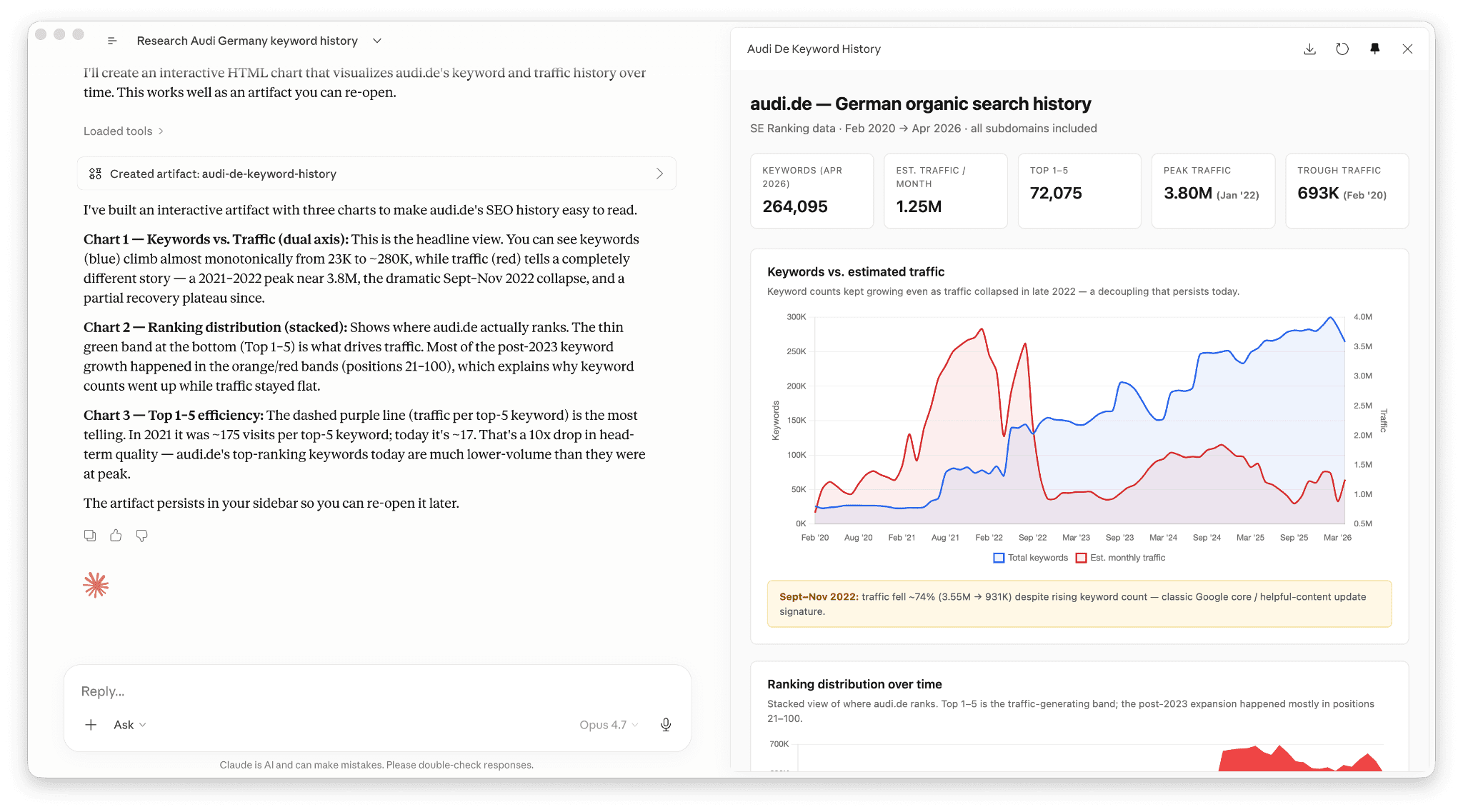
SE Ranking has an MCP server, which matters if you’re building agentic workflows where an AI assistant needs live data without manual exports. With MCP, you can query SEO data using plain English right from ChatGPT, Claude, Gemini, Cursor, and any other AI assistant you use. For example, instead of exporting data manually, you can ask an AI assistant to analyze competitors, find keyword opportunities, or generate reports, and it will retrieve the data directly via the API.
Pros and Cons
Pros:
- Backlinks, keyword research, domain analysis, website audit, AI Search, Project Management API run from a single credit balance under one subscription.
- AI Search API goes beyond mention tracking. The Leaderboard endpoint benchmarks up to 10 competitors across all major LLMs simultaneously; Prompts by Brand and Prompts by Target show exactly which queries surface a domain in AI results.
- Broader data coverage (188 countries, 420M domains, 6B pages crawled daily) with databases running up to 10x larger than DataForSEO’s in specific markets.
- Predictable pricing: pay-as-you-go for low-volume workloads, volume-based discounts for recurring workflows.
- Pre-built connectors for Make, n8n, and Looker Studio for no-code workflow automation.
- Free 14-day trial with 100K API credits and full endpoint access from day one
Cons:
- No first-party SDKs. Integration relies on a Postman collection and REST reference rather than native client libraries
- Default RPS (requests per second) are lower than DataForSEO’s. You might need to contact support to increase them
- Migrating from DataForSEO means remapping endpoints. Existing integrations will need to be updated
Pricing
SE Ranking includes API in every pricing plan. You can also start with a $50 minimum deposit with credits that don’t expire. It’s also available as an add-on starting at $149/month and as a standalone product at $179/month for higher-volume needs.
Pricing scales with usage. Low-volume workloads can run on a pay-as-you-go basis; teams with recurring workflows get volume-based rates where the cost per action decreases as usage grows.
You can also test the API during a 14-day trial period for free.
2. SerpAPI
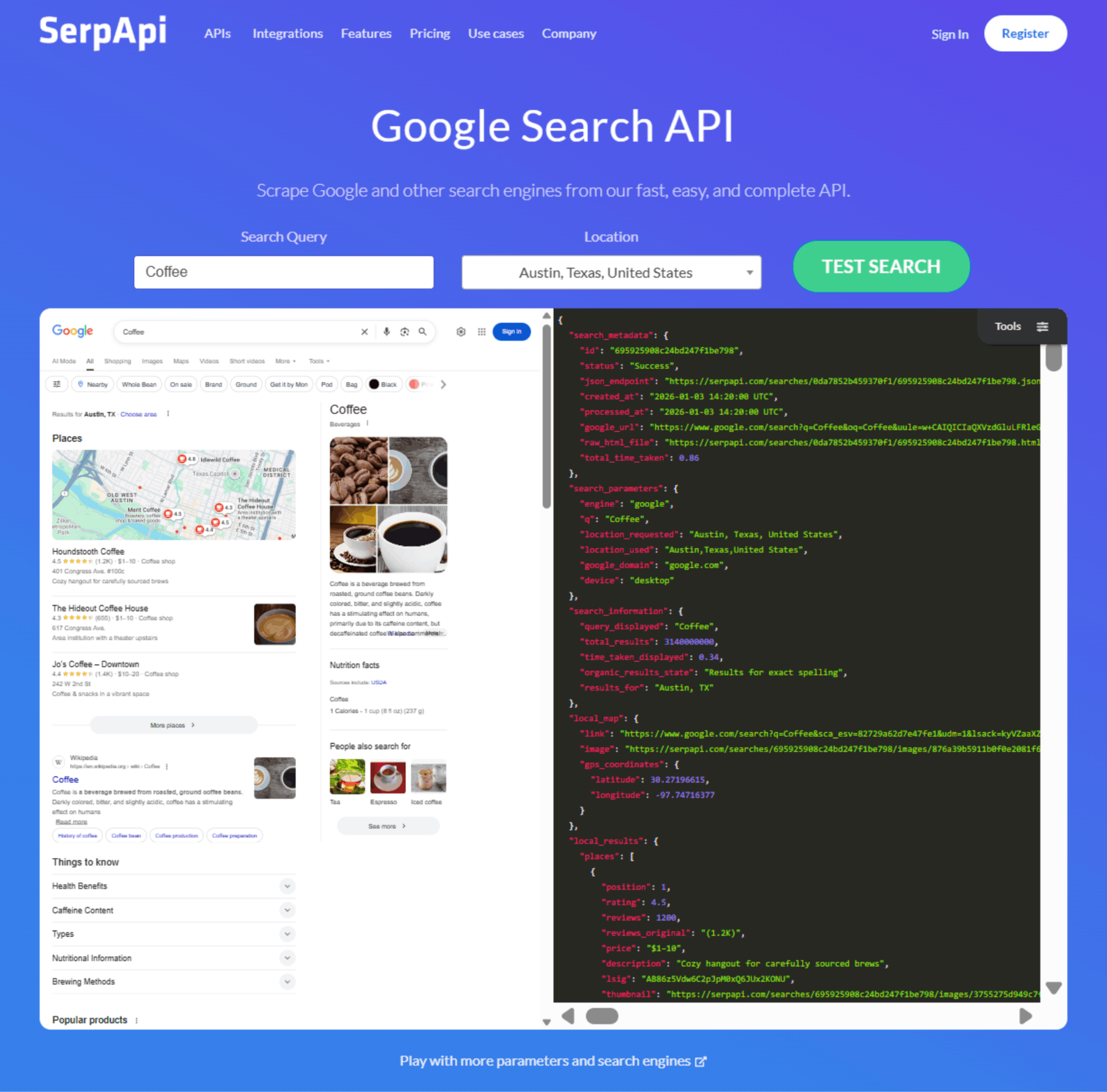
SerpAPI is a good choice among DataForSEO alternatives for those who prioritize real-time data parsing and breadth of search engine coverage over all-in-one platform features. In 2026, SerpAPI has expanded its supported engines to over 100, including niche platforms like Baidu, Naver, and specialized Google endpoints like the Ads Transparency Center and Google Lens. It is fundamentally a developer-first tool, designed to return a pixel-perfect JSON representation of what a human sees in a browser.
SerpAPI is best for developers under 5k requests/month or needing non-Google engines (Bing, YouTube, Baidu, etc.).
Key Features
- SerpAPI can extract structured data from virtually any element on a search page, including knowledge graphs, local maps, shopping results, and the latest AI Overview panels.
- Its U.S. Legal Shield provides legal protection under the hiQ Labs v. LinkedIn precedent, giving enterprise users peace of mind when scraping public data at scale.
- SerpAPI’s architecture is optimized for speed and reliability, featuring a global infrastructure that maintains a 99.9% uptime SLA and supports up to 100 requests per second in production environments.
- SerpAPI introduced an AI Mode and specialized AI Overview endpoints, catering directly to the needs of developers building RAG (Retrieval-Augmented Generation) pipelines that require real-time web knowledge.
- Its documentation is widely considered the gold standard in the industry, offering native libraries for Python, Ruby, Node.js, and several other languages.
Pros and Cons
Pros:
- SerpAPI offers fast onboarding.
- SerpAPI maintains high quality of its JSON output and the zero-maintenance requirement for its parsers.
- When search engines change their HTML structure, SerpAPI updates its extraction models within minutes, preventing breakages in downstream applications.
- Its massive engine support (100+ engines), covering everything from Google Scholar to Walmart and eBay, makes it a versatile tool for cross-platform market intelligence.
Cons:
- SerpAPI is strictly a data extraction service.
- For high-volume SEO operations pulling millions of requests, SerpAPI can be 10 to 20 times more expensive than DataForSEO’s standard queue.
- SerpAPI does not provide its own keyword or backlink databases, requiring users to look elsewhere for historical SEO metrics.
Pricing
SerpAPI uses a traditional tiered subscription model. While it lacks the extreme cost-efficiency of DataForSEO’s standard queue at the highest volumes, it offers the most generous free tier for prototyping and low-volume projects.
Monthly Cost
$0
Search Volume
250 Searches
Cost per Search
$0.00
Monthly Cost
$75
Search Volume
5,000 Searches
Cost per Search
$0.015
Monthly Cost
$150
Search Volume
15,000 Searches
Cost per Search
$0.01
Monthly Cost
$275
Search Volume
30,000 Searches
Cost per Search
$0.009
$0
250 Searches
$0.00
$75
5,000 Searches
$0.015
$150
15,000 Searches
$0.01
$275
30,000 Searches
$0.009
A critical pricing nuance for SerpAPI is that unused searches do not roll over to the next billing cycle. For teams with fluctuating demand, this can lead to an effective cost per search that is significantly higher than the advertised rate—sometimes reaching $0.05 per search at low utilization levels.
3. Bright Data SERP API
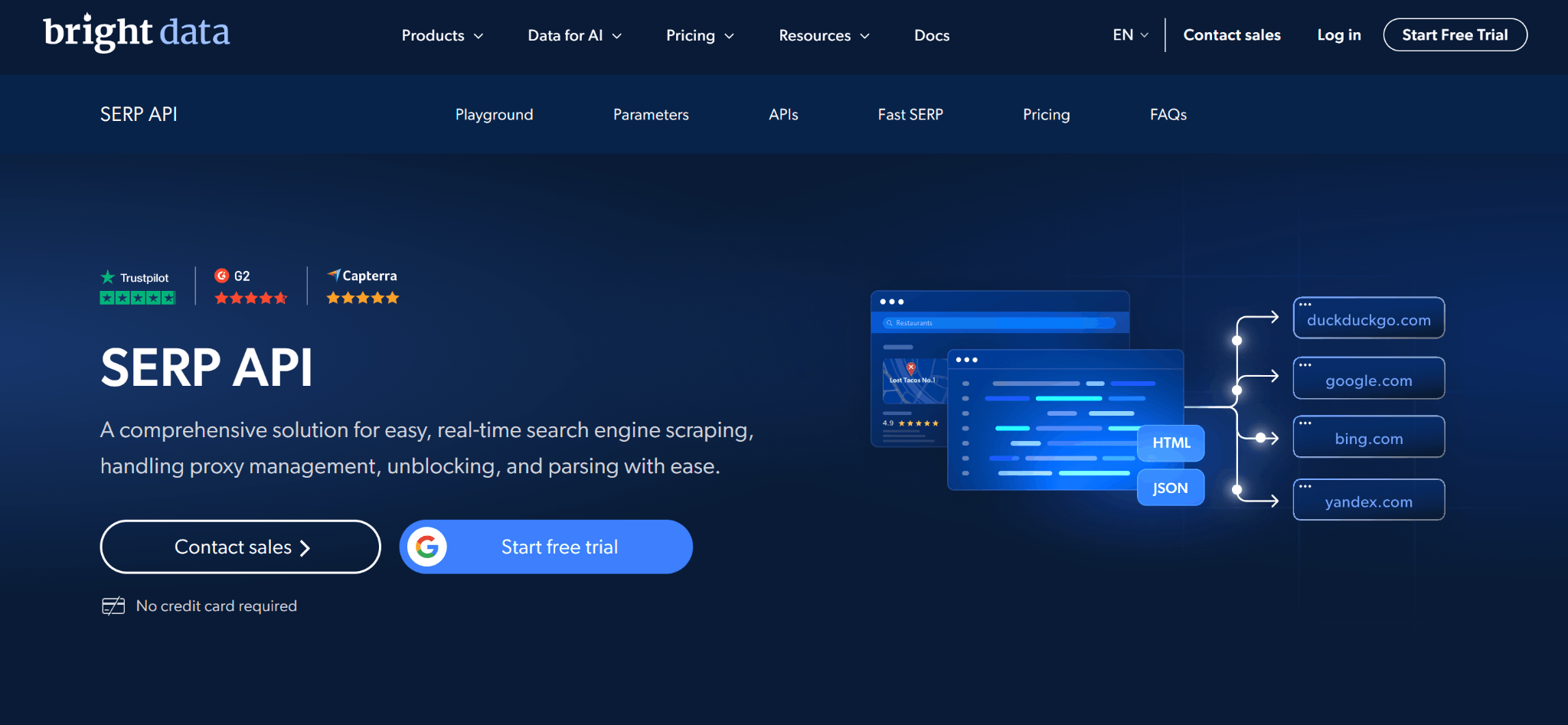
Bright Data has transitioned from being the world’s largest proxy network to a comprehensive web data platform. Its SERP API in 2026 is built on an infrastructure of over 150 million residential IPs. It is the most resilient option for bypassing the aggressive anti-bot measures and geographic blocks that major search engines have implemented. This software is specifically engineered for enterprise-scale scraping where success rates and geographic precision are the only metrics that matter.
Bright Data SERP API is best for enterprise teams needing anti-bot handling at scale.
Key Features
- Bright Data SERP API offers Web Unlocker technology, which automatically handles CAPTCHA solving, browser fingerprint rotation, and request throttling.
- Bright Data SERP API allows users to retrieve search results from any city in the world, seeing content exactly as a local user would, which is essential for verifying local ad placements or regional pricing.
- Bright Data has heavily invested in AI agent compatibility.
- Bright Data MCP server enables LLMs to invoke its scraping tools as native functions, allowing an agent to “scrape_as_markdown” or “scrape_as_html” from JavaScript-heavy sites with a single natural-language command.
- Claude Skills integration allows Bright Data’s tools to work in tandem with the AI’s internal reasoning, enabling complex tasks like downloading localized news videos or generating competitive heatmaps from live SERP data.
Pros and Cons
Pros:
- Bright Data’s unrivaled IP pool and 99.99% uptime SLA make it the most reliable tool for mission-critical data pipelines.
- Its compliance with GDPR, CCPA, and ISO 27001 is a non-negotiable requirement for many enterprise procurement departments.
- The availability of over 120 pre-built scrapers for platforms like Amazon and LinkedIn allows teams to expand their data collection beyond SERPs with minimal additional development.
Cons:
- A highly complex interface has a steep learning curve for non-technical users.
- Bright Data SERP API pricing is at a significant premium, as it is not the cheapest option for scraping basic, unprotected sites where simpler tools might suffice.
- Bright Data SERP API requires a complex setup.
- Bright Data SERP API does not offer SEO-specific endpoints (keywords, backlinks).
Pricing
Bright Data employs a consumption-based pricing model that rewards scale. While its entry-level subscription prices are high, it offers a “Pay As You Go” tier that allows for zero-commitment testing.
Monthly Cost
$0
SERP API Rate (per 1k)
$1.50
Monthly Cost
$499
SERP API Rate (per 1k)
$1.30
Monthly Cost
$999
SERP API Rate (per 1k)
$1.1
Monthly Cost
$1999
SERP API Rate (per 1k)
$1
$0
$1.50
$499
$1.30
$999
$1.1
$1999
$1
A unique and highly valued pricing feature in 2026 is Bright Data’s pay-per-success policy. Users are only billed for requests that return a successful status code and valid data, ensuring that budget is not wasted on blocked requests or network failures.
4. Ahrefs API
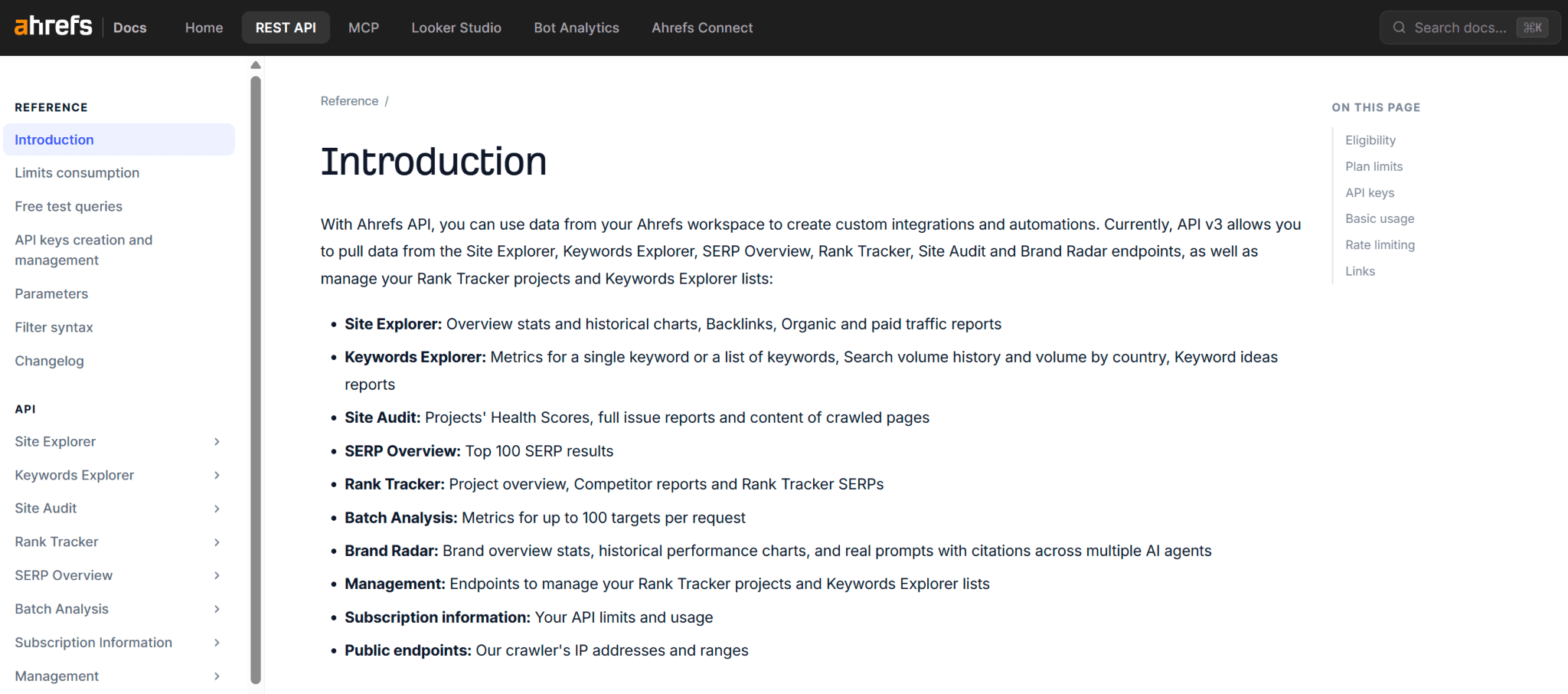
The Ahrefs API remains the gold standard for backlink analysis and organic keyword intelligence, powered by a database of 28.7 billion keywords. In 2026, the transition to API V3 introduced more granular control over data consumption and powerful new endpoints designed to track brand visibility in the age of AI search.
Ahrefs API is the best for teams already on Ahrefs Enterprise who need programmatic backlink/keyword data.
Key Features
- Ahrefs V3 API provides deep programmatic access to its core modules, including Site Explorer, Keywords Explorer, and Rank Tracker.
- The Brand Radar system tracks how brands are mentioned and cited across over 100 million AI prompts.
- Developers can now use the API to pull cited pages and cited domains from AI responses, allowing them to automate the tracking of which competitors are winning the Share of Voice within ChatGPT or Google AI Overviews.
- Ahrefs provides a hosted MCP server, enabling users on Lite plans or higher to connect their Ahrefs data directly to AI assistants.
- Hosted MCP server enables natural-language queries within AI assistants that can perform complex backlink gap analysis or import multi-year keyword history into a rank tracking project with a single command.
- For data-intensive operations, the Batch Analysis endpoint allows for the evaluation of metrics for up to 200 URLs simultaneously, significantly reducing the number of individual API calls required.
Pros and Cons
Pros:
- The Ahrefs MCP server is available for all paid plans.
- The Ahrefs API is unrivaled for the freshness and size of its link index, which is updated every 12 hours for active link growth tracking.
- Its new Brand Radar features provide the most mature data available for tracking visibility within the LLM ecosystem.
- The documentation for V3 is excellent.
- Unit-based consumption allows users to optimize costs by requesting only specific fields rather than entire data rows.
Cons:
- Prohibitive cost for small-to-medium-sized businesses.
- The lack of a true pay-as-you-go model and the mandatory annual commitment for enterprise tiers make it significantly less accessible than DataForSEO.
- Users are limited to 60 requests per minute across all tiers, which can be a bottleneck for very high-volume real-time applications.
- Ahrefs does not support raw SERP data.
Pricing
Ahrefs pricing in 2026 is heavily segmented by plan tier, with API access becoming increasingly expensive as data volume requirements grow. It is essentially an enterprise-first model. Moreover, there are no public prices. So you need to contact the sales department.
A major barrier for many is that full programmatic API access (beyond basic Ahrefs Connect integrations) requires an Enterprise subscription. It involves a $1,499 monthly commitment billed annually.
5. Semrush API
Semrush is a good choice among DataForSEO alternatives for those who need software focused on providing data that spans SEO, PPC, social media, and AI Search visibility. Its API is widely used by the world’s largest marketing teams to power internal dashboards and proprietary competitive intelligence models.
Semrush API is the best for teams already on Semrush who need programmatic backlink/keyword data.
Key Features
- The Semrush API suite is divided into the Standard API (SEO and Projects) and the Trends API (Market Intelligence).
- In 2026, the platform launched the AI Visibility Index, which analyzes 2,500 prompts across major industries to identify which brands are being recommended by LLMs.
- The API provides specialized Intent columns (Informational, Navigational, Transactional, Commercial), allowing developers to programmatically segment traffic based on user search behavior.
- The Semrush MCP connector is an official, OAuth-based product that allows AI tools a secure, direct connection to live keyword and traffic data.
- Semrush MCP connector enables agentic workflows that can validate new feature ideas against real-time search behavior or detect competitor growth trends before they manifest in standard monthly reports.
Pros and Cons
Pros:
- Semrush provides the most diverse dataset in the market, making it the best choice for organizations that need to correlate SEO performance with paid media spend and market-wide traffic trends.
- Its Semrush One plan offers a unified entry point into AI visibility tracking, providing a cost-benefit advantage for those who would otherwise buy separate tools for rank tracking and AEO monitoring.
- Semrush offers good documentation.
Cons:
- Adding team members can cost between $45 and $100 per month per seat.
- The entry cost for API access ($500/month) is high.
- The platform has a steep learning curve due to the sheer volume of available metrics and reports.
- Semrush does not support raw SERP data.
- Semrush does not support LLM tracking with API (AIO only).
Pricing
API access in the Semrush ecosystem is primarily gated behind the Business plan, which positions it as a high-tier investment for serious marketing organizations.
Monthly (Annual)
$139.95
API Access
No (Project API only)
Daily Analytics Reports
3,000
Monthly (Annual)
$249.95
API Access
No (Project API only)
Daily Analytics Reports
5,000
Monthly (Annual)
$499.95
API Access
Yes
Daily Analytics Reports
10,000
Monthly (Annual)
$549
API Access
Varies by tier
Daily Analytics Reports
Included AI Visibility
$139.95
No (Project API only)
3,000
$249.95
No (Project API only)
5,000
$499.95
Yes
10,000
$549
Varies by tier
Included AI Visibility
For organizations that only need market traffic data without a full SEO toolkit, Semrush offers the Trends API as a standalone purchase. This is unique among enterprise competitors, as it allows users to buy Trends API units directly to replenish their balance without an active recurring subscription.
6. SimilarWeb API
SimilarWeb is the industry leader for traffic intelligence and digital market share data. It does not work with SERP or SEO data. Its API (DigitalRank API) is the foundational data source for companies that need to understand the absolute volume and quality of traffic going to any website or mobile app. It is favored by investment analysts, product managers, and enterprise growth teams.
SimilarWeb API is the best for searchers who need traffic estimation, audience insights, and industry benchmarking.
Key Features
- The SimilarWeb API offers unmatched granularity in web traffic analysis, including visits, page views, bounce rates, and session duration across both desktop and mobile platforms.
- Its Agentic AI focus has led to the development of an MCP server that provides AI systems with context-rich access to digital market data.
- SimilarWeb API allows AI agents to autonomously identify emerging market patterns and forecast shifts in consumer behavior by interpreting clickstream data.
- The platform’s data coverage includes over 100 million websites, 5 billion keywords, and 4 million mobile apps.
- Specialized APIs like the Technographics API allow users to see the underlying tech stack of any website, while the Shopper Intelligence API provides product-level performance metrics for major e-commerce marketplaces like Amazon.
Pros and Cons
Pros:
- SimilarWeb is the only tool that provides a truly comprehensive view of where traffic is coming from and how it behaves once it arrives on a site.
- SimilarWeb focuses on innovative AI solutions, making it a critical partner for firms building high-level market simulation models.
- SimilarWeb offers different industry benchmarks.
Cons:
- SimilarWeb is not an SEO API (no keywords, backlinks, SERPs).
- High cost makes it inaccessible for the vast majority of small agencies and individual SEO professionals.
- Data accuracy for very small websites (low traffic) is weak compared to high-fidelity data for mid-to-large-market sites.
Pricing
SimilarWeb uses an enterprise contract model where pricing is largely opaque and tailored to specific data modules and user counts. It is significantly more expensive than standard SEO APIs.
How to Choose the Right DataForSEO Alternative
Selecting the best one solution among DataForSEO alternatives depends on whether your organization prioritizes cost-efficiency at extreme scale or high-fidelity insights for a specific niche. DataForSEO pricing is divided into three-speed tiers ($0.0006 to $0.002 per SERP) and remains the benchmark for budget-conscious developers. However, as you look for an alternative to DataForSEO, the following table will help you to decide.
For the majority of mid-sized agencies and mid-market SEO teams in 2026, SE Ranking is the superior choice among DataForSEO alternatives. It is the only platform that offers a professional-grade SEO dashboard alongside a high-scale API that includes dedicated AI Search visibility tracking. Its integration with the MCP makes it the most ready-to-use solution for teams wanting to deploy AI agents immediately.
SE Ranking
AI Search + Value
SerpAPI
100+ Engines
Bright Data
Proxy/Anti-Bot
Ahrefs
Backlink Depth
Semrush
Market Intel
SimilarWeb
Traffic Volume
SE Ranking
Yes (Official)
SerpAPI
Yes (Official)
Bright Data
Yes (Official)
Ahrefs
Yes (Hosted)
Semrush
Yes (Official)
SimilarWeb
Yes (Official)
SE Ranking
$50/mo
SerpAPI
$75/mo
Bright Data
$499/mo
Ahrefs
$129/mo
Semrush
$499.95/mo
SimilarWeb
N/A
SE Ranking
Agencies & AI
SerpAPI
Developers
Bright Data
Enterprise
Ahrefs
SEO Specialists
Semrush
Large Orgs
SimilarWeb
Investors
AI Search + Value
100+ Engines
Proxy/Anti-Bot
Backlink Depth
Market Intel
Traffic Volume
Yes (Official)
Yes (Official)
Yes (Official)
Yes (Hosted)
Yes (Official)
Yes (Official)
$50/mo
$75/mo
$499/mo
$129/mo
$499.95/mo
N/A
Agencies & AI
Developers
Enterprise
SEO Specialists
Large Orgs
Investors
The transition to agentic search means that data must now be delivered in a way that AI models can understand and act upon. While DataForSEO provides the raw materials, SE Ranking has built the cognitive layers (sentiment analysis, share of voice, and citation tracking). They allow AI agents to move from mere data collection to recommendations.
FAQ
Q1: What is the best DataForSEO alternative?
The best among DataForSEO alternatives is the SE Ranking API. In 2026, it stands out by combining comprehensive traditional SEO endpoints (rankings, backlinks, audits) with high-fidelity AI search visibility tracking. Its native MCP server integration allows AI agents to query search data directly in natural language.
Q2: What is API in SEO?
An SEO API provides programmatic access to search engine data. It allows developers to retrieve keyword metrics, backlink profiles, SERP rankings, and technical audit data without using a graphical interface.
Q3: Is there a free SEO API?
Yes, but they are generally limited to small-scale testing. SE Ranking offers a 14-day free trial with 100,000 credits. SerpApi provides a permanent free tier of 250 searches per month. DataForSEO provides a free sandbox environment with $1 in credits to test its output.
Q4: What is the best SERP API for AI agents?
For AI agents, SE Ranking and DataForSEO are both leaders due to their robust MCP server integrations. However, SE Ranking adds a layer of value by providing dedicated endpoints for AI search visibility that track how LLMs cite and recommend brands. This feature is essential for agents focused on Answer Engine Optimization (AEO).
Q5: How does DataForSEO pricing work?
DataForSEO uses a pay-as-you-go model with three speed tiers for its SERP API. Standard tier (Normal) costs $0.0006 per SERP (5-minute latency). Priority tier costs $0.0012 (1-minute latency). Live Mode tier costs $0.002 (6-second latency). There are no monthly fees, but a $50 minimum deposit is required to start.
Conclusion
The evolution of the search data market in 2026 has provided SEO professionals with a wealth of specialized DataForSEO alternatives. While DataForSEO remains the undeniable cost leader for high-volume, standard-queue scraping, the needs of modern organizations have expanded toward integrated intelligence. So:
- SE Ranking is the #1 recommendation for teams that want a comprehensive SEO API combined with the most advanced AI search visibility tracking available in 2026.
- SerpAPI remains the premier choice for developers who need extreme breadth across over 100 different search engines with perfect JSON parsing.
- Bright Data is the non-negotiable choice for enterprises requiring global residential proxy coverage and high-tier anti-bot resilience.
- Ahrefs, Semrush, and SimilarWeb provide the strategic big data layers (backlink fresh indices, market-wide traffic Behavior, and complex PPC insights) that form the foundation of high-level digital strategy.
As AI agents become the primary gatekeepers of information, the APIs that can most accurately measure brand sentiment and citation frequency will become the most essential tools in the marketer’s arsenal. We encourage you to try the SE Ranking API and its 14-day free trial!