How to advertise on ChatGPT: A practical guide based on our first 97,000 ad impressions
ChatGPT Ads can put a brand in front of people while they are comparing products, researching a problem, or deciding what to do next. That sounds close to paid search, but the mechanics are different enough that copying a Google Ads campaign structure is unlikely to work.
We learned the difference firsthand.
In June 2026, SE Ranking tested ChatGPT Ads across the US, Canada, Australia, and New Zealand. Three campaigns, eight ad groups, and 48 ads generated 97,131 impressions and 1,263 clicks, with an average CTR of 1.30%.
The traffic looked promising. The business result did not: the campaigns produced almost no sign-ups. We stopped the test before spending the full planned budget.
That experience shaped this guide. Below, we explain how ChatGPT advertising works, how to build a campaign around conversational intent, what to measure before launch, and what we would do differently if we ran the same test today.
-
ChatGPT Ads is OpenAI’s platform that allows businesses to advertise within AI conversations.
Unlike search ads, it matches ads to the context and intent of a conversation rather than an exact query.
-
ChatGPT Ads launched in the US on February 9, 2026, and is now available in 40 markets.
Ads are shown to logged-in adults on Free and Go plans, while Plus, Pro, Business, Enterprise, and Edu accounts remain ad-free.
-
ChatGPT Ads supports three campaign objectives: Reach, Clicks, and Conversions.
Advertisers can also use contextual targeting, negative keywords, custom audiences, conversion tracking, and product feeds.
-
Setting up a ChatGPT Ads campaign involves six main steps.
Create an advertiser account, install conversion tracking, choose a campaign objective, set the budget and markets, build ad groups with targeting, and add the ads before reviewing and launching the campaign.
-
For ChatGPT Ads, targeting = conversation context + keywords.
Describe the audience, task, and situation, add keyword-style phrases, and use negatives to filter out similar but irrelevant contexts.
-
ChatGPT Ads delivery can be highly uneven.
In SE Ranking’s test, just two of eight ad groups generated around half of all impressions. So, ad delivery depends heavily on the volume of conversations matching each ad group’s targeting.
-
ChatGPT Ads clicks do not always translate into meaningful product demand.
SE Ranking’s campaign generated 1,263 clicks but almost no sign-ups. This shows why CTR and traffic alone are not enough to judge performance.
-
ChatGPT Ads provides limited information for diagnosing targeting problems.
Advertisers cannot see the queries or conversations that triggered their ads, so they must test different context hints and measure how performance changes.
-
ChatGPT Ads may currently be better suited to consumer, prosumer, and e-commerce products.
B2B SaaS companies should treat it as an additional experiment, especially if many of their ideal customers use paid, ad-free ChatGPT plans.
One note on timing: SE Ranking ran its test in June 2026, and OpenAI has introduced several significant changes to its advertising platform since then. This article includes the latest information available, while our firsthand observations reflect how Ads Manager worked during the test. Since the platform is evolving quickly, check OpenAI Ads Manager, the ChatGPT Ads Help Center, and the current ad policies before launching your campaign.
How ChatGPT Ads work
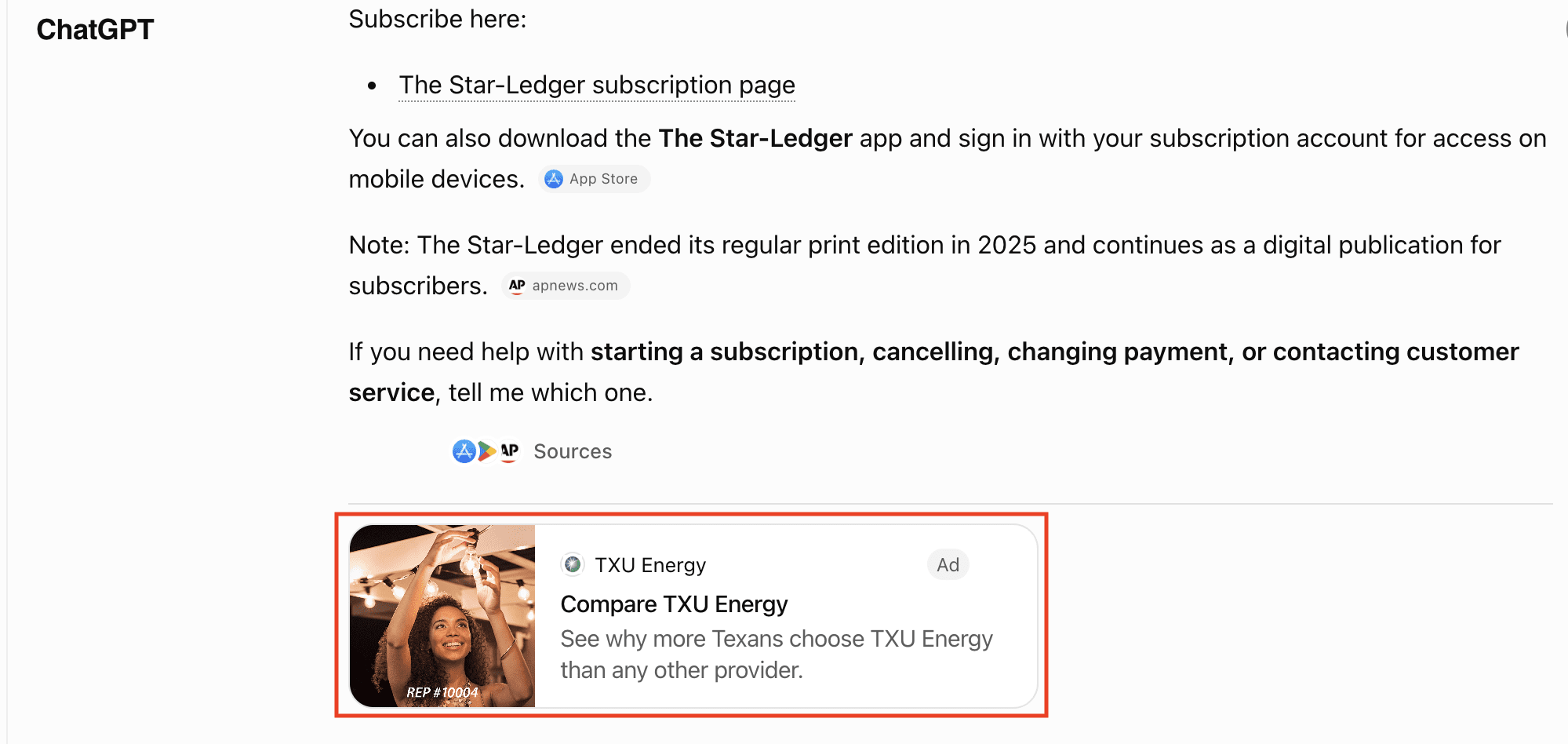
ChatGPT Ads is a conversational ad format that places a labeled sponsored card below a ChatGPT response when the conversation matches an advertiser’s targeting context.
A standard ad can include the advertiser’s name and favicon, a title, a short description, a landing page, and an image.
OpenAI says its delivery system considers expected relevance and outcomes. Signals can include:
- the context and intent of the current conversation
- the ad group’s context hints
- the ad title and copy
- the content of the landing page
- when ad personalization is enabled, select signals from the user’s broader ChatGPT experience
Advertisers do not receive the user’s conversation or a search-term-style report. Reporting is aggregated. That protects conversation privacy. It also removes one of the main diagnostic tools paid search teams rely on.
What you can optimize for with ChatGPT Ads
ChatGPT Ads currently supports three campaign objectives:
Buying model
CPM
Best suited to
Awareness and exposure
Important details
You pay per 1,000 impressions. Some Ads Manager screens and help articles label this objective Views, so confirm which term appears in your account.
Buying model
CPC
Best suited to
Traffic and engagement
Important details
You pay per valid click. OpenAI currently suggests a starting maximum CPC of $3–$5, although the appropriate bid depends on your market.
Buying model
oCPC
Best suited to
Sign-ups, purchases, or other tracked actions
Important details
Delivery optimizes toward one standard conversion event. Billing remains based on valid clicks.
CPM
Awareness and exposure
You pay per 1,000 impressions. Some Ads Manager screens and help articles label this objective Views, so confirm which term appears in your account.
CPC
Traffic and engagement
You pay per valid click. OpenAI currently suggests a starting maximum CPC of $3–$5, although the appropriate bid depends on your market.
oCPC
Sign-ups, purchases, or other tracked actions
Delivery optimizes toward one standard conversion event. Billing remains based on valid clicks.
The auction is relevance-weighted and uses a second-price mechanism. A higher bid may improve delivery, but it does not replace relevance. The product, context hints, creative, and landing page still need to make sense together.
Who can see ChatGPT Ads
Ads now appear for Free and Go users. Paid professional plans do not carry them. Accounts identified as belonging to users under 18 are excluded. Free users can also opt out of ads in exchange for fewer daily messages.
Every layer of that narrows the audience you can attract. For a B2B product, it narrows it in the direction of your least qualified prospects.
Where ChatGPT Ads are available
As of August 31, 2026, ChatGPT Ads are available in more than 40 countries through Ads Manager, OpenAI’s Ads Solutions team, agencies, and technology partners.
Self-service Ads Manager access was initially limited to markets including the United States, Canada, Australia, New Zealand, the United Kingdom, Mexico, Brazil, Japan, and South Korea. OpenAI is now expanding direct Ads Manager access across India, Europe, the Middle East, and North Africa.
Because this rollout began on August 31, availability may not appear in every eligible advertiser account immediately. Check the current location options in Ads Manager before planning a campaign for a particular market.
Before you launch: decide whether ChatGPT Ads fits your offer
The first question is not “What should our context hints say?” It is “Can this channel realistically reach and convert our audience?”
Use the following three checks before allocating a test budget.
1. Is your ICP likely to use an ad-supported ChatGPT plan?
As we’ve already mentioned, ads currently reach Free and Go users, not users on Plus, Pro, Business, Enterprise, or Edu accounts.
For broad consumer offers, that still leaves a large pool of potential customers. For professional software, enterprise services, or products aimed at intensive AI users, it may exclude a meaningful share of the strongest prospects.
This does not automatically rule out B2B campaigns. It changes the hypothesis. Instead of assuming ChatGPT reaches your whole ICP, identify the ad-eligible segment you can realistically reach (for example, freelancers, early-stage teams, students entering a profession, or prospects still exploring a category).
2. Does your product fit an exploratory conversation?
ChatGPT users often explain a goal, constraints, and preferences before choosing an option. Offers that help someone compare, plan, learn, or solve a defined problem have a natural opening.
Strong use cases may include:
- consumer products with several attributes to compare;
- travel, experiences, and local services;
- education and digital products;
- tools that solve a specific, clearly described task;
- e-commerce catalogs with enough products to match different needs.
A weaker fit is a product that depends on a very narrow professional audience, has little conversational demand, or requires a long enterprise buying process before a user can take a measurable action.
3. Is the offer allowed and suitable for the placement?
OpenAI’s ad policies apply to the creative, image, and landing page as one connected experience. Some sensitive or regulated categories are restricted or reviewed case by case. Check eligibility before building campaigns, especially for healthcare, finance, legal services, dating, alcohol, gambling, political content, or products involving sensitive claims.
How to set up a ChatGPT Ads campaign
Create an account at OpenAI Ads Manager before building the campaign. Use a work email, add the brand logo and billing profile, complete account verification, and invite any teammates who need access.
Step 1: Set up measurement before campaign creation
Measurement should be the first implementation task, not a post-launch fix.
OpenAI currently offers a browser-based Measurement Pixel and a server-side Conversions API. OpenAI describes the Conversions API as the more reliable source where it can be implemented. If the same event is sent by the browser and server, use consistent event IDs so the platform can deduplicate it.
A practical measurement setup has three layers:
- OpenAI conversion measurement. Install the Pixel, Conversions API, or both. Verify that the chosen standard event is active and firing correctly.
- Independent analytics. Add UTMs to every destination URL so ChatGPT Ads traffic is visible in GA4, Matomo, or your analytics platform.
- CRM or revenue tracking. Store the source, campaign, ad group, and creative identifiers with each lead so you can evaluate quality and downstream revenue.
A simple UTM convention might look like this:
utm_source=chatgpt
utm_medium=paid_ai
utm_campaign=ai_visibility
utm_content=monitoring_angle
Run a test conversion yourself and confirm it appears in all three layers before you turn anything on.
Step 2: Choose the objective based on the decision you want the system to make
Choose Reach when the real goal is exposure and you can evaluate brand impact separately. Choose Clicks when you need traffic and do not yet have enough reliable conversion data. Choose Conversions when the desired event is configured and occurs often enough to guide optimization.
For oCPC campaigns, there are several easy-to-miss details:
- only one standard conversion event can be selected per campaign;
- custom events are not currently supported as oCPC optimization goals;
- the objective and conversion event cannot be changed after the campaign is created;
- existing CPM or CPC campaigns cannot simply be converted to oCPC;
- the bid cap represents the maximum conversion-oriented bid, but billing remains based on valid clicks.
OpenAI recommends using an event with enough signal and reviewing performance over sufficient volume before making major changes. See the official conversion-optimized campaigns guide for the current setup.
Step 3: Structure campaigns around business goals and ad groups around needs
The account hierarchy is familiar:
- Campaign: objective, budget, dates, geography, platform, and optional audience targeting.
- Ad group: one intent area or use case, with context hints and a bid.
- Ad: title, description, image, and landing page.
The important change is what belongs inside an ad group.
In search advertising, a team might organize keywords by wording or match type. In ChatGPT Ads, organize around a coherent customer situation. If two use cases need different messages or landing pages, they should usually be separate ad groups.
For our test, we used three campaigns, each pointed at a different landing page rather than at the homepage:
- AI Search Visibility: people asking how to track Google AI Overviews, monitor brand mentions across LLMs, or choose an AI visibility platform. Landing page: our AI Overviews Tracker and AI Visibility Tracker pages.
- Agency SEO Operations: agency owners and SEO leads asking about white-label reporting, multi-client rank tracking, and selling GEO or AEO as a service. Landing page: SE Ranking for Agencies.
- Developer API and MCP: technical users asking about SEO data APIs and MCP or AI-workflow integrations. Landing page: our API page.
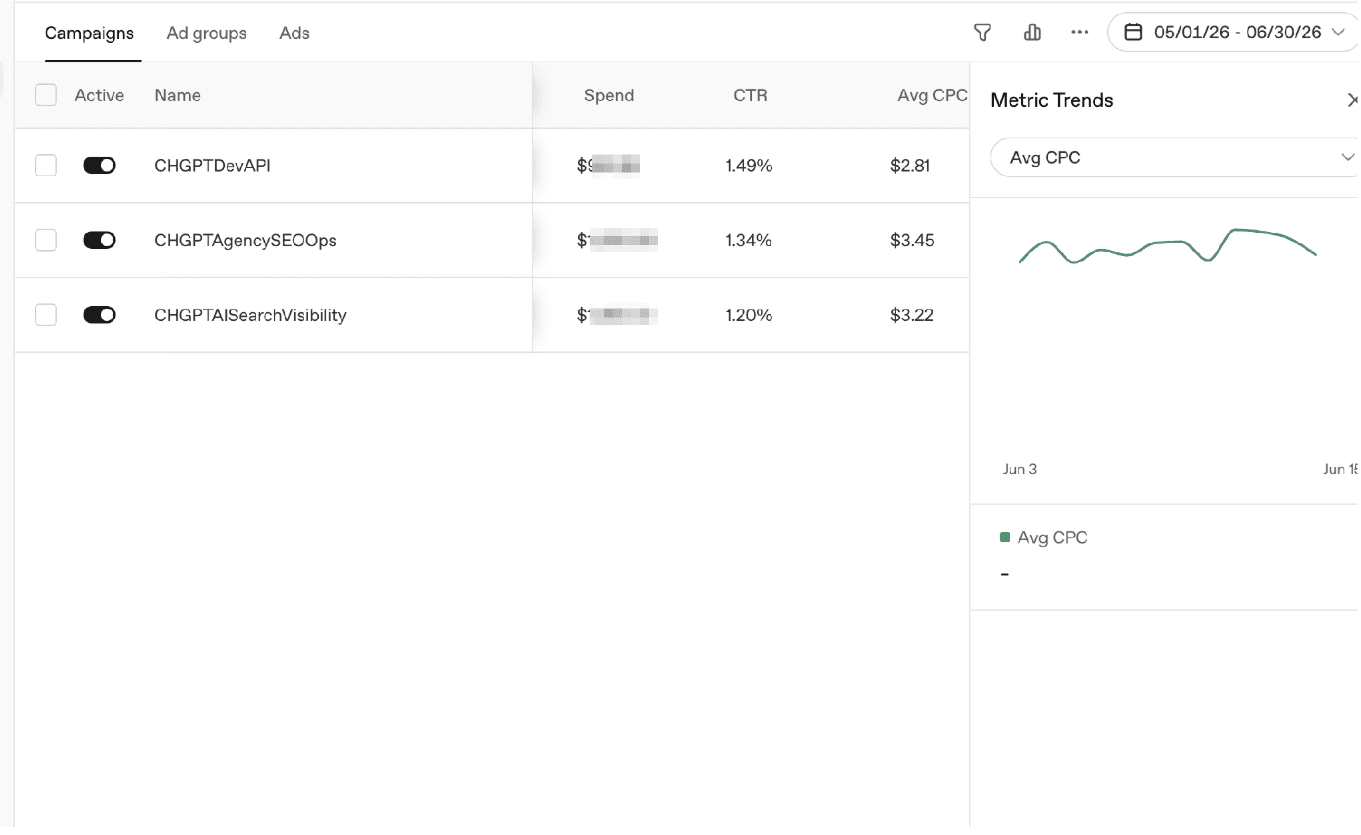
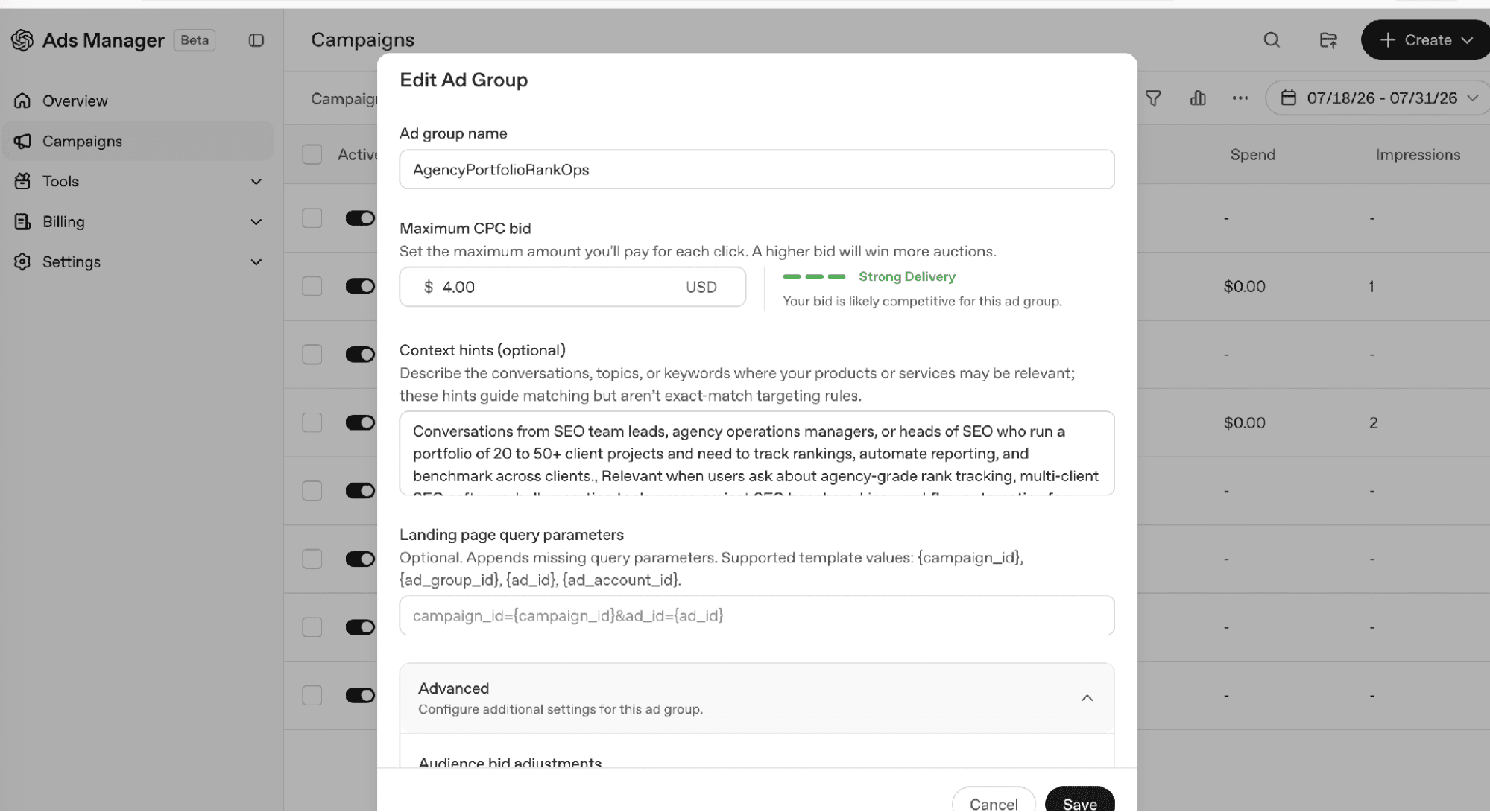
Inside those, we separated themes including AI visibility platform evaluation, LLM brand-mention monitoring, agency white-label reporting, portfolio rank operations, and developer API needs. Bids were set per ad group between $3.00 and $4.00 max CPC.
That gave each ad group a clear hypothesis. It also showed us where conversational volume actually existed. Some themes received tens of thousands of impressions. Others barely served.
Step 4: Write context hints like short customer scenarios
Context hints are the most distinctive part of ChatGPT Ads. They describe what the product offers, who it helps, and when it may be useful.
They are not exact-match keywords, hard audience restrictions, or instructions that guarantee delivery. Think of them as relevance evidence for the system.
A useful formula is: [Audience] + [task or problem] + [situation or constraint] + [relevant product capability]
Weak context hint:
“SEO software, rank tracker, agency reporting”
Stronger context hint:
“Conversations from SEO team leads and agency operations managers who manage 20–50+ client projects and need to track rankings, automate branded reports, or compare performance across client accounts.”
The second version explains the user, the job, the scale, and the reason the product may help. It also stays close to one landing page and one creative promise.
When drafting context hints:
- describe genuine needs and situations, not just demographics;
- include natural variations in how someone might explain the same problem;
- keep one product category or intent area per ad group;
- avoid combining discovery, comparison, troubleshooting, and unrelated use cases in one description;
- add details that are not already obvious from the ad or landing page;
- review every phrase for ambiguous meanings.
In our account, negative keywords were particularly useful for disambiguation. We used them to distinguish MCP from medical or certification topics, GEO from geography, white label from unrelated e-commerce categories, and API from people looking specifically for an OpenAI API key.
Our wider study of 50,006 commercial prompts explains why this matters. We found that 14.35% of placements were no more topically related to their prompt than randomly paired ads. Advertisers cannot inspect the underlying conversations, so precision at setup is one of the few available ways to reduce semantic drift.
Step 5: Build creative coverage, not cosmetic variations
OpenAI recommends using multiple distinct ads within an ad group so the system can find more relevant opportunities. “Distinct” is the important word.
Do not create six ads that repeat the same claim with synonyms. Test meaningfully different reasons to click, such as:
- a specific outcome;
- a use case;
- a differentiating feature;
- proof or breadth of coverage;
- ease of adoption;
- a concrete resource or demo.
At the time of writing, OpenAI recommends titles of 16–24 characters and copy of 32–48 characters, with maximums of 50 and 100 characters, respectively. Images should be square PNG or JPG assets, no larger than 1200 × 1200 pixels. Check the current specifications in the campaign launch guide.
Keep the creative direct. A user has already received a detailed ChatGPT answer, so a vague slogan adds little. Explain what the offer is, who it is for, or what the user can do next.
The image should reinforce the same idea, not introduce another one. A simple product view, recognizable item, or concrete benefit is usually easier to interpret than an abstract brand graphic.
Step 6: Match each ad to the most specific useful landing page
The landing page contributes to both conversion and relevance. Avoid sending every campaign to the homepage.
The ad, context hint, and destination should form one uninterrupted path:
user need → ad promise → landing-page proof → next action
If the context hint describes an agency comparing white-label reporting tools, the ad should mention reporting for agencies and land on an agency or reporting page—not a generic platform overview.
Before launch, check that:
- the page immediately confirms the ad’s promise;
- the CTA matches the user’s likely stage of awareness;
- the page works well on mobile and web;
- UTMs survive redirects;
- the form or purchase event is tracked;
- the page does not block OAI-AdsBot or OAI-SearchBot;
- the creative and destination comply with the same ad-policy category.
OpenAI’s creative guidance recommends linking to product, collection, or content pages that closely match the ad instead of defaulting to a homepage.
Step 7: Set a controlled budget and define stopping rules
Budget behavior changed after our test, and the change matters for anyone reconciling spend. We ran lifetime budgets, which was the model available in June. Automatic intraday pacing arrived in late July.
A daily budget is now an average over a seven-day period rather than a hard per-day cap. Spend can reach up to twice the selected daily amount on an individual day, and total spend will not exceed seven times the daily budget over the applicable seven-day period. If you change the daily budget partway through the week, the seven-day limit is prorated from the latest change through the following Sunday at midnight.
If you built an alert or a client reconciliation script on the assumption that a daily budget is the most a campaign can spend today, that assumption is now wrong by up to 100%.
Separate campaigns when objectives, regions, product categories, or economics differ materially. That makes it easier to stop an underperforming hypothesis without disturbing the rest of the test.
Before launch, write down:
- the maximum total test spend
- the minimum data threshold before making a decision
- the primary conversion and acceptable CPA
- the lead-quality or revenue threshold
- conditions for pausing an ad group
- conditions for expanding the test
This is what protects you from optimizing toward the most flattering metric. In our case, the CPC was genuinely attractive. Our blended average cost per click came in at $3.16, which sits at the very bottom of reported ranges for software ($8–18) and matches OpenAI’s recommended starting bid ($3–5).
At the same time, cost per sign-up landed far above what we accept from paid search in the same geos, which is why we stopped early rather than spending the full planned budget.
Step 8: Optimize with the reporting that is actually available
Ads Manager reports impressions, clicks, spend, CTR, average CPC, average CPM, and conversions when measurement is configured. Results can be reviewed by campaign, ad group, and ad, charted over time, or exported as CSV.
What it does not currently provide is just as important: there is no conversation-level report showing the exact prompts beside which an ad appeared. Advertisers therefore cannot diagnose relevance as they would with a Google Ads search terms report.
Use a weekly review with three layers:
Questions to ask
Which ad groups and ads are receiving impressions? Are some starving?
Action
Separate broad themes, adjust bids carefully, or pause low-priority groups.
Questions to ask
Which messages produce clicks without sacrificing relevance?
Action
Keep distinct winners; replace repetitive or weak variants.
Questions to ask
Which groups produce qualified conversions, pipeline, or revenue?
Action
Shift budget using CPA and quality, not CTR or CPC alone.
Which ad groups and ads are receiving impressions? Are some starving?
Separate broad themes, adjust bids carefully, or pause low-priority groups.
Which messages produce clicks without sacrificing relevance?
Keep distinct winners; replace repetitive or weak variants.
Which groups produce qualified conversions, pipeline, or revenue?
Shift budget using CPA and quality, not CTR or CPC alone.
Do not interpret low delivery as proof that the creative is bad. It may mean conversation volume is small, the context hints are too narrow, the bid is uncompetitive, or another ad in the group is winning most opportunities.
Similarly, do not interpret high CTR as proof that targeting is good. A broad message can attract curiosity while producing poor-fit traffic.
What happened in SE Ranking’s first ChatGPT Ads test
Our campaign was designed to answer three questions:
- Could ChatGPT Ads reach people discussing AI visibility, agency SEO operations, or technical SEO data?
- Could it generate consistent engagement across those use cases?
- Would that traffic turn into qualified product sign-ups?
The answer to the first two was yes. The answer to the third was no.
The setup
Our test
June 3–15, 2026
Our test
US, Canada, Australia, New Zealand
Our test
3
Our test
8
Our test
48, or 6 per ad group
Our test
Clicks, using manual CPC
Our test
UTMs and our analytics; no in-platform conversion optimization during the test
June 3–15, 2026
US, Canada, Australia, New Zealand
3
8
48, or 6 per ad group
Clicks, using manual CPC
UTMs and our analytics; no in-platform conversion optimization during the test
The results
Impressions
51,867
Clicks
620
CTR
1.20%
Impressions
21,573
Clicks
290
CTR
1.34%
Impressions
23,691
Clicks
353
CTR
1.49%
Impressions
97,131
Clicks
1,263
CTR
1.30%
51,867
620
1.20%
21,573
290
1.34%
23,691
353
1.49%
97,131
1,263
1.30%
The developer segment achieved the highest CTR. One API-focused ad alone generated 11,074 impressions and 201 clicks, with a CTR of 1.81%. Yet the broader result remained the same: ChatGPT could generate attention, but that traffic rarely developed into meaningful product interest.
The most useful finding, however, was how unevenly the platform distributed impressions:
Impressions
25,793
Impressions
23,048
Impressions
14,578
Impressions
11,428
Impressions
9,288
Impressions
9,113
Impressions
3,026
Impressions
857
25,793
23,048
14,578
11,428
9,288
9,113
3,026
857
The two largest ad groups captured roughly half of all impressions. Meanwhile, AI Overviews Tracking received just 3,026 impressions, and Agency GEO/AEO Service Line received only 857. Both were strategically important to us, but neither generated enough volume to prove or disprove anything.
The same pattern appeared within individual ad groups. The API creative titled “SEO API: Full Docs” received 11,074 impressions and 201 clicks at a 1.81% CTR, while each of its five sibling ads received between 43 and 584 impressions.
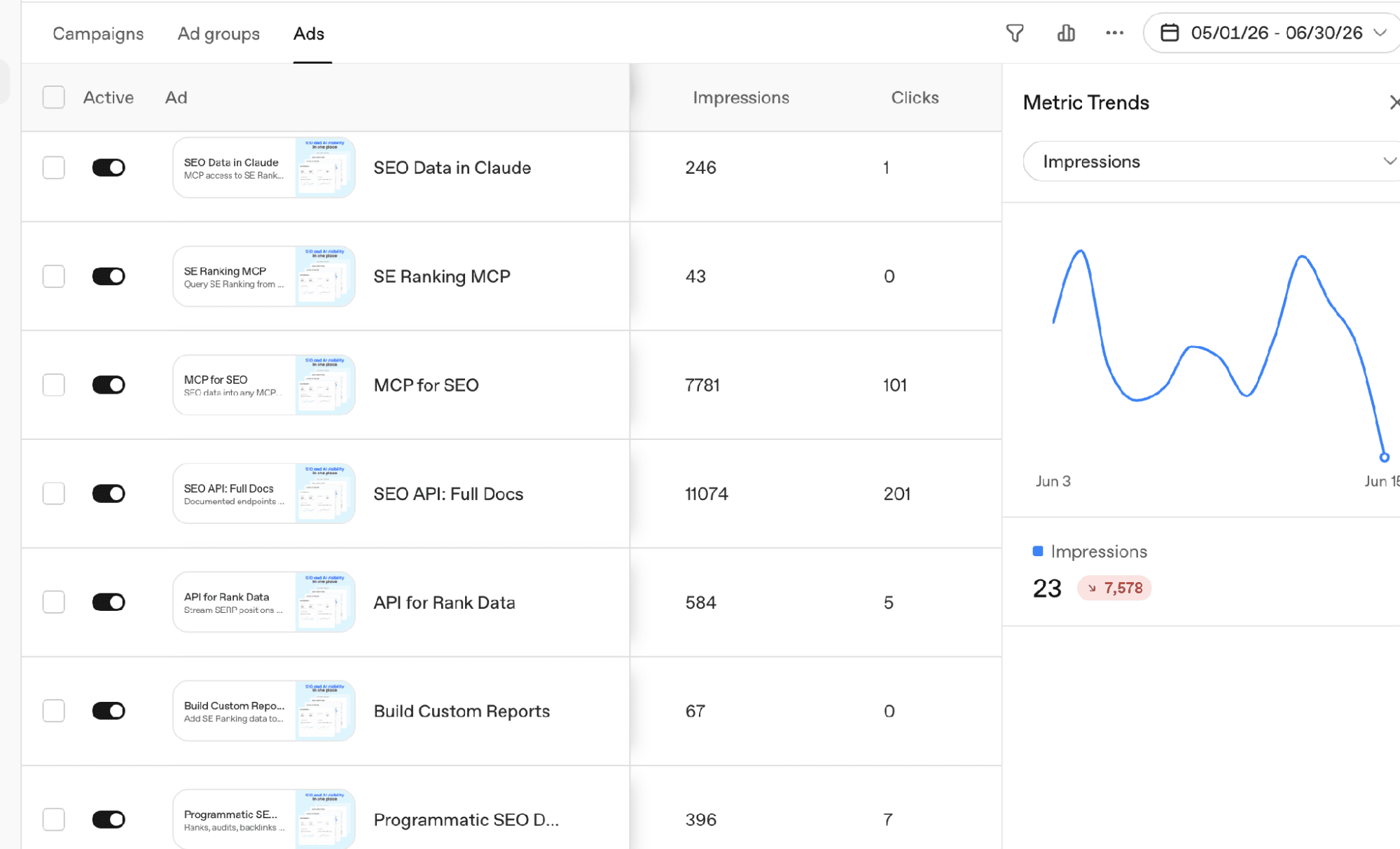
This leads to two practical conclusions. First, the platform’s assessment of available conversation volume can outweigh the campaign structure you designed. A strategically important use case may receive almost no delivery if too few eligible conversations match it.
Second, placing six ads in a group does not automatically create a six-way creative test. When delivery is this concentrated, evaluate only the variants that received meaningful exposure and deliberately rotate new challengers instead of treating every uploaded ad as tested.
Why we believe the campaign underperformed
The clearest issue was audience fit.
Our ideal customers include agency owners, SEO team leads, and in-house specialists. These are intensive professional AI users and may be more likely to subscribe to paid, ad-free ChatGPT plans. The better a user fit our ICP, the less likely that person was to see the campaign at all.
Public numbers support the mechanics: ChatGPT reports one billion weekly active users, and over 80% of them are on the free tier — a huge audience, but consumer-skewed by construction of the ad-eligible pool.
The second issue was optimization. We launched with the Clicks objective and without an in-platform conversion signal. The system could find people likely to click, but it had no campaign-level signal telling it which clicks became sign-ups. Conversion-optimized bidding was not available to us during the test window.
The third issue was intent. A click below an exploratory ChatGPT conversation is not necessarily equivalent to a click on a high-intent search ad. Some users may be learning about a problem or surveying options rather than actively choosing a vendor.
Finally, the reporting limited diagnosis. We could see which ad groups, creatives, and landing pages received traffic, but we could not inspect the exact conversations that produced it. We could identify the point where the funnel failed, but not replay the targeting context behind each click.

What we would do differently now
The platform added conversion optimization and expanded its measurement toolkit soon after our test. If we launched again, we would change both the setup and the decision framework.
- Start with the Pixel and Conversions API already validated. We would test real events before campaign creation and preserve UTMs as an independent check.
- Narrow the audience hypothesis. We would explicitly target the ad-supported segment most likely to need the product instead of treating all SEO professionals as equally reachable.
- Use custom audiences strategically. Where we had at least 25,000 matched users, we would test inclusion, suppression, and ad-group bid multipliers rather than relying only on contextual delivery. OpenAI’s current custom-audience setup allows multipliers from 0.1× to 10×.
- Separate exploration from evaluation. “How do I monitor my brand in AI answers?” and “Which AI visibility platform should my agency choose?” represent different levels of intent and should lead to different messages and landing pages.
- Reduce ambiguity in context hints and negatives. We would audit every acronym and broad term for unrelated meanings before launch.
- Treat delivery concentration as expected. We would prepare replacement creatives and define minimum-impression thresholds rather than assuming an even split.
- Use a staged rollout. We would expand the campaign only after measurement health, delivery relevance, and initial lead quality passed separate checkpoints.
This would produce a fairer test of today’s platform. It would not solve the underlying audience-eligibility issue, but it would tell us whether optimization and sharper segmentation could generate more qualified demand from the reachable audience.
Who should test ChatGPT Ads now?
The strongest near-term candidates are businesses with a broad consumer or prosumer audience, products that fit comparison or planning conversations, enough conversion volume to support optimization, clear product pages with short paths to action, and several distinct offers that can match different needs.
E-commerce is the most interesting case, and the release log shows where OpenAI is putting its effort. OpenAI’s product feeds keep titles, descriptions, prices, availability, images, and destination URLs current, then let the system select an eligible product when an ad serves. That reduces the need to build a static ad for every item. Feed ingestion arrived in June, product feed cards gained price and star ratings in July, conversion-optimized bidding is now in beta for product feed campaigns, and OpenAI is testing a multi-product carousel.
ChatGPT Ads is less attractive today when:
- most buyers are likely to use ad-free professional plans
- the total addressable audience is narrow
- the final conversion takes months and no meaningful earlier event can be measured
- the offer requires exact keyword control or strict placement transparency
- the campaign cannot tolerate learning-period waste
- policy restrictions affect the product or the claims
For B2B SaaS, treat this as an incremental experiment rather than a replacement for search, retargeting, or organic AI visibility.
Paid ads and organic ChatGPT visibility require different strategies
Advertising can place your brand in a sponsored card, but it does not influence ChatGPT’s answer.
In our research, the advertiser’s domain appeared among the sources cited in the answer in only 3.63% of placements. The exact advertised URL appeared in just 0.09%. In 96.37% of placements, the advertiser was not cited.
That creates two separate workstreams:
- Paid ChatGPT visibility: campaigns, context hints, creatives, bids, audiences, landing pages, and conversion optimization.
- Organic AI visibility: content authority, brand mentions, source eligibility, citations, and prompt coverage.
The distinction matters because paid-plan users do not see ads. If important prospects are concentrated on those plans, organic visibility is the only way to reach them inside ChatGPT answers.
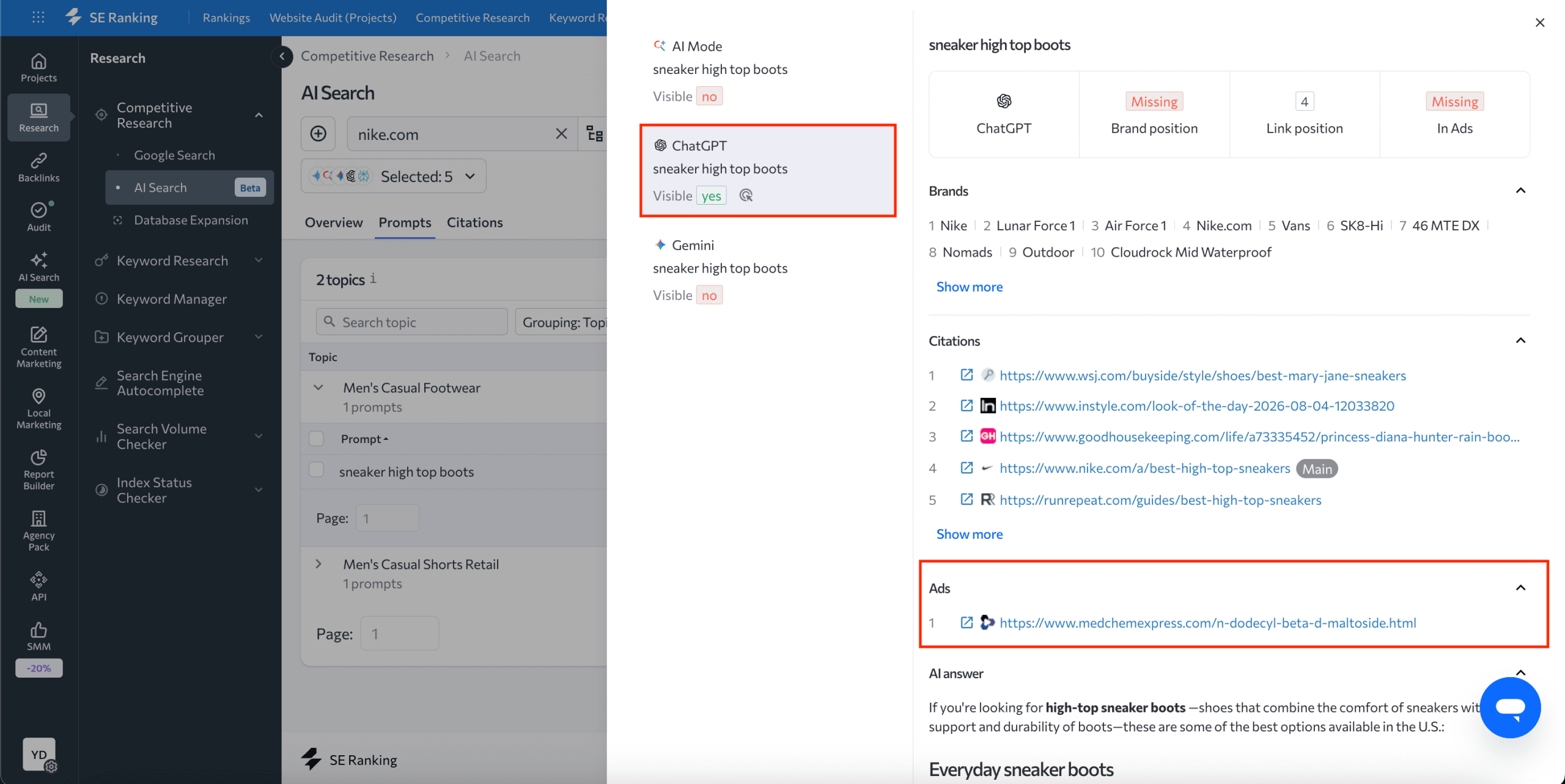
Teams can use SE Ranking’s AI Search Ads Tracker to monitor which brands advertise against tracked prompts, where their ads lead, and how ad presence changes over time. That competitive view cannot reveal private conversations, but it can show which advertisers and offers repeatedly appear around the prompts that matter to your market.
Final thoughts
ChatGPT Ads is already capable of generating meaningful reach and comparatively inexpensive clicks. Our test proved that, but it also showed that neither guarantees qualified demand.
Still, the experiment gave us a clear framework for the next test: better measurement, conversion-focused bidding, sharper segmentation, and stricter qualification from click to revenue.