The 8 Best Ahrefs API Alternatives in 2026: Pricing, Endpoints & Data Compared
If you’re pulling keyword, backlink, domain, and AI search data programmatically, Ahrefs is probably already on your shortlist. The catch is throughput, trialability, reliability of programmatic access, and data trust. That friction sends agencies, engineering, and SEO teams looking elsewhere.
In this article, we evaluate the 8 best Ahrefs API alternatives in 2026 on what actually decides adoption: endpoint coverage, data freshness, commercial models, and how well each one fits automation-driven workflows.
-
SE Ranking API is the best comprehensive 1:1 Ahrefs API alternative.
It is the top choice for those requiring full-stack search datasets paired with MCP integrations and dedicated LLM brand visibility tracking. You can start at $50 with pay-as-you-go or choose annual plans if your needs are scaling.
-
DataForSEO is the best raw pay-as-you-go scaling.
It was built strictly for heavy-duty SaaS engineering teams needing modular REST APIs, standard queuing structures, and consumption-only billing starting from a $50 deposit.
-
Semrush API is the best enterprise clickstream analytics.
It unlocks multi-year historical databases and traffic projections via clickstream-powered Trends endpoints, though it mandates a high entry threshold starting with a $549/month Advanced tier.
-
Moz API is the best domain authority metric access.
It is the most cost-efficient mechanism to retrieve industry-standard Domain Authority, Page Authority, and Spam Score metrics, starting at $20/month with a baseline free tier.
-
Majestic API is the best historic link intelligence.
This Ahrefs API alternative features a massive link index spanning over 19 years, making it highly valuable for specialized link-building platforms and domain traders at $399.99/month.
Ahrefs API Overview: Features, Access, and Integration
The integration of programmatic search intelligence through Ahrefs is governed by its third-generation API (v3). This version provides structured JSON payloads across key analytical divisions, including:
- Organic traffic
- Referring domain metrics from Site Explorer
- Localized queries from Keywords Explorer
- Crawl diagnostics from Rank Tracker and Site Audit modules
To address generative AI search, Ahrefs introduced the Brand Radar add-on. This tool tracks brand visibility across 6 conversational AI platforms: ChatGPT, Gemini, Perplexity, AI Overviews, Google AI Mode, and Copilot. Brand Radar add-on correlates brand mention rates with traditional search and backlink graphs.
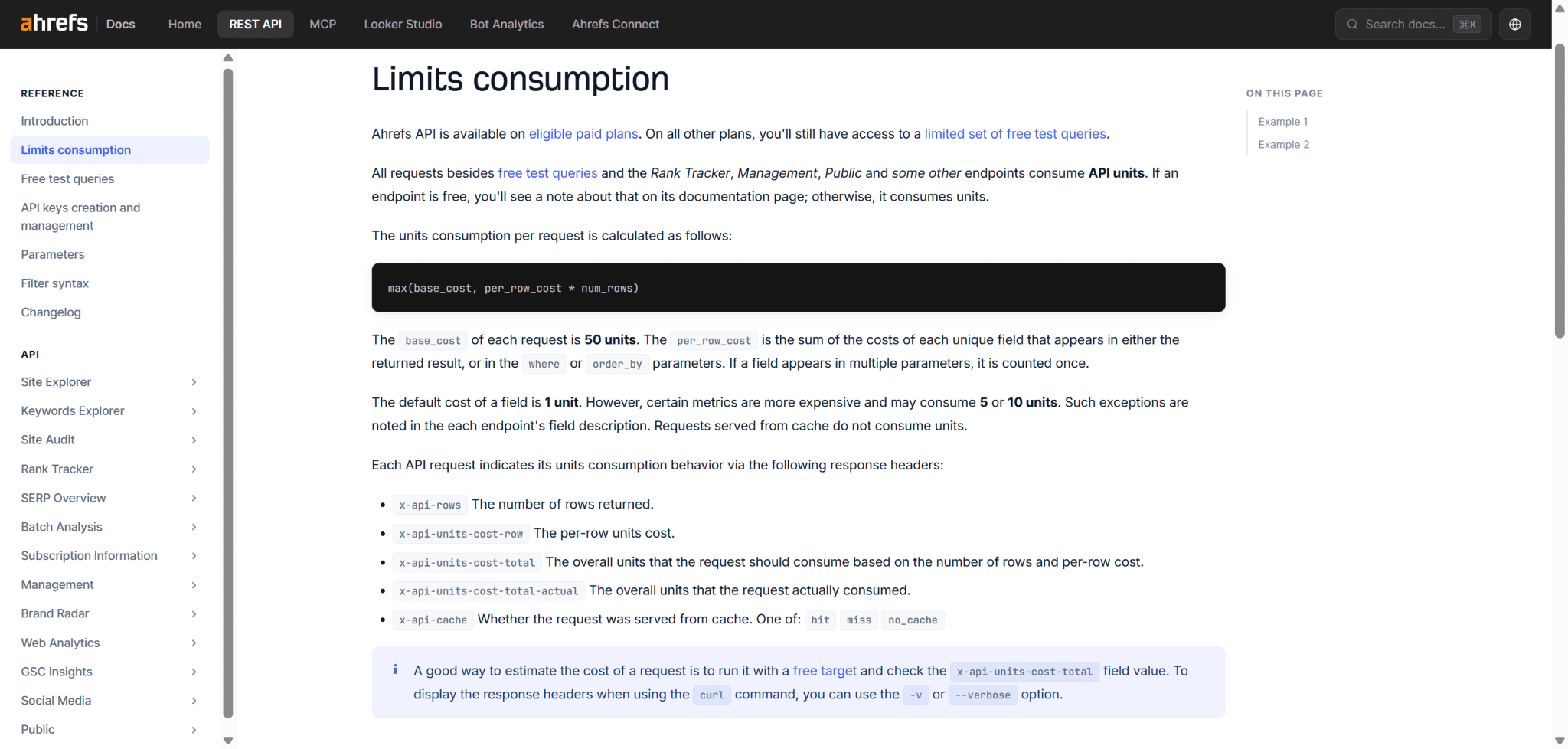
Despite these advanced metrics, the commercial and structural design of Ahrefs API v3 presents operational challenges for growing software tools and agencies. Programmatic data retrieval relies on a restrictive, unit-based billing model. All analytical requests, except for free test queries and basic rank tracker updates, consume API integration units based on the complexity of the fields requested and the volume of rows returned.
The base cost for any paid endpoint request is fixed at a minimum of 50 units. While standard rows typically cost 1 unit each, high-value parameters scale rapidly to 5 or 10 units per row. This structure penalizes low-volume, high-frequency requests. Developers must build complex caching pipelines and query consolidation scripts to prevent rapid budget depletion.
Furthermore, developers looking to build public integrations, custom applications, or scaled internal dashboards face a steep commercial barrier. High-volume programmatic extraction is restricted to the Enterprise subscription plan, which begins at $1,499 per month and requires an upfront annual commitment of $14,990. Standalone API standard subscriptions are restricted to existing account holders and start at an additional $500 per month.
This combination of strict unit limits, lack of trial periods, and high subscription thresholds has led many technical teams to seek Ahrefs API alternatives.
Comparison Table: Best Alternatives to Ahrefs API
Main Data Types
Domain, Keywords, Backlinks, Site Audits, LLM Search Visibility
Key Limitations
Credit consumption rules vary by endpoint.
Starting Price
- $129/mo (with Core plan)
- $45/mo (annual billing) for add-on to existing SE Ranking subscription
Free Trial
14-Day Free Trial (100K credits, no card).
Best For
Full-stack SEO tool builders & agencies requiring AI search metrics and MCP.
Main Data Types
Keywords, Domains, Backlinks, Position Tracking, Trends
Key Limitations
Requires high-tier Advanced plan, strict rate limits, 1-month caching restriction.
Starting Price
$549/mo (Business plan required) + unit packages.
Free Trial
No free API-only tier.
Best For
Enterprise agencies wanting unified marketing analytics and deep historical databases.
Main Data Types
SERP, Keywords, Backlinks, On-Page, Domain Analytics, LLM Mentions
Key Limitations
Developer-heavy (no UI/dashboard), Backlinks/LLM API requires monthly minimum top-up.
Starting Price
Pay-as-you-go starting at $50 deposit.
Free Trial
$1 trial credit.
Best For
SEO tool developers and data scientists building custom programmatic platforms.
Main Data Types
Links, Domain/Page Authority, Spam Score, Keyword Metrics, Search Intent
Key Limitations
Keyword metrics lack deep PPC analysis and search volume granularity.
Starting Price
$20/mo (Starter Plan).
Free Trial
Free tier available (50 rows/mo).
Best For
Budget-conscious builders tracking classic URL metrics and Spam Score.
Main Data Types
Backlinks (Fresh & Historic Indexes), Trust Flow, Citation Flow, Topical Trust Flow
Key Limitations
No keyword, SERP, or technical audit data.
Starting Price
$399.99/mo (full API tier); Lite/Pro plans have third-party OpenApps limits.
Free Trial
No free trial.
Best For
Specialized link builders, domain traders, and backlink audit applications.
Main Data Types
PPC Research, Ad History, Kombat (Competitors), Domain Stats, Organic Ranking History
Key Limitations
Bundled with platform subscription, smaller index, data quality varies by region.
Starting Price
$119/mo (Pro+AI plan required for API).
Free Trial
No free trial.
Best For
Paid search specialists and competitive research tools focusing on PPC history.
Main Data Types
Google & Multi-engine SERPs, Local/Geo-targeting, Batch, Maps/News/Images
Key Limitations
No native backlinks, domain analytics, keywords database, or audits.
Starting Price
$49.99/mo.
Free Trial
50 searches/mo free tier.
Best For
Teams needing highly localized, real-time SERP scraping and rank monitoring.
Main Data Types
Keyword suggestions (KWFinder), SERP checking, Backlinks (LinkMiner), Authority (SiteProfiler)
Key Limitations
Highly dependent on Mangools UI subscription quotas, smaller backlink index.
Starting Price
Bundled with subscription starting at $30.50/mo (Basic).
Free Trial
10-day trial with extremely tight quotas.
Best For
Small agencies and solo builders looking for basic, low-cost keyword and SERP metrics.
Domain, Keywords, Backlinks, Site Audits, LLM Search Visibility
Credit consumption rules vary by endpoint.
- $129/mo (with Core plan)
- $45/mo (annual billing) for add-on to existing SE Ranking subscription
14-Day Free Trial (100K credits, no card).
Full-stack SEO tool builders & agencies requiring AI search metrics and MCP.
Keywords, Domains, Backlinks, Position Tracking, Trends
Requires high-tier Advanced plan, strict rate limits, 1-month caching restriction.
$549/mo (Business plan required) + unit packages.
No free API-only tier.
Enterprise agencies wanting unified marketing analytics and deep historical databases.
SERP, Keywords, Backlinks, On-Page, Domain Analytics, LLM Mentions
Developer-heavy (no UI/dashboard), Backlinks/LLM API requires monthly minimum top-up.
Pay-as-you-go starting at $50 deposit.
$1 trial credit.
SEO tool developers and data scientists building custom programmatic platforms.
Links, Domain/Page Authority, Spam Score, Keyword Metrics, Search Intent
Keyword metrics lack deep PPC analysis and search volume granularity.
$20/mo (Starter Plan).
Free tier available (50 rows/mo).
Budget-conscious builders tracking classic URL metrics and Spam Score.
Backlinks (Fresh & Historic Indexes), Trust Flow, Citation Flow, Topical Trust Flow
No keyword, SERP, or technical audit data.
$399.99/mo (full API tier); Lite/Pro plans have third-party OpenApps limits.
No free trial.
Specialized link builders, domain traders, and backlink audit applications.
PPC Research, Ad History, Kombat (Competitors), Domain Stats, Organic Ranking History
Bundled with platform subscription, smaller index, data quality varies by region.
$119/mo (Pro+AI plan required for API).
No free trial.
Paid search specialists and competitive research tools focusing on PPC history.
Google & Multi-engine SERPs, Local/Geo-targeting, Batch, Maps/News/Images
No native backlinks, domain analytics, keywords database, or audits.
$49.99/mo.
50 searches/mo free tier.
Teams needing highly localized, real-time SERP scraping and rank monitoring.
Keyword suggestions (KWFinder), SERP checking, Backlinks (LinkMiner), Authority (SiteProfiler)
Highly dependent on Mangools UI subscription quotas, smaller backlink index.
Bundled with subscription starting at $30.50/mo (Basic).
10-day trial with extremely tight quotas.
Small agencies and solo builders looking for basic, low-cost keyword and SERP metrics.
1. SE Ranking
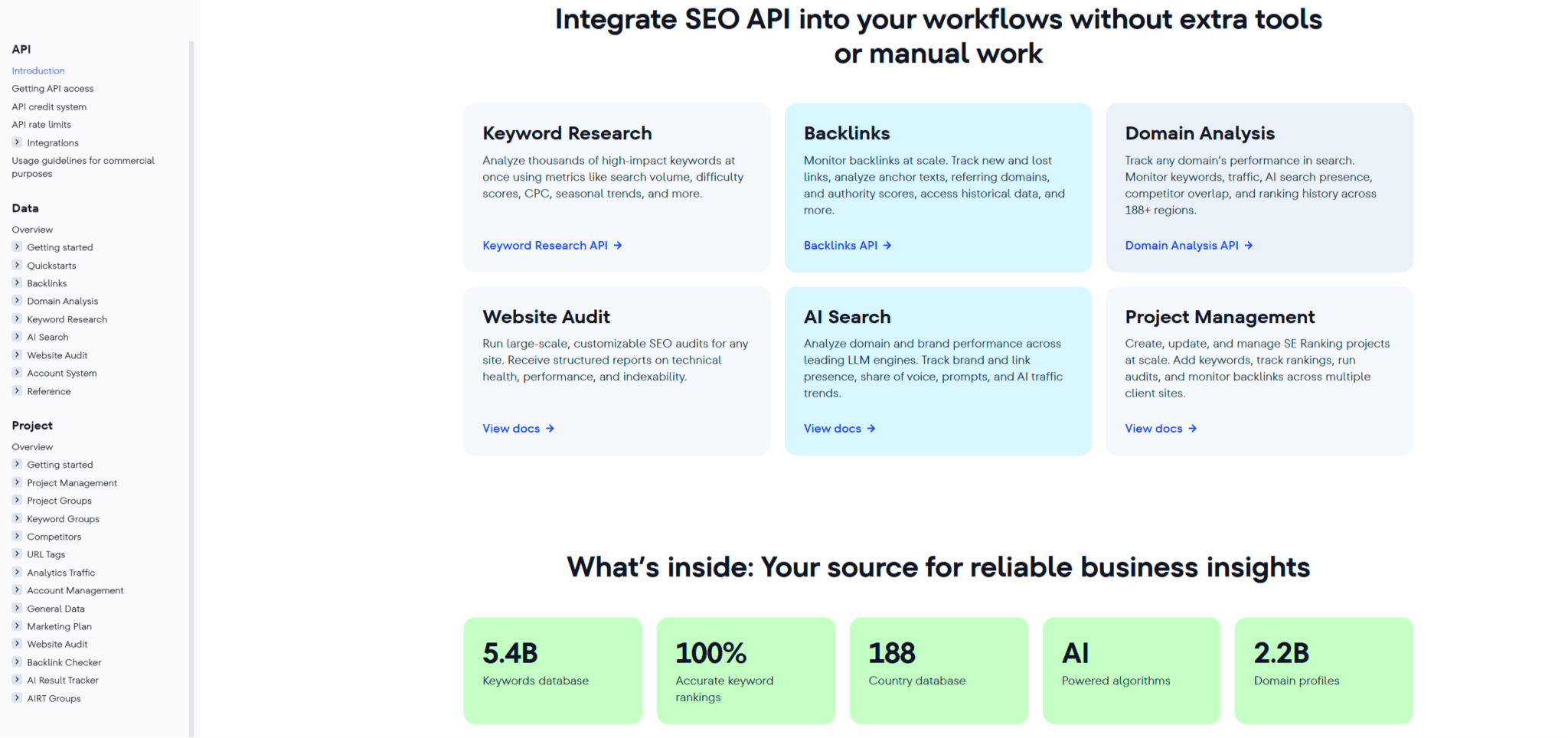
SE Ranking API stands as the closest 1:1 functional alternative to Ahrefs API, delivering comparable domain, keyword, backlink, AI search metrics, and more, as well as workflow automations. And all of that is included in every plan.
The platform uses a clear, dual-API architecture designed to separate research operations from active project management:
- Data API handles large-scale research: keywords, backlinks, domain analysis, website audits, and AI search visibility. It runs on a credit-based consumption model, so you pay for what you query.
- Project API handles everything inside the platform: rank tracking schedules, keyword groups, competitor watchlists, audit triggers, sub-account management, and more. It operates within subscription limits, and it’s what lets you manage multiple client projects programmatically without touching the dashboard.
G2 review by Shilpa Dikaio, Owner at Morphine Limited:
“I appreciate that with SE Ranking’s API, I can have AI Agents running throughout the day, alerting me of any issues and providing me with a morning brief sent to my Slack Ops channel. Additionally, the initial setup of SE Ranking was easy for me.”
Core API Endpoints & Functionality
- Programmatic rank tracking. Enables automated rank queries across desktop and mobile devices for major search engines. It provides access to 188+ regional search databases.
- Backlinks API. Supports comprehensive backlink profile auditing with dedicated endpoints to track new and lost links, evaluate anchor text distributions, monitor referring subnets, and compute domain authority via InLink metrics.
- Domain analysis API. Pulls domain-level performance data, organic and paid keyword databases, competitive overlap scores, traffic history estimates, and subfolder-level visibility hierarchies.
- Keyword research API. Connects programmatically to a database of over 5.4 billion keywords, returning precise monthly search volumes, localized CPC values, historical search trends, keyword difficulty metrics, and related search suggestions.
- Website audit API. You can trigger technical crawls programmatically, generating structured audit summaries, crawlability checklists, and specific technical issue codes across pages.
- AI visibility tracking. Tracks brand presence across ChatGPT, Gemini, Perplexity, Google AI Overviews, and Google AI Mode, returning citation rates, average positions, AI traffic estimates, historical trends, and share-of-voice comparisons against up to 10 competitors.
- Looker Studio + Make/n8n integrations. Native connectors let you automate client reporting and build no-code SEO pipelines. These connectors and the MCP server are available on every plan, not reserved for higher tiers.
MCP Server Integration
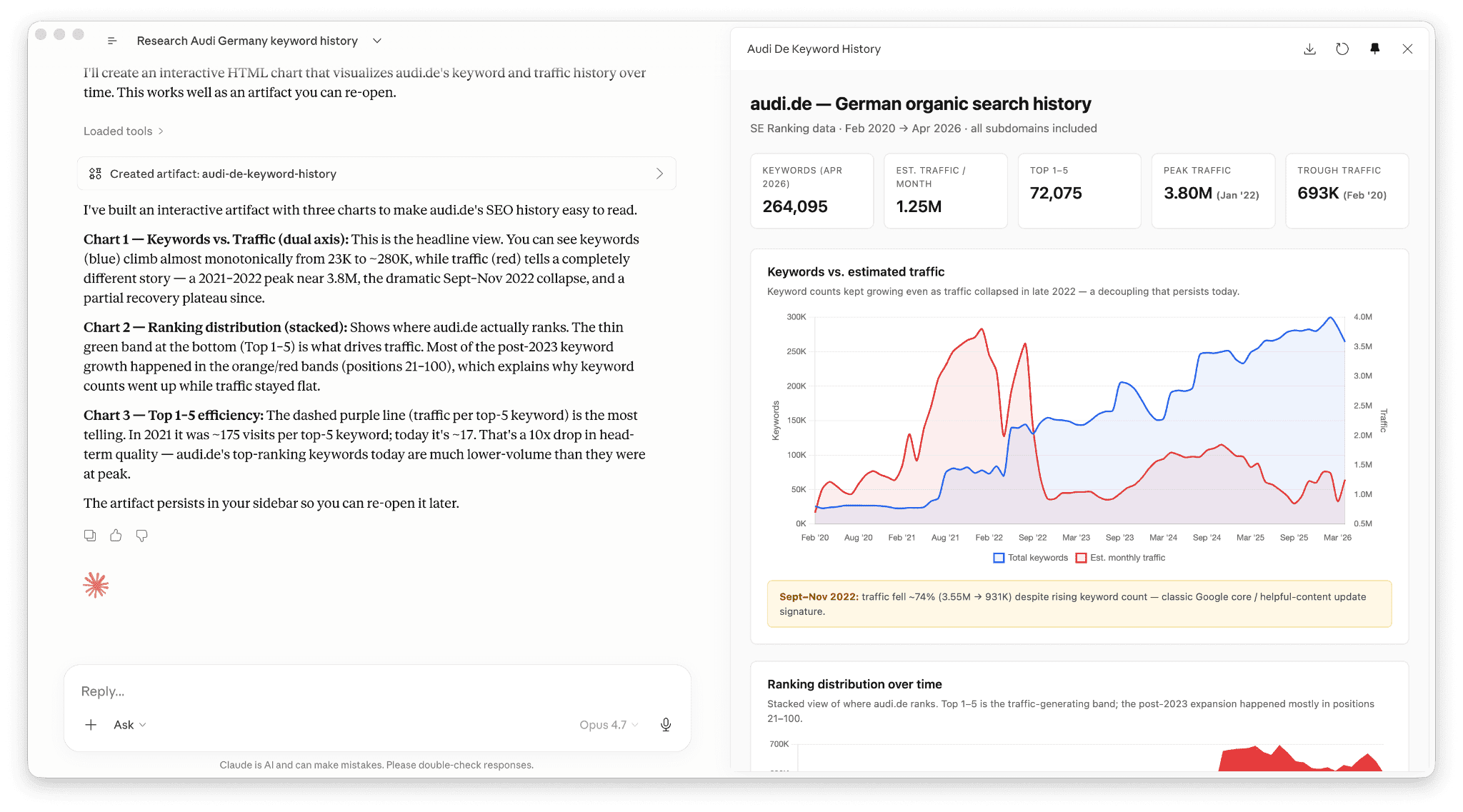
To support AI-assisted development, SE Ranking provides a fully integrated Model Context Protocol (MCP) server. This integration bridges the gap between raw SEO and GEO data and LLMs. Compatible agents, such as Claude Code, Cursor, or ChatGPT, can query keywords, backlinks, domains, AI mentions, directly in plain English. This means you can build complex, AI-driven workflows without writing custom integration code.
SE Ranking also provides 20+ prebuilt Claude SEO Skills under the open-source MIT license. These skills package the raw MCP endpoints into structured deliverables. For example, they allow an AI assistant to:
- Generate comprehensive content briefs.
- Map AI search share-of-voice leaderboards.
- Track technical site change logs.
- Perform automated backlink gap analyses.
All these and much more can be done based on a simple natural language prompt.
API Pricing Model
SE Ranking API and MCP are included in standard SE Ranking plans:
- Core: $129/month with 25K credits
- Growth: $279/month with 100K credits.
You can also start paying as you go with a $50 minimum deposit for 250K credits that don’t expire. It’s also available as an add-on to the current SE Ranking subscription, starting at $45/month and as a standalone product at $179/month for higher-volume needs. Both come with annual billing. SE Ranking has a separate page for API pricing for more details.
Pros and Cons
Pros:
- Dual API structure covers both data retrieval and workflow automation in every plan.
- AI search visibility tracking is programmatically available across five major AI platforms.
- MCP server supports agentic SEO and GEO workflows without custom integration.
- Built for bulk retrieval, with no batch-size limits on calls.
- Reselling and embedding permitted after internal approval; design-partner collaboration available.
- Pay-as-you-go option with non-expiring credits
- 14-day trial with 100,000 credits and full endpoint access
- Native connectors for Data Studio, n8n, and Make.com.
Cons:
- Its raw backlink index is smaller than legacy databases like Majestic.
- No first-party SDKs. Integration works from the REST reference or the Postman collection.
- Migrating from another provider means remapping endpoints rather than a one-to-one swap.
2. Semrush API
G2 review by Jaime Suarez Fernandez:
“I like that Semrush provides a lot of information about competitors, keywords, etc. The initial setup was easy. I’d like easy API integration. I use Semrush for SEO reporting. It helps in tracking progress of keyword positions and competitors’ traffic, and provides a lot of information about competitors and keywords.”
Core API Endpoints & Functionality
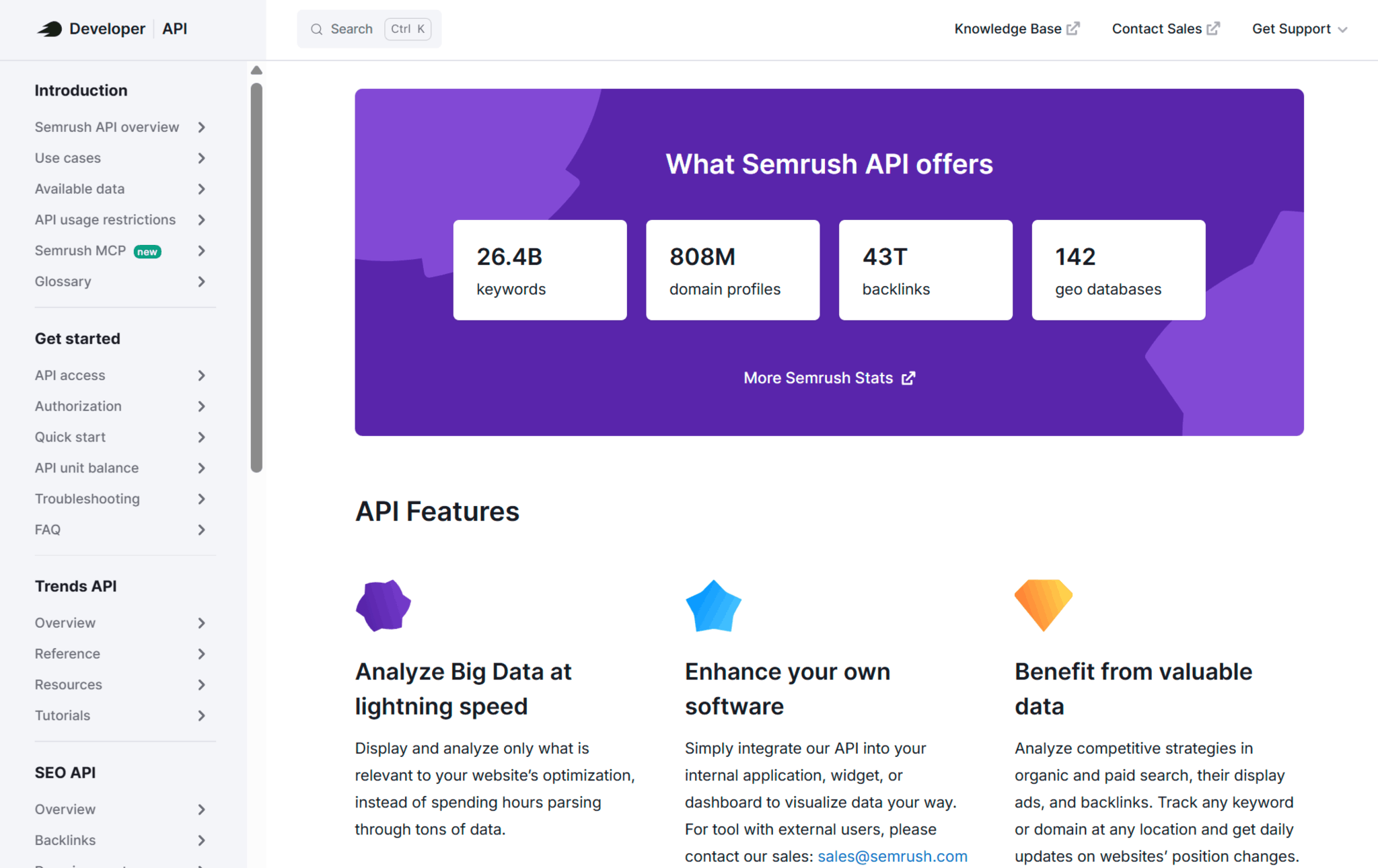
The Semrush API is a robust, enterprise-grade solution split into two primary components:
- Standard API (comprising Analytics and Projects). The Analytics endpoints allow developers to query extensive global search datasets, retrieving organic keyword rankings, domain-level performance histories, competitor ad campaign details, and backlink records.
- Trends API. The Projects API allows applications to interact with active tracking campaigns, pulling programmatic data from high-frequency Position Tracking and technical Site Audit modules. Additionally, the Trends API provides traffic summaries, such as unique monthly visits, bounce rates, and device distributions.
The Trends API is billed under a separate, dedicated subscription plan that defaults to 10,000 monthly requests and does not consume Standard API credits.
API Pricing Model
3 pricing plans of Semrush:
- SEO Plan ($139.95/month): 5 monitored websites, 500 daily tracked keywords, keyword research & competitor analysis, position tracking, site audit, AI search performance tracking, AI sentiment monitoring, AI visibility reports, and custom prompt monitoring.
- Pro+ Plan ($299/month): 15 monitored websites, 1,500 daily tracked keywords, keyword cannibalization analysis, historical SEO data, multi-location/device tracking, MCP access, AI visibility tracking across Google Search, ChatGPT, Perplexity, Gemini & more, 100 prompts/day, 1 AI brand domain, and 300 AI visibility reports/day.
- Advanced Plan ($549/month): 40 monitored websites, 5,000 daily tracked keywords, SEO share of voice, API integration, and expanded AI visibility tracking with 200 prompts/day plus automation and advanced reporting features.
Developers must buy recurring API unit packages in scalable bundles of 2 million, 5 million, 10 million, or 20 million units. Standard analytical queries consume units based on the depth of the returned rows. Regular domain searches consume 10 units per keyword line, while historical domain queries from preceding years consume 50 units per line.
Pros and Cons
Pros:
- Unlocks rich, multi-year historical datasets and detailed Clickstream traffic estimations.
- Integrates deeply with the broader Semrush marketing ecosystem.
- Trends API operates on its own quota, meaning it does not burn standard API units.
Cons:
- Imposes a high financial barrier, requiring a minimum $500 monthly platform subscription before purchasing API units.
- Unused standard API units expire at the end of each billing cycle.
- Requests are subject to a strict rate limit of 10 requests per second.
- Terms of Service strictly prohibit caching received data for more than one month.
3. DataForSEO
G2 review by Mark Godfrey, Technical Director at Lead Intuition:
“DataForSEO is very easy to use and has more data available than most users would need. I use it daily to retrieve data for clients to keep them informed where their name appears. Its incredible value for money and significantly cheaper than using one of the more famous SEO services.”
Core API Endpoints & Functionality
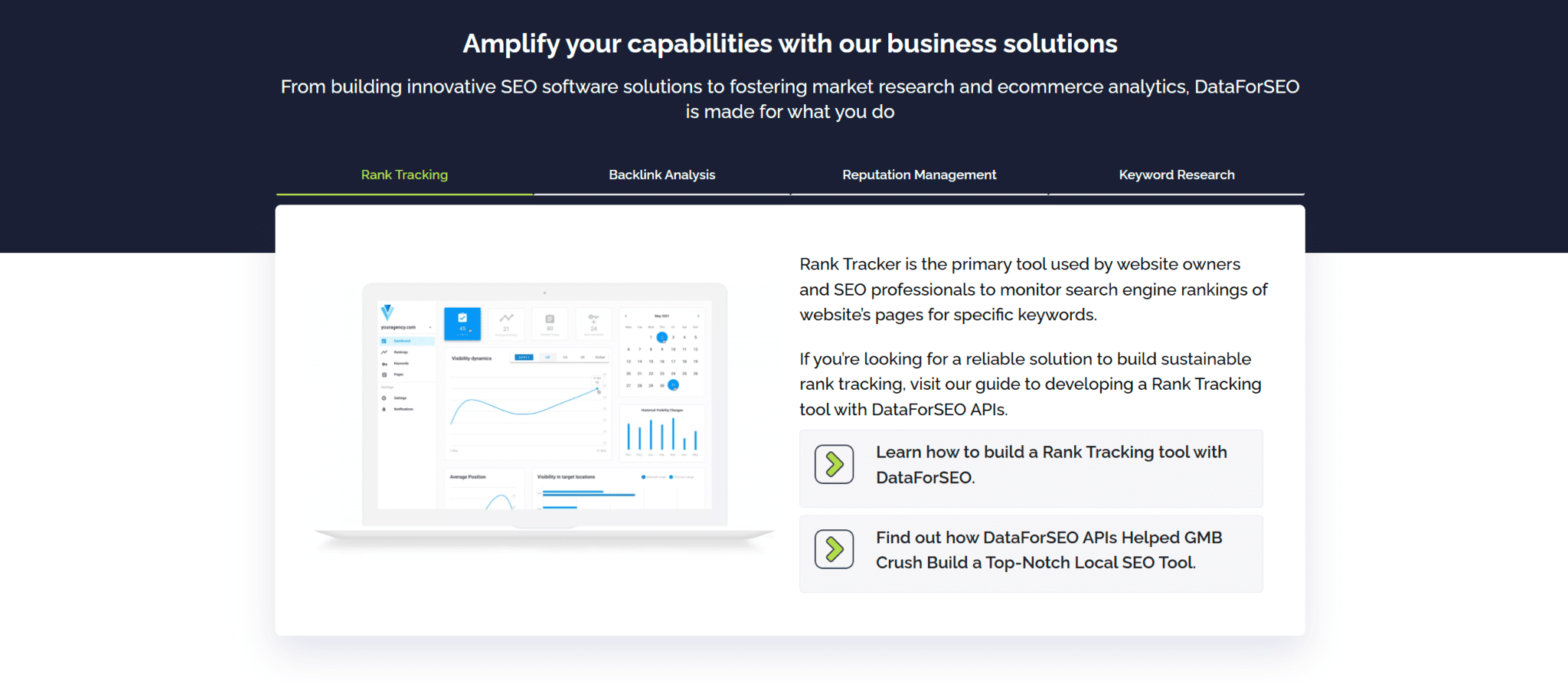
Among all the Ahrefs API alternatives, DataForSEO is the only developer-focused, raw data provider. It offers over 15 highly modular REST APIs. Its endpoints cover:
- Multi-engine SERP scraping
- Historical keyword search volumes
- Backlink analysis
- Technical on-page crawling
To support AI development, its AI Optimization API features specialized LLM Mentions, AI Keyword Data, and LLM Responses endpoints. These allow programmatic applications to track brand mentions, query language models via a single interface, and scrape prompt outputs. Most endpoints support both a queued asynchronous delivery mode and a real-time “Live” mode with a turnaround time of under 2 seconds.
API Pricing Model
DataForSEO operates on a true, pay-as-you-go consumption model with no monthly subscription fees or user seat costs. Developers fund an account balance via a minimum deposit of $50, which never expires.
Standard SERP scraping is priced at $0.0006 per task (scaling to $0.002 in Live mode). Backlink queries cost a flat $0.02 per request plus $0.00003 per returned data row. The LLM Mentions API is billed at a flat rate of $0.10 per request plus $0.001 per returned data row.
At a volume of 1 million monthly requests, DataForSEO costs approximately $600, whereas a similar volume through other DataForSEO alternatives reaches higher.
Pros and Cons
Pros:
- Features a pure consumption-based pricing model with no recurring commitments or seat fees.
- Highly modular endpoints reduce query costs.
- 30-day cached JSON capability reduces query costs.
Cons:
- Lack of a visual dashboard makes the platform strictly suited for developer-heavy teams.
- Both the Backlinks API and the LLM Mentions API require a separate $100 monthly minimum commitment to remain active.
- Modeling monthly expenses at scale requires rigorous development planning.
4. Moz API
G2 review by Rhiannon Davies, Head of Marketing and Communications at SafeLane Global:
“Hard to get clear, unequivocal data about performance…too much interrogation and interpretation required. You need to me a Moz Pro expert to get the best out of it and marketers generally have too much going on to have the time to invest in becoming an expert.”
Core API Endpoints & Functionality
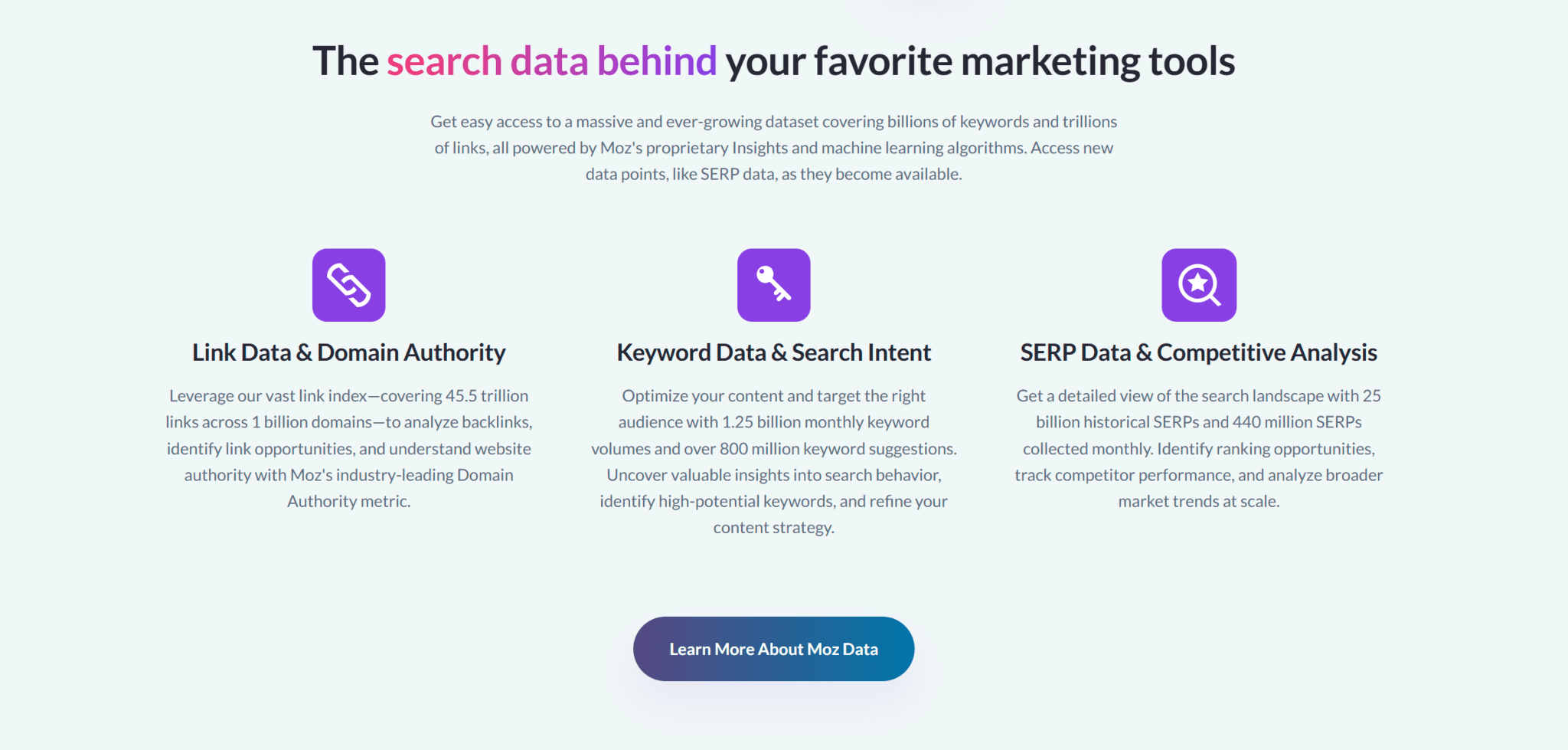
The Moz API provides programmatic access to an expansive 45.5-trillion-link index. Its endpoints deliver bulk URL metrics (such as Domain Authority and Page Authority), referring domain profiles, and final redirect path resolutions. It also features the unique Spam Score metric, which evaluates linking domains to flag potential link-profile risk.
On the keyword front, the API provides search volumes, keyword suggestions, organic CTR estimates. It also features an AI-driven search intent endpoint that programmatically classifies keywords into informational, navigational, commercial, or transactional categories.
API Pricing Model
Moz uses a structured, tier-based row consumption pricing model:
- Starter Plan (from $20–$75/month): 3,000 rows/month, no overages, +150 beta rows/month, suitable for basic research and reporting integrations
- Growth Plan (from $125–$500/month): 50,000 rows/month, overages at $25 per 10,000 rows, +3,500 beta rows/month, designed for scaling businesses needing flexible data access
- Advanced Plan (from $2,000/month): 4 million rows/month, overages at $5 per 10,000 rows, +400,000 beta rows/month, built for large-scale custom tools and dashboards
- Enterprise Plan (from $10,000/month): 40 million rows/month, overages at $3.50 per 10,000 rows, +4 million beta rows/month, optimized for commercial product integrations at scale
Certain endpoints have weighted row costs based on request parameters. For example, the Link Intersect endpoint carries a 5x multiplier (consuming 5 rows for every returned intersect object). The Link Status endpoint applies a 2x multiplier.
Pros and Cons
Pros:
- Offers an affordable programmatic entry point starting at just $20 per month.
- Includes a unique “Spam Score” metric that helps identify the potential risk of linking domains.
- Maintains a functional free API tier for low-volume testing and small-scale development.
Cons:
- Limited keyword depth.
- The keyword research API lacks the massive volume and granular PPC metrics found in competitors like Ahrefs.
- Row calculations on weighted endpoints can be complex to forecast and track.
5. Majestic API
“One of the most important benefits it offers is to check out the sites you are linking to, whether those sites are adding value to your site or it if is just a junk sites with inflated backlinks. You can check the trust-citation flows and their link graphs. The link graph is the best thing about Majestic which makes it very easy to see the backlink state of any website. This can help you not only for your existing backlinks but also to checkout sites you are planning to reach out to. I regularly use this tool to analyze my competitor, keep track of their backlinks, check for any gaps in our backlinks. This ensures you are not missing out on any opportunities your competitor is taking advantage of. Moreover, this can be used to find even more sites for outreach that are relevant to your niche with a good authority score.”
Core API Endpoints & Functionality
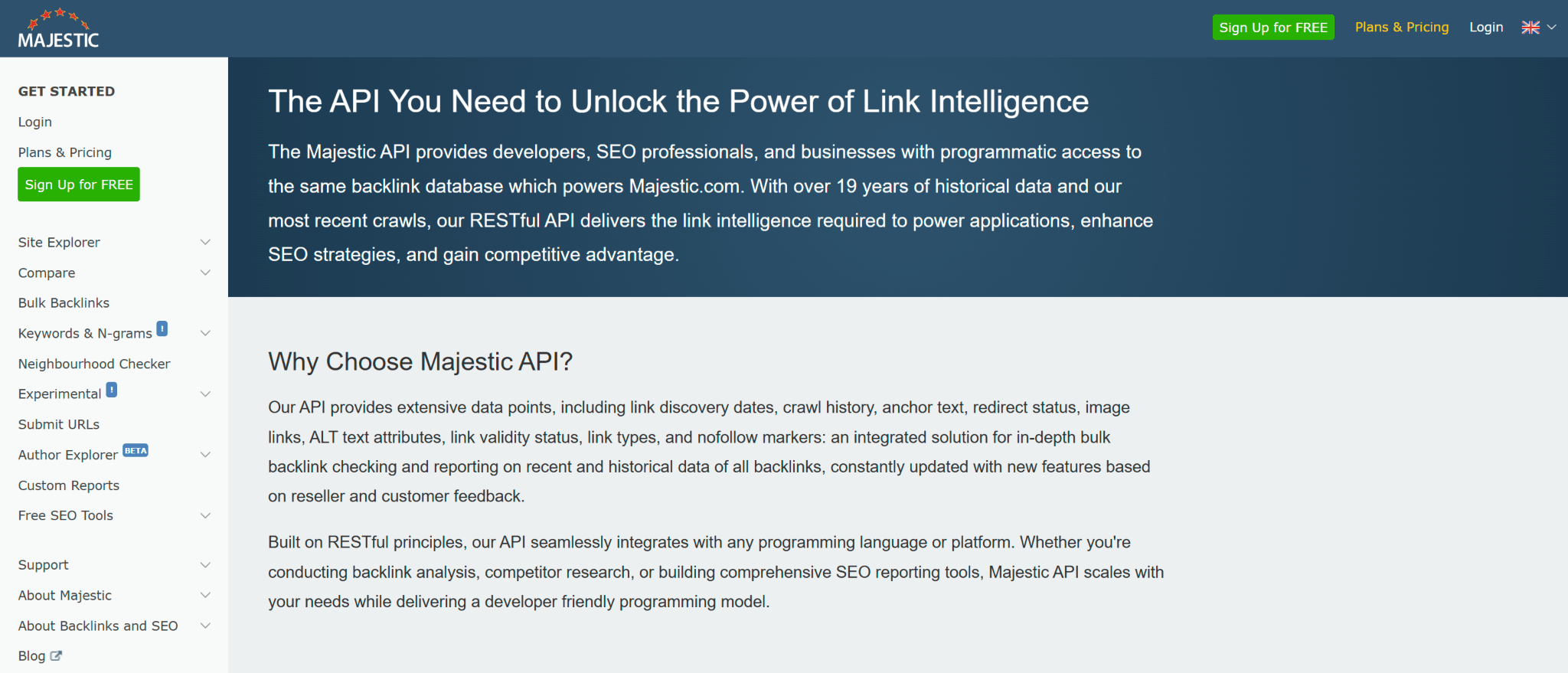
Majestic is a specialized link intelligence API that maps the backlink graph of the web, completely omitting keyword, SERP, or on-page auditing tools. It operates two separate indexes:
- Fresh Index, which is updated daily with recent crawling data from the last 120 days.
- Historic Index, which spans back over 19 years.
Majestic delivers proprietary metrics, including Citation Flow (CF) to measure link quantity and Trust Flow (TF) to evaluate link quality based on proximity to hand-reviewed seed sites. It also features Topical Trust Flow, which categorizes link influence across more than 800 thematic industries.
API Pricing Model
Full programmatic access requires the Majestic API plan:
- Lite Plan ($49.99/month): 1 million analysis units, 1 user, access to Fresh Index, Site Explorer, Link Graph, Trust Flow metrics, backlink tools, keyword checker, bulk backlink checker, PDF reports, and core website tools
- Pro Plan ($99.99/month): 20 million analysis units, 1 user, everything in Lite plus Historic Index, raw data exports, custom reports, site comparison, backlink history, Search Explorer, email alerts, and extended analytics tools
- API Plan ($399.99/month): 100 million analysis units, 5 users, everything in Pro plus full API access, scalable data volumes (up to 1B units), and custom data integration capabilities for agencies and developers
Although Majestic offers lower-priced plans, such as Lite ($49.99/month) and Pro ($99.99/month), these tiers exclude direct custom API keys. They restrict developers to pre-built third-party OpenApps integrations.
Pros and Cons
Pros:
- Massive historical backlink index.
- Distinct link-quality metrics, such as Topical Trust Flow.
- Generous unit allowances on the dedicated API plan.
Cons:
- No keyword data, SERP scraping, or technical website audit capabilities.
- Direct custom API access requires a relatively high baseline cost of $399.99 per month.
- API structure lacks the modern REST design.
6. SpyFu
G2 review by Luke Hayes, Digital Strategist and eCommerce Specialist at Honeywell:
“First, the tool greatly increases the value of our ad spend by identifying critical opportunities and/or new audiences to capture through paid ads, especially in areas where our competitors are focused, which helps us find better opportunities at a lower cost. Second, it significantly reduces the time needed to create and align our SEO efforts, and it improves the overall process of optimising organic data for content, blogs, and SEO.”
Core API Endpoints & Functionality
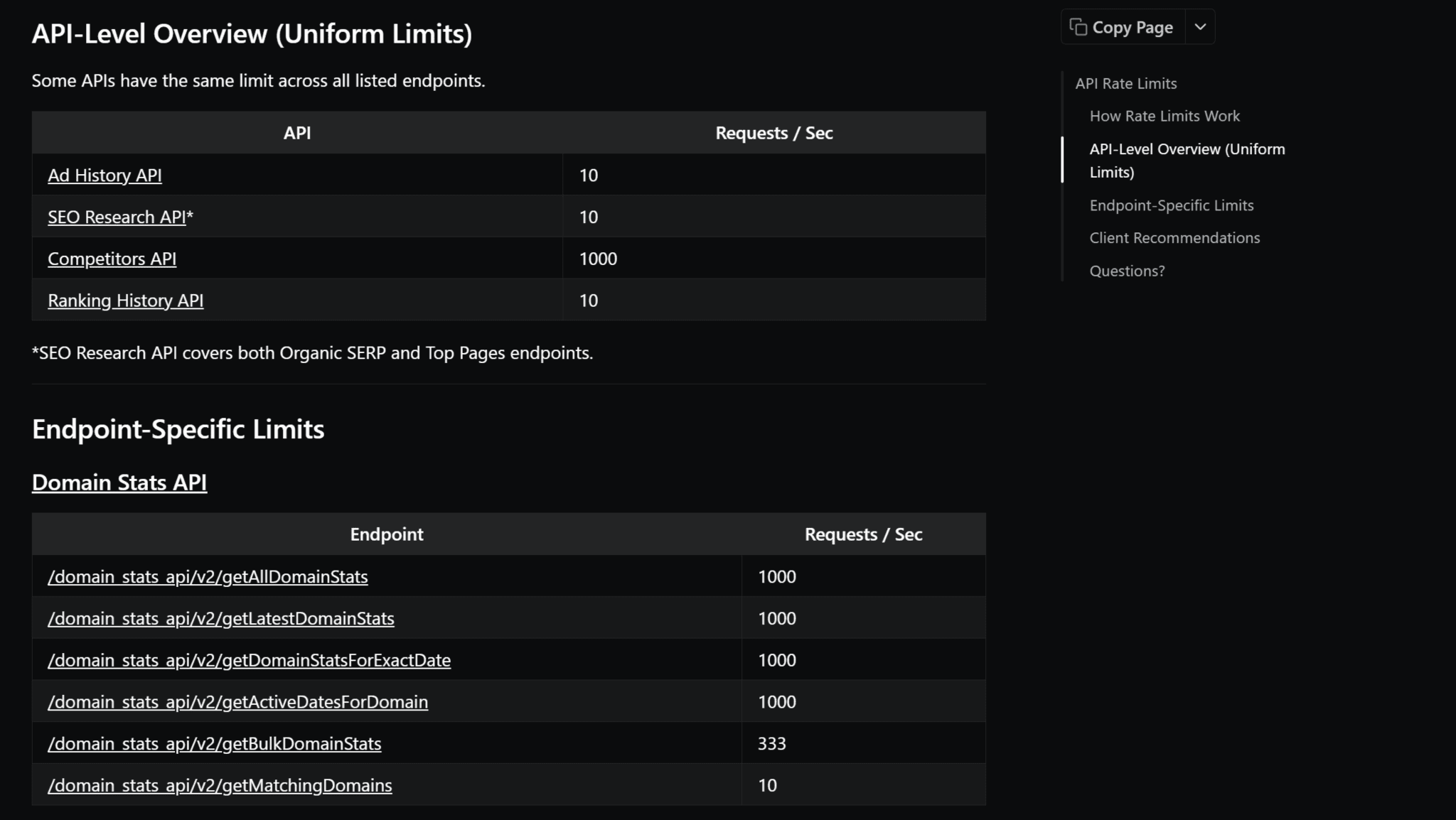
SpyFu focuses on competitive intelligence and paid search analytics, drawing on over 19 years of continuous Google SERP and advertising campaign tracking. The API features 8 uniform endpoints:
- Domain Stats
- Ad History
- PPC Research
- SEO Research (which parses Organic SERPs and Top Pages)
- Competitors
- Kombat (a domain keyword overlap tool)
- Keyword Research
- Ranking History
Among all the Ahrefs API alternatives, SpyFu offers the best PPC-specific endpoints that retrieve historical ad copy, keyword bid estimates, and ad placement records.
API Pricing Model
API access is not sold as a standalone subscription but is bundled into standard platform plans:
- Basic Plan ($39/month): 10k search result rows, 10k exports, 1 live tracking project, 10+ years historical data, RivalFlow (0 sites), ChatGPT integration, AI brand monitoring, 5k weekly keyword tracking, 10 automated reports, Google Ads templates, GSC integration, white-label reporting, API access, 1 user
- Pro + AI Plan ($59 first month, then $119/month): unlimited search results & exports, 10 tracking projects, 10+ years historical data, RivalFlow (1 site), ChatGPT integration, AI brand monitoring, 15k weekly keyword tracking, 100 automated reports, Google Ads templates, GSC integration, white-label reporting, API access, 1 user (+$30 per extra)
- Team / Agency Plan ($249/month): unlimited search results & exports, unlimited tracking projects, 10+ years historical data, RivalFlow (10 sites), ChatGPT integration, AI brand monitoring, 50k weekly keyword tracking, unlimited automated reports, Google Ads templates, GSC integration, white-label reporting, API access, 5 users (+$30 per extra)
The API operates on a pay-as-you-go model where queries are billed on a Cost Per Mille (CPM) rows returned framework. For example, Domain Stats and SEO Research queries cost $0.50 per 1,000 rows, keyword metrics cost $0.20 per 1,000 rows, and historical ad copy and ranking timelines cost $3.00 per 1,000 rows.
Pros and Cons
Pros:
- Delivers extensive historical PPC and ad placement datasets.
- Cost-effective competitive overlapping keyword metrics.
Cons:
- The API is bundled with the complete visual platform, meaning developers may pay for dashboards they do not use.
- Backlink metrics are highly limited.
- Technical website audits are absent.
- Smaller index than SE Ranking or Ahrefs.
- Database depth varies outside of core US and Western European regions.
7. Zenserp
Core API Endpoints & Functionality
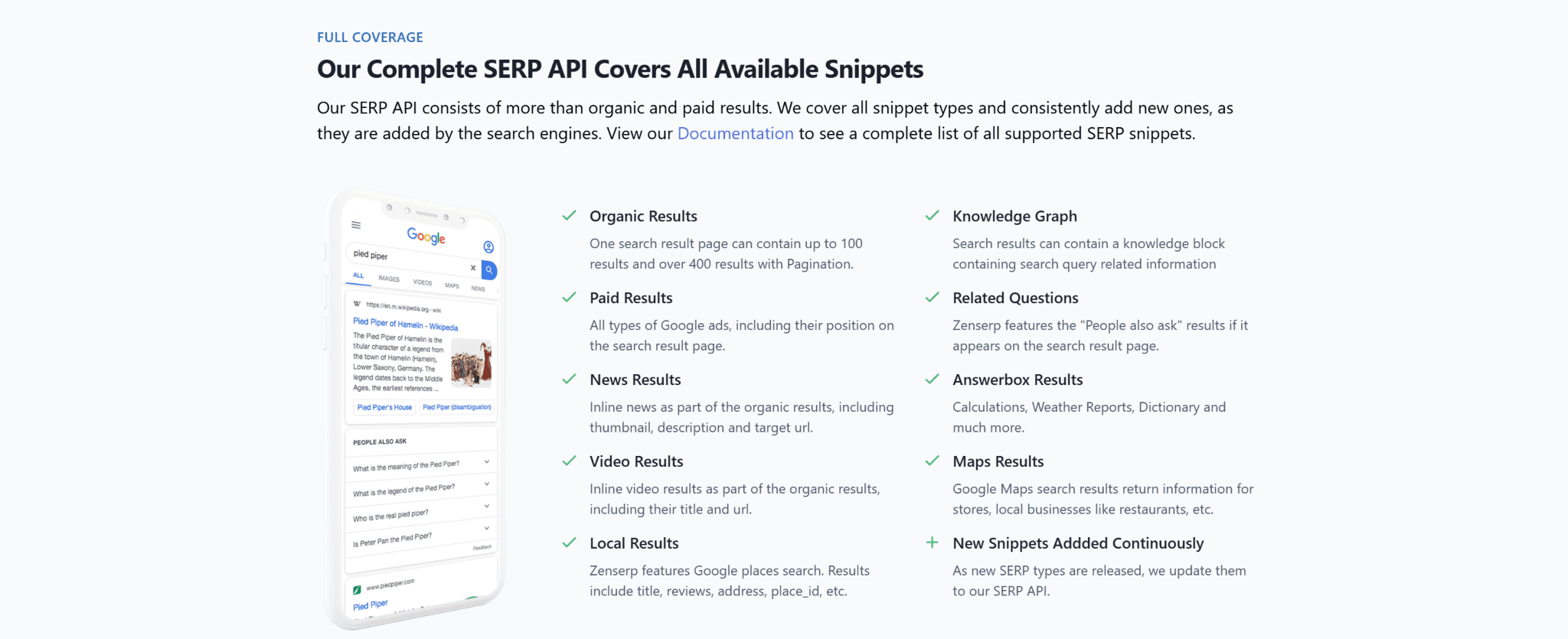
Zenserp is a dedicated SERP scraping API designed to extract structured data from multiple search engines, including Google, Bing, DuckDuckGo, and Yandex. The API parses organic search results, paid advertisements, local maps, shopping listings, news archives, and image channels. It is built with developer-friendly features.
Zenserp includes:
- Precise localized geo-targeting via coordinate-level parameters.
- Mobile and desktop device emulation.
- Interactive request builder that generates production-ready code snippets across multiple programming languages.
This Ahrefs API alternative is the best choice if you need highly localized, real-time SERP scraping and rank monitoring.
API Pricing Model
Zenserp uses a tiered monthly subscription structure based on search volume:
- Free Plan ($0/month): 50 searches, basic access for getting started
- Small Plan ($49.99/month): 25,000 searches, access to all SERP types
- Medium Plan ($149.99/month): 100,000 searches, all SERP types, batch endpoint, keyword search volume & CPC data, bulk index checker, onboarding, SLA, and personal support
- Large Plan ($299.99/month): 250,000 searches, all Medium features with higher limits
- Premium Plan ($499.99/month): 500,000 searches, all Premium SEO/API features plus custom queue support
- Enterprise Plan ($899.99/month): 1,000,000 searches, all Premium features with maximum scale and enterprise-level capacity
Pros and Cons
Pros:
- Features a simple, clean per-tier pricing structure.
- Multi-engine support.
- Hgh-concurrency batch processing endpoints.
- Nice free tier.
Cons:
- No native domain analytics.
- No native backlink indexes.
- No native site auditing tools.
- Critical programmatic features, including batch processing and keyword search volume data, are restricted to plans starting at $149.99 per month.
8. Mangools API
G2 review by Danilo Manca, SEO Consultant:
“I’ve used Mangools for years across keyword research, rank tracking and quick SERP/competitor checks. The suite with KW Finder, Serp Watcher etc. covers 90% of my day-to-day SEO needs without the bloat. The UI is fast, intuitive, and ideal for agencies and SMBs that want reliable insights without enterprise complexity. Support was exceptionally helpful and responsive: Maria proactively accommodated my situation with a fair solution within the same day, which made it easy to me to work. This kind of empathy and speed is rare in SaaS and deserves credit. If you want an SEO toolset that’s focused, affordable, and backed by human support, Mangools is an easy recommendation.”
Core API Endpoints & Functionality
The Mangools API programmatically connects developers to its core five-app marketing suite, which includes:
- KWFinder
- SERPChecker
- LinkMiner
- SERPWatcher
- SiteProfiler
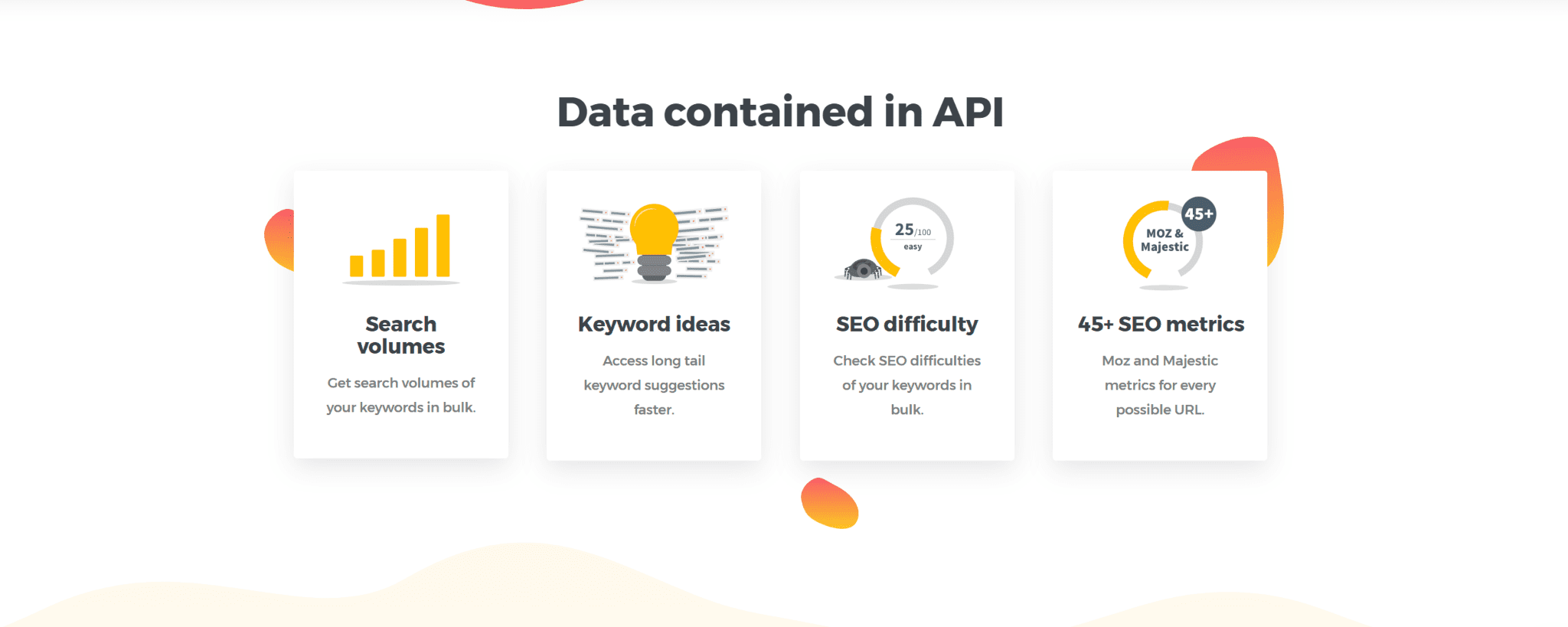
The KWFinder endpoints fetch up to 700 related keyword suggestions or extract up to 2,000 competitor-ranking keywords per query. The SERPChecker endpoints extract search rankings paired with up to 50 localized SEO metrics pulled from Moz and Majestic integrations. SiteProfiler and LinkMiner endpoints deliver basic website authority metrics and backlink row previews.
API Pricing Model
Among all the Ahrefs API alternatives, Mangools does not sell API capabilities as a standalone product. They are bundled directly into standard Mangools monthly subscriptions. These plans are structured as follows:
- Mangools Basic ($30.50/month billed annually): 500 prompts monitored, unlimited monitors, multi-LLM tracking (+3), no extra seats, 100 keyword research requests/day, 200 keyword suggestions/request, 100 SERP analyses/day, 200 tracked keywords, 100k backlinks/month, 20 site analysis requests/day.
- Mangools Premium ($40.50/month billed annually): 500 prompts, unlimited monitors, multi-LLM tracking, 3 extra seats, 500 keyword research requests/day, unlimited keyword suggestions, 500 SERP analyses/day, 700 tracked keywords, 500k backlinks/month, 70 site analysis requests/day.
- Mangools Agency ($70.50/month billed annually): 500 prompts, unlimited monitors, multi-LLM tracking, 5 extra seats, 1.2k keyword research requests/day, unlimited keyword suggestions, 1.2k SERP analyses/day, 1.5k tracked keywords, 1.2M backlinks/month, 150 site analysis requests/day.
The platform enforces daily search and lookup limits that reset every 24 hours from the exact time of the first request.
Pros and Cons
Pros:
- Simple, highly accessible interface.
- Affordable entry-level pricing for basic tasks.
- Integrated 24-hour cache layer to prevent redundant queries.
Cons:
- Features a narrow endpoint set compared to comprehensive platforms like SE Ranking.
- It lacks programmatic features for automated technical site crawling, nor does it support advanced LLM search tracking.
- Developers are heavily restricted by daily subscription limits.
Conclusion
The evolution of organic search has expanded the criteria for selecting programmatic data providers. When evaluating alternatives to Ahrefs API, developers, agency owners, and tool builders must balance dataset depth against commercial flexibility.
For modular, pay-as-you-go database builds, DataForSEO remains a strong Ahrefs API alternative. Among all the Ahrefs API alternatives, Majestic and Moz provide targeted options for specialized link or domain authority metrics.
For teams seeking a complete 1:1 replacement, SE Ranking is the best Ahrefs API alternative. SE Ranking allows you to start with $50 minimum deposit or standalone API access starting at $159 per month. Furthermore, it addresses modern search behavior through native MCP server integrations and specialized AI Search visibility tracking. With SE Ranking, you can programmatically measure brand metrics inside generative AI engines while enabling AI agents to query live search data directly.
To evaluate SE Ranking’s standalone API, you can sign up for the 14-day free trial. It includes 100,000 free credits to test endpoints, schemas, and MCP integrations directly.
FAQ
What is the cheapest Ahrefs API alternative?
DataForSEO represents the absolute lowest entry point. It operates on a pay-as-you-go consumption model with a $50 minimum top-up that never expires. For teams seeking a complete, developer-ready SEO suite, SE Ranking offers standalone API access starting at $179 per month when billed annually. It is backed by a 14-day free trial that includes 100,000 free credits.
Can SE Ranking API fully replace Ahrefs API?
Yes. For the vast majority of agency reporting, custom dashboard building, and software development workflows, SE Ranking serves as a complete functional replacement. It programmatically tracks keyword rankings, analyzes backlinks, extracts domain-level metrics, executes technical site audits, and provides cutting-edge brand visibility tracking across modern generative AI search assistants.
How much does the Ahrefs API cost in 2026?
Programmatic developer access requires an Enterprise plan subscription, which starts at $1,499 per month and requires an annual contract of $14,990 upfront. Standard plan subscribers who require programmatic access face a minimum combined cost of $949 per month, which packages the Advanced plan with the standard API add-on.
Is there a free Ahrefs API alternative?
Yes, several providers offer basic programmatic testing tiers. The Moz API provides a permanent free plan allowing up to 50 rows of link data per month at a rate of one request every ten seconds. Zenserp offers a free tier with 50 successful searches per month. To evaluate a comprehensive, full-stack database, SE Ranking provides a 14-day trial containing 100,000 free API credits. It is the most generous testing allowance on the market.
Which Ahrefs API alternative offers AI/LLM visibility tracking?
SE Ranking features native LLM visibility tracking endpoints. These endpoints allow platforms to programmatically evaluate how often a domain, subdomain, or brand is cited within ChatGPT, Gemini, Perplexity, Google AI Mode, and Google AI Overviews. They also allow for retrieving specific user prompts and computing share-of-voice leaderboards.