Is domain age a ranking factor? New research on why only 2% of young domains reach the TOP 10
For most new websites, Google’s first page feels out of reach.
And based on our data, that feeling is not far off. Domains under two years old appeared in only 2.03% of TOP 10 results in our analysis of 100,000 SERPs.
Still, “rare” does not mean “impossible.” Some young domains do get there.
So in this research study, we looked beyond the surface-level idea of domain age and used actual SERP data to answer:
- Is domain age a ranking factor? [See what the data says]
- Can a new website become visible in Google’s top 10 — and if so, how? [See how new domains rank]
Here are more details on what we found.
-
New domains rarely appear in Google’s TOP 10.
Domains under two years old account for only 2.03% of TOP 10 results and 1.42% of TOP 3 results.
-
Google’s first page is dominated by older domains.
57.15% of TOP 10 domains are 15+ years old, and that share increases to 62.61% in the TOP 3.
-
But domain age itself is not a ranking factor. Authority is.
Older domains usually have far more backlinks, referring domains, and trust signals. A typical TOP 10 domain aged 15+ years has 128x more backlinks and 27x more referring domains than a domain under two years old.
-
Young websites should not try to compete for high-authority SERPs right away.
Start with narrow, low-competition SERPs where relevance can outweigh authority: target long-tail, low-difficulty keywords first, then strengthen pages that already show early traction through impressions, clicks, or ranking movement. At the same time, consistently build authority with relevant backlinks and cite-worthy assets.
How old are the domains ranking in Google’s TOP 10?
The first thing our data shows is just how little space new domains occupy in Google’s TOP 10.
In our dataset, 57.15% of domains ranking in the TOP 10 are 15+ years old. And the closer we get to the very top of the SERP, the older the domains become: in the TOP 3, 62.61% of domains are 15+ years old.
Young domains, by comparison, barely show up.
Domains under two years old account for only 2.03% of TOP 10 domains and just 1.42% of TOP 3 domains.
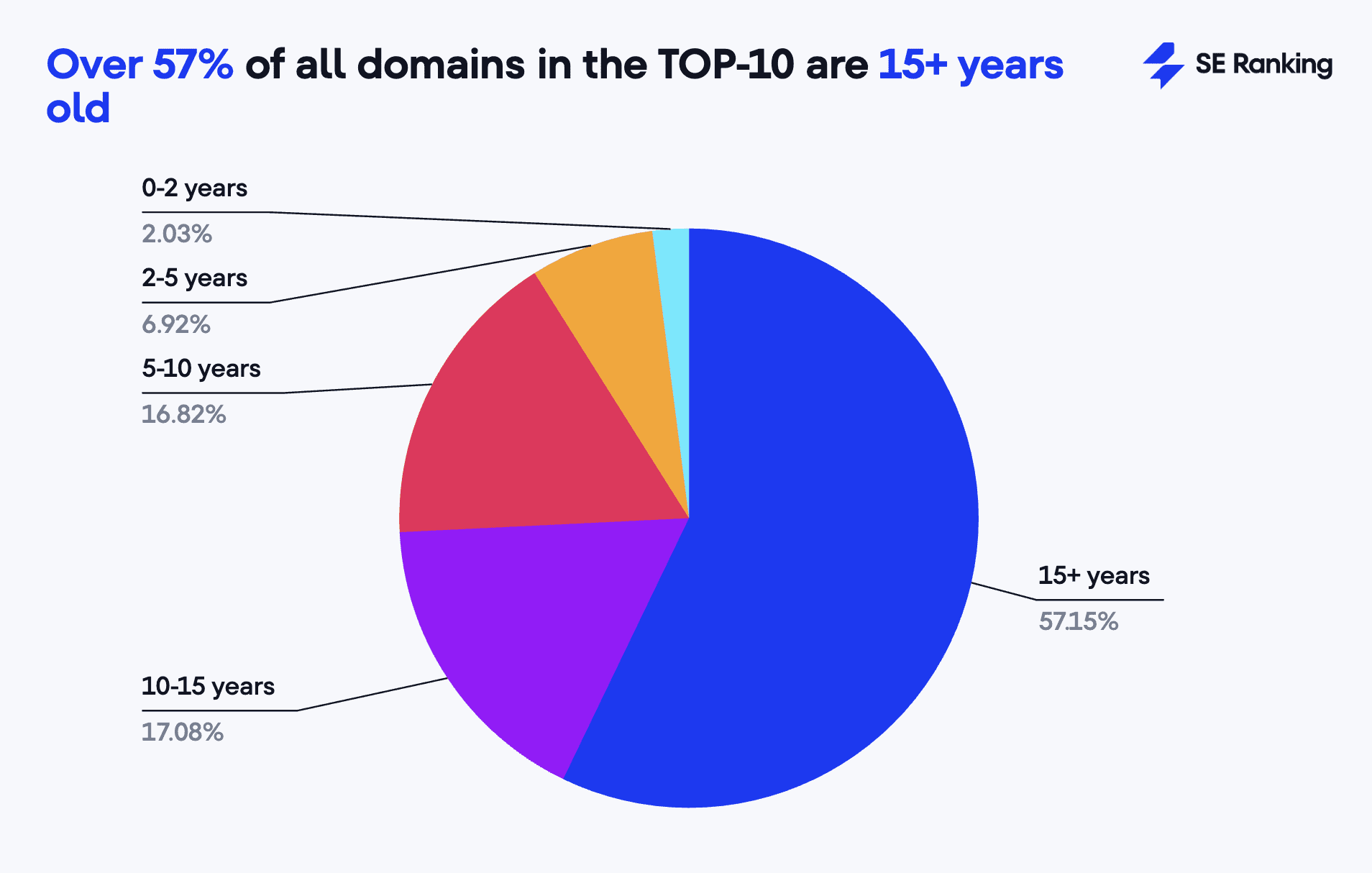
The median age of a TOP 10 domain is 17.3 years. For TOP 3 domains, the median age rises to 19.6 years.
So if you are launching a new website, the first page can feel like a market that has already been claimed. Most of the visible space is occupied by domains that were registered long before your site existed.
At first glance, this makes domain age look like the ranking advantage.
But that would be too simple, and the next layer of the data makes that clear.
So, is domain age a ranking factor?
No, not as a direct ranking factor. Domain age correlates with rankings because older domains have had more time to build authority, not because age itself is rewarded.
A domain does not become more useful just because another year passes. Google does not look at an empty 15-year-old website and reward it for surviving since 2011. A site with no links, no useful content, no brand demand would still have very little reason to rank.
The real advantage is what many older domains have been able to build during that time.
Fifteen years is a long time to earn links. It is a long time to be cited by other websites, mentioned across the internet, and expanded into hundreds or thousands of pages. Those signals compound slowly. And once they compound, they become difficult for a new site to match.
That is where the age gap turns into an authority gap.
Based on our findings, a typical 0–2 year old TOP 10 domain has:
- 85 median backlinks
- 45 median referring domains
- Median Domain Trust of 13
In turn, a typical 15+ year old TOP 10 domain has:
- 10,875 median backlinks
- 1,204 median referring domains
- Median Domain Trust of 72
So the old domain is not just older. It is usually much stronger.
A typical 15+ year old domain in the TOP 10 has 128x more backlinks and 27x more referring domains than a typical domain under two years old.
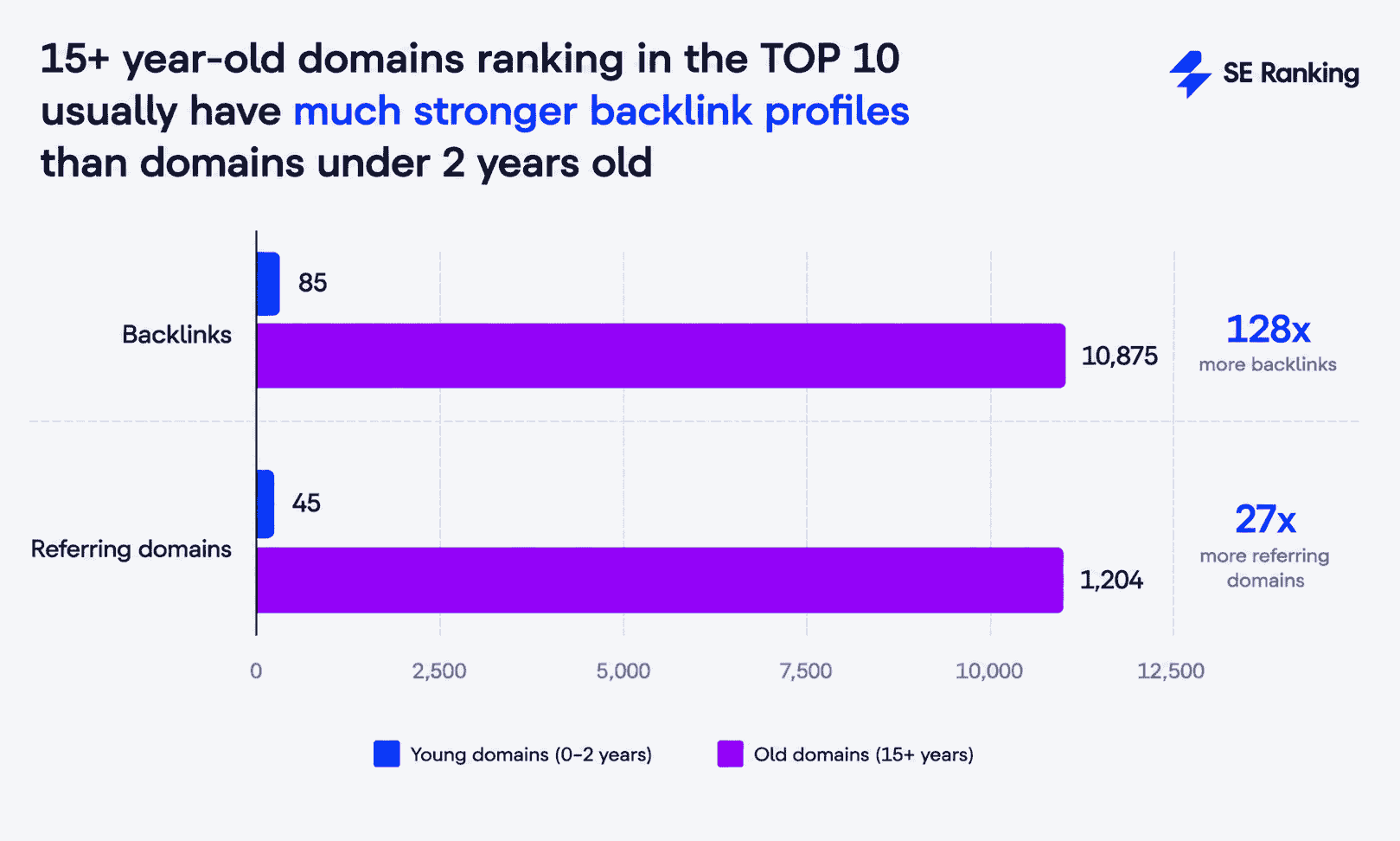
So, when an older domain outranks a new one, it may not be because Google prefers old websites. It may be because that older domain is supported by a much larger authority base: more sites linking to it, more pages reinforcing its topical coverage, more historical visibility, and more signals that the domain has earned trust over time.
The same pattern appears across every age bucket:
Median backlinks
85
Median referring domains
45
Median Domain Trust
13
Median backlinks
340
Median referring domains
100
Median Domain Trust
33
Median backlinks
1,179
Median referring domains
313
Median Domain Trust
45
Median backlinks
3,419
Median referring domains
661
Median Domain Trust
51
Median backlinks
10,875
Median referring domains
1,204
Median Domain Trust
72
85
45
13
340
100
33
1,179
313
45
3,419
661
51
10,875
1,204
72
Every step up in age comes with a step up in authority:
- Moving from 0–2 years to 2–5 years, the median backlink count increases by about 4x.
- From 2–5 years to 5–10 years, it grows by another 3.5x.
- From 5–10 years to 10–15 years, it increases by roughly 3x.
By the way, this finding also aligns with our LLM research, where we found domain authority to be the main ranking factor in ChatGPT and the second most important ranking factor in AI Mode.
So the better question is not:
“How old is the domain?”
The better question is:
“How much authority has the domain built?”
Can young domains get into the TOP 10?
Yes, young domains can get into the TOP 10, but they rarely do it by competing head-on with established websites across an entire niche. In most cases, they win where the competition is narrower, weaker, outdated, too broad, or underserved. Relevance matters more in these SERPs, and a young site can break through if it answers the query better than the pages already ranking.
A good example is story.cv, a new domain registered on May 25, 2025, that appeared in the SERPs after the March Core Update.
At first glance, its visibility looks promising: today, it ranks for around 668 keywords. But when we look closer, the picture becomes more specific. Only 75 of those keywords are in the TOP 10, which is just 11%.
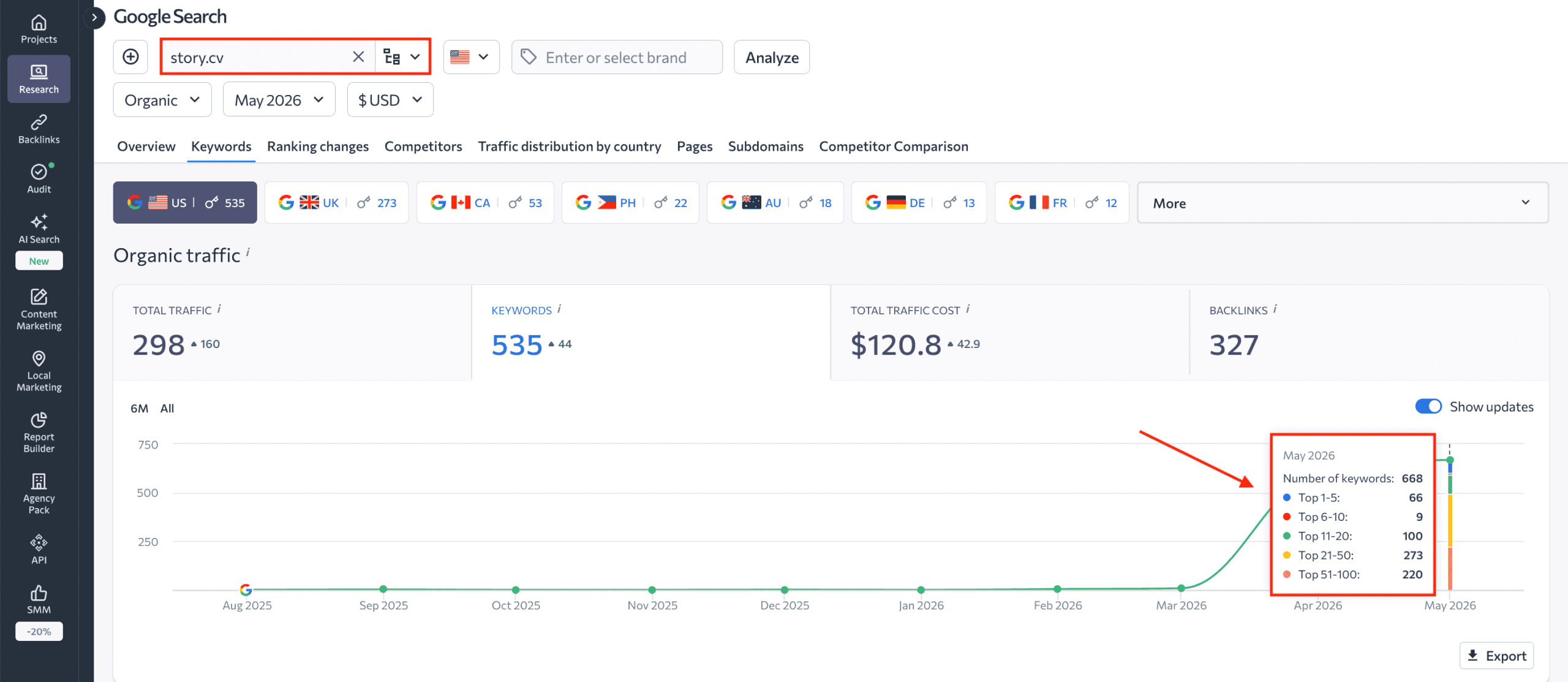
The average keyword difficulty for keywords where story.cv ranks in the TOP 10 is 13, while the highest keyword difficulty is 34.
Search volumes are modest too. Across its TOP 10 keywords, the maximum search volume is 590. What’s more, over one half of keywords the domain ranks for in the TOP 10 (40 out of 75) have a search volume lower than 100.
Here are a few examples of keywords where story.cv ranks #1:
Keyword difficulty
5
Search volume
10
Keyword difficulty
13
Search volume
50
Keyword difficulty
5
Search volume
140
5
10
13
50
5
140
Another interesting thing is that 34 of its 75 TOP 10 keywords revolve around one topic: resumes for career changers. These include “resume example career change,” “resume templates for career change,” “functional resume samples for career changers,” and similar queries.
So nearly half of its TOP 10 visibility comes from a single content cluster. This is exactly how many new domains get into the TOP 10: they do not start by challenging old authority sites on broad, competitive terms. They find a specific cluster of queries that bigger competitors have not covered deeply enough, then build relevance around that topic.
Authority still matters, especially for harder keywords. In our dataset, the young domains that ranked in the TOP 10 for more competitive queries looked very different from typical new websites. We analyzed the top 2% of the most successful domains under two years old (specifically, 60 young authority outliers) and compared them with 60 randomly selected domains from the same age group.
Typical young domain
85
Young authority outlier
21,700
Typical young domain
45
Young authority outlier
1,921
Typical young domain
13
Young authority outlier
77
85
21,700
45
1,921
13
77
And as you can see, ranking for competitive keywords usually requires more than a decent backlink profile. It requires authority signals that look closer to established domains than to typical new sites: thousands of backlinks, thousands of referring domains, and a much higher Domain Trust score.
So the answer is yes: young domains can reach the TOP 10. But for most of them, the realistic path is to start with low-competition, long-tail, highly specific opportunities and build topical authority step by step. If a young domain wants to compete for harder keywords earlier, it needs to build authority unusually fast — through strong backlinks, strong content assets, and consistent brand visibility.
What young websites should do to reach the TOP 10
So, what our data shows is that instead of trying to compete everywhere at once, young websites should first focus on SERPs where they have a realistic chance of winning, then expand into more competitive topics as their authority grows.
1. Find SERPs where the current results are weak
Before targeting any keyword, check what’s actually ranking for it. Not every TOP 10 is dominated by high-authority domains with deep, highly-relevant content. And your job is to find SERPs where the current results are broad, generic, and not fully relevant to the specific query.
If the top results only cover the topic broadly, a more specific and well-structured page, with original data, clear examples, or hands-on insight, will often outperform them over time.
How to find these opportunities: Use SE Ranking’s Keyword Research Tool to check SERPs for any keyword. You can review the domains currently ranking, their authority levels, and how well their content matches search intent. If the top results look beatable, that’s your signal to create something better.
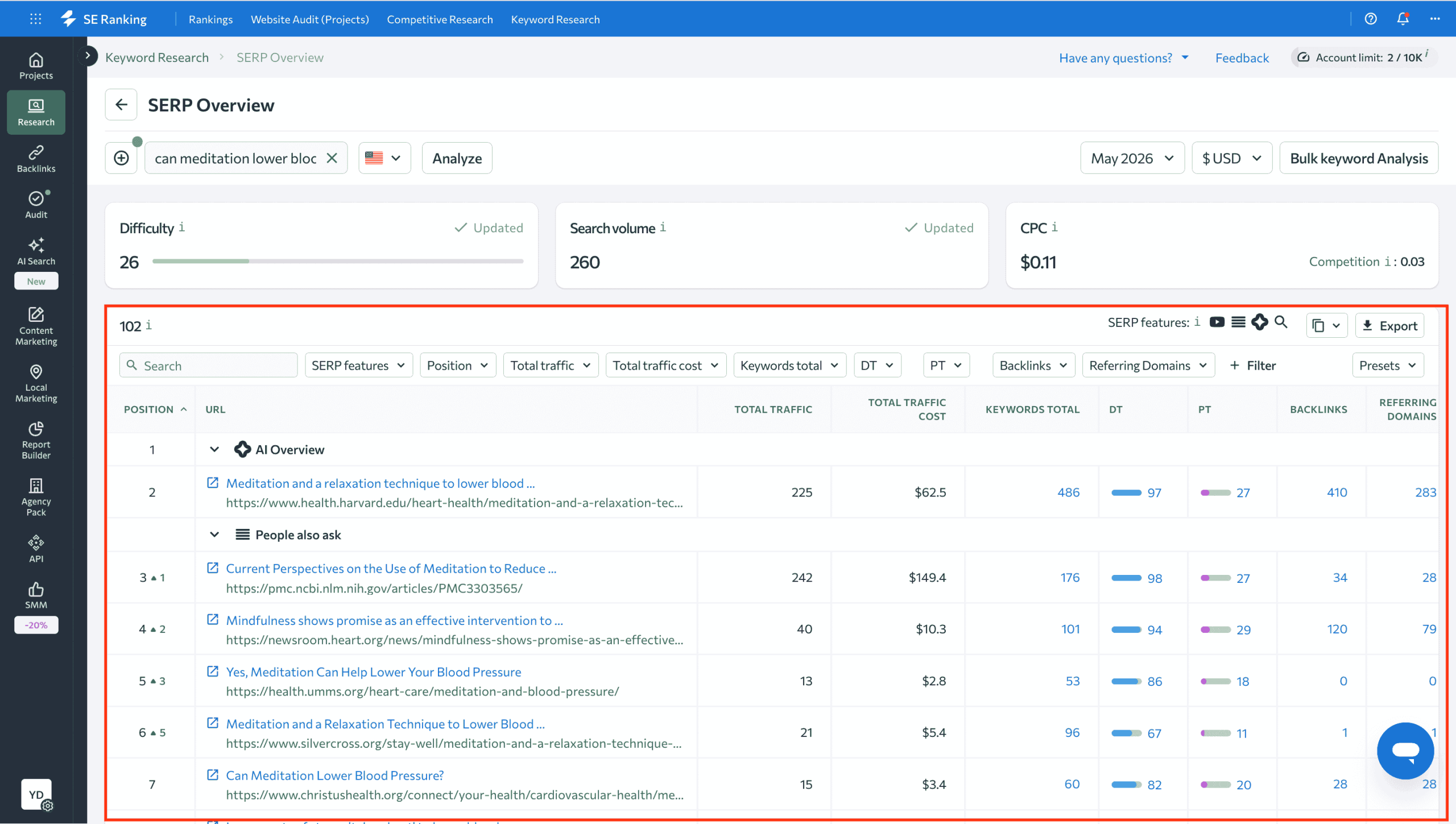
Or you can use our dedicated SERP Checker that shows top-ranking pages along with their metrics to help you learn more about the top players on the SERP for that keyword.
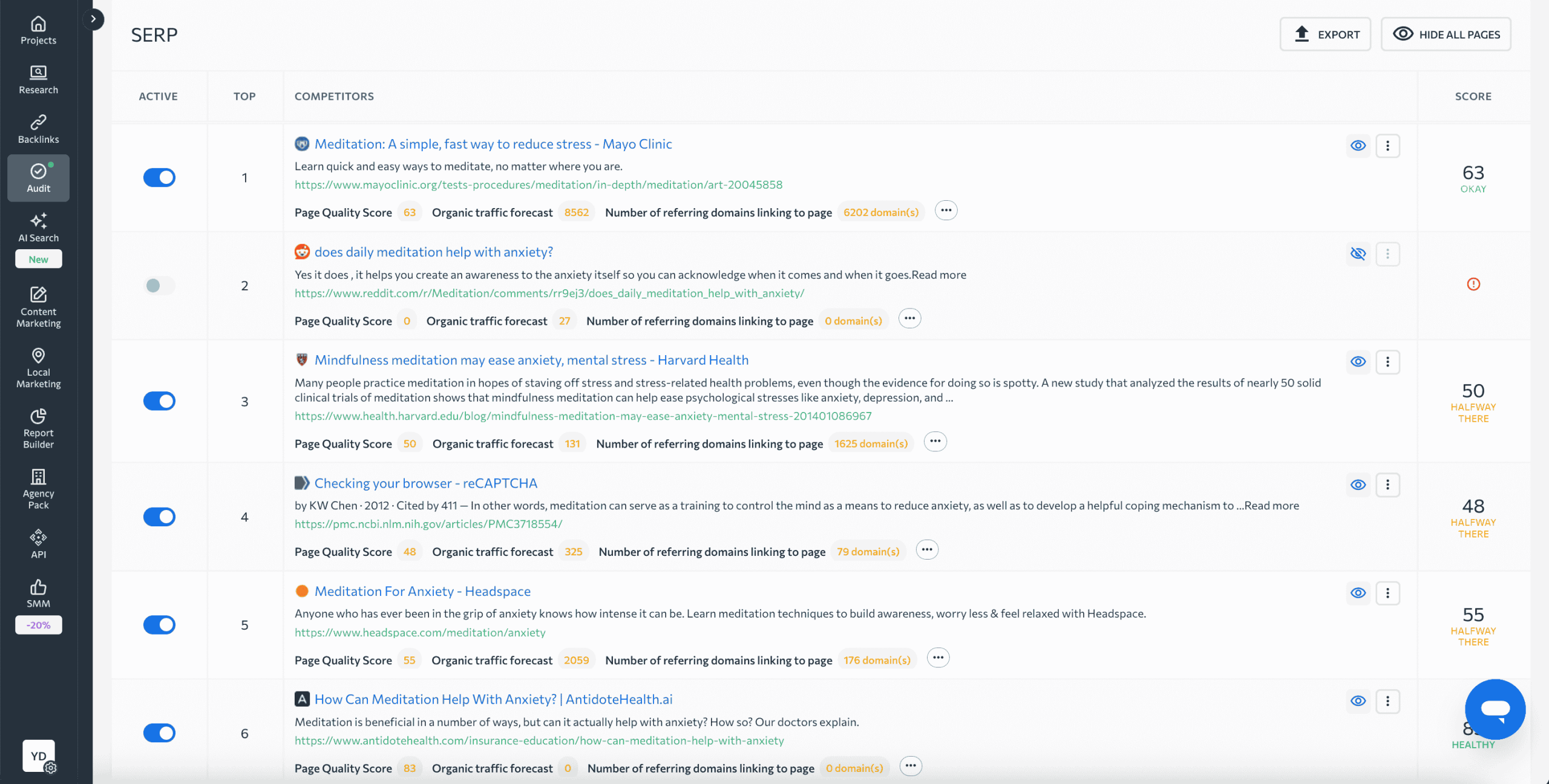
How MCP helps: With the SE Ranking MCP server, you can bring SERP and keyword data directly into AI assistants like Claude, ChatGPT, or Gemini. For example, you can ask the assistant to check the current top-ranking pages for a keyword, compare their authority metrics, and highlight where the SERP looks vulnerable. This helps you quickly assess whether the keyword is realistic to target and what kind of content would have a better chance of competing.
2. Start with long-tail, low-difficulty keywords
Long-tail keywords work for two reasons. First, they usually reflect clearer, more specific intent, which makes it easier to create a page that directly answers what the user is looking for. Second, they usually have lower search volume, and lower search volume often means fewer competitors.
And building a cluster of 5 to 10 well-ranked long-tail pages can generate as much traffic as a single broad, high-volume keyword. More importantly, it helps establish topical authority in a specific area before the site goes after broader terms.
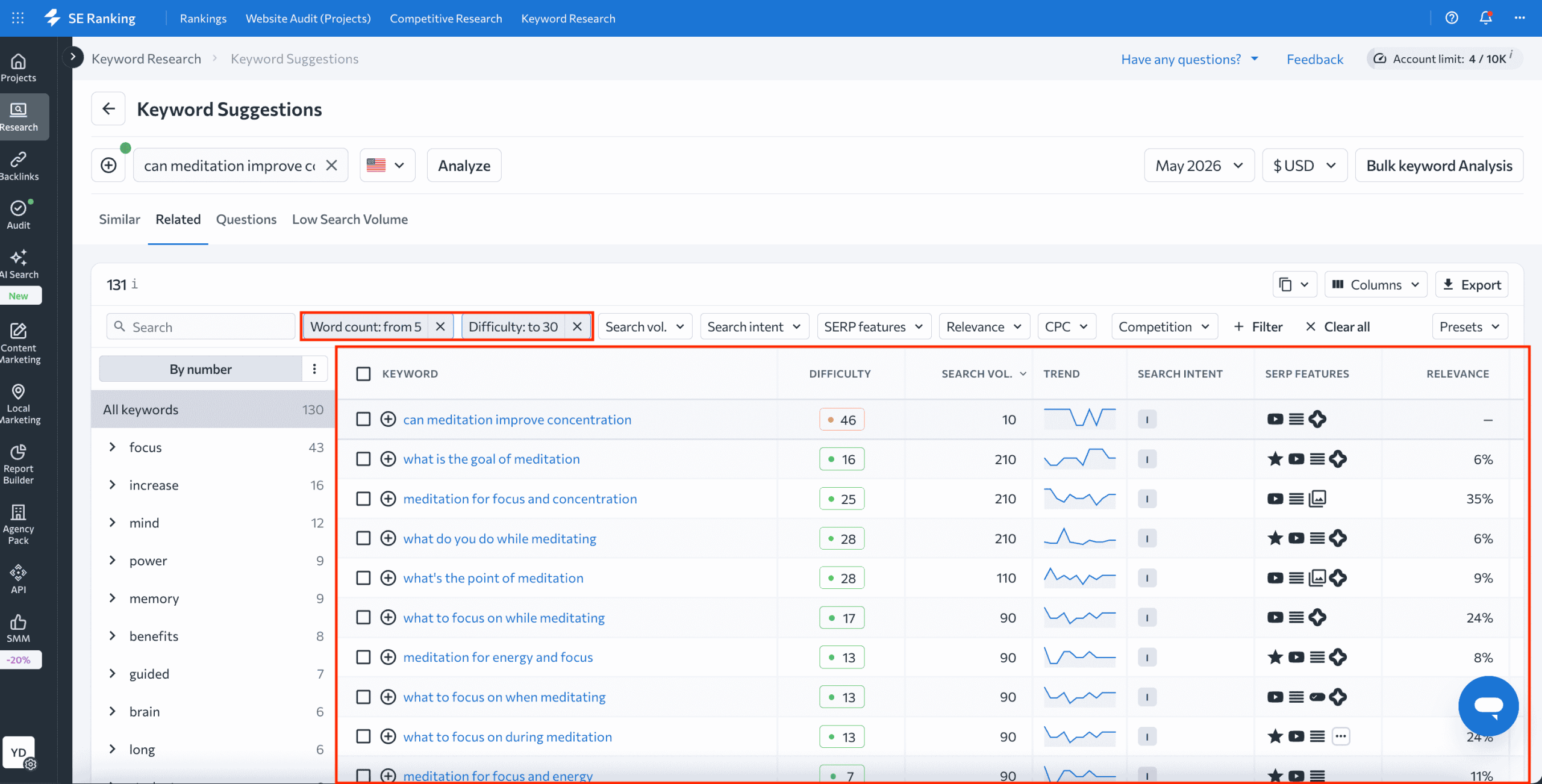
How to find these keywords: In SE Ranking’s Keyword Generator, filter by word count and keyword difficulty to find realistic targets. You can also group related keywords into topic clusters to plan your content architecture in a way that builds authority across an entire subject.
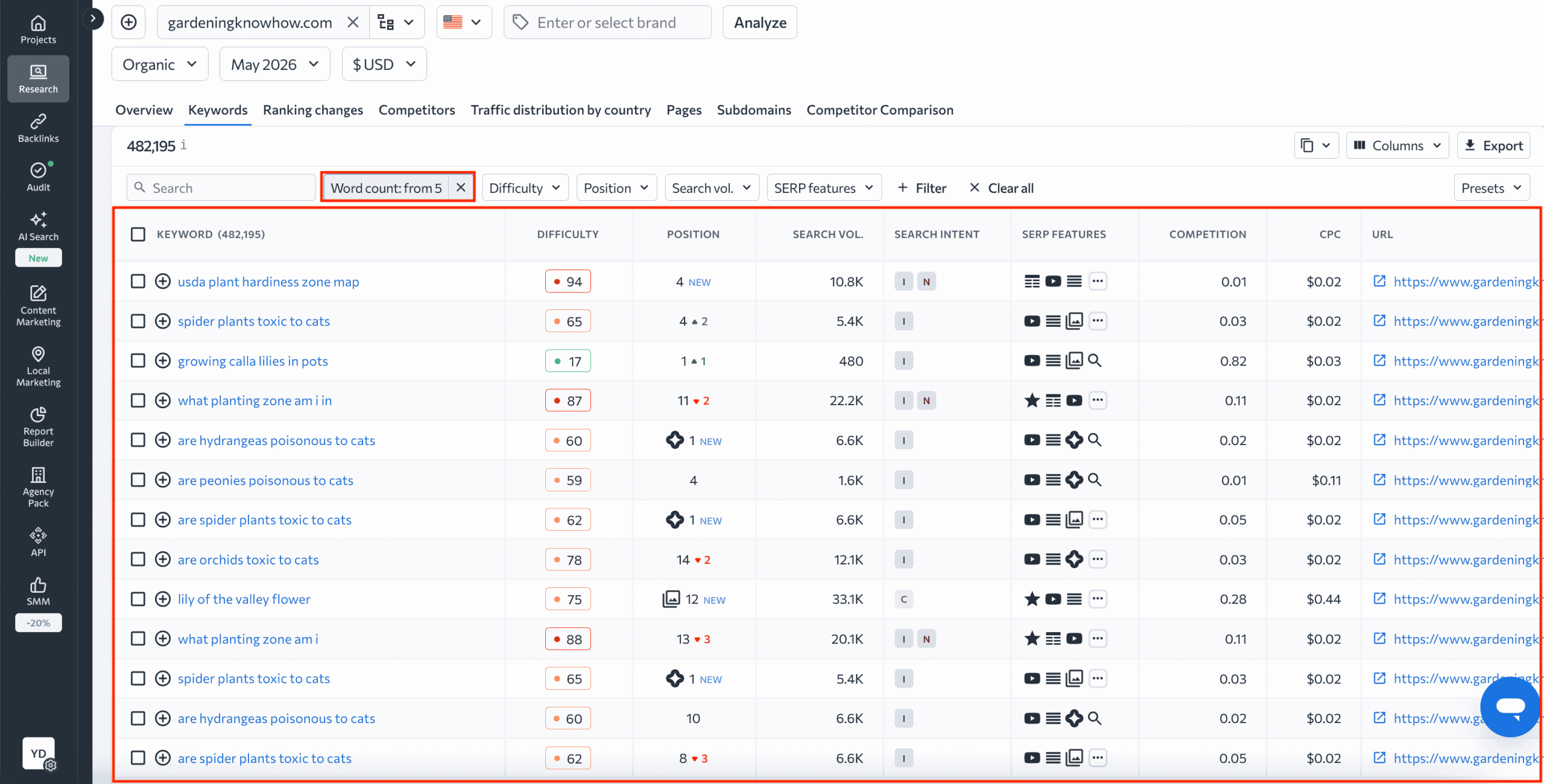
Alternatively, you can use SE Ranking’s Competitive Research tool to identify long-tail keywords that your domain or page already ranks for (and has the potential to rank higher).
How MCP helps: Through SE Ranking’s MCP integration, you can ask an AI assistant to find long-tail keyword opportunities based on difficulty, search volume, and intent. Instead of manually filtering keyword lists, you can prompt it to find realistic targets for a young site, group related queries into clusters, and suggest which topics are worth covering first.
3. Prioritize pages that are already gaining ground
New sites often make the mistake of constantly creating new content while neglecting pages that are already showing early signals. If a page is sitting at position 14 or 18, it’s being tested by Google. A targeted effort to improve that page can move it into the top 10 faster than starting a new piece from scratch.
Look for pages that have recently gained impressions or clicks, even if their rankings are still weak. Look for pages that have attracted a backlink or two organically. These are signals that the content has relevance. What they often lack is stronger internal linking, better alignment with search intent, clearer headings, or additional depth on subtopics users are actually looking for.
And updating these pages is one of the highest-ROI activities for a young site.
How to identify these pages: SE Ranking’s Insights tool provides a list of pages with early ranking movement, keyword shifts, and impression spikes. You can see which content is gaining ground and where to focus your optimization effort.
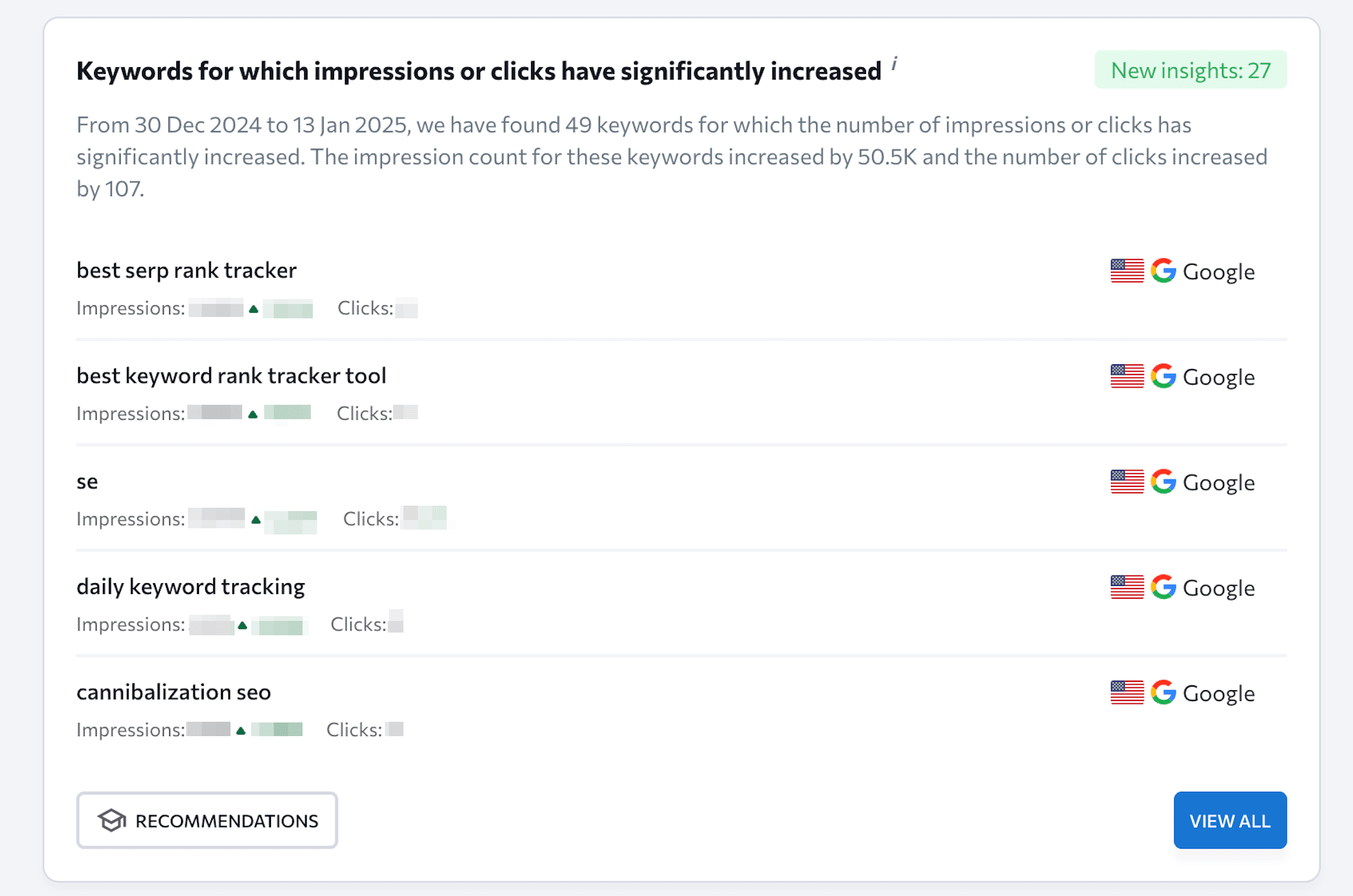
How MCP helps: With MCPs, you can bring SE Ranking and Google Search Console data into the same AI workflow. SE Ranking can show ranking movement and page-level SEO performance, while GSC helps confirm which pages are gaining impressions and clicks. The AI assistant can then compare these signals and identify pages that are already gaining traction.
4. Consistently build backlinks
Backlinks remain one of the clearest signals of trust for a new domain. But the pattern of acquisition matters as much as the volume. A sudden spike of 200 links in one month, followed by nothing, may look artificial. A steady flow of relevant, high-quality links from credible sources in your industry is what builds lasting authority.
Focus on niche-relevant websites, industry publications, expert resources, and media outlets that already cover your topic area. These are the links that can actually help you build domain authority over time.
How to approach this: Use SE Ranking’s Backlink Checker to analyze where your competitors are getting backlinks and turn those insights into outreach targets. Look at which pages attract the most links, which domains link to multiple competitors, and what anchor texts are used.
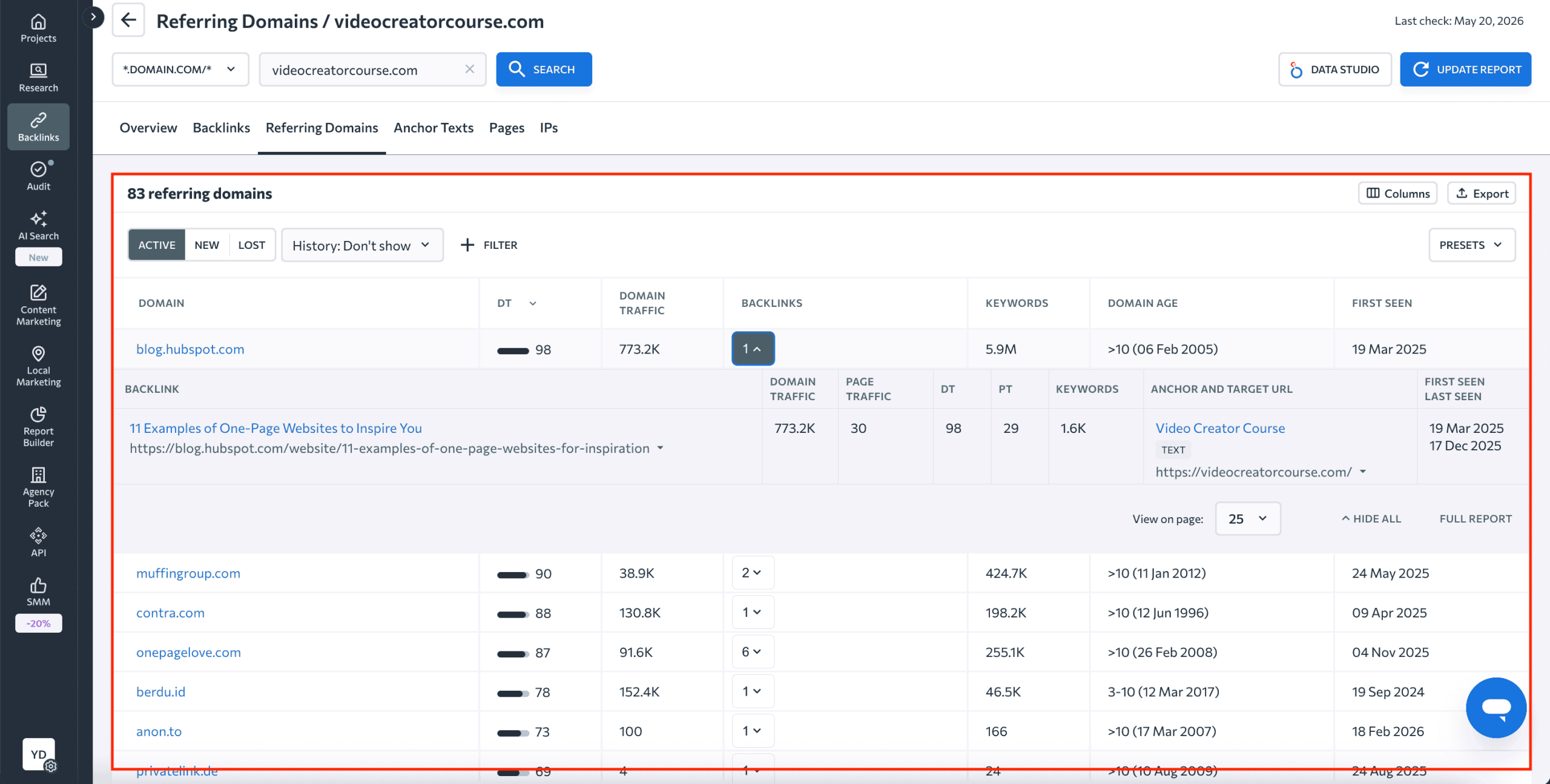
This helps you understand which websites are likely to link to content in your niche and which pages on your own site are worth promoting. From there, you can build a targeted outreach list.
How MCP helps: Through SE Ranking’s MCP integration, you can ask an AI assistant to analyze competitor backlink profiles and turn the data into actionable outreach ideas. For example, it can identify domains that link to several competitors, show which pages attract the most links, and help build a targeted list of websites that may be open to linking to similar content in your niche.
5. Create assets other sites want to cite
Blog posts build content depth, but they rarely attract backlinks on their own. What usually earns links is content that provides something valuable to cite: original data, benchmark studies, industry surveys, statistics pages, and so on.
If you publish a study on, say, which sources get cited the most in AI Mode answers, other websites covering that topic will link to it because it gives their readers evidence. That same study may earn links from publications you never reached out to. A standard blog post rarely does the same.
So, make sure your content and marketing activities are designed to naturally catch attention. Original research, industry reports, data-driven insights, expert collaborations, PR campaigns, and strong opinion-led content can all generate mentions and backlinks without relying only on cold outreach.
How to plan your assets: In SE Ranking’s Backlink Checker, you can see which competitor pages attract the most backlinks and what types of content earn the most links in your niche. If, for example, data studies dominate the referring links in your industry, that’s where to focus your asset creation effort.
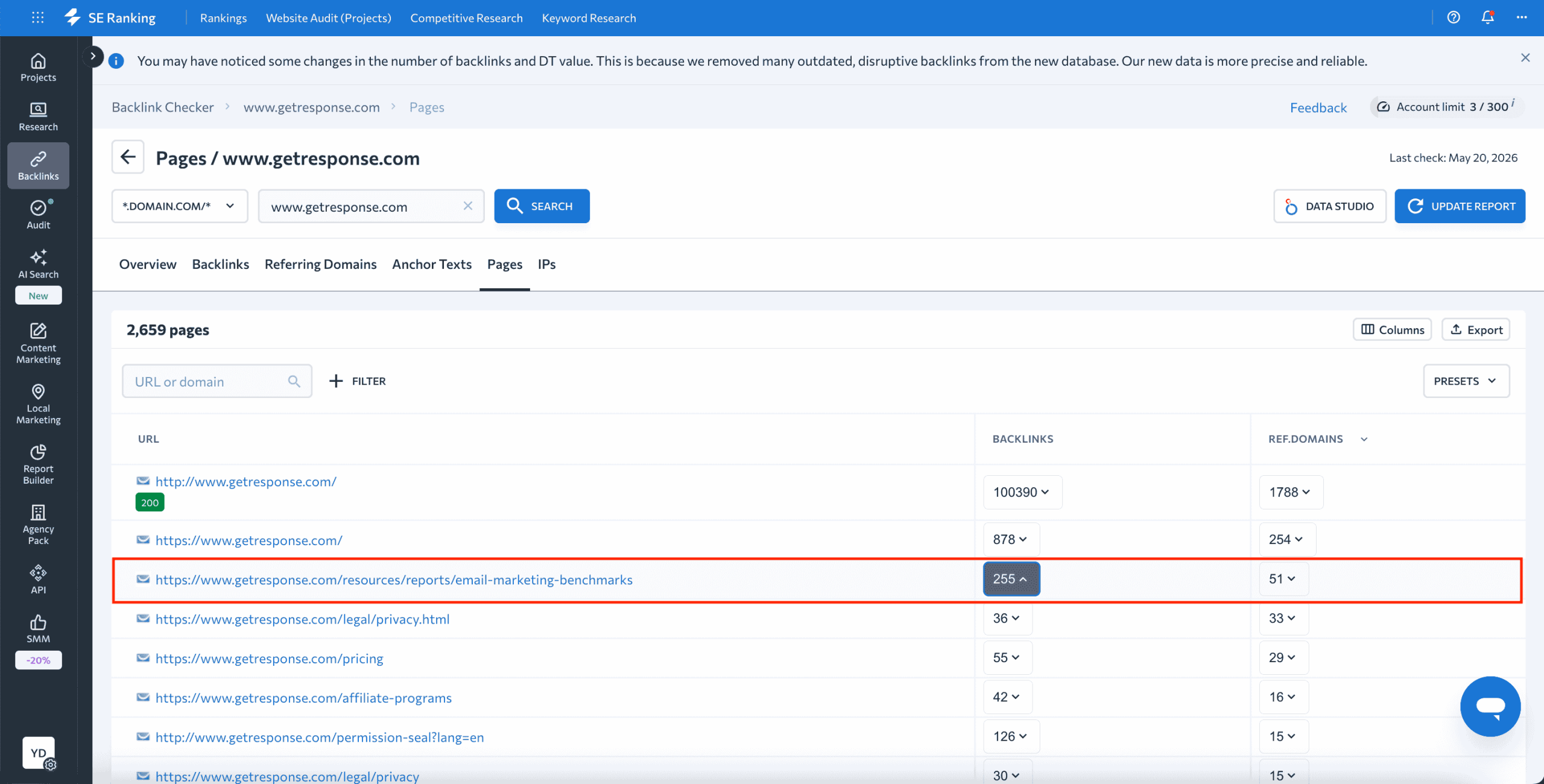
How MCP helps: With SE Ranking’s MCP, backlink data can be pulled directly into your content planning process. You can ask the assistant to analyze which competitor assets attract the most referring domains, identify patterns across linkable content formats, and suggest ideas that have a higher chance of earning citations in your niche.
6. Track visibility beyond traditional rankings
Today, organic rankings tell only part of the story. A page can move from position 12 to position 6 and still bring little extra traffic if an AI Overview answers the query directly. At the same time, a keyword cluster may look stagnant in rank tracking while quietly gaining visibility through citations in ChatGPT or Perplexity. These gaps appear when you track rankings in isolation.
That’s why young sites need to connect multiple signals: keyword movement, traffic and engagement, and AI search visibility. Together, these signals show not only whether a page is ranking, but whether it is actually driving visibility, visits, and brand exposure across search environments.
How to track across signals: SE Ranking gives you an ecosystem-level view of brand visibility. Use Rank Tracker to monitor keyword movement over time, AI Results Tracker to see how, when, and where your brand appears in ChatGPT, AI Mode, AI Overviews, Gemini, and Perplexity, as well as the GA4 integration to connect organic and AI search performance with actual traffic and user behavior.
How MCP helps: Through MCP, you can connect SE Ranking to bring organic ranking data and AI search visibility into your workflow. Then, connect Google Search Console to add impressions, clicks, and query data, and GA4 to add traffic behavior and engagement metrics. This gives the AI assistant enough context to compare what is ranking, what is being cited in AI search, what users are actually clicking, and how they behave once they land on the site.
Research methodology
This study is based on a one-time SERP snapshot collected on April 9, 2026 from New York, United States.
We analyzed 100,000 SERPs and extracted 147,195 unique domains ranking in the TOP 10.
For each domain, we collected:
- Domain age, calculated from WHOIS registration date
- Total backlinks
- Referring domains
- Domain Trust
Backlink, referring domain, and Domain Trust data were obtained via the SE Ranking Data API.
Domains were grouped into five age buckets:
- 0–2 years
- 2–5 years
- 5–10 years
- 10–15 years
- 15+ years
To identify young authority outliers, we looked only at the 0–2 year bucket. There were 2,760 domains in this group.
An “authority outlier” was defined as a domain whose referring domain count fell into the 98th percentile of the 0–2 year bucket. This produced 60 outliers.
For both groups, we calculated the percentage of each domain’s ranking keywords with Keyword Difficulty ≥ 40.
Disclaimer: The results may differ for other keyword sets, locations, dates, SERP samples, industries, or SEO metrics. The conclusions above are our interpretation of the patterns we observed in this specific study.
Conclusion
New domains rarely reach Google’s TOP 10, but the problem is not age itself.
Older domains dominate because they have usually had more time to build the authority that helps pages rank: backlinks, referring domains, trust, visibility, and topical depth.
In the end, domain age is mostly the visible pattern. Authority is what explains it.