The European Parliament replaced Google with Qwant for search. Could Mistral be next for AI?
Europe aims to reduce its dependence on US big tech. The reason is simple: when important technology is controlled outside Europe, access can change for reasons Europe does not control.
The Anthropic case showed this clearly. After the US government ordered the company to suspend foreign access to Fable 5 and Mythos 5, Europe had to deal with the consequences of a decision it did not control.
That also explains the European Parliament’s move from Google to Qwant. It was part of a broader effort to use more European alternatives when control, data, and long-term access matter.
Now the same question is moving to AI. If Europe wants models that run on European infrastructure, follow European laws, and are not dependent on foreign decisions, Mistral AI is the obvious company to watch.
And in this research study, we decided to take a look at where Mistral stands today as an AI traffic source, and whether the numbers support its role as Europe’s AI frontrunner.
Here’s what our research findings show.
-
Mistral AI is the clearest European candidate to benefit from the EU’s push for local tech alternatives.
The European Parliament’s switch from Google to Qwant shows that European institutions are aiming to replace US tech defaults with European tools. In AI, Mistral plays the closest equivalent role: a European-built platform that runs under European rules and could help reduce dependence on US AI providers.
-
But Mistral is not yet Europe’s AI default by usage.
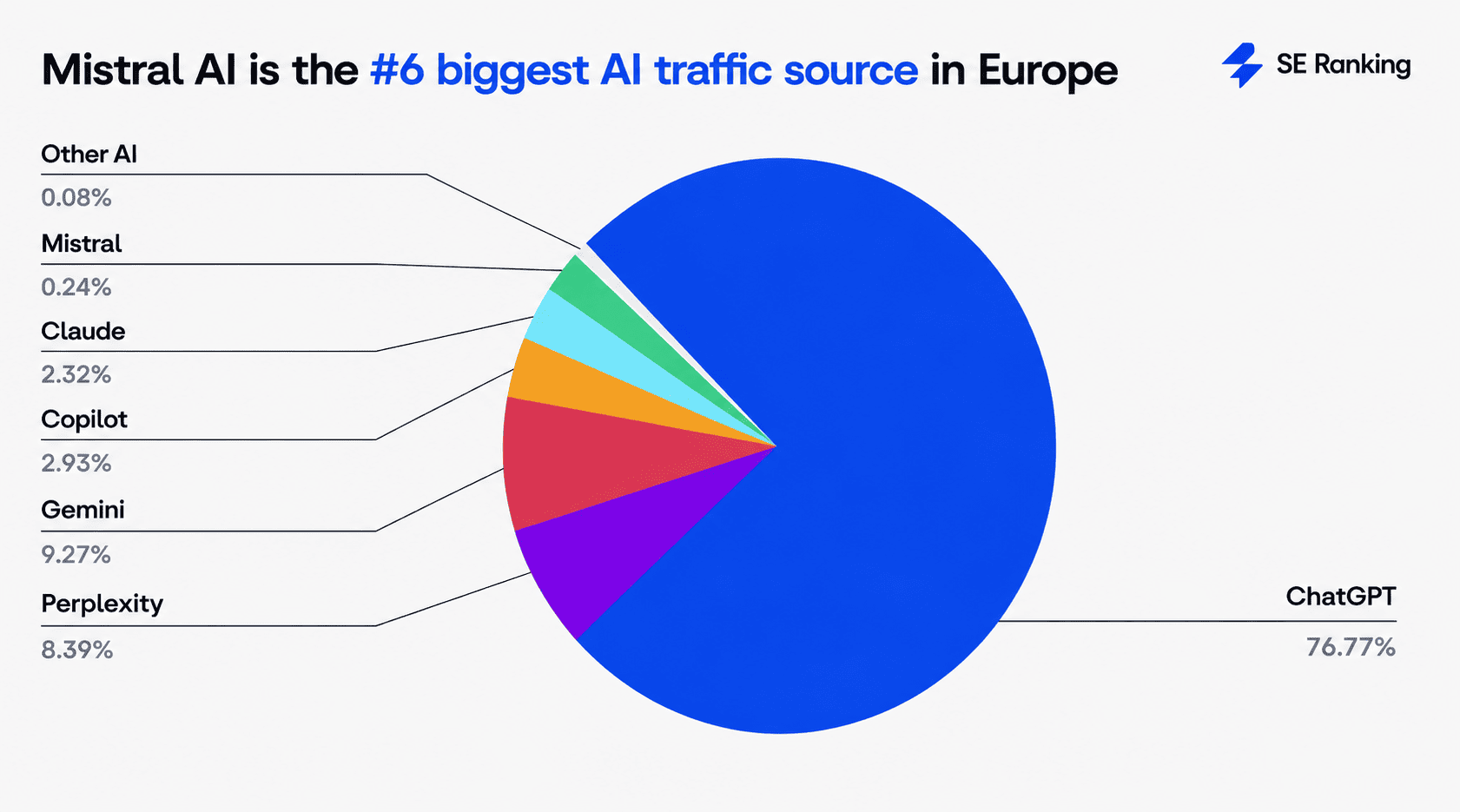
Mistral accounts for 0.24% of all website visits sent by AI tools in the EU, behind ChatGPT, Perplexity, Gemini, Claude, and Copilot.
-
France remains Mistral’s strongest market.
In France, Mistral accounts for 0.85% of all website visits sent by AI tools, which is about 3.5x higher than its share across the wider EU. That is still slightly down from 0.90% in 2025, after Claude overtook it.
-
The traffic gap between France and the broader EU is largely driven by Mistral’s local advantages in the French market.
Mistral benefits from its AFP partnership, which gives Le Chat access to high-quality French-language news content and improves answer relevance for local users. Plus, limited local competition due to restrictions on Google’s AI allows Mistral to stand out in France more than it does elsewhere in Europe.
-
Mistral is sending more website visits in 2026 than it did in 2025.
Traffic rose about 28% in France from 0.0018% to 0.0023%, and 75% across the EU from 0.0004% to 0.0007%. Still, after a January 2026 spike, it stayed roughly flat through May 2026.
A brief history of Mistral AI
Mistral AI was founded in 2023 in Paris by three AI researchers: Arthur Mensch (formerly DeepMind), Guillaume Lample, and Timothée Lacroix (both formerly Meta).
From the beginning, the company had a clear ambition: build advanced AI in Europe and reduce dependence on American tech giants.
The company quickly built a diverse AI portfolio:
- Large and multimodal models: Mistral Large 3 and Mistral Medium 3.1, capable of handling text and images.
- Smaller, efficient models: Ministral 3 family, designed for lower-compute tasks.
- Coding and STEM models: Devstral series for software development and scientific tasks.
- Document and reasoning models: Magistral, for understanding and analyzing documents.
- Audio models: Voxtral, mainly for speech-to-text and audio tasks.
- Chatbot platform: Le Chat, a consumer-facing AI assistant powered by Mistral models.
When Le Chat launched on mobile in February 2025, it reached 1 million downloads in two weeks, becoming the most downloaded free app in France’s App Store at the time.
But this initial success was not only due to the product itself. It also arrived at a moment when European governments were becoming much more concerned about dependence on foreign AI providers.
The thing is, for European governments and institutions, relying on foreign AI providers comes with real trade-offs. Sensitive data may fall under foreign laws (which may clash with rules like GDPR). Access to advanced models can become more expensive, restricted, or unstable because of decisions made outside Europe. And when AI systems are built and controlled elsewhere, European institutions have less visibility into how those systems work, especially in sensitive areas such as public services, defense, healthcare, and critical infrastructure.
Those concerns became more concrete in June 2026, when Anthropic was ordered by the US government to suspend access to its two most advanced models, Fable 5 and Mythos 5.
In a public statement, Anthropic wrote: “We received the directive from the government today at 5:21pm (ET). The letter did not provide specific details of its national security concern.”
The directive was later disputed, but the episode showed the risk European policymakers have been warning about: if critical AI tools are controlled by foreign companies under foreign law, access can change suddenly and for reasons European institutions cannot control.
That is why the European Parliament’s decision on June 4, 2026, to replace Google with Qwant as its default search engine matters a lot in this context. It was part of a broader effort to reduce reliance on non-EU digital tools. The same logic now applies to AI and cloud services: Europe wants more technology that runs on European infrastructure, follows European laws, and remains under European institutional control.
This is the environment in which Mistral became Europe’s leading AI candidate. The company had the technical base, but it also had the political and strategic positioning Europe was looking for.
On the political side, the French government, particularly President Emmanuel Macron, has provided heavy support for Mistral AI:
- He has publicly praised the startup as an example of “French genius,” and encouraged French business leaders to prioritize French and European AI solutions.
- The French Ministry of the Armed Forces signed a framework agreement in January 2026 for the defense AI agency (AMIAD) to use Mistral’s technology across all military branches.
- The government facilitated partnerships with major French companies like Veolia and Iliad, while securing collaboration with Nvidia to build AI cloud infrastructure in France.
Economic support was just as important. Mistral raised significant funding from European investors and industrial players, including €1.3 billion ASML investment. In addition, Europe’s strong research ecosystem (top engineering schools, AI labs, and experienced talent coming from companies like Meta and DeepMind) gave Mistral access to the skills needed to grow quickly.
On paper, this seems like a perfect mix of technical innovation, political support, and strategic positioning. But the real question is whether Mistral can turn all of this into actual usage.
That’s exactly what our research set out to measure.
Mistral AI traffic: France vs. Europe
To answer that, we looked at how much traffic websites receive from Mistral across France (its strongest market) and Europe as a whole.
France: Mistral holds a top-6 position, with growing volume
According to our data, Mistral AI holds 0.85% of all AI-driven traffic in France, which means roughly 1 in every 118 AI-referred visits in France comes from Mistral AI.
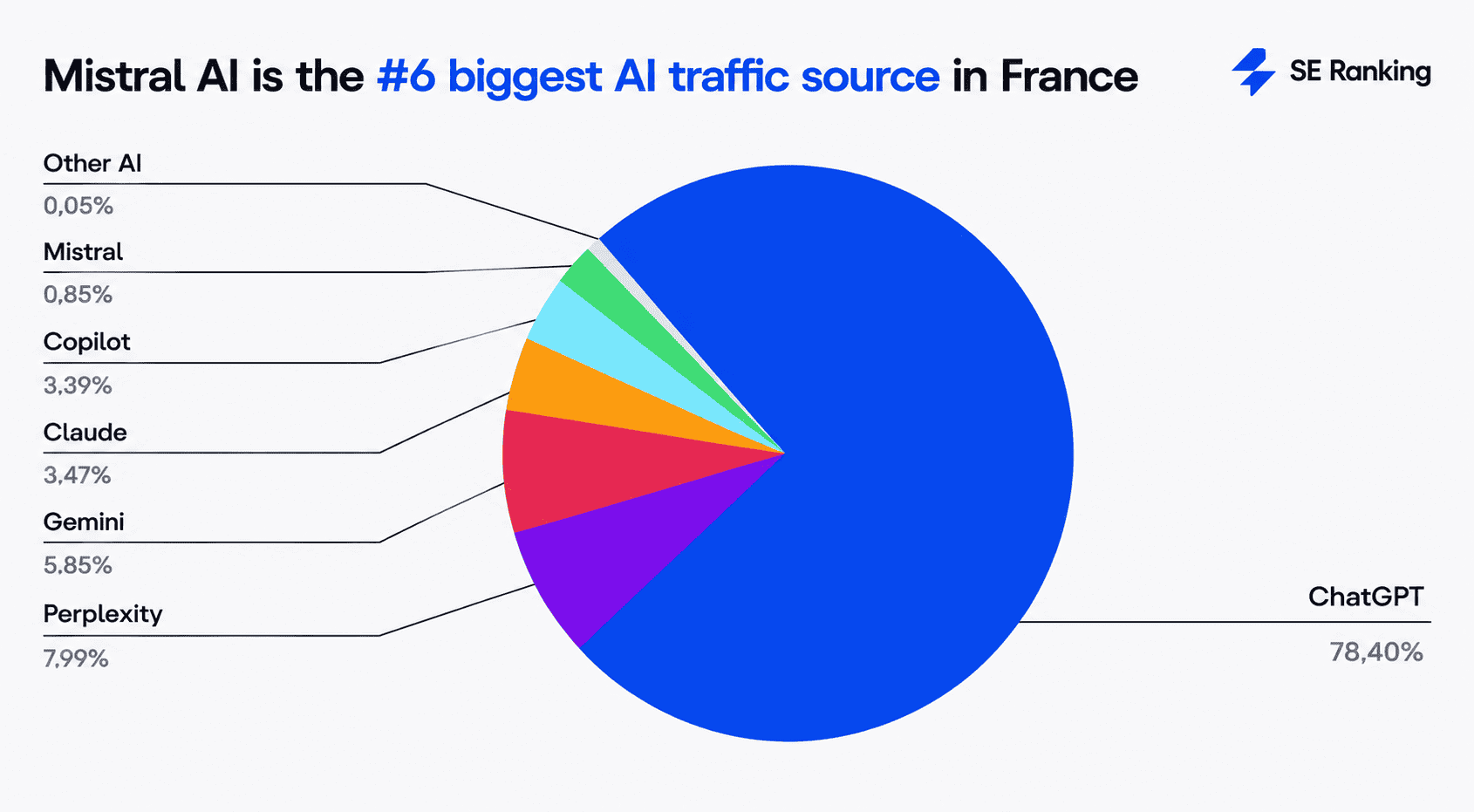
That share is slightly lower than in 2025, when Mistral held 0.90%. But this does not mean Mistral is sending less traffic to websites. In fact, the opposite is true: the amount of traffic Mistral sends to sites in France increased 28% (from 0.0018% across 2025 to 0.0023% in January–May 2026).
The reason Mistral slipped from 5th to 6th place is that the overall AI traffic market grew faster than Mistral did. Claude, which ranked below Mistral in 2025, grew faster and moved ahead of it.
So while Mistral’s ranking fell slightly, its actual traffic increased. For a European AI company competing against much larger US platforms, that is still a strong result.
But Mistral’s success in France does not show up only in AI-referred traffic. Other signals point in the same direction: more are searching for the brand directly, and overall search interest has been climbing again after a quieter period.
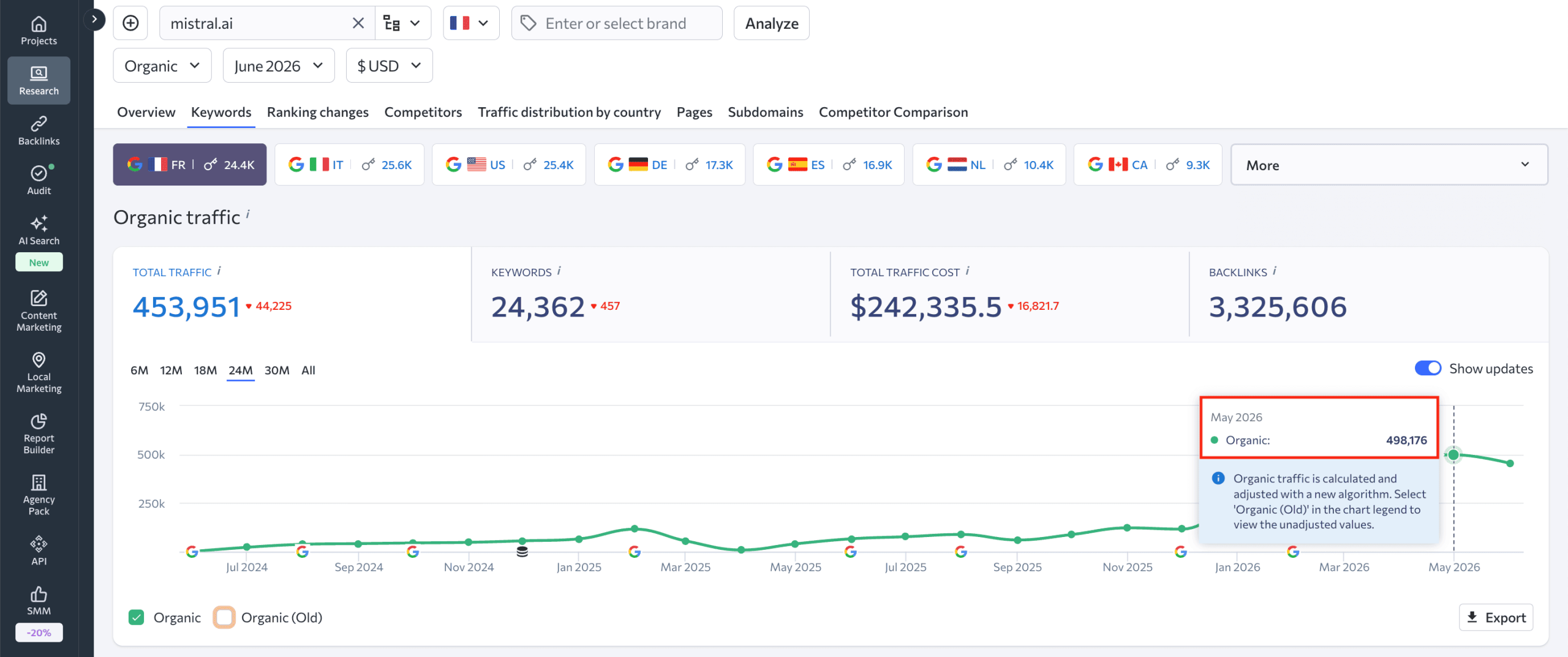
Organic traffic is the first clue. Over the past two years, visits to Mistral’s website have grown sharply, reaching a record in May 2026 with nearly 500K estimated clicks.
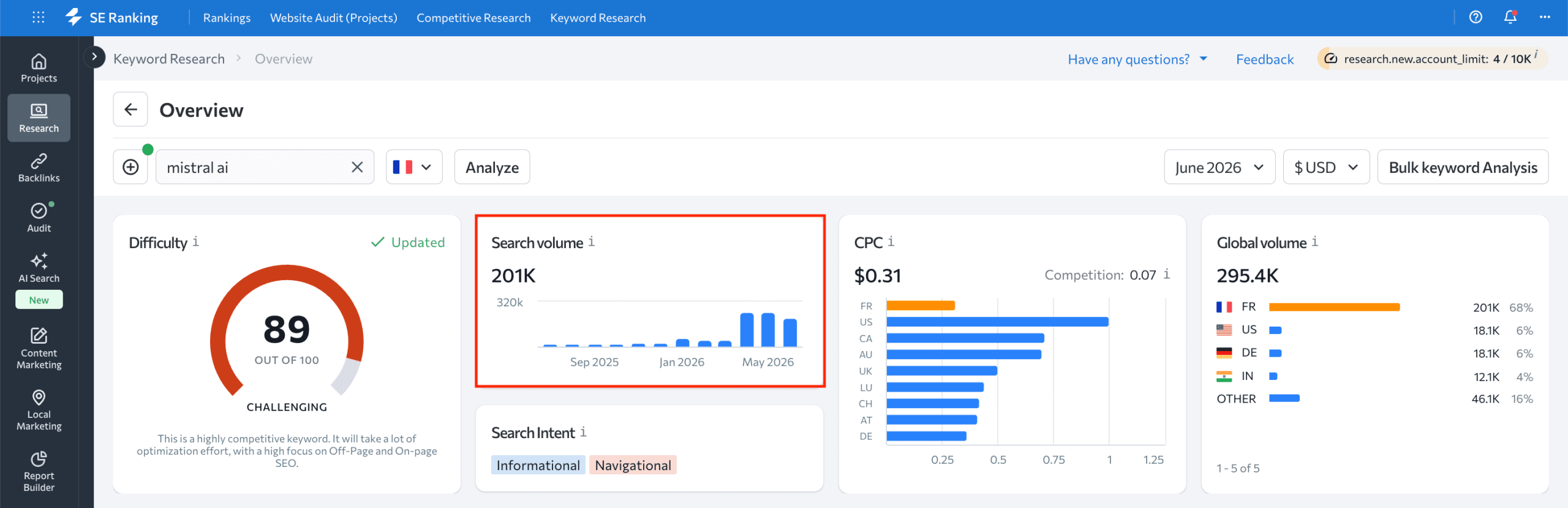
Branded search demand makes the trend even clearer. In March 2026, monthly search volume for “Mistral AI” in France stood at roughly 47,500. Just one month later, in April, it surged to 246,000 (over 5x increase). Importantly, this was not a short-lived spike. Search demand has remained elevated ever since, not falling below 201,000 searches.
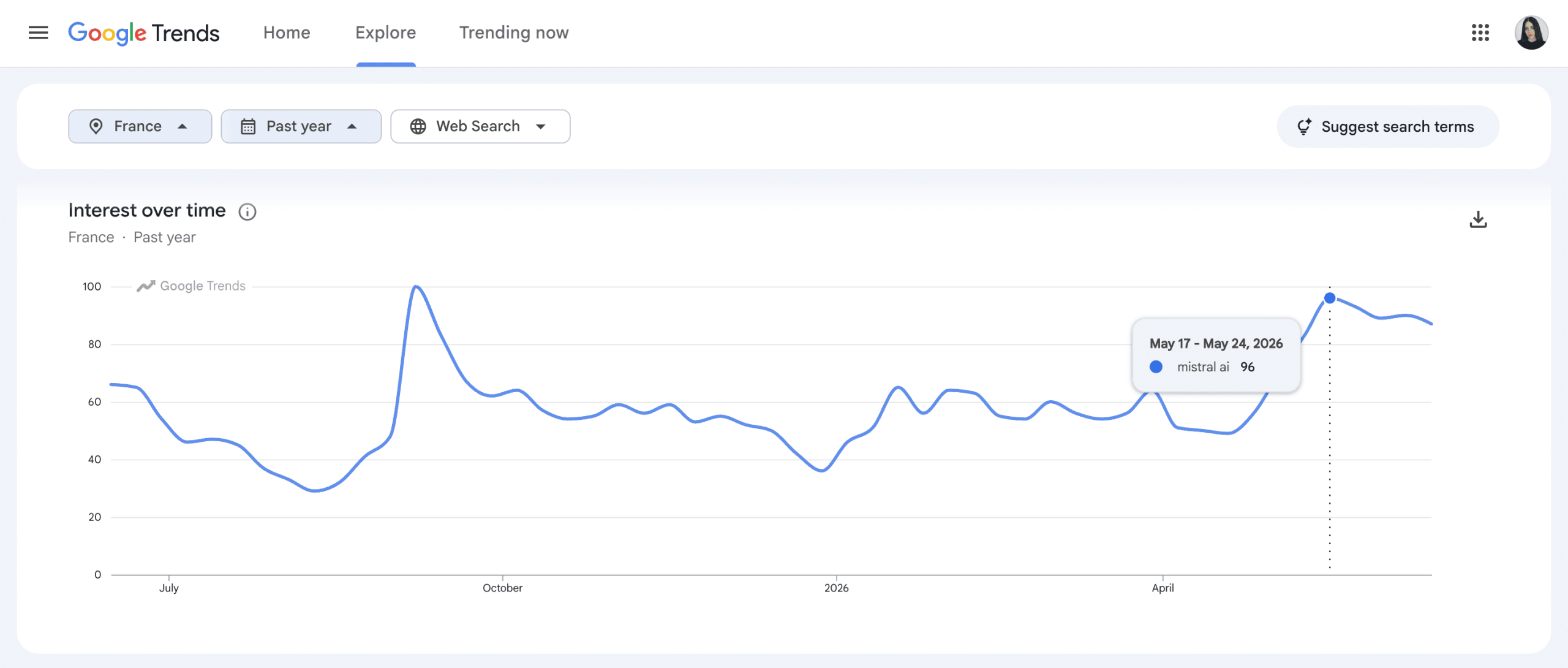
Google Trends adds one more layer. Interest in Mistral AI in France remained relatively high over the past year and reached its highest level in May 2026 since September 2025.
Taken together, these signals show that Mistral’s popularity in France is no longer just a policy narrative or media story. It is increasingly visible in how people search, discover, and return to the brand.
Europe: Mistral grows share and holds position
Across Europe, Mistral’s AI traffic share rose from 0.21% in 2025 to 0.24% in January–May 2026. Yet, this is still over 3.5x lower than in France (0.85%).
Its position in the EU ranking stayed at 6th in both 2025 and 2026.
And this gap between France and the EU is not random. It likely comes from three France-specific factors:
- Focus on local French content
Mistral signed a partnership with Agence France-Presse (AFP), which allows its chatbot to access a large archive of French-language news content. This improves answer quality for French queries and makes the tool more useful for local users.
- Government adoption in France
The French Ministry of Digital Transition announced a partnership with Mistral AI to equip 10,000 civil servants with generative AI to support daily administrative tasks (with an ultimate ambition of making such tools available to all 5.7 million public servants in France). This program is hosted entirely in France under strict public supervision, which gives Mistral a clear advantage over competitors in other European countries.
- Less competitive AI market in France
France has strict national rules regarding copyright and digital rights, which is why Google’s AI Overviews and AI Mode answers are still restricted here. This reduces competition and allows Mistral AI to stand out more than it does in other European countries.
This combination of local content access, government adoption, and a less competitive AI market explains why Mistral performs significantly better in France than in the rest of Europe.
Mistral’s traffic growth in 3 phases: Spike, drop, and recovery
As our data shows, France is Mistral AI’s strongest market. It is where the platform sends the largest share of traffic to websites, and where its local advantages are most visible. For that reason, let’s start by looking at Mistral’s performance in France (a market that may also show where its broader EU growth could go next).
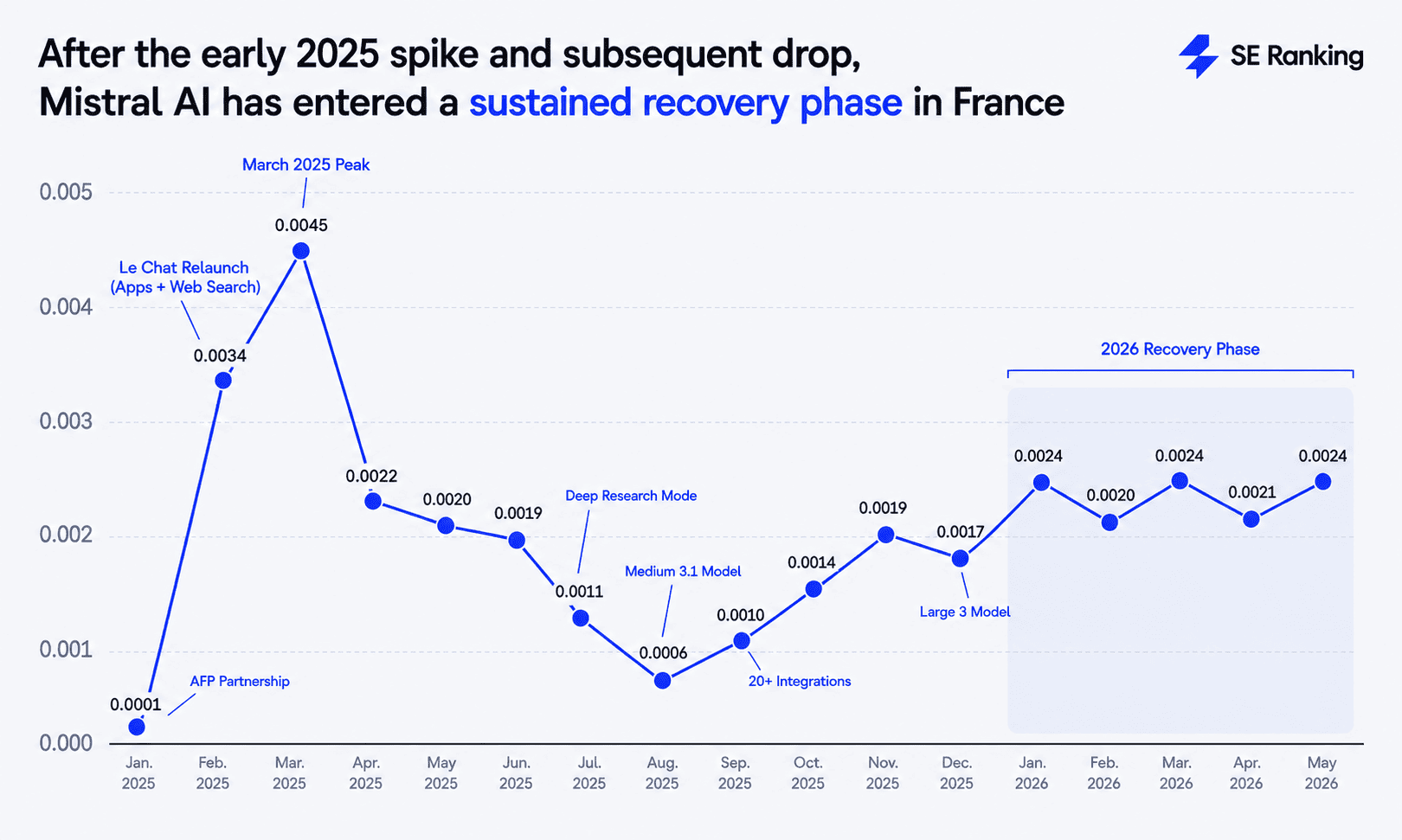
And the first thing the French data shows is that Mistral’s traffic did not grow in a straight line. Instead, it moved through three distinct phases: a sharp launch spike, a post-hype drop, and a later recovery.
Period 1: The launch spike (February–March 2025)
Mistral’s traffic surged dramatically in early 2025. In France, it jumped from 0.0001% in January to 0.0034% in February (a 34x increase), peaking at 0.0045% in March.
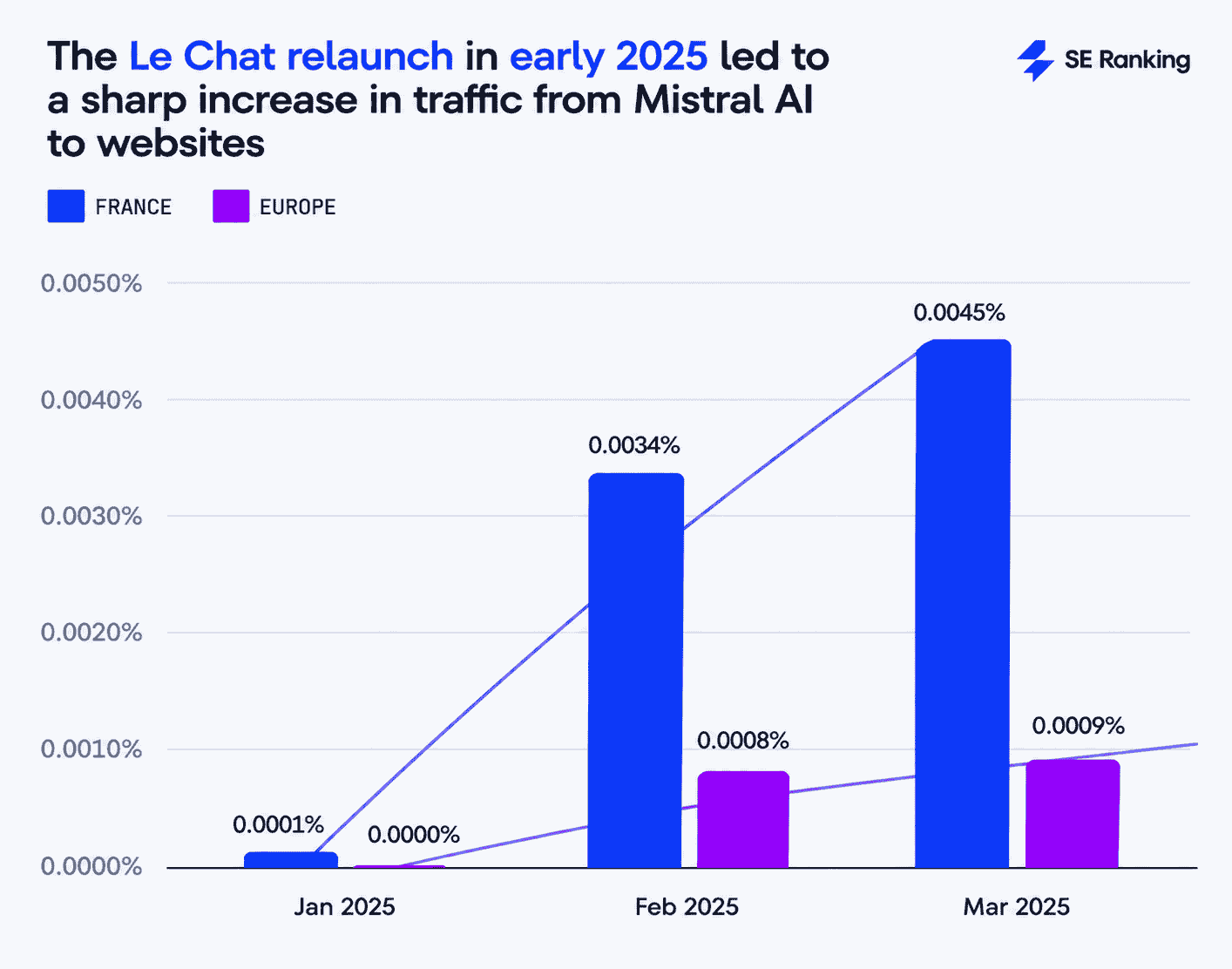
This spike was mainly the result of the mobile launch of Le Chat and full product relaunch announced on February 6. Apart from this, several major events happened within a very short time window:
- Emmanuel Macron publicly encouraged citizens to use Le Chat instead of ChatGPT ahead of the Paris AI Action Summit (February 10-11).
- Mistral Small 3.1 with multimodal improvements released (March 17).
- Significant media coverage across France and Europe.
The EU shows the same pattern, but much weaker (around 4x lower), which already hints at Mistral’s stronger domestic advantage.
This period was likely driven mainly by attention and curiosity.
Period 2: The drop (April–August 2025)
After the initial spike, traffic declined sharply. From its March peak, Mistral’s traffic in France fell by ~87%, reaching a low of 0.0006% in August.
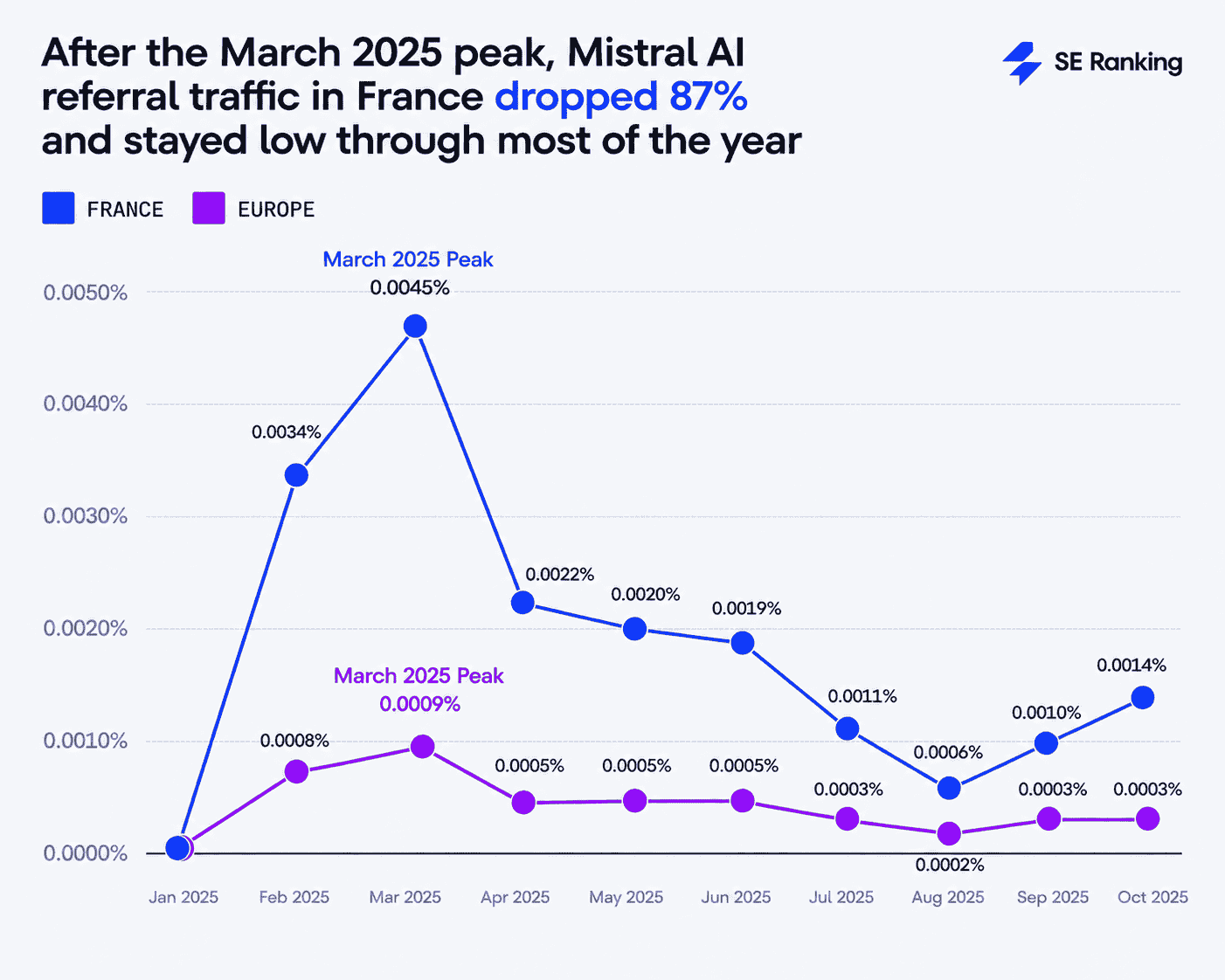
This pattern is typical for AI product launches:
- Users try the product during the hype phase
- Many leave after initial testing
- A smaller group continues using it
The EU follows the same trajectory, which suggests that this was not a local anomaly but a natural post-hype correction.
Period 3: The growth phase (September 2025–May 2026)
After hitting its lowest point in August, Mistral’s traffic began to recover. Notably, the groundwork was laid while traffic was still declining — key product updates shipped in July–August, but their impact on referral traffic became visible starting in September.
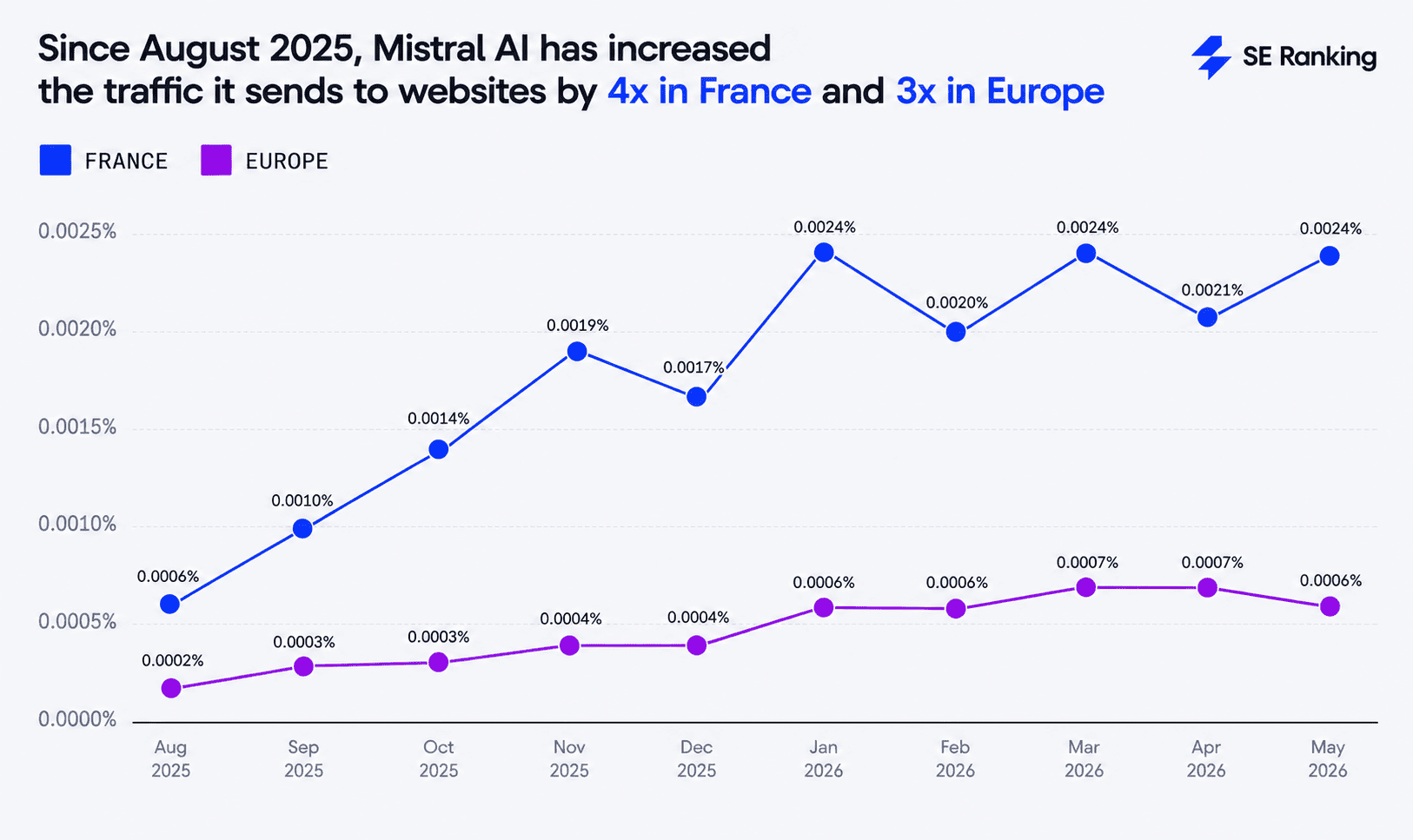
Instead of a spike, growth became gradual and consistent, increasing for five consecutive months:
- From 0.0006% in August → 0.0024% in January 2026 (4x growth)
This growth closely aligns with product improvements and ecosystem expansion:
- Deep Research mode (July 17) → enabling multi-source browsing and structured answers
- Mistral Medium 3.1 (August 12) → improved reasoning and “smarter web searches”
- Integrations (September 2) → 20+ connectors (Google Drive, Notion, GitHub, etc.)
The September jump (+67% month-over-month) likely reflects the impact of these integrations, embedding Mistral into daily workflows rather than one-off usage.
Since January 2026, the growth has plateaued rather than continued climbing. Monthly referral traffic in France moved within a tight range: 0.0024% in January, 0.0020% in February, 0.0024% in March, 0.0021% in April, and 0.0024% in May. The EU showed the same pattern, staying between 0.0006% and 0.0007% throughout.
A small dip in December 2025 (to 0.0017%) was likely seasonal, since holiday periods typically reduce work-related AI use. After that dip, January 2026 brought a 41% jump back to 0.0024%, and traffic has held at that level since.
This is a different situation than continued growth, but it is not a negative signal. Mistral reached its current level without major political endorsements, media events, or a product launch. That baseline appears to be real usage rather than noise.
LinkedIn and Reddit: How people perceive Mistral AI
We also analyzed discussions about Mistral on LinkedIn and Reddit to understand perception within the wider audience.
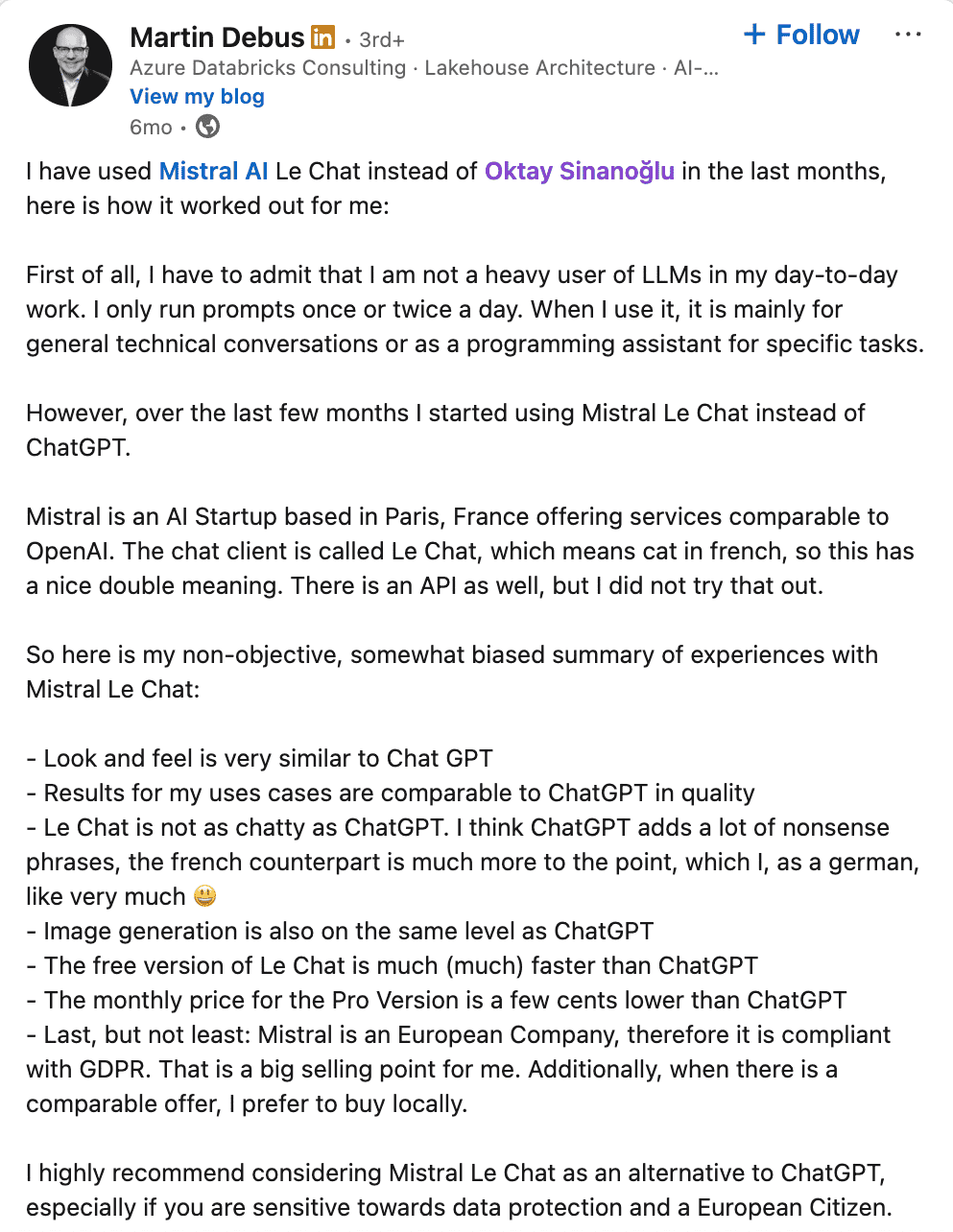
On LinkedIn, many professionals position Mistral as a privacy-friendly, European alternative to the US AI tools. One post recommends Le Chat especially for users “sensitive towards data protection.”
Here’s another one highlighting Mistral AI “may be a valid alternative to the US and Chinese giants.”

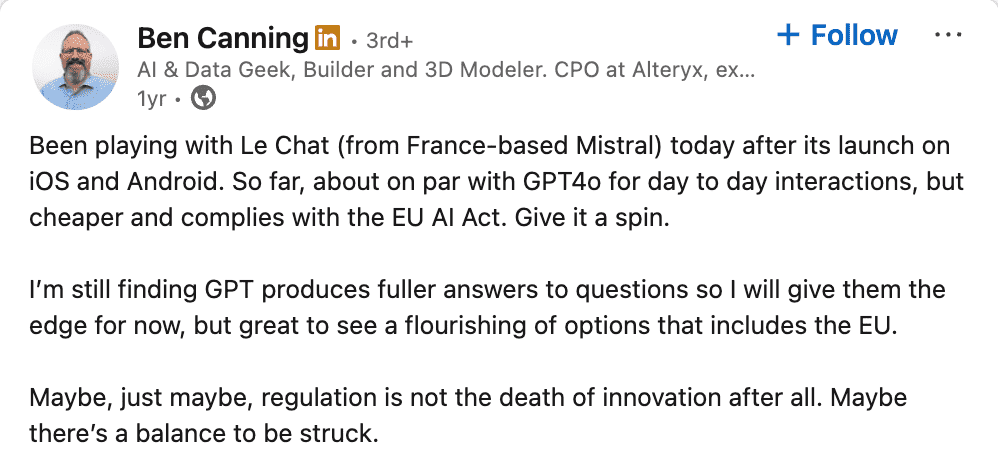
This post states Mistral AI is about on par with ChatGPT for day-to-day interactions “but cheaper and complies with the EU AI Act.” Once again, this points to two recurring advantages: cost efficiency and alignment with European standards.
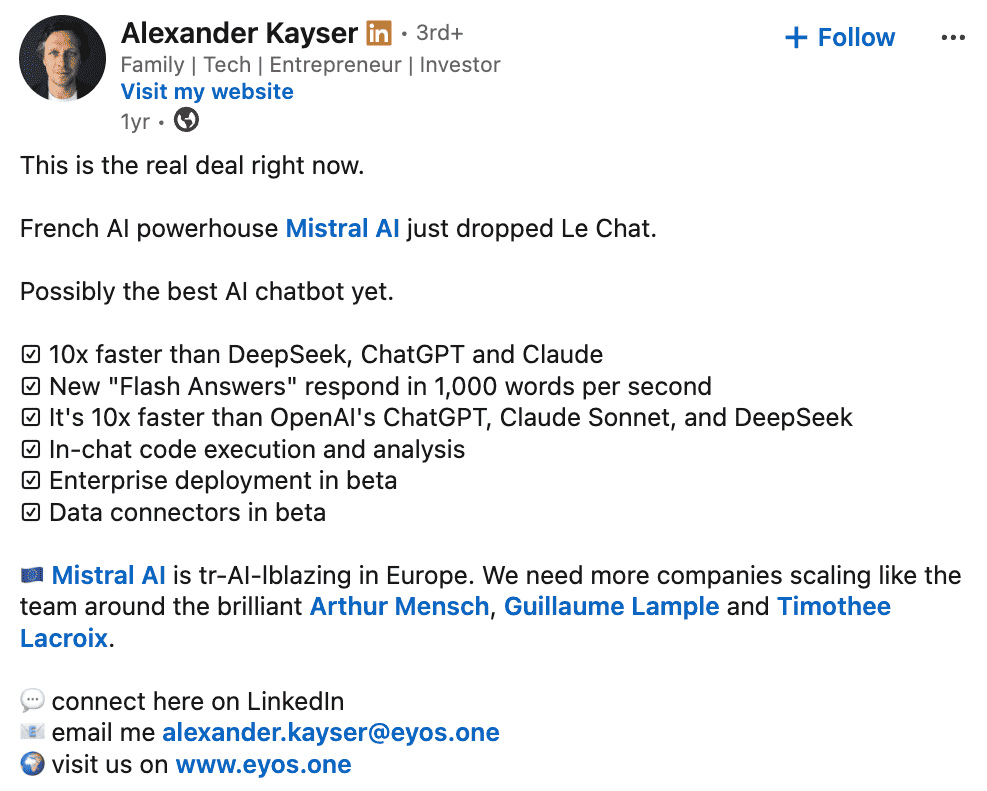
One of the posts even described Le Chat as “possibly the best AI chatbot yet” shortly after its launch.
So, as you can see, the narrative is very consistent:
- Mistral is presented as a leading European AI player
- It is often seen as a credible alternative to ChatGPT
- The tone is generally optimistic and forward-looking
In professional environments, Mistral is seen less as a chatbot and more as a strategic European technology company.
On Reddit, the tone is more mixed (often enthusiastic, but more critical and technical).
Some users are genuinely impressed:
“Mistral is worth it. Its small models outperform mainstream larger models. Run it locally and you will be impressed.”
Others highlight where it still lags:
- Not as polished as other LLMs like ChatGPT or Claude
- Requires more precise prompting to get the best results
- Very inconsistent results in terms of the quality
Overall, Mistral is seen as technically impressive and promising, but not yet a reliable, top-tier choice for everyday use.
Research methodology
Our analysis is based on a dataset of 101,574 websites, all of which have Google Analytics installed in accordance with SE Ranking’s Terms of Service.
All insights in this article are derived from anonymized historical data and represent our interpretation of these datasets.
For this study, we focused specifically on AI referral traffic generated by Mistral AI, and compared it with other major AI platforms, including ChatGPT, Perplexity, Gemini, Copilot, and Claude (as well as smaller platforms like Qwen, iAsk.Ai, Venice.ai, and WRTN.ai).
The analysis covers the period from January 2025 to May 2026, which allows us to track how Mistral’s traffic evolved over time and how it compares across regions, particularly between France and the rest of Europe.
Note: While we aim to provide accurate and unbiased insights, alternative interpretations of the data may exist.
Conclusion
Mistral AI is not yet close to challenging ChatGPT, Perplexity, Gemini, Claude, or Copilot at scale. But that is not the most important finding here.
The more important point is that Mistral is no longer just a political symbol or a “European alternative” discussed in policy circles. It is sending more traffic to websites than it did in 2025, holding a top-6 position in France, and maintaining a stable usage baseline after its early-2026 recovery.
France remains Mistral’s strongest market, helped by local content partnerships, government adoption, and a less crowded AI search environment. Across the wider EU, its position is still smaller, which shows that becoming Europe’s AI default will require much broader adoption outside its home market.
Still, the direction is clear. Europe is actively looking for AI systems that can run on European infrastructure, follow European laws, and remain under European control. Mistral is currently the strongest candidate to fill that role.
The question now is whether it can turn Europe’s political support and local advantages into sustained user growth across the region.