Claude is now driving 386% more traffic to websites. But its role in workflow automation could matter more
A year ago, if you asked an SEO which AI tool they used, the answer was usually ChatGPT. Not always because it was the best fit for every task, but because it was the default: the tool everyone knew, the one mentioned in every guide, the one no one had to explain.
That default is less obvious now. Claude has become the tool more professionals reach for when the work needs more depth: writing, research, analysis, coding, and automation.
Anthropic is clearly building for that shift. For example, Claude Code brings Claude into developer workflows, where it can read codebases, plan changes, write code, and run commands. Its weekly active users have doubled since January 1, while business subscriptions have grown 4x since the start of 2026.
And Claude is moving beyond coding. With Claude Cowork, Skills, plugins, and 300+ data connectors, it can work across files, apps, and external tools to complete multi-step tasks. In other words, Claude is becoming less like a chatbot and more like a workspace.
But as Claude becomes part of more workflows, it is also starting to matter as a traffic source. The more people use Claude to research, compare, analyze, and make decisions, the more likely it is to influence which websites, tools, and products they visit next.
So in this research, we looked at both sides of the story: how much traffic Claude actually sends to websites today, and why businesses may still need to prioritize being present in Claude even if that traffic is still small.
-
Claude is the fastest-growing AI traffic source in 2026.
Claude’s referral traffic share grew 386%, from 0.0029% in January 2026 to 0.0141% in April 2026. In comparison, ChatGPT only grew 1.53% over the same period.
-
March 2026 was the largest single-month jump in Claude’s history.
In one month, Claude went from 0.0049% to 0.0127% of global web traffic — a 2.6x increase. The catalyst was Anthropic’s public stance on AI safety and the user migration that followed.
-
Claude ranks fifth among AI traffic sources, currently accounting for 1.40% of AI-referred traffic.
By comparison, ChatGPT dominates the channel, driving 78.23% of all AI-referred traffic. Perplexity follows at 9.33%, with Gemini at 6.85% and Copilot at 3.57%.
-
Still, Claude should not be judged only as a traffic source.
Unlike search-first AI platforms, Claude is now mostly used for workflows: writing, coding, analysis, automation, reporting, and working with data. That means businesses should first think about making their content, product, or data usable inside Claude workflows.
-
Make your data available in Claude as the platform is becoming a new acquisition channel.
For example, SE Ranking’s MCP connects its SEO and GEO data to AI assistants like Claude. This allows users to access keyword data, backlink analysis, site audits, competitor insights, and AI visibility metrics directly within their AI workflows.
Global website traffic from AI platforms: what the baseline looks like
Website traffic from AI platforms is growing fast, but still makes up a small share of overall web traffic.
As of April 2026, AI platforms account for 0.33% of global web traffic, up from 0.1976% in April 2025. That means the channel almost doubled in just one year.
Across the full analysis period, from January 2025 to April 2026, ChatGPT generated the vast majority of AI-referred traffic, accounting for 78.23% of the total. It was followed by Perplexity at 9.33%, Gemini at 6.85%, Copilot at 3.57%, and Claude at 1.40%.
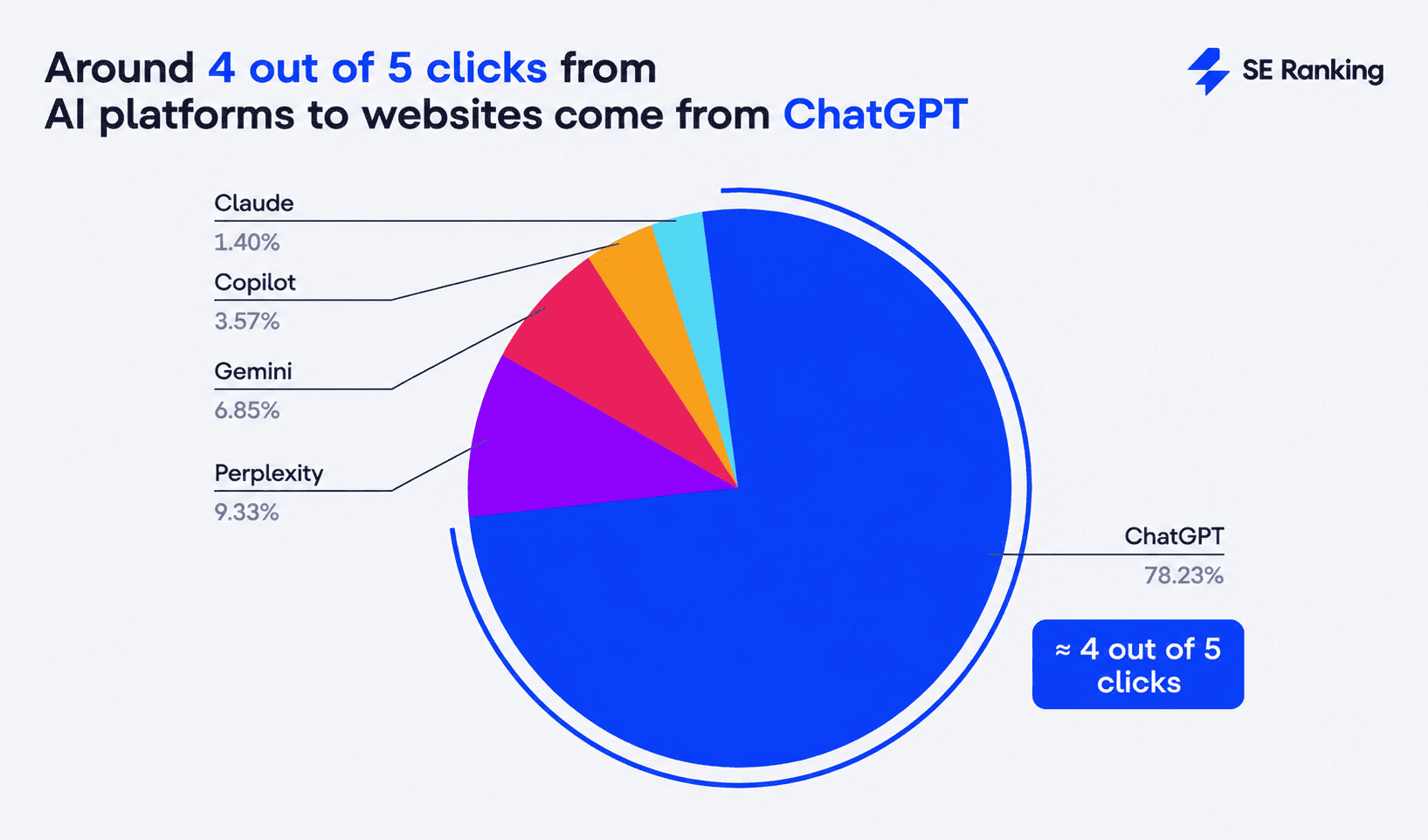
So, at first glance, Claude looks small.
But what’s interesting here is that the current leaders are not necessarily the ones driving growth in 2026.
Between January and April 2026, referral traffic from Claude increased by 386%. Gemini also grew by 63% over the same period. ChatGPT, by contrast, grew by just 1.53% in four months.
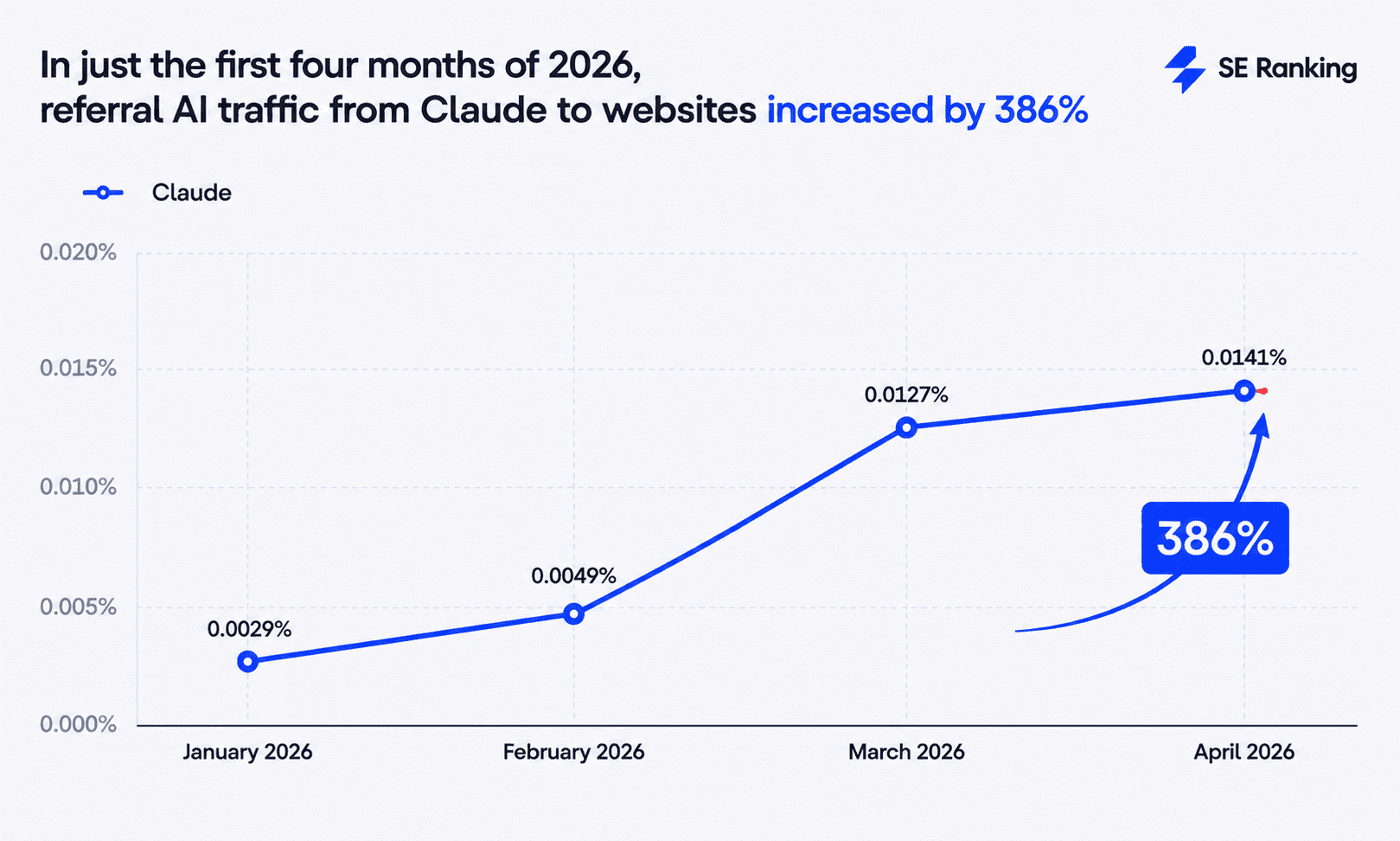
So while ChatGPT remains the clear leader in absolute share, Claude is the platform showing the sharpest growth in 2026.
That is what makes Claude worth analyzing separately.
Website traffic from Claude: what the data shows
Referral traffic from Claude was effectively zero in January 2025.
It first appeared in our dataset in April 2025, when its global referral traffic share reached 0.0007%. It stabilized through summer at around 0.0033% to 0.0036% of global web traffic, then pulled back slightly to close 2025 at 0.0027%.
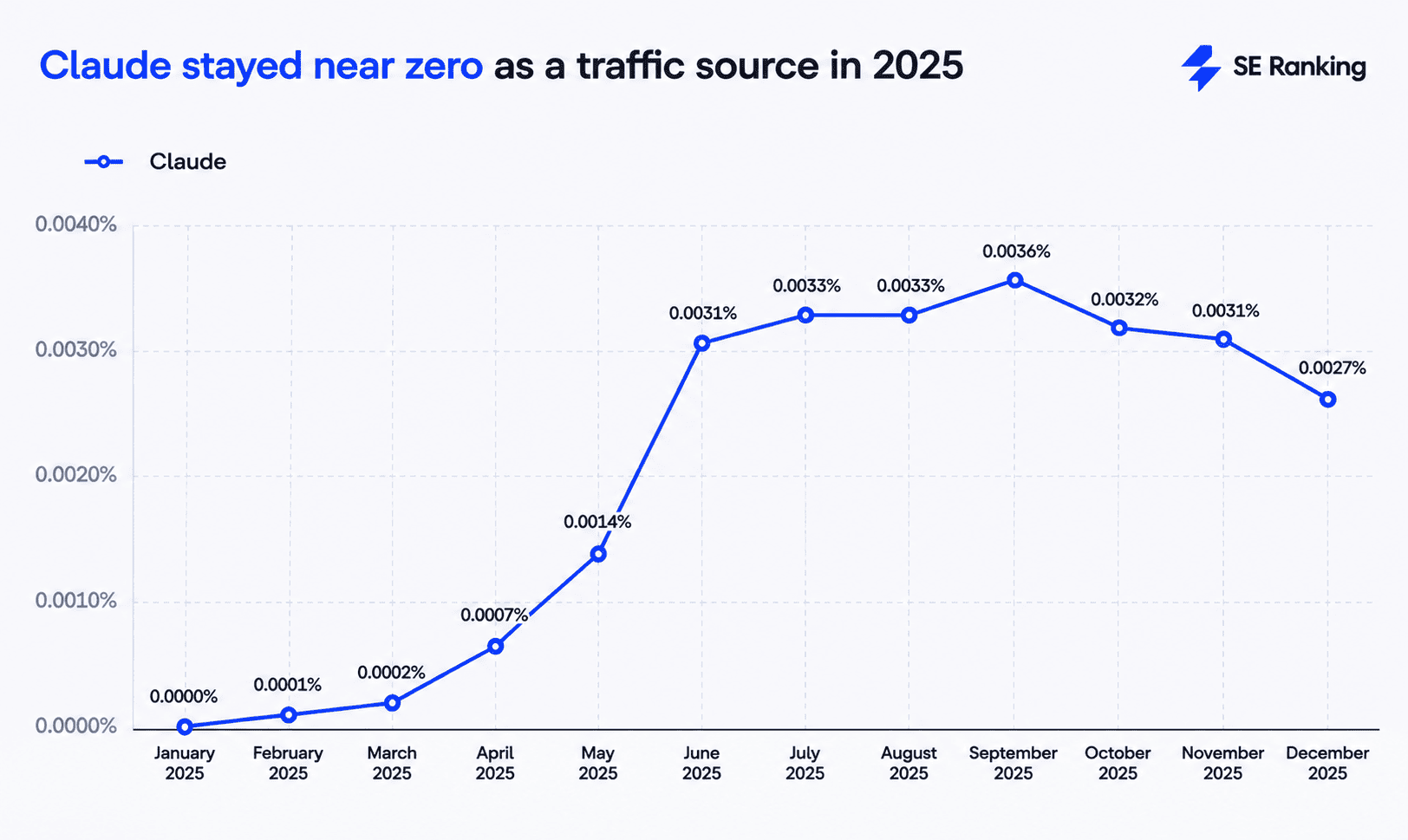
The first months of 2026 looked modest at first: 0.0029% in January and 0.0049% in February. Then March happened.
In a single month, Claude’s share went from 0.0049% to 0.0127% (roughly 2.6x). That is the largest single-month jump in Claude’s history across our dataset.
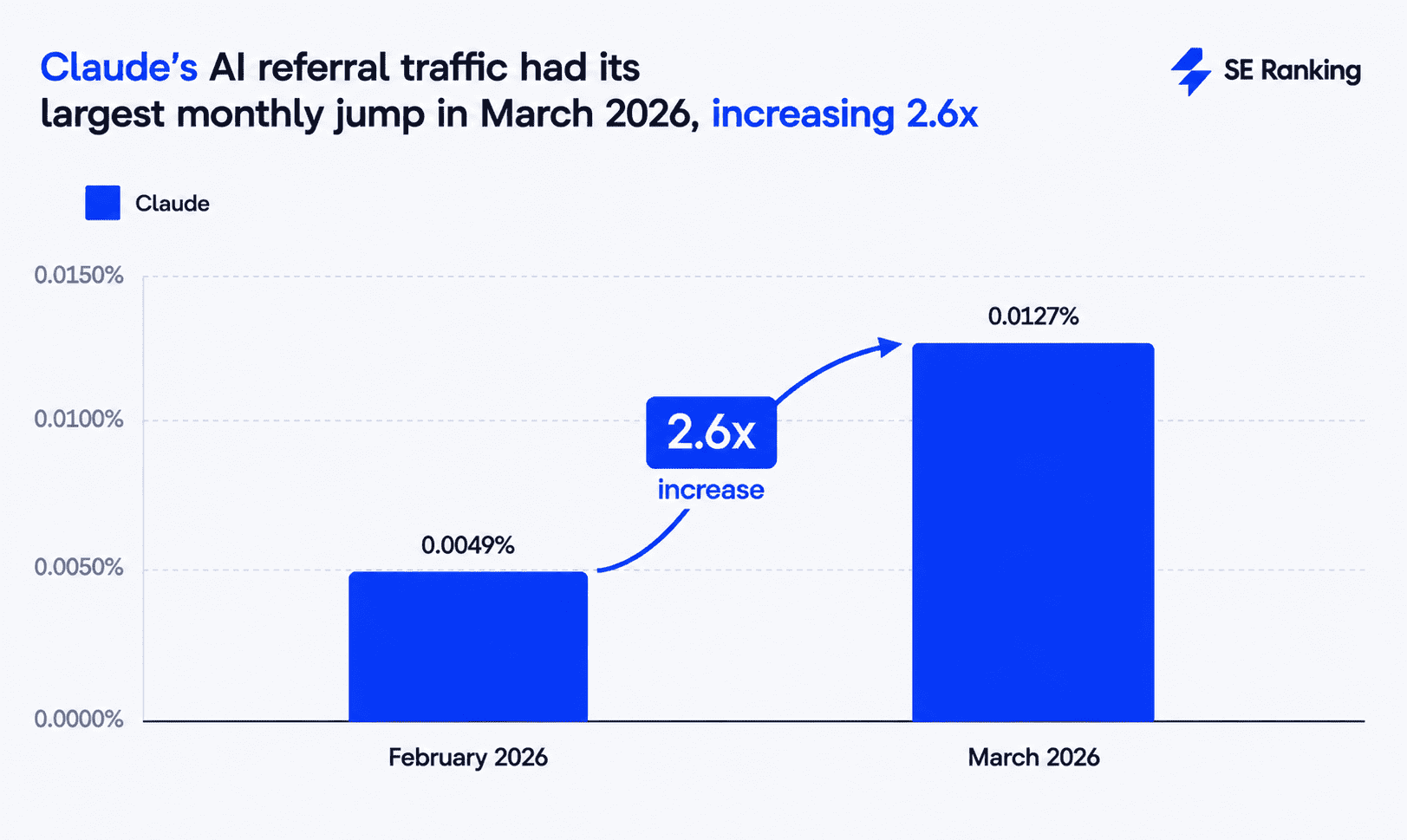
In general, from January to April 2026, referral traffic from Claude to websites grew by almost 4x.
The timing is not coincidental. In February 2026, Anthropic publicly said it would not allow its AI systems to be used for mass surveillance of Americans or fully autonomous weapons. Soon after, Claude saw a visible increase in user interest.
According to Similarweb, Claude’s mobile daily active users reached 11.3 million in early March — a 183% increase since the start of 2026.
At the same time, Ramp reports Anthropic growing quickly among businesses as well: by May 2026, 71% of organizations using generative AI rely on Anthropic, up from 46% a year earlier.
So, Claude’s March jump looks less like a random spike and more like the first visible sign of a broader shift in user behavior.
Regional patterns: the US leads, others follow
The monthly trend of Claude’s growth is consistent across every region in the dataset: flat through most of 2025, a dip in December, then a sharp rise in March and April 2026. What differs is the starting point and timing.
The US leads with an average Claude traffic share of 0.0049% across the full analyzed period, from January 2025 to April 2026. The EU averages 0.0022%.
Among individual European countries, France has the highest average at 0.0028%, followed by Germany (0.0025%), Spain (0.0020%), and the UK at 0.0014%.
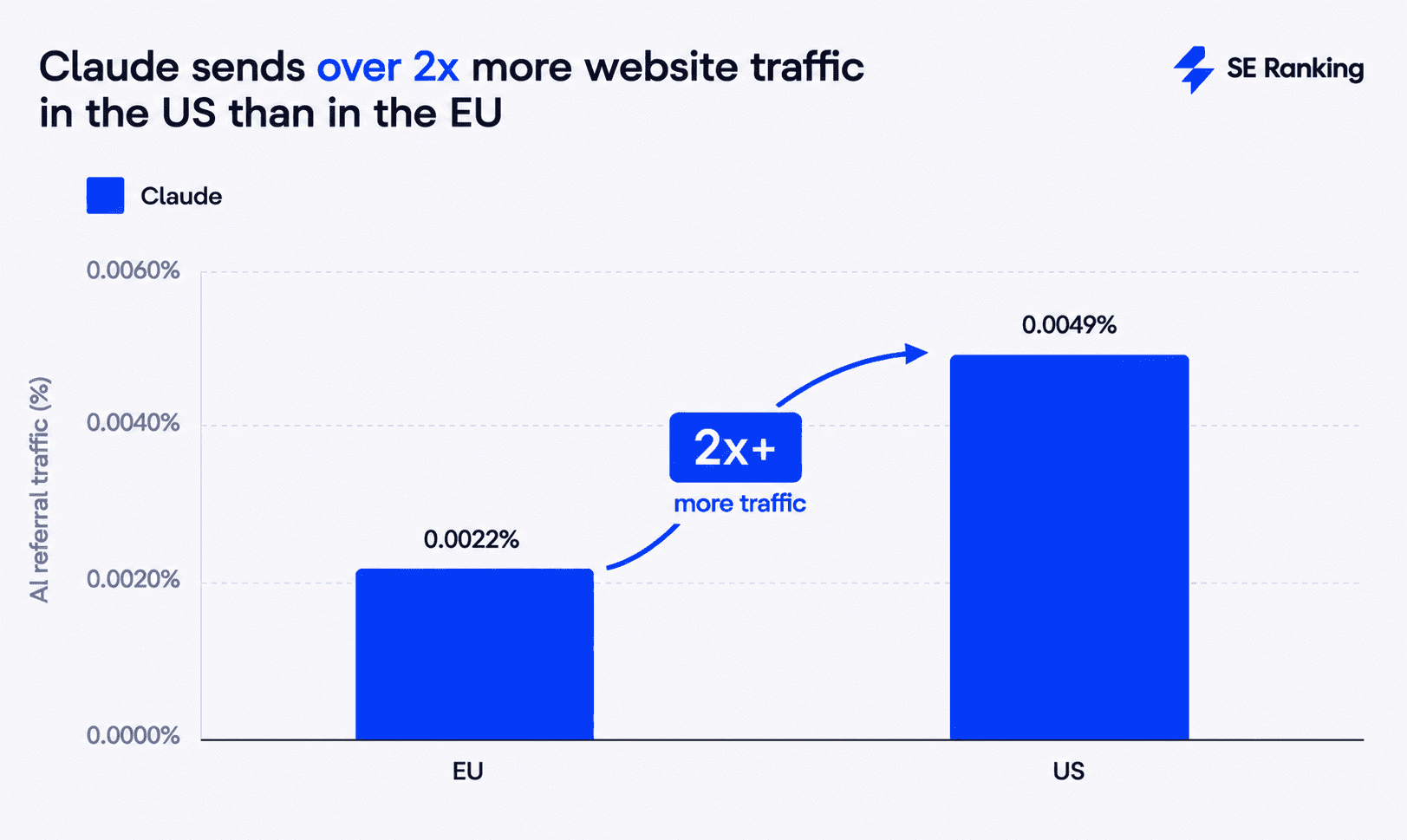
This gap was especially visible in April 2026. Claude accounted for 0.0186% of website traffic in the US, compared with 0.0100% in the EU and 0.0054% in the UK. All three markets reached their highest levels in the dataset that month, but the US remained clearly ahead: traffic from Claude was nearly twice as high as in the EU and more than three times as high as in the UK. At the same time, the EU’s April performance is notable in its own right, passing the 0.0100% mark and showing that traffic from Claude becomes more and more visible beyond the US.
The interesting part is the timing.
The US reached a Claude traffic share of 0.0022% in April 2025. Other analyzed regions did not reach a similar level until early 2026, roughly 10 months later.
For international businesses, this matters because a small global average can hide different adoption stages by market. Companies operating in the US may see Claude-related changes earlier. Companies focused on Europe may see the same pattern later.
Why you should look beyond the traffic Claude sends to websites
Claude is not a typical search channel
When businesses think about AI visibility, the goal is usually the same: get cited, get mentioned, generate clicks.
And this logic makes sense. AI referral traffic is growing, the trend toward AI search is consistent, and building presence inside LLMs is a reasonable extension of any SEO strategy.
But Claude is a slightly different case.
Users do not typically open Claude the way they open Google. They are not usually looking for a list of results, a quick answer, or a cited summary that sends them somewhere else.
More often, they come with a task. They want to draft a brief, analyze a dataset, summarize research, build a report, turn scattered information into a decision-ready output, and even schedule its delivery by email.
That changes what it means to have a presence inside it.
Claude is mostly used as a work tool
This is where Claude seems to be moving in a different direction from many other AI platforms.
ChatGPT has leaned heavily into search and general-purpose assistance. Perplexity has built its identity around AI-powered web search. Claude, meanwhile, is being shaped around work: writing, coding, analysis, automation, and repeatable workflows.
You can see this in Anthropic’s recent product direction: Claude Code helps developers work directly in their codebases, Claude Cowork handles multi-step tasks across files and apps, and Claude Skills turn repeatable processes into guided workflows.
This shows that Claude is not just being developed as an assistant that answers questions. It is being developed as a system that helps people get work done.
That is also how many SEOs and content professionals now talk about it.
For example, one user on Reddit said they were building their first app and using Claude Code heavily to help with development. Another described a content workflow where ChatGPT creates the outline (including keywords, image descriptions, tables, and FAQs) and Claude turns that structure into the full article. They said they had created several long-form articles this way, all over 3,000 words.
Others described using Claude for resumes, Notion pages, Canva presentations, and writing projects, pointing out that Claude asks useful follow-up questions that help them stay focused and develop their ideas. Another user said they use Claude heavily to build internal automations for their team and manage outreach data, saving a significant amount of time.
The same pattern shows up in LinkedIn conversations among SEOs, content teams, and product marketers. Here are some workflows you can build with Claude:
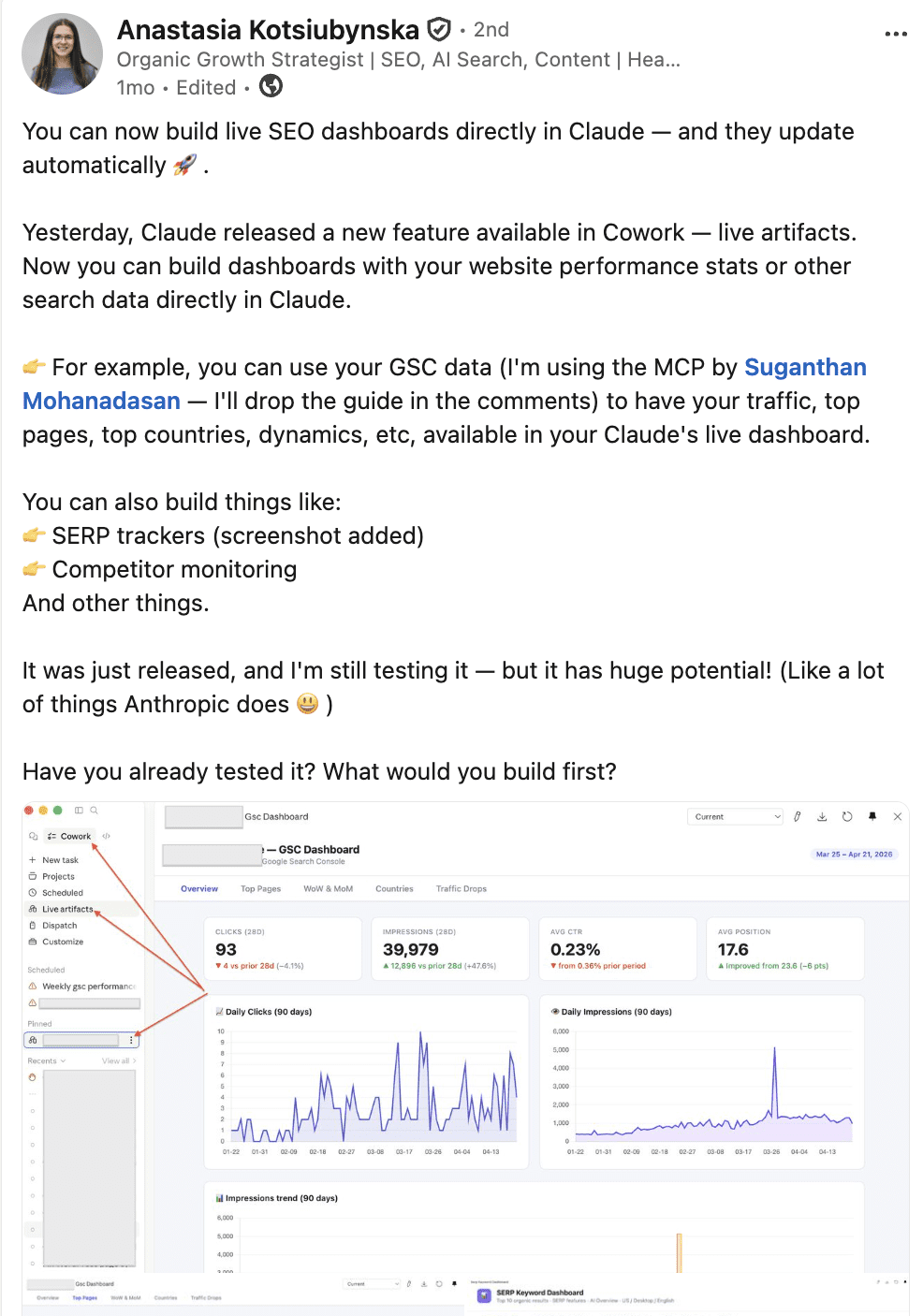
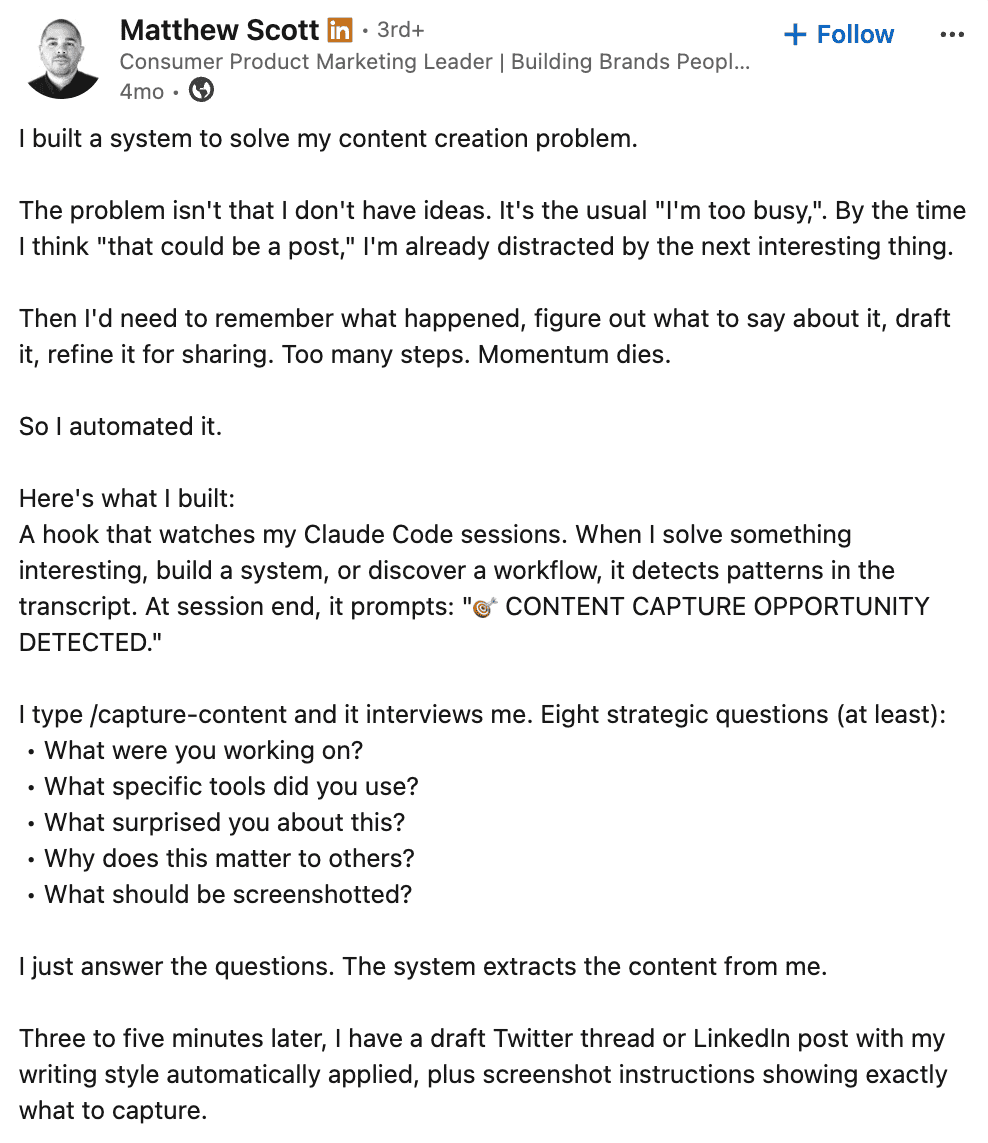
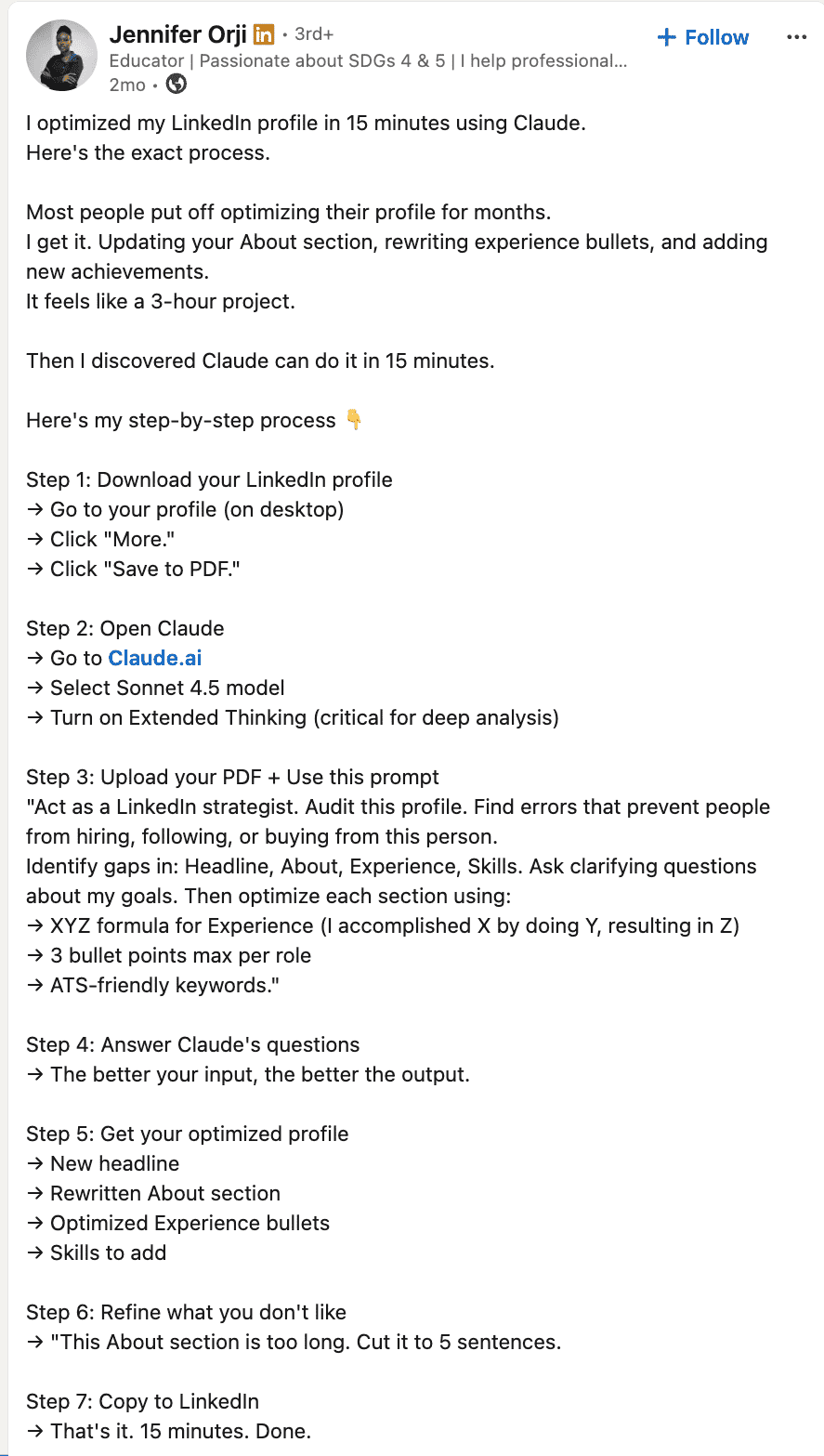
All in all, for many users, Claude is becoming part of the actual production workflow: the place where the outline becomes the article, the idea becomes the app, or the notes become the presentation.
Visibility now means being useful inside Claude workflows
If Claude is a work tool, the more relevant question for any business is not “does Claude mention us?” It is “can Claude use us as a data source?”
And MCP provides a way for businesses to become this data source.
It lets a product connect its data and capabilities to Claude, so the product becomes part of the user’s AI workflow. Claude can pull the data, reason over it, and turn it into the output the user needs.
And that can turn into a real competitive advantage. If two products offer similar functionality, users may prefer the one that works smoothly inside their AI assistant. The product that “talks to AI” becomes easier to use, easier to adopt, and more likely to become part of a user’s routine.
SE Ranking’s MCP is a good example of what this looks like in SEO.
It gives Claude and other compatible AI assistants access to 180+ SEO and GEO tools, including keyword data, backlinks, domain insights, website audits, AI search visibility, and more. Because the MCP is hosted and managed by SE Ranking, users can connect it with one URL, without local installation or Docker setup.
For example, competitor domain analysis can move directly into the Claude workflow. You can ask Claude something like: “Show me the organic and paid search stats for [domain] in [country].” And it will produce an interactive dashboard with the stats right in the chat.
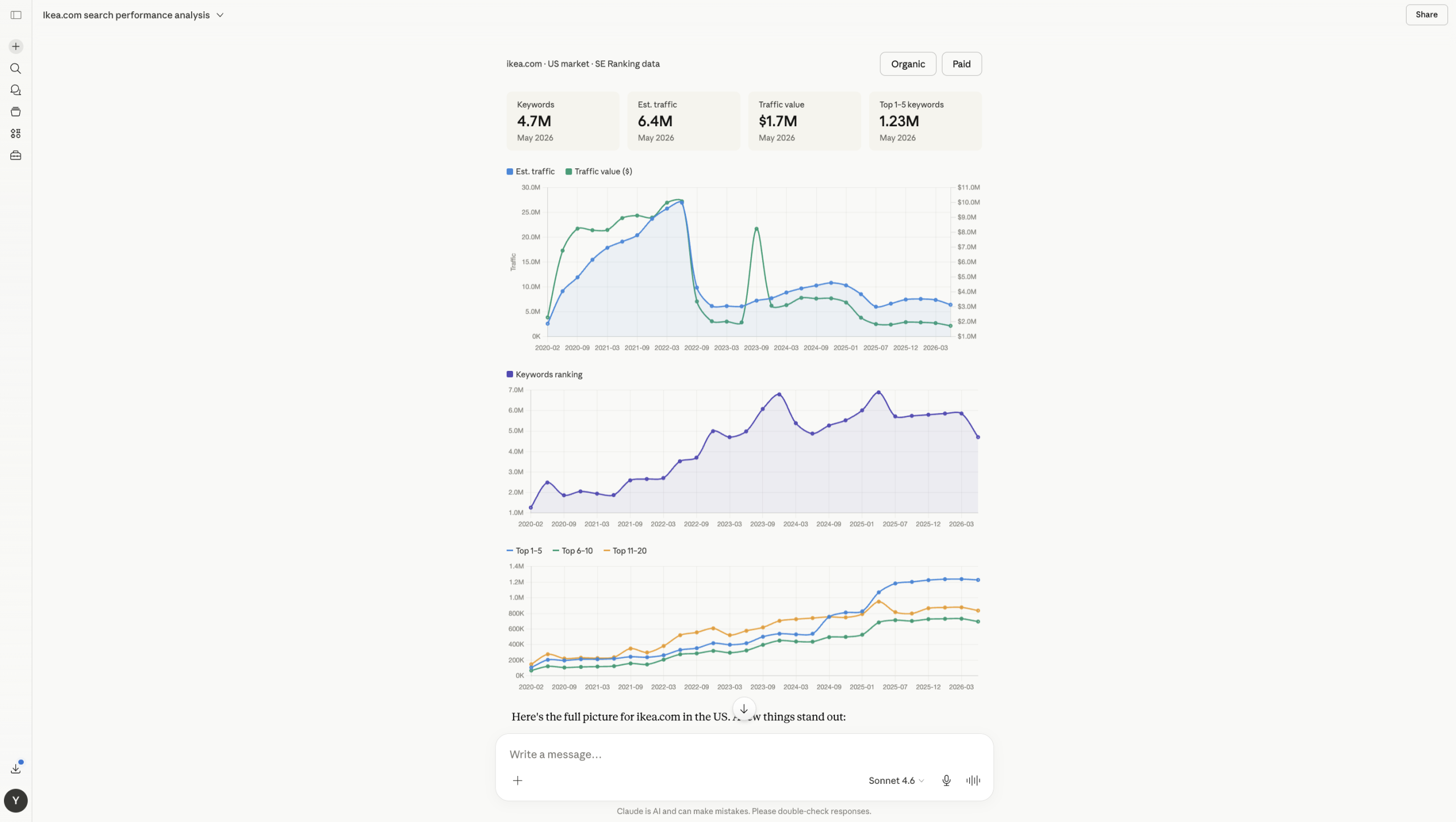
Plus, the MCP connection opens up a more advanced layer of analysis: finding correlations across data types that isolated dashboards do not surface on their own.
For example, you can use Claude to explore whether a drop in organic visibility is showing up in AI search mentions, or whether traffic shifts align with changes in how LLMs cite your brand. Claude can pull organic performance data and AI search visibility data from SE Ranking in the same session, then compare them, identify patterns, and flag divergences.
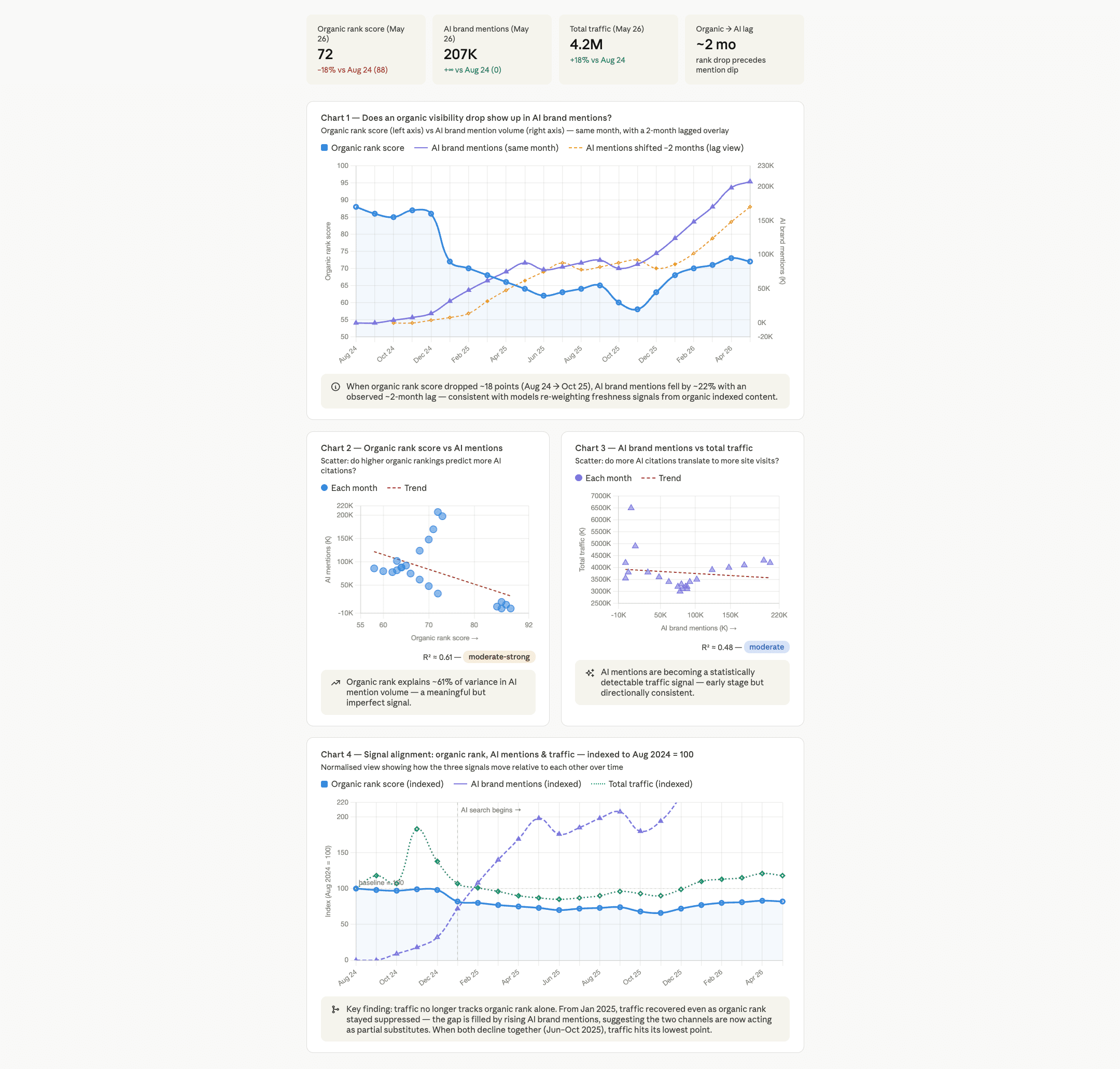
That kind of correlation work is still something many teams handle manually across separate tools, if they do it at all.
On top of that, Planable now also offers an MCP connector. That means you bring social media workflow and performance context into Claude alongside other marketing data.
The key point is not that MCP replaces the tools themselves, but that it gives teams a shared workspace for comparing signals that usually live apart.
SE Ranking also offers open-source Claude Skills that turn MCP data into complete workflows.
Each Skill is built around a specific SEO or GEO task. It defines which SE Ranking MCP tools Claude should use, what steps to follow, and what output to create. So, instead of writing a long prompt every time, you can describe the result you need (or trigger them with slash commands like /seo-content-brief, /seo-ads, or /seo-backlink-gap), and Claude can run the right workflow with live SE Ranking data.
In total, there are seven SE Ranking Skills available for Claude, including the ones for content briefs, AI Search visibility analysis (across ChatGPT, Perplexity, Gemini, Google AI Overviews, and AI Mode), backlink gap analysis, keyword clustering, paid search intelligence, content audits, and SXO.
That is the practical meaning of being useful inside Claude workflows: your product is not just mentioned by Claude, it actively helps Claude complete the task.
The same idea applies beyond SEO & GEO tools.
For marketplaces and data-heavy businesses, the opportunity is to make their data available when users are actively trying to choose, book, buy, plan, or compare.
This is already starting to happen across different businesses. Claude can now connect to apps such as Tripadvisor, Booking, Resy, Instacart, Spotify, Audible, AllTrails, Thumbtack, TurboTax, and others.
That means users can ask Claude for help with tasks that previously required opening several apps or websites: planning a trip, choosing a restaurant, finding groceries, picking a hiking trail, comparing local services, or working through tax-related questions.
Booking.com is one example. A user can ask Claude to find hotels for a specific trip based on budget, location, dates, availability, reviews, or cancellation policy, and Claude can use Booking.com data to surface relevant options directly in the conversation.
That is why businesses should look beyond traffic that Claude sends to websites.
Referral clicks still matter. But in a workflow-led AI environment, the stronger advantage may come from becoming the data source behind the work.
Research methodology
Our analysis covered 101,574 websites across 250 countries and territories. Each website had Google Analytics integrated in compliance with SE Ranking’s Terms of Service.
The analyzed period covers January 2025 to April 2026, a total of 16 months. AI referral traffic was identified by source domain, with each platform’s monthly share calculated as a percentage of total global or regional website traffic in the dataset.
The five AI platforms included in the analysis were:
- ChatGPT
- Perplexity
- Gemini
- Microsoft Copilot
- Claude
Regional breakdowns cover the US, EU aggregate, France, Germany, Spain, and the UK. All percentages in this report refer to shares of total global or regional website traffic unless otherwise stated.
The insights in this report are based on historical records and reflect our interpretation of anonymized information.
Disclaimer: These findings reflect the websites, countries, platforms, and time period included in this dataset. Referral traffic also captures only direct clicks from AI platforms to websites; it does not measure AI-influenced decisions that result in visits through search, direct, paid, or other channels.
Conclusion
Claude is not replacing ChatGPT or Google as a traffic source today. Its absolute referral share is still small, and for most websites, it will not register as a significant channel in current analytics reports.
But that does not make it irrelevant.
Claude’s growth matters because it is happening alongside a broader shift in how people use the platform. Claude is not only being used to search for information. It is also being used to complete work: write, analyze, compare, code, summarize, automate, and make sense of data.
That makes Claude different from a typical referral source. Its impact may show up first in workflows, not traffic reports.
For businesses, especially those built around content, software, marketplaces, or structured data, this is the part worth watching. If Claude becomes a place where users do more of their research and decision-making, then its referral traffic may change quickly too.
So the practical takeaway is simple: do not overstate Claude’s traffic impact today, but do not ignore it either. Keep monitoring Claude’s AI referral traffic, track how it changes over time, and pay attention to how the platform is being used. The numbers are still small, but the trend is no longer static.