March 2026 Google Core Update was far more volatile than December’s: Over 24% of TOP 10 pages gone from search results
In March, Google released two updates back-to-back. The March 2026 Spam Update rolled out from March 24 to March 25, and the March 2026 Core Update began shortly after, running from March 27 to April 8.
And now that both rollouts are complete, it’s time to see what changed in the SERPs.
We turned to the data for answers. Using the same keyword set from our earlier December 2025 Core Update analysis, we compared the impact of the December 2025 Core Update with the combined March period.
What we found is that March caused far more volatility across every ranking tier.
Still, because the March 2026 Spam Update and the March 2026 Core Update were rolled out within a short time frame, it is difficult to clearly separate the impact of each one in the ranking data. For that reason, this analysis looks at both March updates together as a single comparison period.
-
Google’s March 2026 Spam & Core updates caused more ranking volatility than the December 2025 Core Update. Movement was higher across TOP 3 (79.5% vs. 66.8%), TOP 10 (90.7% vs. 83.1%), and TOP 100 (98.5% vs. 96.9%).
-
Over 24% of TOP 10 pages dropped out of the TOP 100 after the March 2026 updates, compared with 15% after December.
-
Nearly 30% of current TOP 3 pages ranked outside the TOP 20 before the March 2026 updates, more than double December’s 13%.
-
Despite stronger SERP volatility, the age profile of TOP 10 domains changed very little, with domains older than 15 years continuing to dominate.
Did the March 2026 updates cause more ranking volatility across TOP 3, TOP 10, and TOP 100?
Compared to the December 2025 Core Update, the March 2026 updates (Spam Update + Core Update) created more ranking movement at every level of the SERPs.
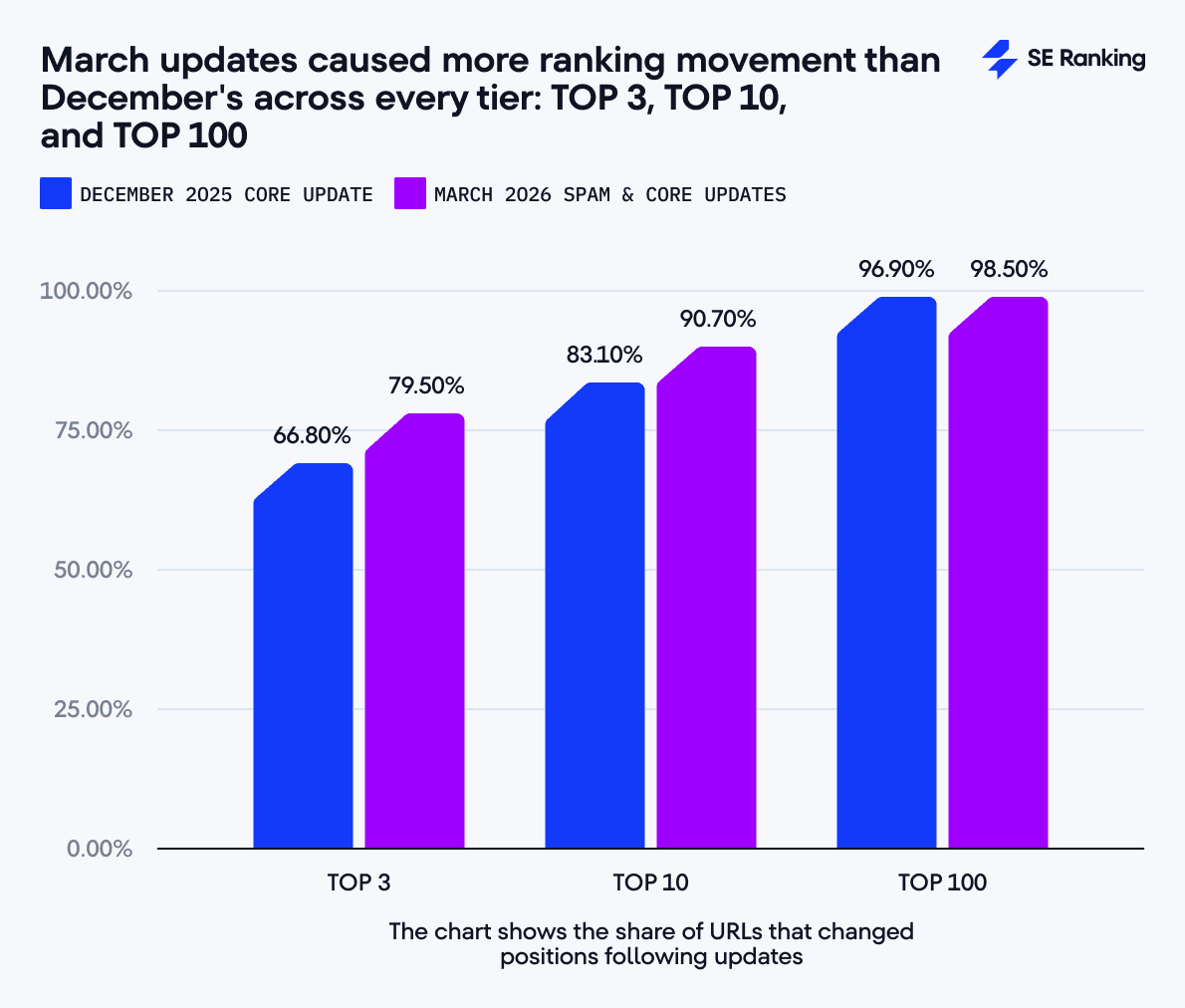
Note: To measure ranking stability, we compared the positions of the same URLs for the same keywords before and after each measurement period. Any movement in rankings—whether a small change (such as from position 2 to 3) or a larger drop out of the top results—was treated as a sign of instability.
After the December 2025 Core Update:
- TOP 3 URLs: 66.8% changed positions
- TOP 10 URLs: 83.1% changed positions
- TOP 100 URLs: 96.9% changed positions
After the March 2026 Spam Update & March 2026 Core Update:
- TOP 3 URLs: 79.5% changed positions
- TOP 10 URLs: 90.7% changed positions
- TOP 100 URLs: 98.5% changed positions
The difference was most visible near the top of the results, where even small shifts can have the biggest traffic impact. For example, in the TOP 3, changes rose from 66.8% after December to 79.5% after March. In the TOP 10, they increased from 83.1% to 90.7%.
The pattern still confirms what we’ve said before: Google treats rankings like layers of confidence. The higher you are, the more certain the algorithm is about you.
Even so, March updates disrupted those top positions more than December did.
How many TOP 10 pages disappeared after the March 2026 updates?
In our previous report on the impact of the December 2025 Core Update, we saw 14.7% of pages that ranked in the TOP 10 disappearing entirely from the TOP 100. Already a significant figure.
But after both the March 2026 Spam Update and the March 2026 Core Update, that number jumped to 24.1%. That’s nearly 1 in 4 TOP 10 pages gone, compared to around 1 in 7 after December’s update.
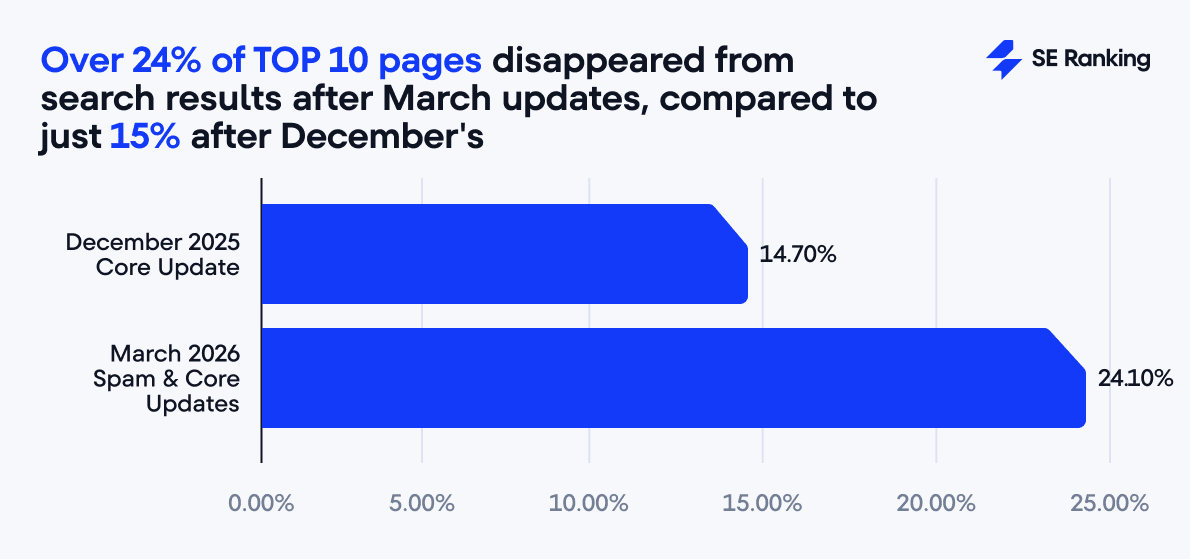
The gap between December and March here is huge: brands were almost twice as likely to lose a TOP 10 page from the rankings completely after March than after December.
So, if your traffic took a sharp hit in late March or early April and you’re seeing pages that previously ranked well simply not appearing in results anymore, this is the context.
Where did the new TOP 3 results come from after the March 2026 updates?
The flip side of all that movement: where did the new TOP 3 results come from?
After December, 13% of URLs in the TOP 3 had previously been outside the TOP 20 for the same keyword. That was already an encouraging signal for mid-tier sites.
After the March 2026 Spam Update and the March 2026 Core Update, that figure was 29.7%. More than double.
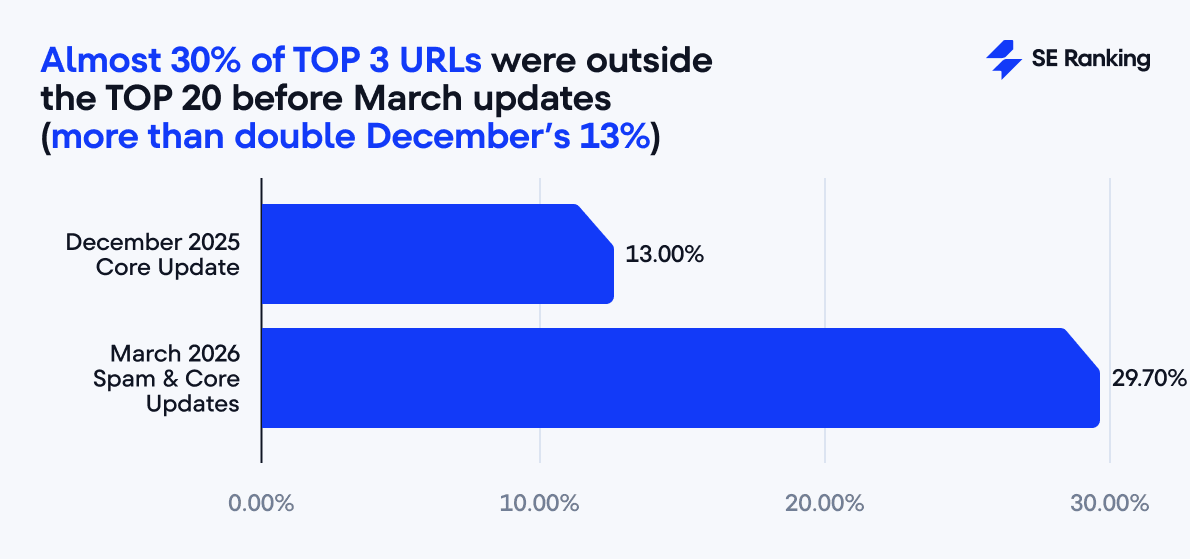
Nearly 3 in 10 current TOP 3 results in our dataset are pages that weren’t even in the TOP 20 before the update. Rather than only reordering existing leaders, March promoted pages from much lower positions.
Do domains aged 15+ years still dominate the TOP 10 after the March 2026 updates?
Here’s what didn’t change, despite everything else: the age profile of domains ranking at the top.
Our findings show that it is almost identical between December and March:
- Domains 15+ years old: 57.5% (December 2025 Core Update) vs. 57.2% (March 2026 Spam Update & March 2026 Core Update)
- Median domain age: 17.5 years (December 2025 Core Update) vs. 17.3 years (March 2026 Spam Update & March 2026 Core Update)
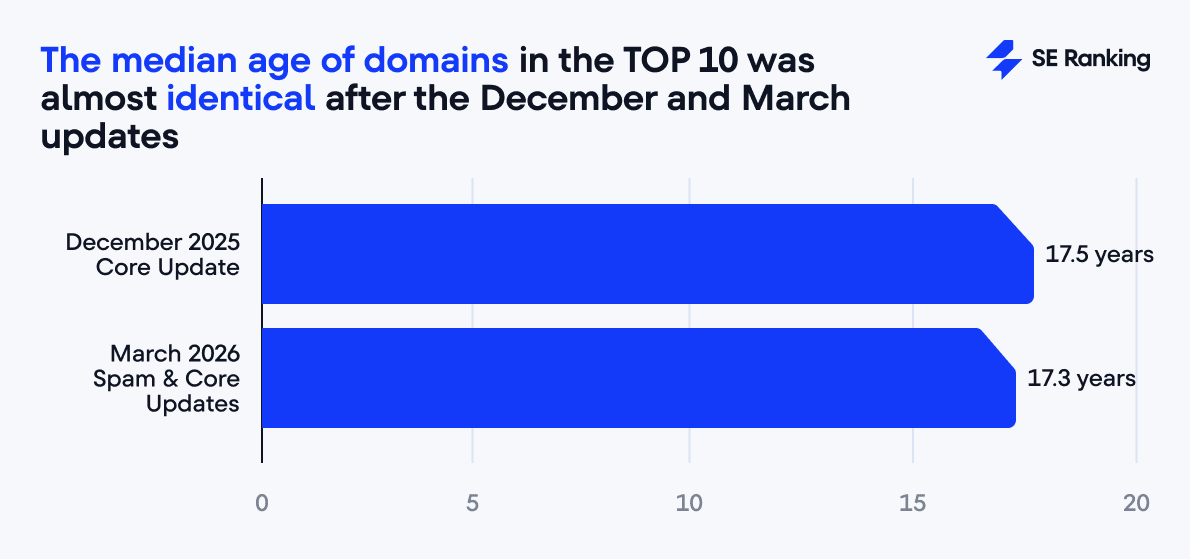
The only notable shift: domains under 1 year old grew from 0.5% to 0.7%. A small number in absolute terms, but a +40% relative increase. Whether that’s a trend or temporary fluctuation, we’ll know more with time.
All in all, older domains still dominate the TOP 10. What changed is which pages on those domains rank (and which new pages, often from equally established domains, displaced them). New domains can still break through, but trust and authority accumulated over years remain meaningful ranking factors.
How many domains hit by the March 2026 Spam Update recovered after the Core Update?
The March 2026 Core Update started rolling out just one day after the March 2026 Spam Update ended.
Because the two updates happened almost back to back, it is not possible to say with complete certainty which ranking changes were caused by which update in every case.
To get a clearer picture, we ran a separate domain-level analysis focused on what happened right after the Spam Update. Specifically, we wanted to see whether domains that lost rankings during the Spam Update recovered once the Core Update rolled out.
The short answer: mostly no.
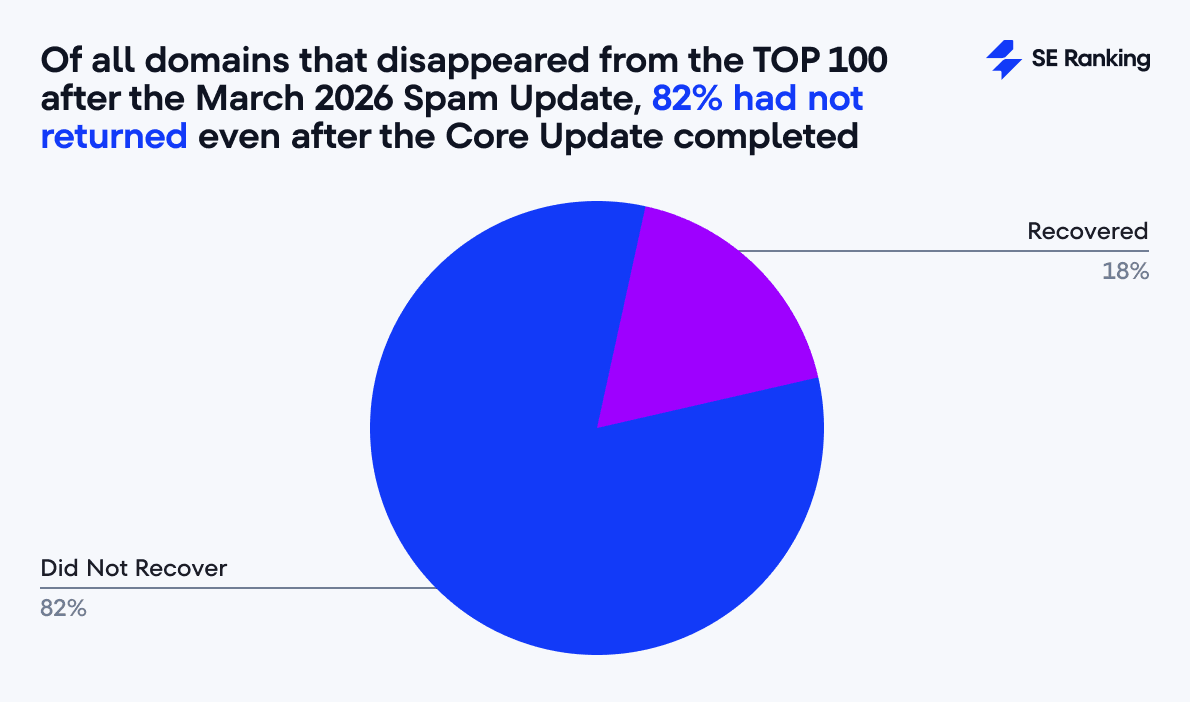
Out of approximately 302,000 unique domains that disappeared from the TOP 100 after the Spam Update (across all analyzed keywords), 82% had not returned even after the Core Update completed. Only 18% came back.
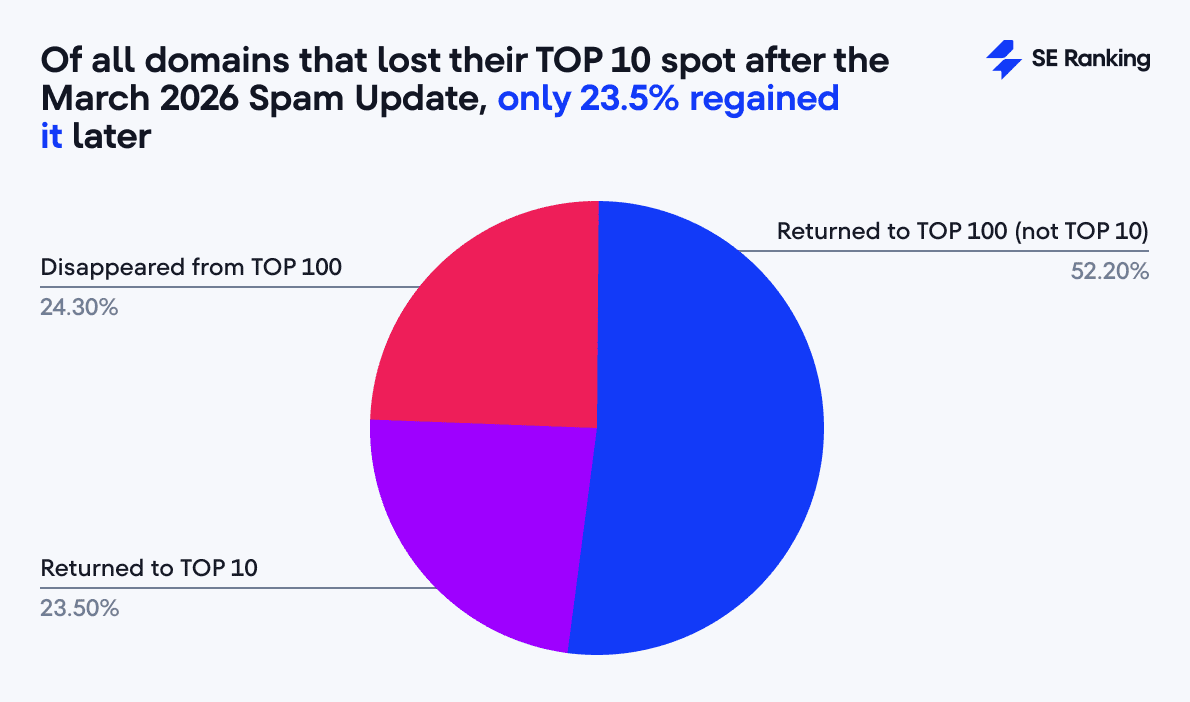
At the TOP 10 level, the story is more nuanced. Of the ~52,000 domains that lost a TOP 10 position after the Spam Update:
- 52.2% returned to the TOP 100 (but not to the TOP 10)
- 23.5% made it back into the TOP 10
- 24.3% disappeared from the TOP 100 completely
So, if your domain lost rankings during the Spam Update, don’t expect the Core Update to reverse that automatically. These are two separate systems, and recovery from spam-related issues requires a different response than recovery from content quality issues.
Research methodology
To compare the two updates directly, we analyzed organic search results before and after each rollout under consistent conditions.
Location: New York, USA
December 2025 Core Update:
- Before: November 10, 2025
- After: January 5, 2026
March 2026 updates:
- Before: February 16, 2026
- After: April 9, 2026
Keywords analyzed: 100,000, across 20 niches.
Both measurement windows were chosen to capture the full rollout period for each update. The March figures include the combined effect of the Spam Update and Core Update.
Domain-level Spam Update recovery analysis was conducted separately to better isolate the impact of each update, using additional data collected on March 25, 2026.
Final thoughts
It is difficult to know for sure which Core Update was more powerful. December was a single Core Update rollout, while in March Google released two major updates one after another: the Spam Update, followed by the Core Update.
Because those updates happened so close together, some ranking shifts seen in March were likely shaped by the combined effect of both, while others may have been driven more strongly by one update than the other.
Understanding what type of change affected your site is the first step toward deciding what to do next.