Your search and social strategies working from the same data
Connect the SE Ranking and Planable MCPs to your AI assistant without coding. Plan from search demand and what your audience engages with, then get drafts back to review.

Trusted by 40,000+ agencies
Read across both channels in one conversation
Search shows you the demand. Social data tells you what can land. The two start to make more sense when they are next to each other.
What search data answers
The SE Ranking MCP reads the keywords competitors rank for and you don’t, the questions people keep typing, and how demand for a term has moved, plus the live SERP for context. It tells you where attention exists, but it doesn’t tell you which of those topics your audience will stop for.
What social data answers
The Planable MCP reads your posts, their per-post metrics and your competitors’ pages. It tells you which topics and formats already earn traction with your audience, and which ones they scrolled past.
Plan on one signal, and you’re guessing at the other half
Search and social already feed each other. Connect the two, and you can act on the topics carrying your visibility across both and compound your presence for LLMs.
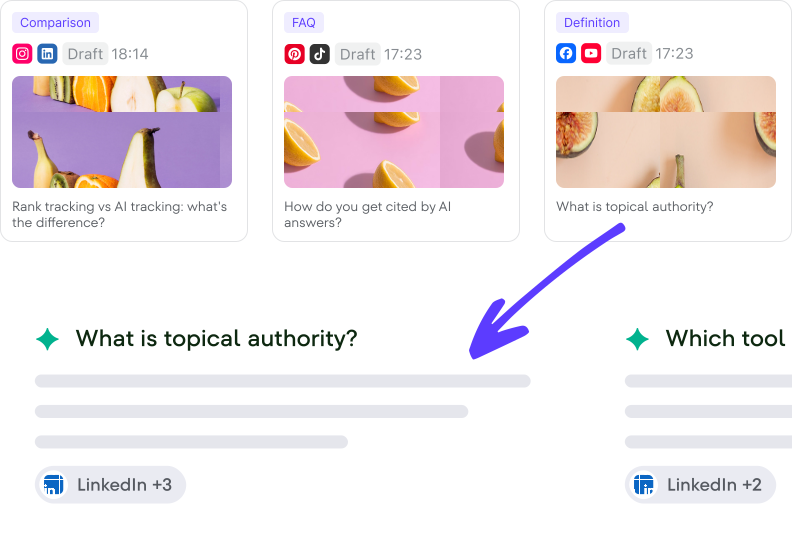
Post on topics that are wanted and will land
Demand on its own gives you topics people search for. Your engagement tells you which of those your audience can stop for. Planning from both means each theme is one you can defend on relevance and expect to perform.
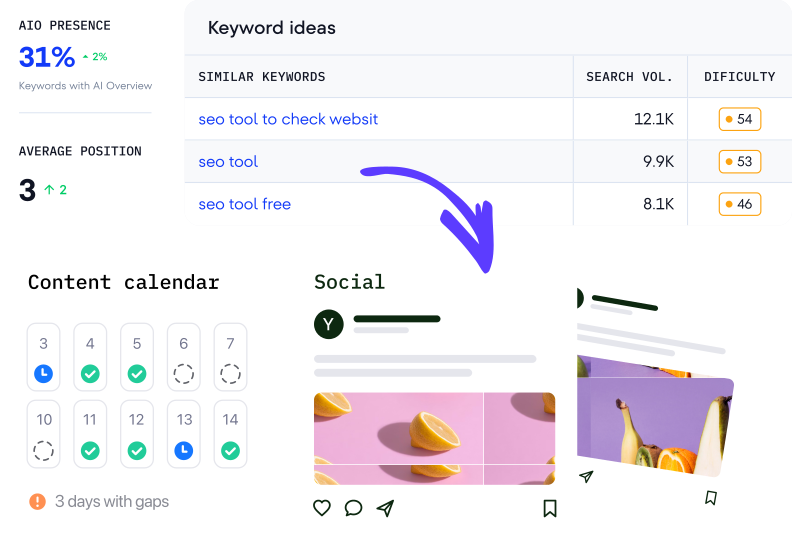
Compound your presence across channels
Search and social are one ecosystem. A topic covered in both earns links, gets crawled, and gets shared, and AI answers are assembled from sources across the open web, your site, and your social alongside each other. Consistency across both is what an LLM reads as presence.
See which of your themes carry both signals
Two MCPs, one prompt. Setup is two server URLs and an authorization.
No credit card required
How a run goes
You describe what you want in plain language. Here’s what your assistant takes in, what it reads across both datasets, and what it hands back.
Domain and market
Name your domain and target country to read search demand data.
A destination workspace
Point it at a Planable workspace with at least one connected page. That’s where engagement history is read from and where the drafts land.
Optional inputs
Connect an SE Ranking project with history. Also, add the competitor domains you want measured against, and say how many posts you want back.
Optional data layers
Planable’s Analytics add-on to read per-post metrics and competitor pages. GA4 or Search Console if you want on-site behavior in the same conversation.
Search demand
It pulls the terms competitors rank for and you don’t, then adds the related and long-tail expansions around them, plus the live SERP for context.
Questions people ask
It reads People Also Ask and question keywords, then groups them into angles that map to threads, series and explainers.
Engagement on your channels
Per-post and per-page metrics from Planable, so every candidate theme is checked against how your audience treated comparable content (requires Planable’s Analytics add-on).
Traction beyond your channels
Competitor pages and tracked mentions with volume and sentiment (Instagram and Facebook, read-only; requires Planable’s Analytics add-on).
Ranking movement
It flags the positions your site is losing if you have an SE Ranking project with position history connected. Otherwise, it’ll work from competitor and demand gaps.
A content plan you can scan
Each row names the theme, the demand behind it, the traction behind it, the platform, and the angle — with volume and difficulty where the source keyword has them.
The reasoning stays attached
Every draft carries the term or question it came from and the signal that ranked it. The demand behind a post isn’t buried in a spreadsheet someone has to go find.
Drafts in your workspace
Each draft lands in Planable rewritten for its platform. It carries its label and link, and sits next to the rest of your calendar.
Nothing publishes itself
Everything arrives as a draft. You still review, refine, approve and schedule in your normal process.
Put search and social in the same AI conversation
Start a 14-day free trial, connect both MCPs, and ask your first question. No credit card required.
No credit card required
A plan you can defend line by line
The topic, its order and its format each trace back to a number you can point to, not a gut call.
Relevance with a source attached
Every post traces back to a search term or a question, and to evidence that your audience engages with that theme. When a client or an exec asks why this topic, the answer sits in the plan.
Traction you’re not guessing at
Themes that already earn engagement on your channels get picked first, and the formats that carried them get reused. You stop spending a publishing slot to find out what lands.
Visibility that compounds across the ecosystem
A theme covered in search and on social has two routes into AI answers, which are assembled from sources across the open web. Consistency across both is what an LLM reads as presence.
What marketers say about the SE Ranking and Planable MCPs



Do I need both MCPs?
The workflow depends on both: SE Ranking supplies demand, Planable supplies engagement and the destination for drafts. Either one works alone, but you’re back to one signal.
Do I need Planable’s Analytics add-on?
For per-post metrics, competitor pages, and tracked mentions through the assistant, yes. Without it, planning runs on search data plus your calendar and post statuses.
Do I have to write the prompt myself?
No. You describe what you want in plain language. Or start from the open-source skill we published for Claude, which runs the whole sequence as one command. Get the skill on GitHub →
Can anything publish automatically?
No. Posts created through the assistant are always drafts, and it can’t approve or publish on its own. Your review and approval flow stays as it is.
Can I bring GA4 or Search Console into this?
Yes. Both connect to SE Ranking projects, so on-site behavior and impression data can sit next to demand and engagement.