AI traffic grew 16x from 2024 to 2026: Here are the top AI search engines driving visits to websites
For a while, traffic from AI search engines was barely visible in website analytics.
And that is still mostly true in terms of volume. Even top AI engines do not come close to Google as traffic sources, and for most websites, AI referrals remain a very small share of total visits.
But the direction is changing. In fact, our research shows that website traffic from AI search engines to websites increased 16x from 2024 to 2026.
That growth raises an obvious question: if AI search is starting to send measurable traffic to websites, which platforms are driving it?
To answer that, we analyzed AI referral traffic from major AI search engines, including ChatGPT, Gemini, Perplexity, Microsoft Copilot, Claude, DeepSeek, and Grok.
Here’s what we found.
-
Website traffic from AI search engines grew 16x from 2024 to 2026.
AI platforms now account for 0.32% of all website traffic, up from 0.24% in 2025 and 0.02% in 2024.
-
ChatGPT, Gemini, Perplexity, Copilot, and Claude are the top AI search engines sending traffic to websites in 2026.
ChatGPT leads with 74.78% of AI referral traffic, followed by Gemini at 11.56%, Perplexity at 7.23%, Copilot at 3.51%, and Claude at 2.62%.
-
Although ChatGPT now dominates, the share of AI traffic it sends to websites is falling.
ChatGPT generated 79.74% of all AI referral traffic in 2025. In 2026, that dropped to 74.78%. Its actual traffic still grew by 27% year over year, but the rest of the AI market grew faster.
-
Gemini is now the second-largest AI traffic source globally.
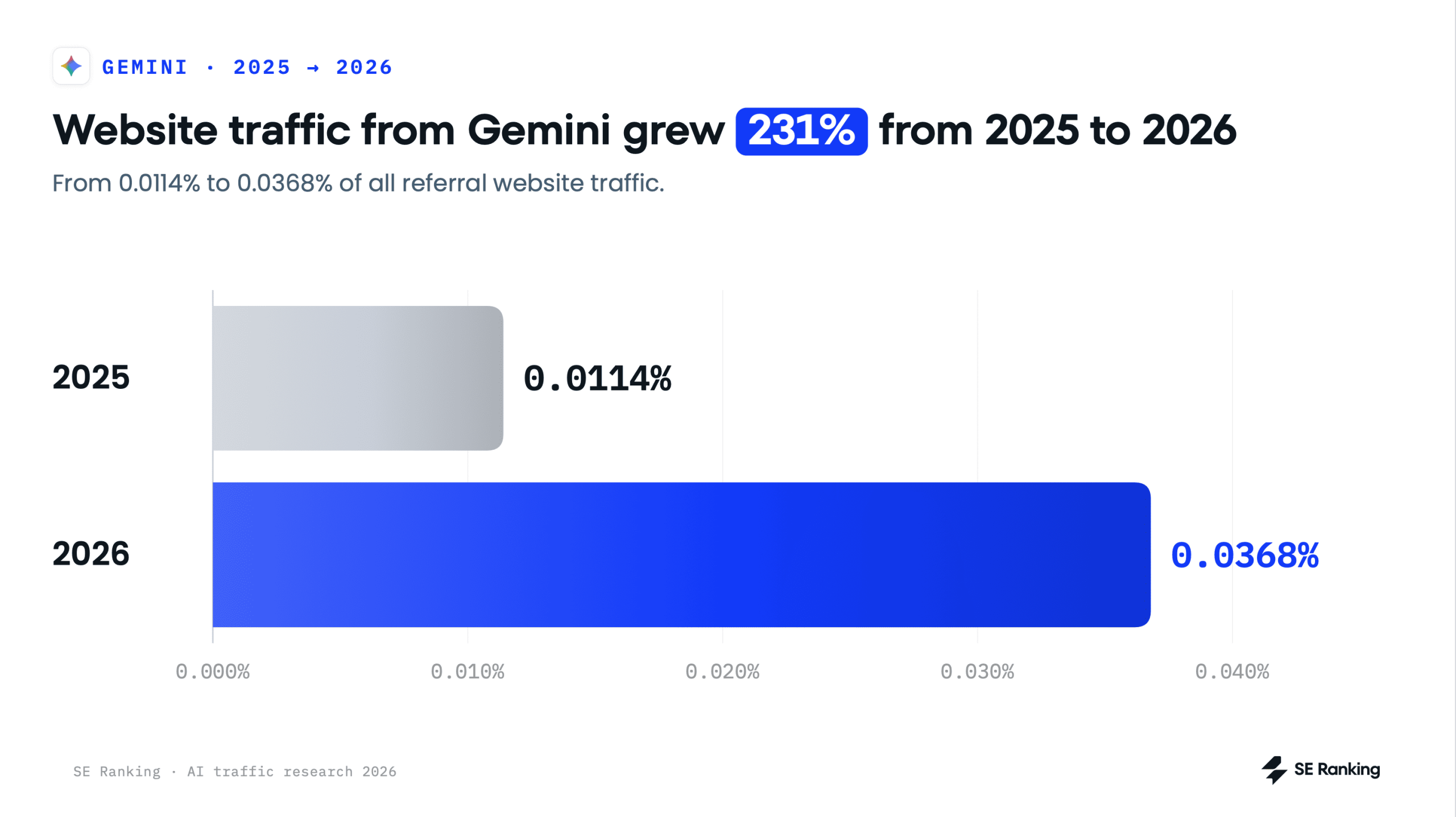
Gemini grew 231% from 2025 to 2026, one of the largest increases among the top five AI search engines. By early 2026, it had also overtaken Perplexity as the second-largest AI traffic source.
-
Claude is the fastest-growing platform by growth rate.
Claude grew 320% from 2025 to 2026. Most of that increase happened in March 2026, when its worldwide traffic share jumped 159% in a single month.
-
Perplexity is losing momentum.
Its global traffic stayed almost flat, while its US share of AI traffic fell from 11.42% in 2025 to 6.85% in 2026.
-
AI traffic now shows a seasonal pattern.
Global AI traffic peaked in October 2025 at 0.3511%, dipped through December, and recovered in early 2026. This pattern appeared across every region we tracked.
-
Website visitors from AI search engines are more engaged than organic search visitors.
On average, visitors referred by AI engines spend 68% more time on websites than those from traditional organic search. This is because AI tools act as “intent filters,” bringing users who are already engaged and further along in their decision journey.
Global website traffic from top AI search engines: 2024 to 2026 overview
Today, AI search engines are sending more traffic to websites than they did a year ago.
In 2026, AI referral traffic reached 0.32% of total website traffic, up from 0.24% in 2025 and 0.02% in 2024. This is a 16x increase in less than two years.
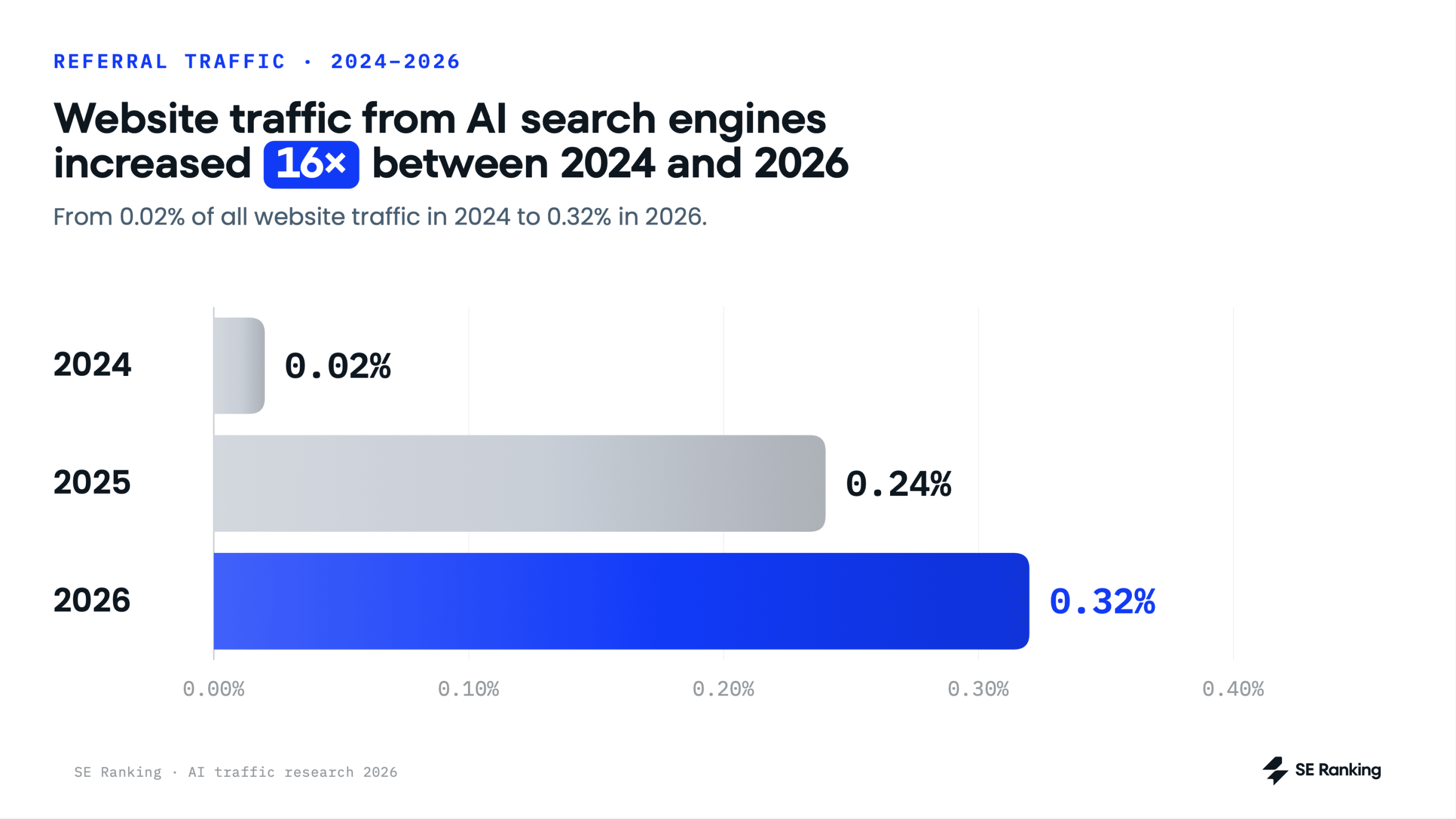
Put another way, roughly 1 in every 312 website visits now comes from an AI search engine.
That growth is meaningful, but it is still small compared with traditional organic search. In 2026, organic search accounts for 42.75% of all website traffic, which means Google still sends 134x more visitors than AI platforms.
Still, the gap is narrowing. At the start of 2025, organic search was sending roughly 300x more traffic to websites than all AI search engines combined. Within 18 months, that ratio compressed sharply.
The 16-month trend line
Website traffic from AI search engines followed a surprisingly consistent pattern over the past 16 months.
Across every region we analyzed, referrals from AI platforms grew throughout most of 2025, peaked in the fall, dipped during the holiday season, and then began recovering in early 2026.
The high point came in October 2025, when AI search engines sent 0.3511% of all website traffic—the highest level in our dataset. Traffic then declined through December before stabilizing and gradually rebounding in the first months of 2026.
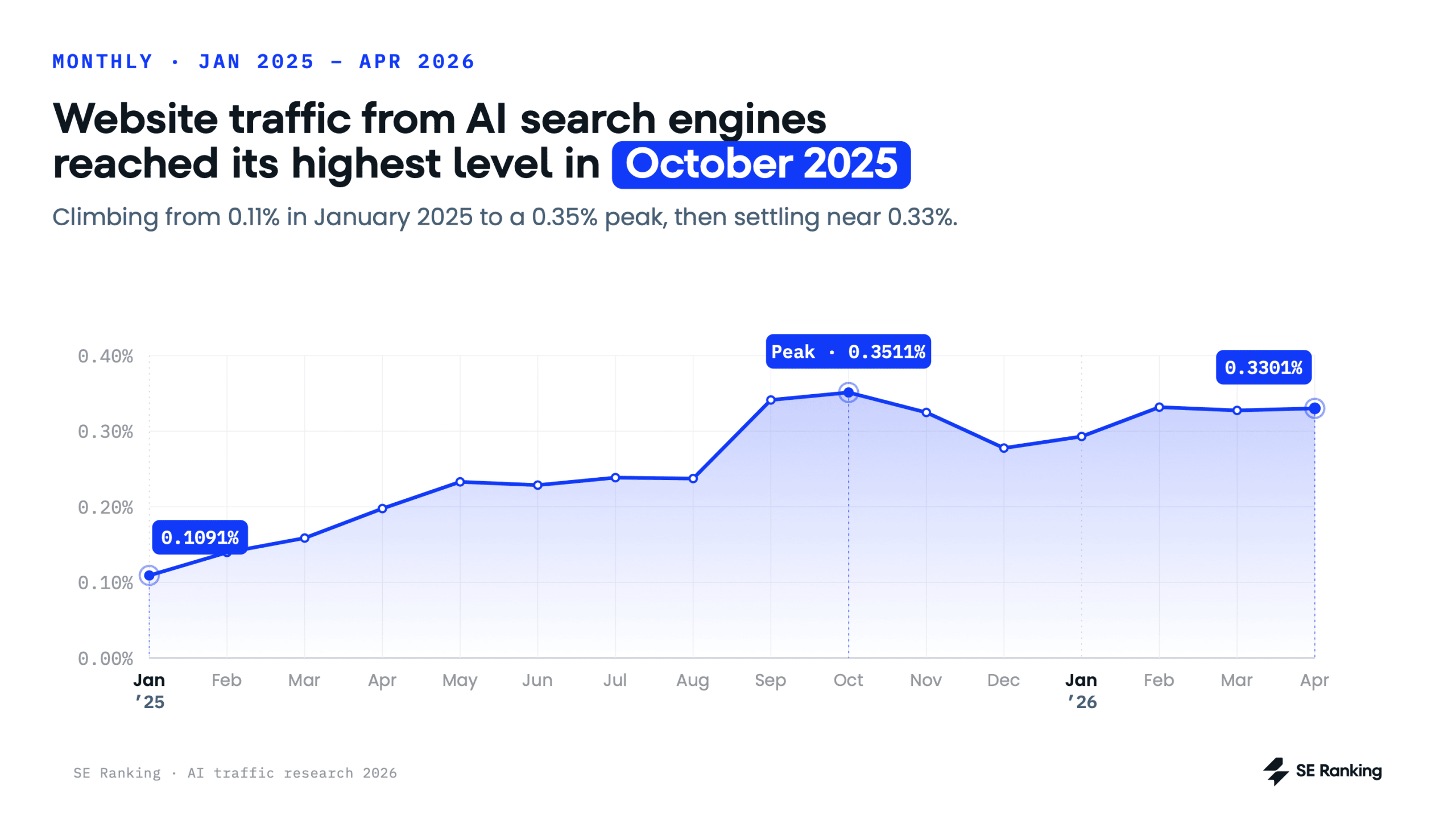
One of the biggest drivers of that fall peak was ChatGPT. In September 2025, AI referral traffic jumped 51% month over month, the largest increase we recorded. ChatGPT was responsible for roughly 90% of that growth, with its share of total website traffic rising from 0.1838% in August to 0.2770% in September.
What this shows is that AI search referral traffic is no longer growing randomly. For the first time, the data suggests a recognizable seasonal pattern: strong growth through most of the year, a fall peak, a holiday slowdown, and a recovery in the new year.
Which AI search engine sends the most traffic?
ChatGPT is still the top AI search engine sending traffic to websites, by a wide margin.
In 2026, ChatGPT ranks first, accounting for 74.78% of all AI referral traffic. Gemini ranks second with 11.56%, followed by Perplexity in third place with 7.23%. Copilot ranks fourth with 3.51%, and Claude ranks fifth with 2.62%.
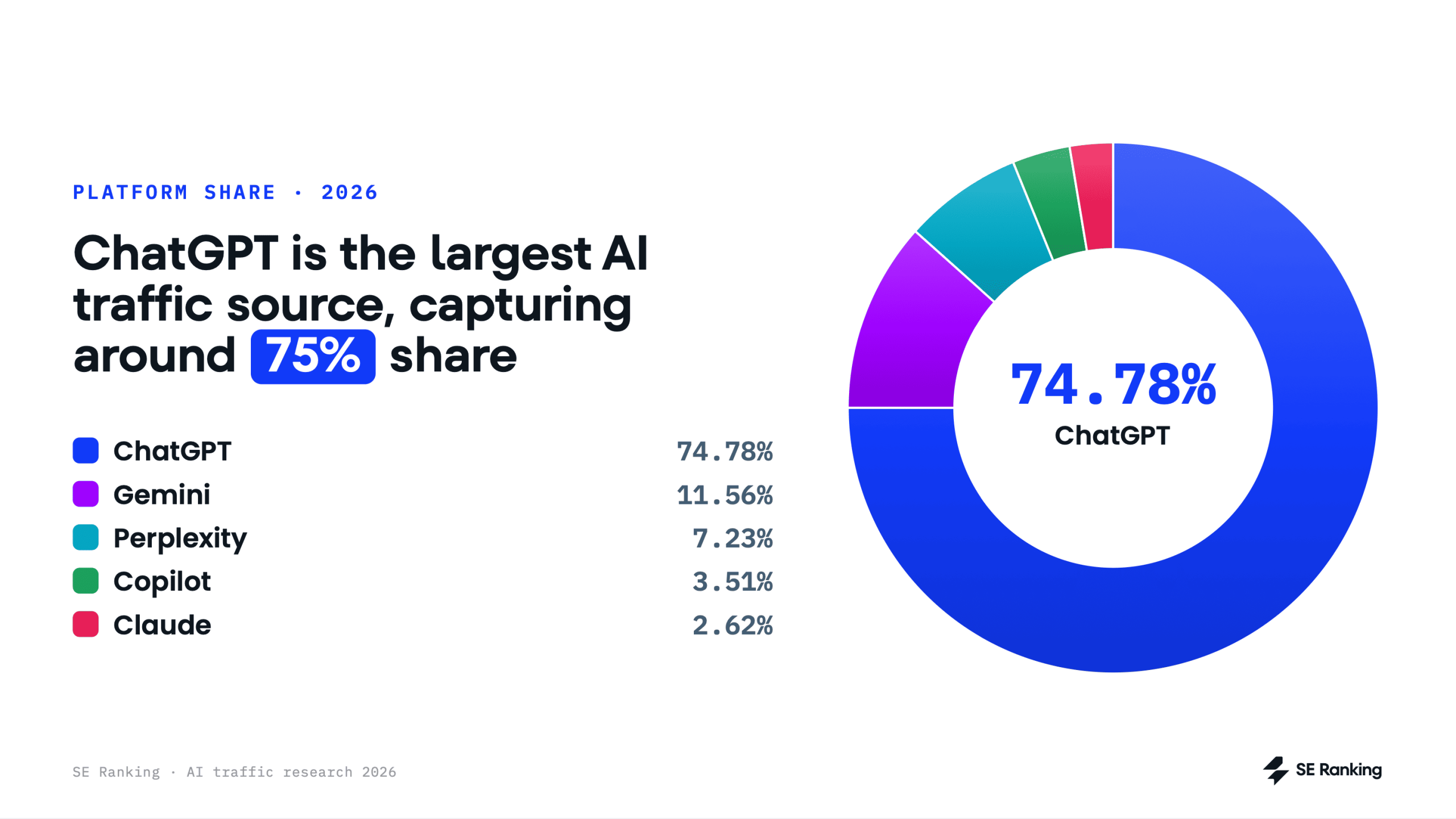
What’s interesting is that ChatGPT’s share is down from 79.74% in 2025. But this does not mean ChatGPT is shrinking. Its actual website referral traffic grew by 27% year over year.
The key point is that other AI search engines are growing faster. Gemini, for example, grew by 231% year over year, Claude by 320%, and Copilot by 31%. Perplexity was the only major AI search engine to decline slightly.
So ChatGPT is still the clear leader, but its lead is narrowing because newer and smaller AI search engines are gaining traffic faster.
ChatGPT: still dominant, but growth has slowed
ChatGPT’s 2026 worldwide average is 0.2384% of total traffic. That is 6.4x higher than Gemini, the next-largest platform at 0.0368%.
But its growth has slowed within 2026. In January, it sent 0.2286% of all web traffic. In April, it sent 0.2321%. That is only a 1.5% increase over four months.
During the same period, total AI traffic grew 13%.
So ChatGPT is still growing in absolute terms, just not as fast as the smaller players. That makes the next phase of AI search traffic especially interesting to watch.
September 2025 remains ChatGPT’s biggest traffic moment in the dataset: in just one month, website traffic from ChatGPT jumped 51%.
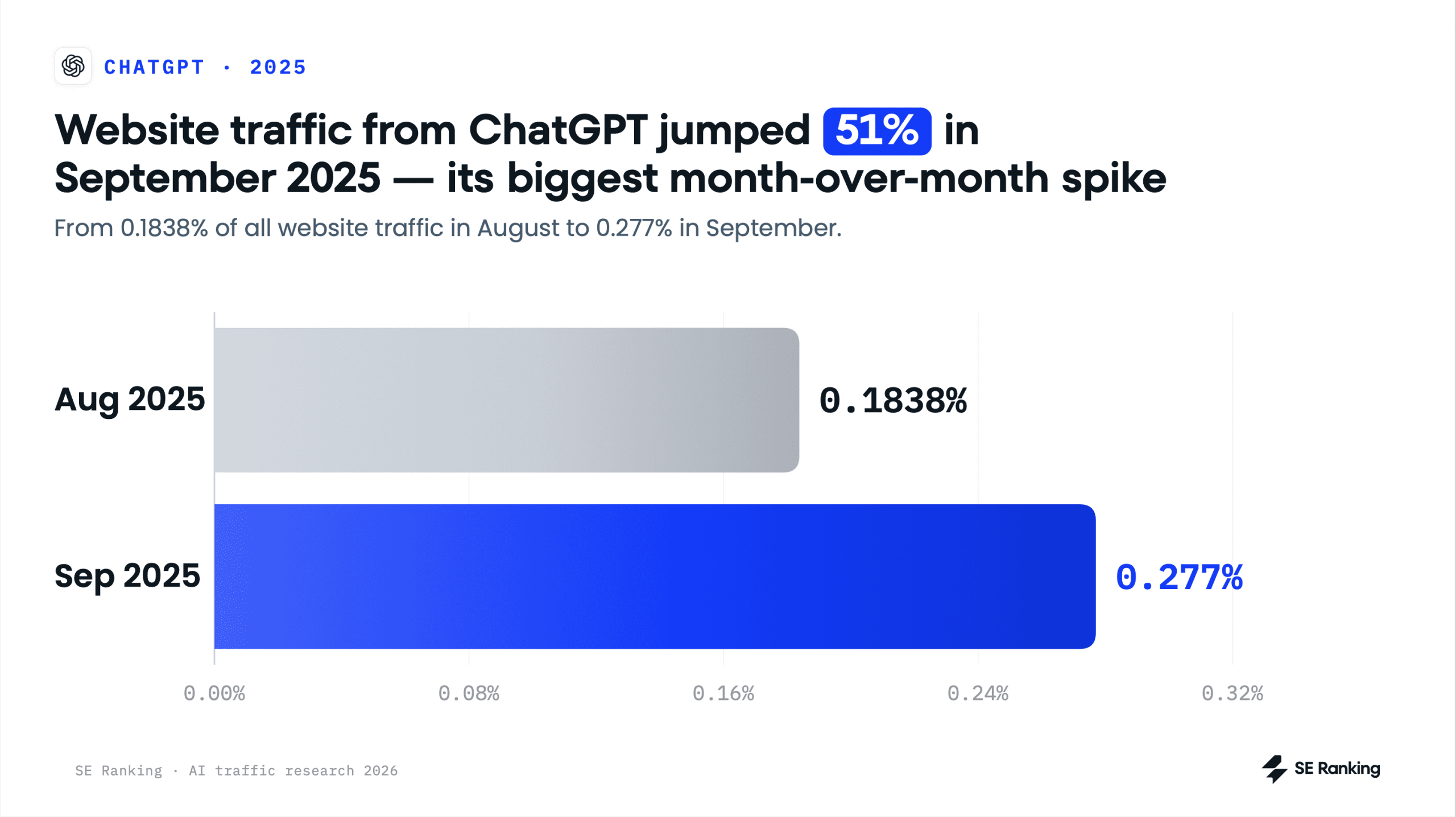
But since then, its trajectory has been much flatter.
Gemini: the fastest-growing platform in absolute traffic terms
Gemini is the clearest breakout story in the 2026 data.
Its average traffic share grew from 0.0114% in 2025 to 0.0368% in 2026, which is an impressive 231% increase. Among the top five AI search engines, this was one of the largest traffic gains.
What makes Gemini’s growth especially interesting is when it started.
In December 2025, traffic from most AI platforms declined. ChatGPT fell 19%. Perplexity fell 13%. Gemini moved in the opposite direction, growing 52% in one month from 0.0132% to 0.0200%.
Gemini is now also ahead of Perplexity in every region we track. It overtook Perplexity in January 2026 in the US, UK, and globally, and in February 2026 in the EU.
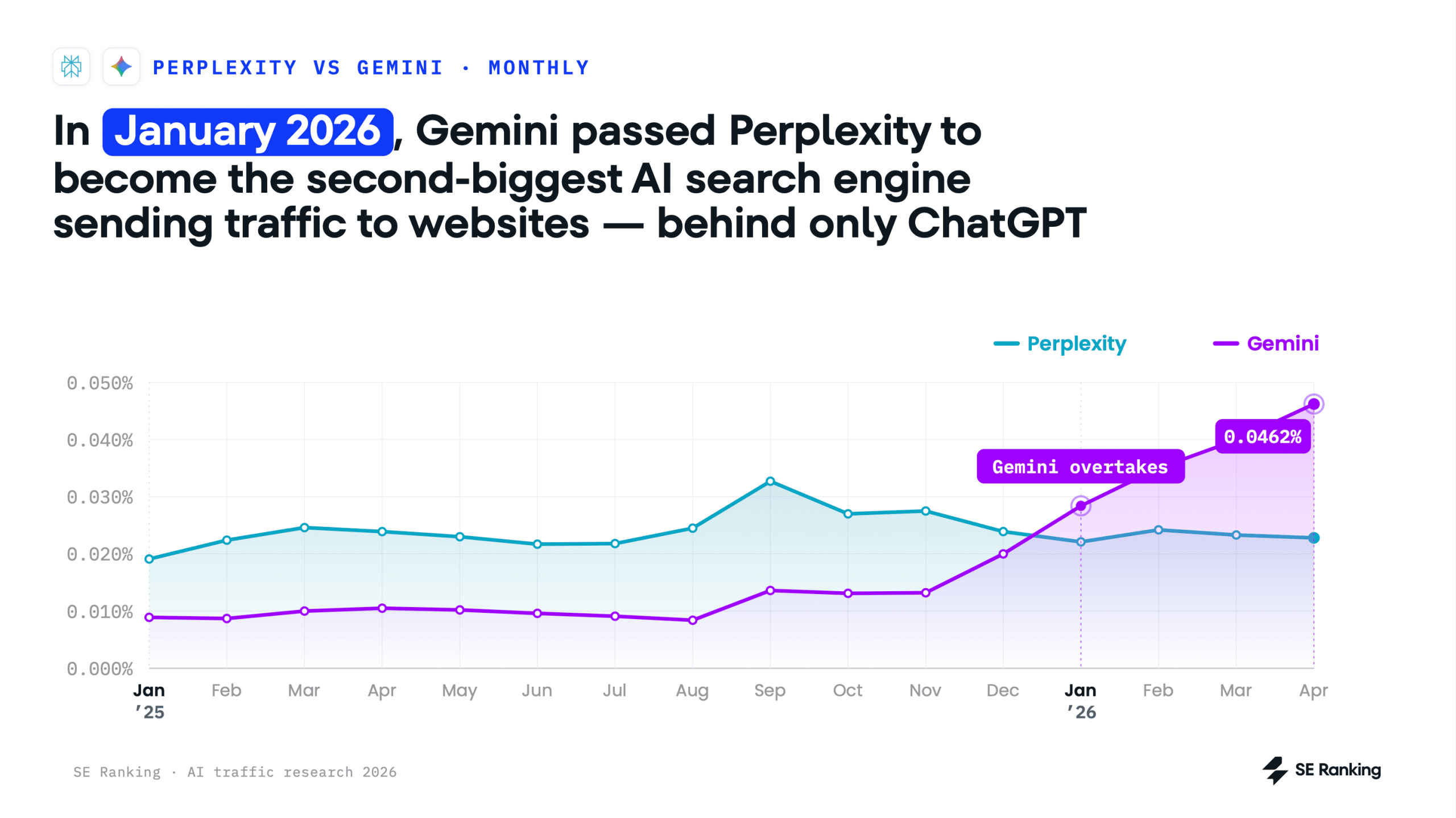
The EU is the only region where the gap remains narrow. In the US, Gemini’s lead over Perplexity is already much wider.
Perplexity: stagnating even in its strongest markets
Perplexity looked like the durable second-place AI traffic source in early 2025. By 2026, that position had changed.
Globally, its traffic has barely moved. Perplexity averaged 0.0245% of total traffic in 2025 and 0.0230% in 2026. That is a slight decline at a time when the overall AI traffic pool grew 36%.
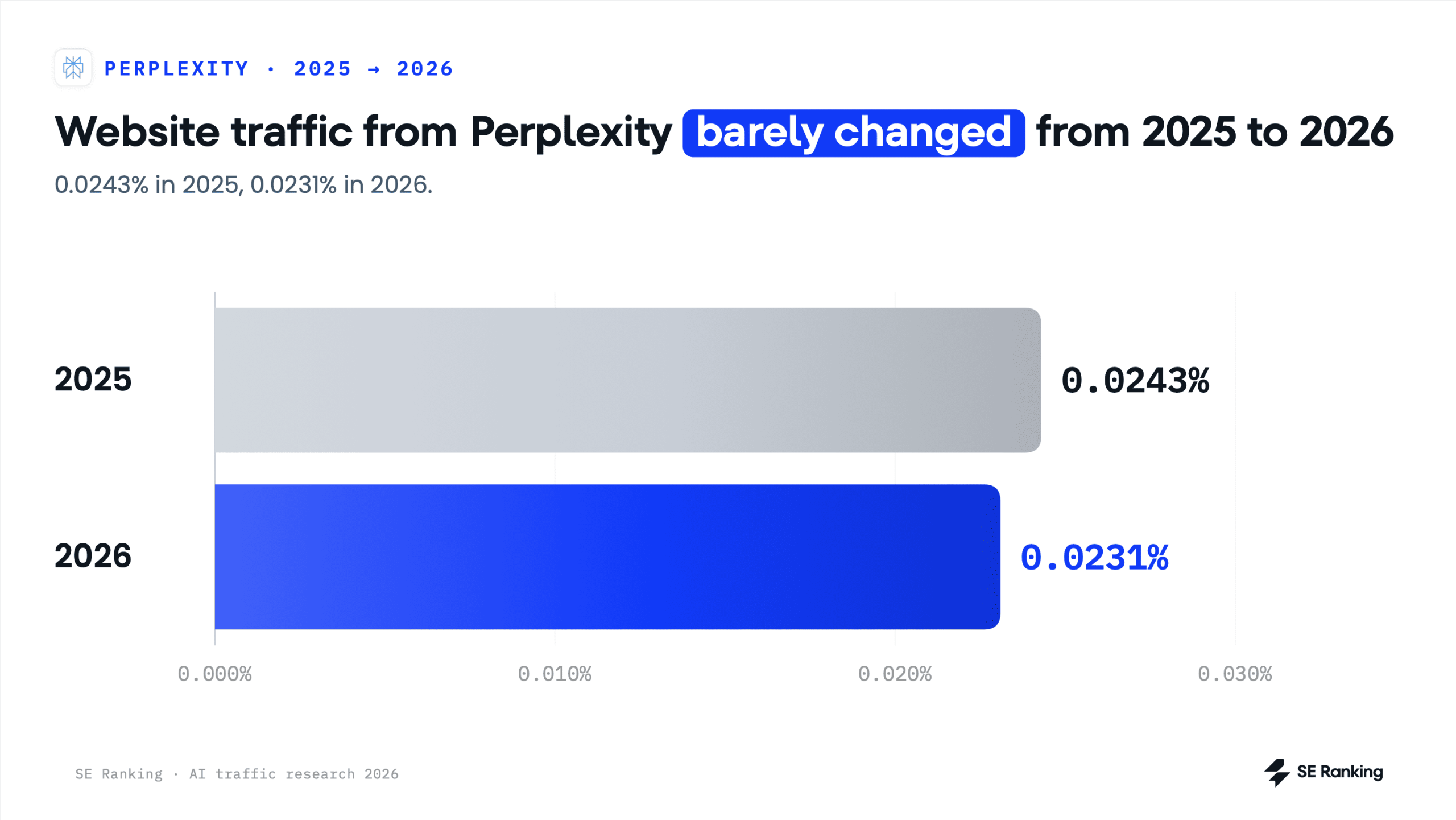
This means Perplexity is not just losing share because others are growing faster. Its absolute traffic has also softened slightly.
The biggest shift is in the US, which used to be Perplexity’s strongest market.
In the first four months of 2025, Perplexity held 19.73% of US AI traffic. Across full-year 2025, that dropped to 11.42%. In 2026, it fell again to 6.85%.
Claude: small traffic volume, very fast growth
Claude is still a much smaller referral source than ChatGPT, Gemini, or Perplexity. But it is growing faster than all of them by percentage.
Claude grew 320% year over year, from 0.0021% of total traffic in 2025 to 0.0084% in 2026.
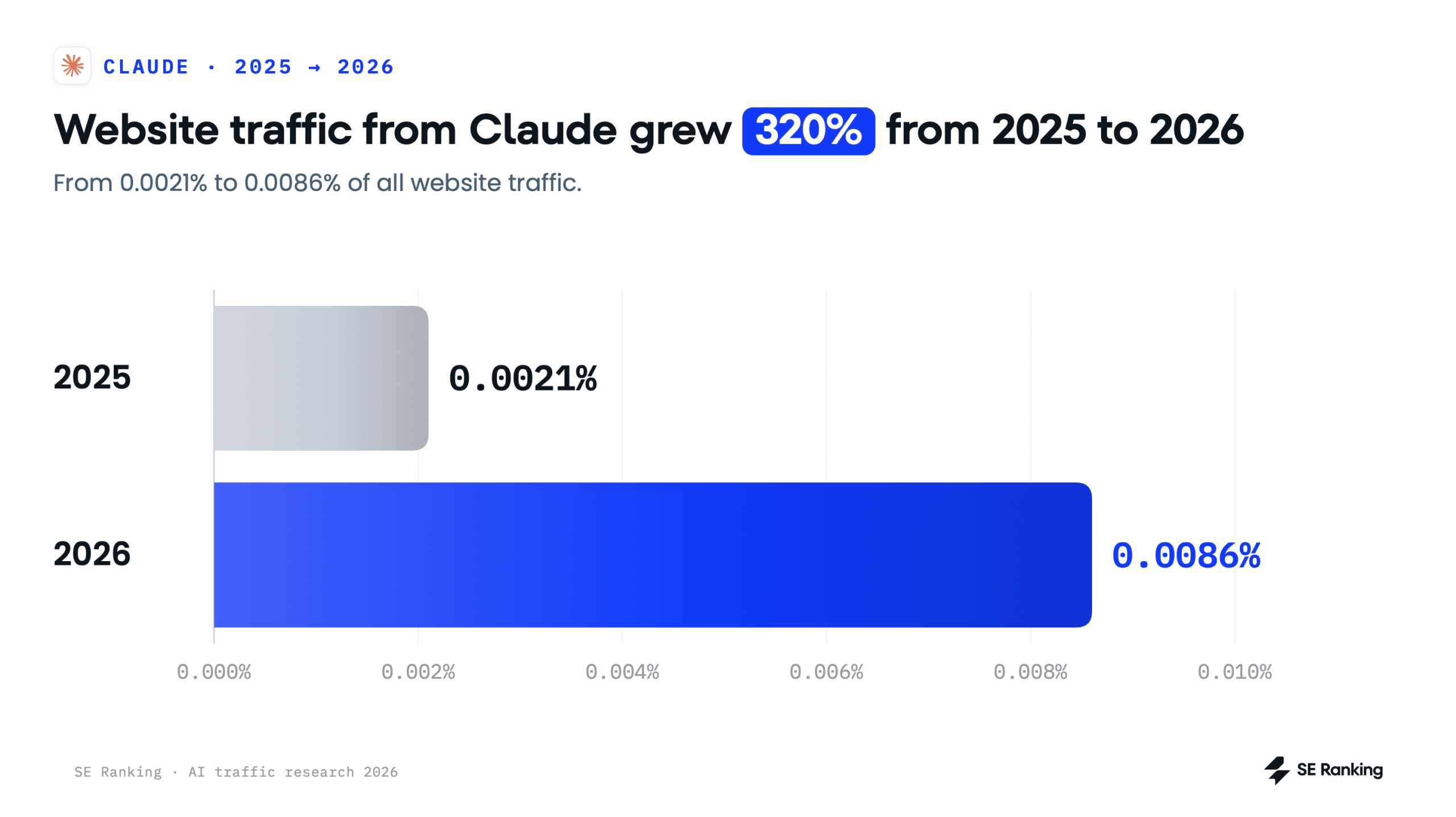
Most of that growth happened in March 2026. In February, Claude’s worldwide traffic share was 0.0049%. In March, it jumped to 0.0127%, a 159% increase in one month. In April, it rose again to 0.0141%.
Around that period, Anthropic was publicly discussed for its stance on limiting certain government and defense uses of Claude, including mass domestic surveillance and fully autonomous weapons, which may have raised awareness of the company.
But the traffic data alone cannot confirm that this caused the referral spike. What we can say with confidence is that March 2026 marked a clear breakout month for Claude as a source of website referral traffic.
Microsoft Copilot: small, stable, and now consistently measurable
Copilot did not appear as a measurable referral source in the first few months of 2025. It first showed up meaningfully in May 2025, when traffic from Copilot to websites reached 0.0129%.
After that, Copilot stayed in a narrow range. Its average global website traffic share was 0.0086% in 2025 and 0.0112% in 2026. That means traffic from Copilot to websites grew by about 31% year over year, but from a very small base.
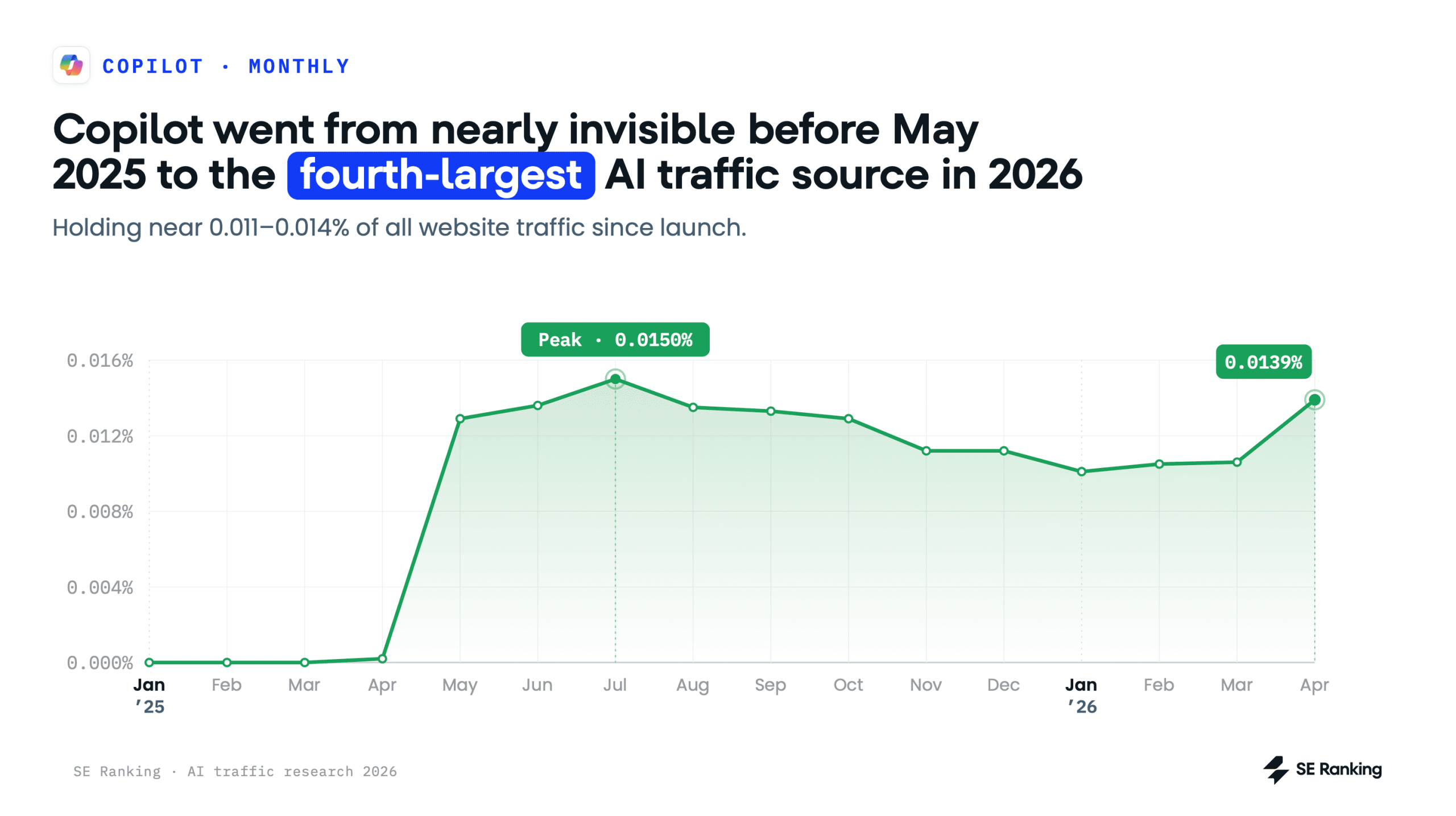
So globally, Copilot is not a breakout traffic source yet. It is small, stable, and now consistently measurable.
DeepSeek and Grok: brief spikes, then near-zero
DeepSeek was one of the more notable platforms in early 2025. In fact, it held a 0.37% share of AI traffic, being the fourth biggest AI traffic source worldwide.
But from September 2025 onward, DeepSeek’s referral traffic dropped to essentially zero across all regions.
Grok followed a different but similarly short-lived pattern. It had a brief spike in July and August 2025, reaching 0.0017% and 0.0019% of total traffic. That spike coincided with a Grok product launch. After that, traffic returned to near-zero.
Together, DeepSeek and Grok show how much the market has consolidated.
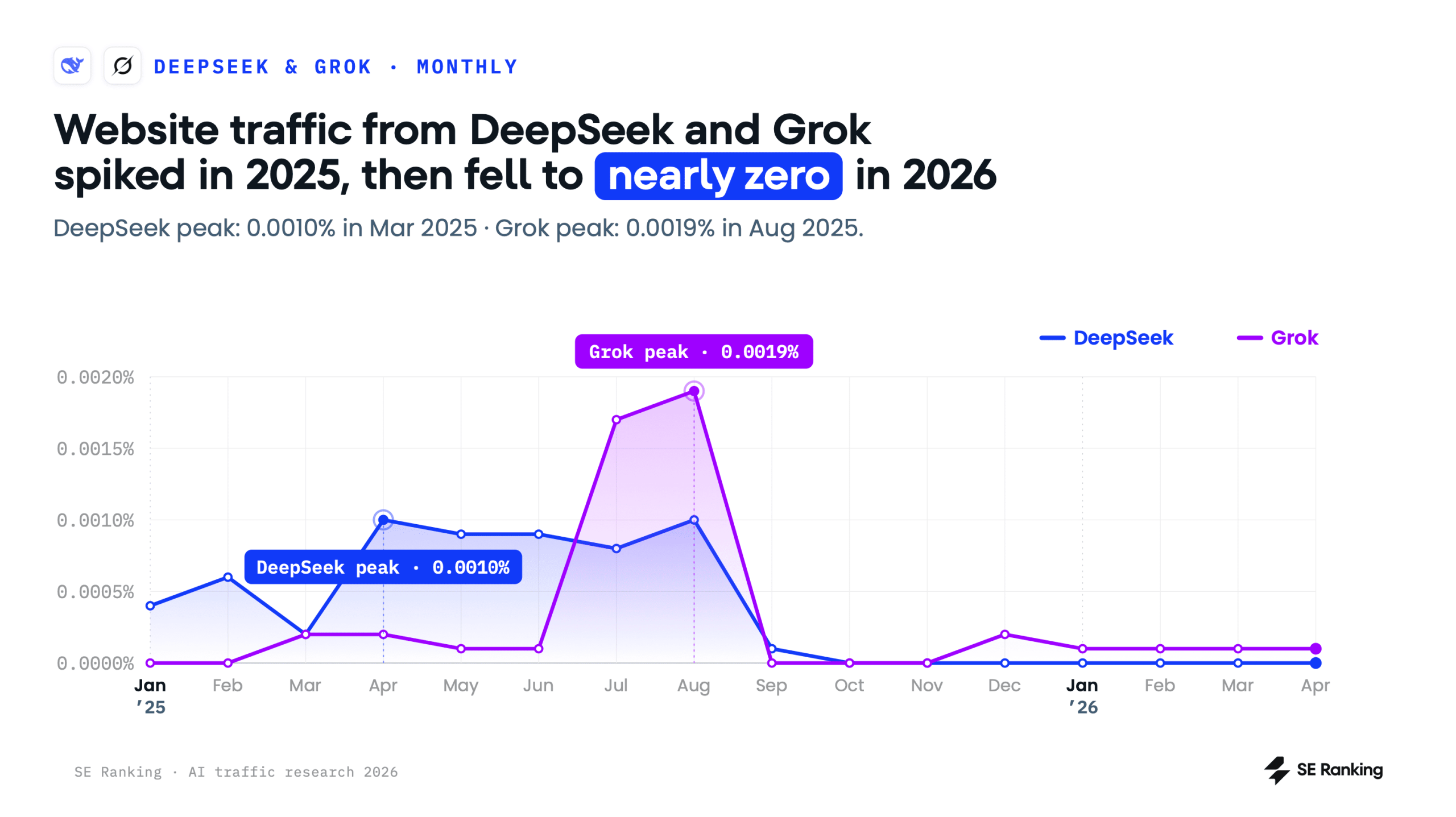
The likely explanation is that users were still experimenting with a wider range of AI tools in 2025. By 2026, consistent website referral traffic had consolidated around five platforms: ChatGPT, Gemini, Perplexity, Copilot, and Claude.
Regional breakdown: top AI engines in the US, EU, and UK
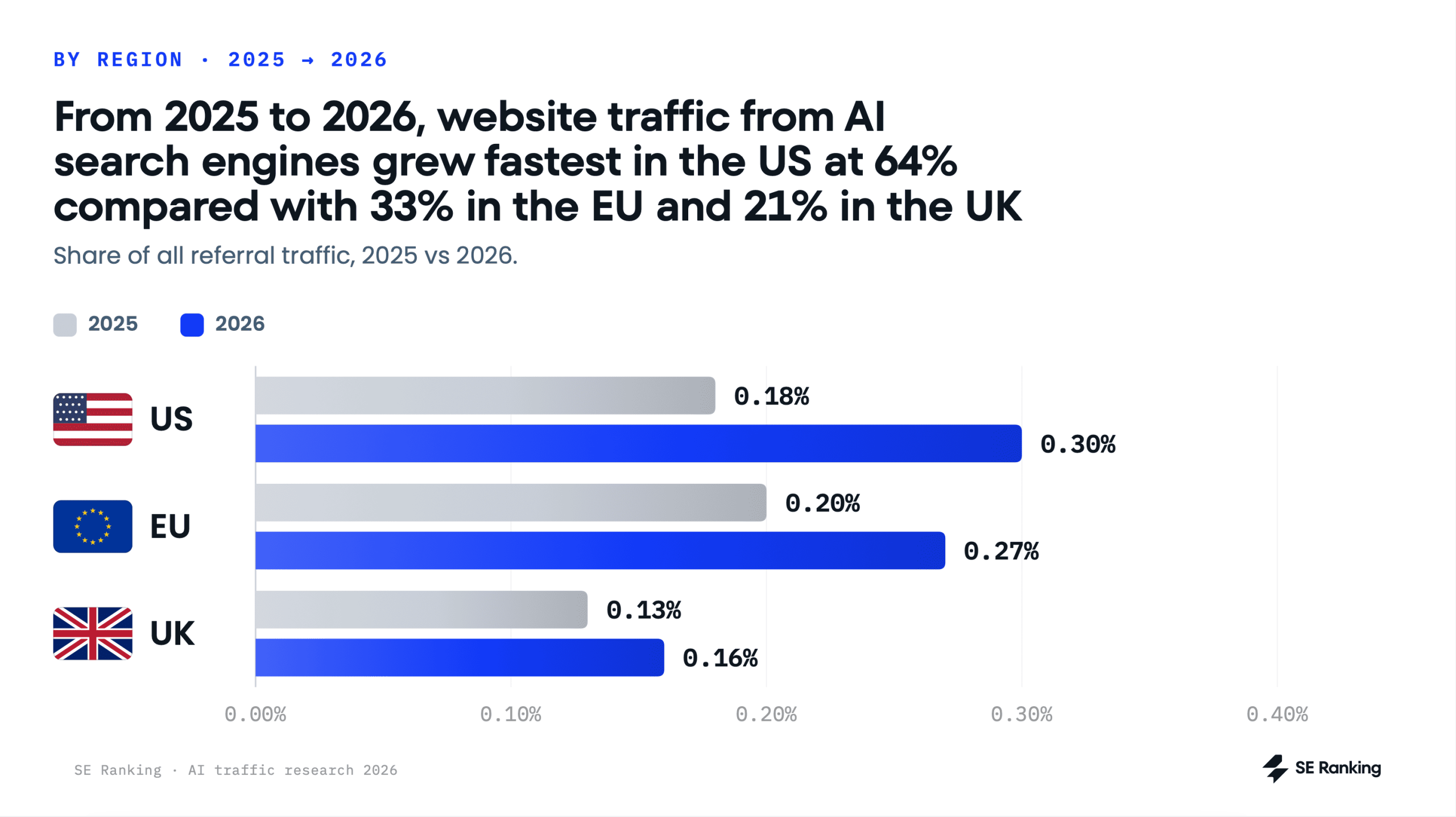
Website traffic from AI search engines looks different across regions. The US now has the highest AI traffic share among the regions we analyzed, the EU sits in the middle, and the UK remains the smallest AI referral market.
In 2026 specifically, AI search engines sent 0.29% of total website traffic in the US, compared with 0.27% in the EU and 0.16% in the UK.
The growth patterns are also different. The US grew the fastest year over year, rising 64% from 2025 to 2026. The EU grew 33%, but started declining within 2026. The UK grew only 21%, making it the slowest-growing region in the dataset.
The US is the only region where the latest month in our dataset is also the all-time high. In April 2026, AI search engines sent 0.3343% of total website traffic in the US, slightly above the global average of 0.3301%. Everywhere else, the peak came earlier, in October 2025.
This makes the regional picture clear: the US is accelerating, the EU is still above the UK but losing momentum, and the UK remains the most dependent on traditional organic search.
United States: the most diversified AI referral market
The US has the most distributed AI referral traffic mix of any region we analyzed.
ChatGPT is still the top AI search engine sending traffic to websites, but its dominance is weaker here than elsewhere. In 2026, ChatGPT accounted for 71.33% of US AI referral traffic (lower than its global share and much lower than in the UK).
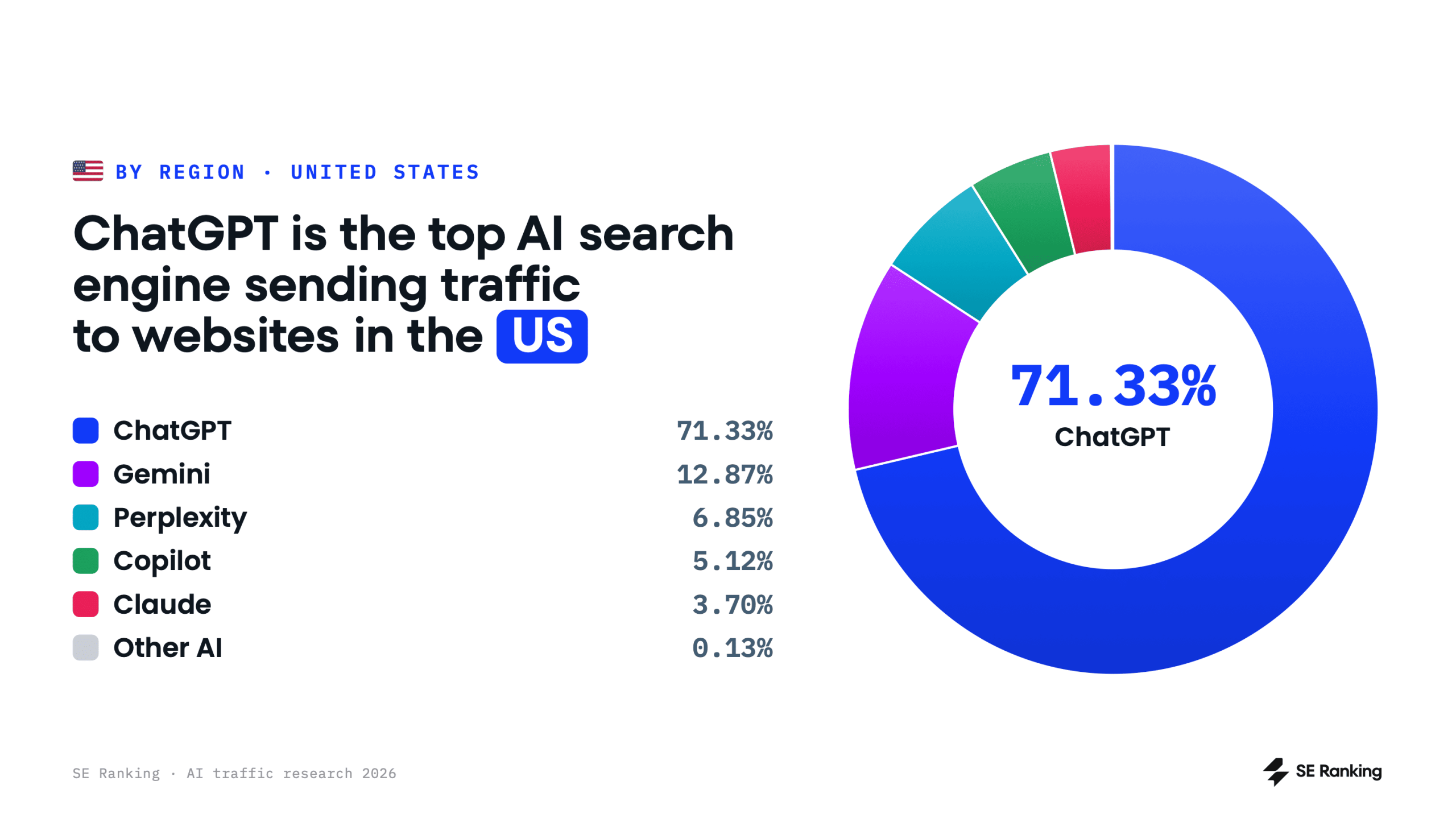
Gemini is the clear second-largest AI referral source in the US, with 12.87% of AI traffic. It overtook Perplexity in January 2026 and has continued widening the gap. By April, Gemini’s US traffic share was already more than twice Perplexity’s.
Perplexity, once especially strong in the US, has lost ground. Its share of US AI referral traffic fell from 11.42% in 2025 to 6.85% in 2026.
Copilot and Claude also matter more in the US than they do globally. Copilot holds 5.12% of US AI referral traffic, while Claude holds 3.70%. Both have their strongest regional presence here.
European Union: ChatGPT is weakening, but Perplexity is still competitive
The EU sits between the US and UK in overall AI referral traffic. In 2026, AI search engines sent 0.2689% of total website traffic in the EU, up from 0.2023% in 2025.
But the EU is the only region where AI referral traffic declined within 2026. It fell from 0.2858% in February to 0.2506% in April, a 12% drop over three months.
ChatGPT still leads in the EU, with 75.59% of AI referral traffic in 2026. But that is down from 83.03% in 2025, the steepest year-over-year decline in ChatGPT’s share across all regions.
The EU is also the only major region where Perplexity remains competitive with Gemini as a website referral source. In 2026, Gemini accounts for 9.8% of EU AI referral traffic, while Perplexity is close behind at 9.02%. In the US, Gemini already leads Perplexity by almost 2x.
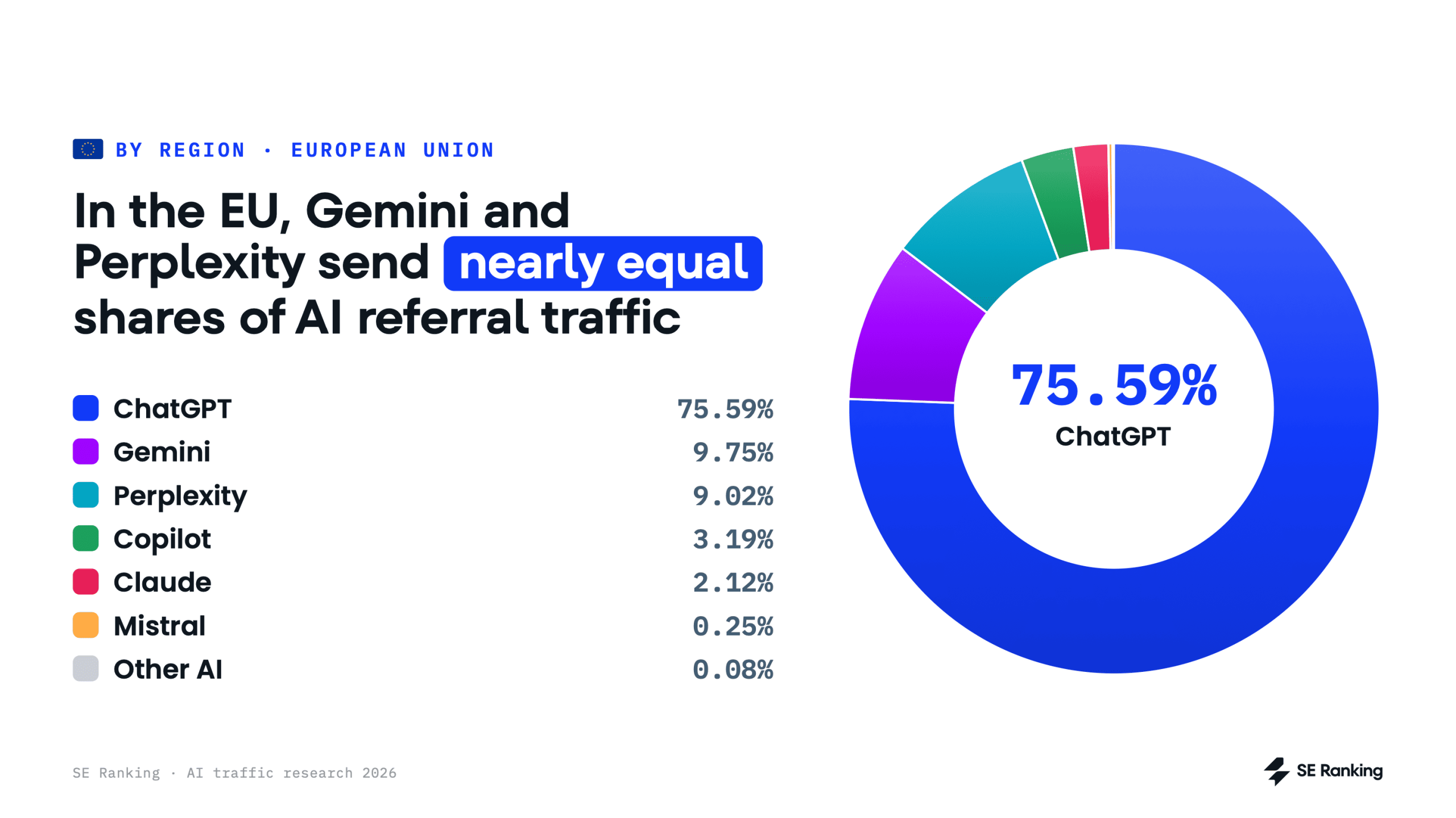
The EU also has one local AI platform visible in the data: Mistral AI. It holds 0.22% of EU AI referral traffic, which is small, but it does not appear as a separate category in the US, UK, or global data.
United Kingdom: the most ChatGPT-dominated market
The UK has the lowest AI referral traffic share among the regions we analyzed.
In 2026, AI search engines sent 0.1565% of total website traffic in the UK. That is well below the US at 0.2958% and the EU at 0.2689%.
The UK also grew the slowest year over year: 21%, compared with 64% in the US and 33% in the EU. Its 2026 average is still 22% below its October 2025 peak of 0.1998%, and growth from January to April 2026 was almost flat.
The platform mix is also the least diversified. ChatGPT accounts for 85.28% of UK AI referral traffic, the highest share across all regions. In practical terms, the UK AI referral market is still mostly a ChatGPT market.
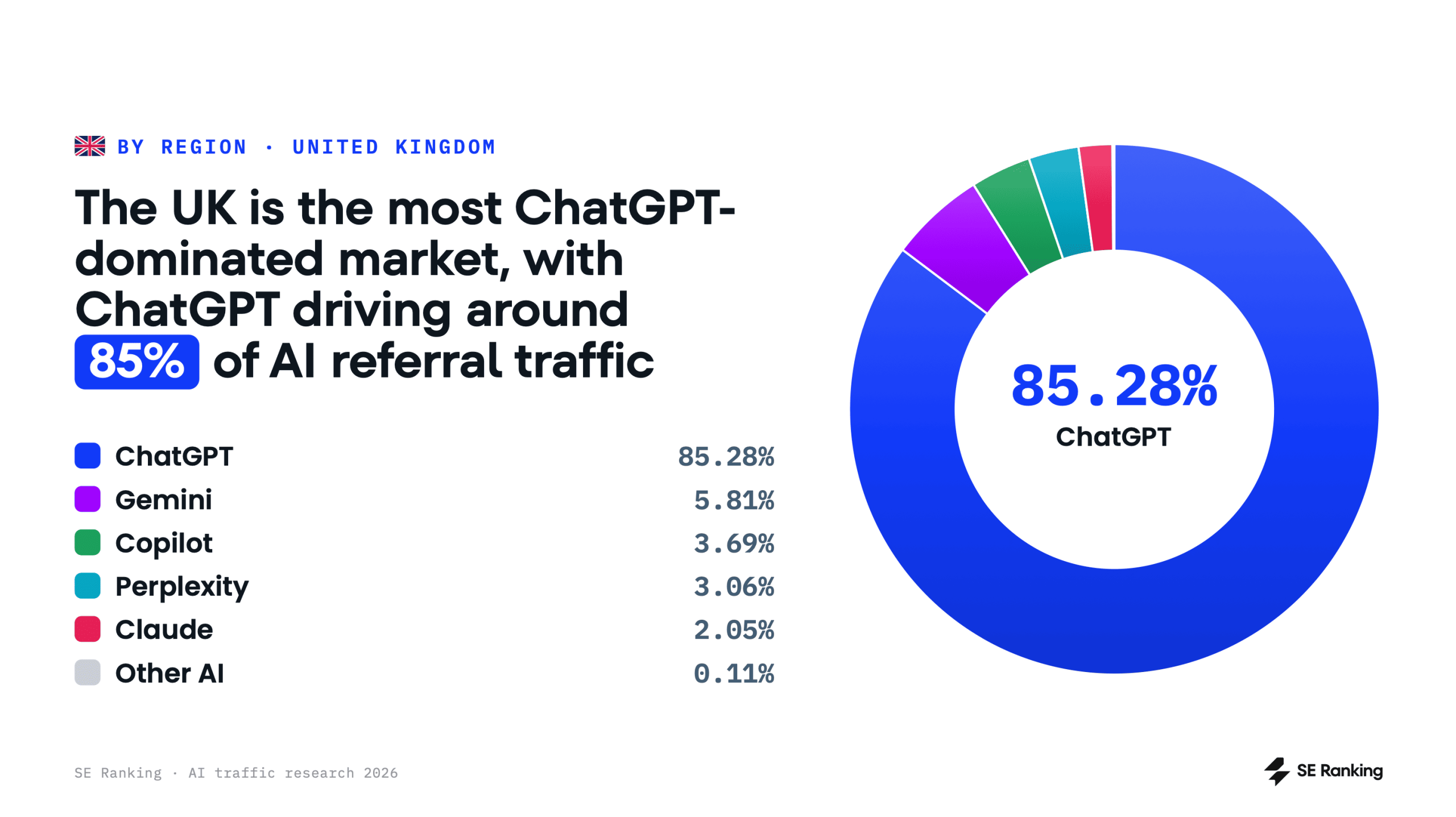
Gemini is now the second-largest AI search engine sending traffic to UK websites, with 5.81% of AI referral traffic. It overtook Perplexity in January 2026, the same month it did globally and in the US.
Perplexity is weakest in the UK. Its share fell from 5.64% in 2025 to 3.06% in 2026, and its absolute traffic declined 33% year over year.
Claude is growing quickly in the UK, but from a very small base. It rose from 0.0010% of total website traffic in January 2026 to 0.0054% in April.
Is AI traffic “better” than organic traffic?
If we measure engagement rather than volume, AI-driven traffic already shows clear advantages over traditional search.
Across our dataset, visitors arriving from AI platforms spend 67.7% more time on sites than those coming from organic search results. That’s an average of about 9 minutes 19 seconds compared to 5 minutes 33 seconds for Google and other search engines.
Median session durations (which reduce the skew from outliers) tell the same story: 2 minutes 24 seconds for AI vs. 1 minute 53 seconds for organic.
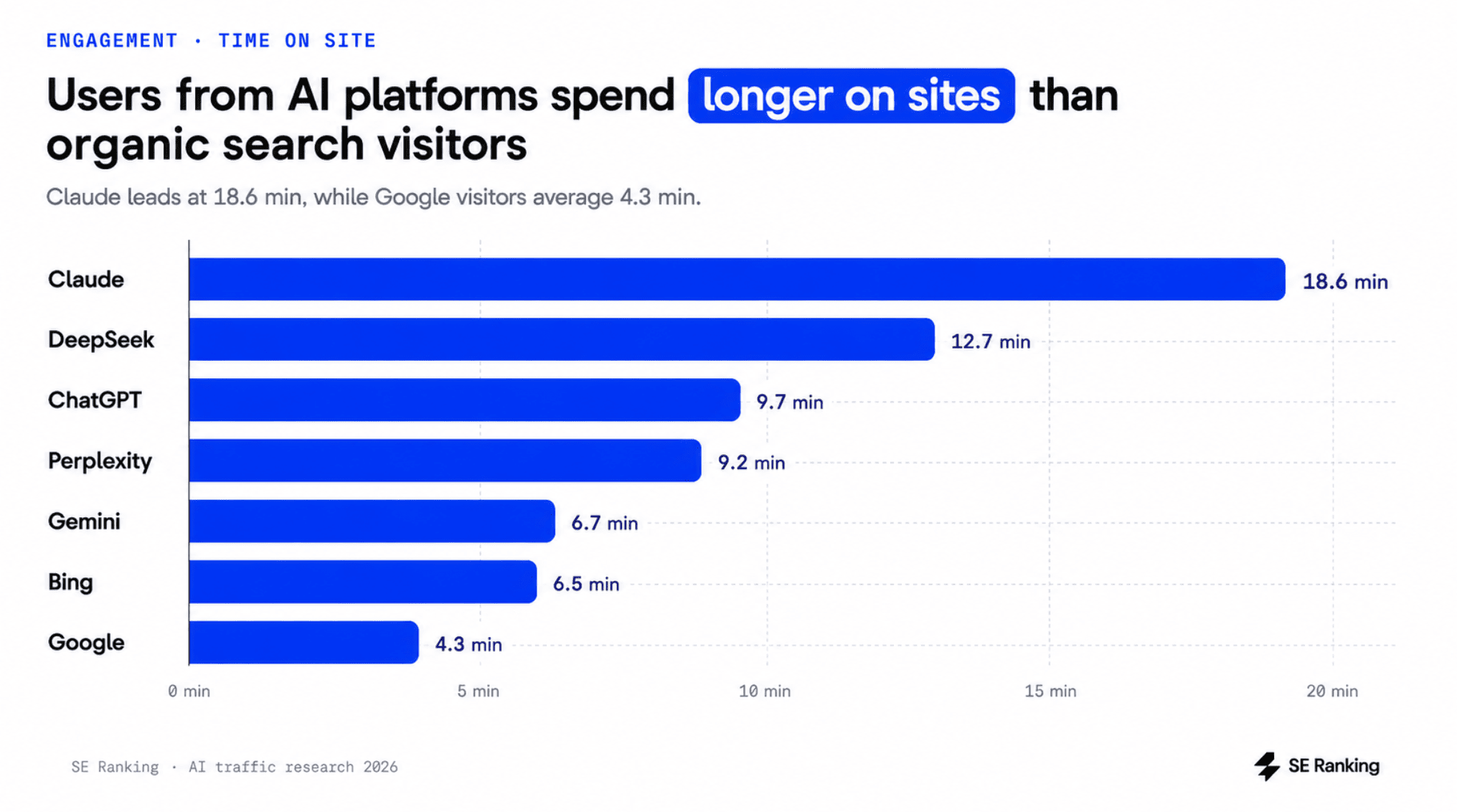
Globally, Claude users spend an average of almost 19 minutes on the site (in the EU, it’s over one hour!), but the median is only 1 minute and 29 seconds. DeepSeek averages nearly 13 minutes, with a median of just over 2 minutes. This gap between the average and median shows that a small group of highly engaged users skews the statistics. In contrast, platforms with a larger AI market share have more consistent visit times, so their average and median are much closer.
Taken together, these differences point to more than just session length.
AI search visitors tend to show up with more pre-qualifications, often after a conversational exchange with a model that refines their query and context before they ever click through. In other words, the “pre-filter” effect of AI might be sending fewer visitors, but they’re often the right visitors.
Engagement by region
AI users tend to spend more time on sites than organic visitors, but the size of this advantage varies by region.
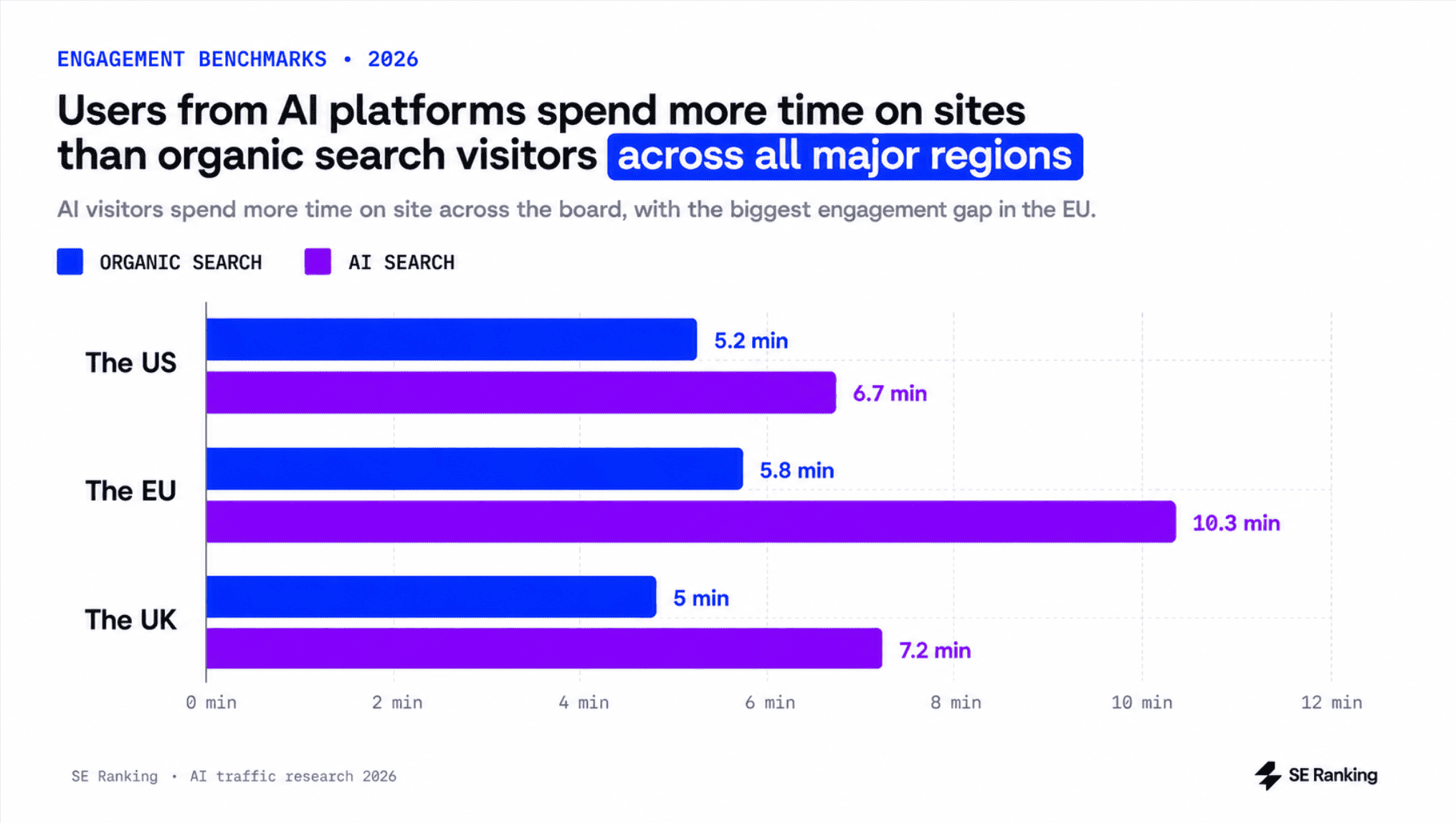
In the US, it’s the smallest at 28.7%, with AI users spending 6.7 minutes on average, only slightly more than organic visitors. The UK sits in the middle, with AI sessions averaging 7.3 minutes versus 5 minutes for organic. The EU shows the largest difference: AI users linger for nearly 10.3 minutes, almost double the 5.8 minutes of organic traffic.
Platform performance adds another layer of insight. ChatGPT and Perplexity consistently drive long sessions, with EU users spending over 10 minutes on average, while Claude stands out with a staggering 3,998 seconds in the EU, which is almost 67 minutes (!). In the US and UK, Claude sessions are closer to the global average, around 6.7–10 minutes.
What this means for AI search visibility strategy
AI search is not replacing organic search yet, but it is becoming a separate discovery channel. The traffic volume is still small, but the behavior behind that traffic makes it worth tracking.
1. The platform mix is consolidating
In 2025, AI referral traffic was spread across more platforms. Nine AI tools had measurable referral traffic to websites.
By 2026, that changed. Only five platforms consistently remain above the 0.10% AI traffic threshold globally:
- ChatGPT
- Gemini
- Perplexity
- Microsoft Copilot
- Claude
This makes AI visibility tracking more manageable. Instead of chasing every new AI tool, you can monitor the top AI search engines that are actually sending consistent traffic.
ChatGPT is still the clear leader, but Gemini, Claude, and Copilot are growing faster. So AI visibility strategy should not focus on ChatGPT alone.
2. AI traffic is lean, but high-value
As our research shows, visitors who do arrive from AI search engines tend to be more engaged. They often spend more time on websites than organic search visitors, which suggests they may be further along in the decision journey.
This makes AI traffic worth optimizing for now: not because it is already the biggest channel, but because it can bring visitors who are more likely to explore, evaluate, and take meaningful action.
3. AI search optimization needs its own workflow
AI search visibility overlaps with SEO, but it cannot be measured the same way.
In organic search, teams usually work from a familiar model: keywords, rankings, URLs, clicks, and sessions. AI search requires a broader visibility model. Teams need to monitor where the brand appears across top AI search engines, which prompts trigger those mentions, which pages are cited, how competitors are positioned, and whether AI visibility translates into actual referral traffic.
SE Ranking’s AI Results Tracker is one way to build that workflow. It helps teams monitor brand and competitor visibility across ChatGPT, Gemini, Perplexity, Google AI Overviews, and Google AI Mode, showing which prompts surface a brand, which competitors appear instead, and how AI visibility changes over time.
What makes it especially useful is that teams can bring AI visibility insights into their existing workflows.
With SE Ranking MCP, these insights can be used directly inside AI assistants such as Claude, Cursor, and similar tools. The MCP connects teams to SE Ranking’s AI search visibility data, along with 180+ SEO capabilities, including keyword research, backlink analysis, domain insights, website audits, and more.
For example, inside your preferred AI assistant, you could start with a prompt like this:
Using SE Ranking MCP, audit AI visibility for [domain.com] across ChatGPT, Gemini, and Perplexity. Identify which queries mention my brand, which URLs are cited, which competitors appear, and what content changes would improve visibility in AI-generated answers. Return a prioritized action plan.To help teams get more out of Claude specifically, SE Ranking also offers seven pre-built SEO Skills for Claude: ready-to-use instruction sets that configure Claude for tasks such as content brief creation, backlink gap analysis, content auditing, and, most relevant here, AI visibility reporting.
The AI visibility reporting Skill lets you compare a target brand’s AI search visibility against competitors across major LLM engines. It also helps identify the topic clusters each brand owns, where competitors are gaining visibility, and where your brand has gaps to close.
You can use these Skills in two ways: simply describe the task in plain language and let Claude choose the right Skill, or run a specific Skill directly with slash commands such as /seo-content-audit or /seo-ai-search-share-of-voice.
Together, SE Ranking’s AI Results Tracker, MCP integration, and Claude SEO Skills give teams a practical workflow for AI search optimization: monitor visibility, compare competitors, understand topic-level gaps, and turn those insights into clear actions.
Research methodology
This study is based on aggregated, anonymized data from 101,574 websites across 250 countries and territories. The data comes from websites with Google Analytics integrated in compliance with SE Ranking’s Terms of Service.
The analysis covers 16 months of continuous tracking, from January 2025 through April 2026.
- 2024: Used as a historical reference point to show how much AI referral traffic has grown over time.
- 2025: Used as the baseline year. It includes a full 12 months of data, giving us a stable view of AI referral traffic patterns.
- 2026: Represents the current period. The data covers January through April 2026 and is compared against the 2025 baseline to show what is changing now.
Monthly trend data is used to show movement across the full 16-month period, including the September 2025 spike, the October 2025 peak, the holiday dip, and the early-2026 recovery.
Note: The statistics in the section “Is AI traffic ‘better’ than organic traffic?” are based on data collected from January through April 2025.
We tracked referral traffic from major AI search engines, including:
- ChatGPT
- Gemini
- Perplexity
- Microsoft Copilot
- Claude
- DeepSeek
- Grok
- Poe
- Mistral AI
- Other AI (includes all AI search engines and platforms that individually account for less than 0.1% of total AI referral traffic)
Regional breakdowns cover the US, UK, and EU.
Disclaimer: The results show patterns in this specific dataset and may not reflect AI referral traffic trends for every website, industry, region, or audience. Individual results can vary depending on market, content type, brand visibility, analytics setup, and how AI platforms surface or attribute referrals.
Conclusion
AI search engines might not match Google in traffic (yet), but their influence is growing fast. Even better, the visitors they do bring are often more engaged, more intentional, and potentially more valuable.
For now, the top AI search engines sending traffic to websites are clear: ChatGPT leads, Gemini is gaining ground, Perplexity remains firmly in the mix, Copilot has become consistently measurable, and Claude is growing fastest by percentage.
We’re keeping a close eye on this trend and will continue updating this study as new data becomes available.