How to optimize for AI Mode: Global domain traffic matters 3x more than content
Getting cited by AI Mode takes more than just publishing content. Domain authority, content quality, technical optimization, and social media presence all play a role. But how much, and which factors should you prioritize first?
To answer these questions, we conducted a new research study analyzing over 50 ranking factors that impact AI Mode citations. As a result, we identified the 20 most impactful areas to focus on to boost your chances of being cited.
Of course, understanding the factors is just the first step. Seeing the impact of your efforts in real time is equally important. That’s why we created the AI Mode Tracker. With this tool, you can:
- Track every brand mention, linked or unlinked.
- Identify your most-cited pages.
- Benchmark your AI visibility against competitors.
- Access full AI-generated answers with all the referenced sources.
With both the research insights and the AI Mode Tracker, you can not only understand what drives citations, but actively track and improve your presence.
Now, let’s dive into our research findings to see what actually predicts AI Mode citations.
-
Google visibility is the most powerful predictor of AI Mode citations.
Websites with over 1.16M visitors earn about 6.4 citations, compared to just 2.4 citations for those with under 2.7K visitors (roughly 3x difference). This confirms that higher traffic correlates with higher chances of being cited by AI Mode.
-
Traffic to your homepage strongly predicts AI Mode citations.
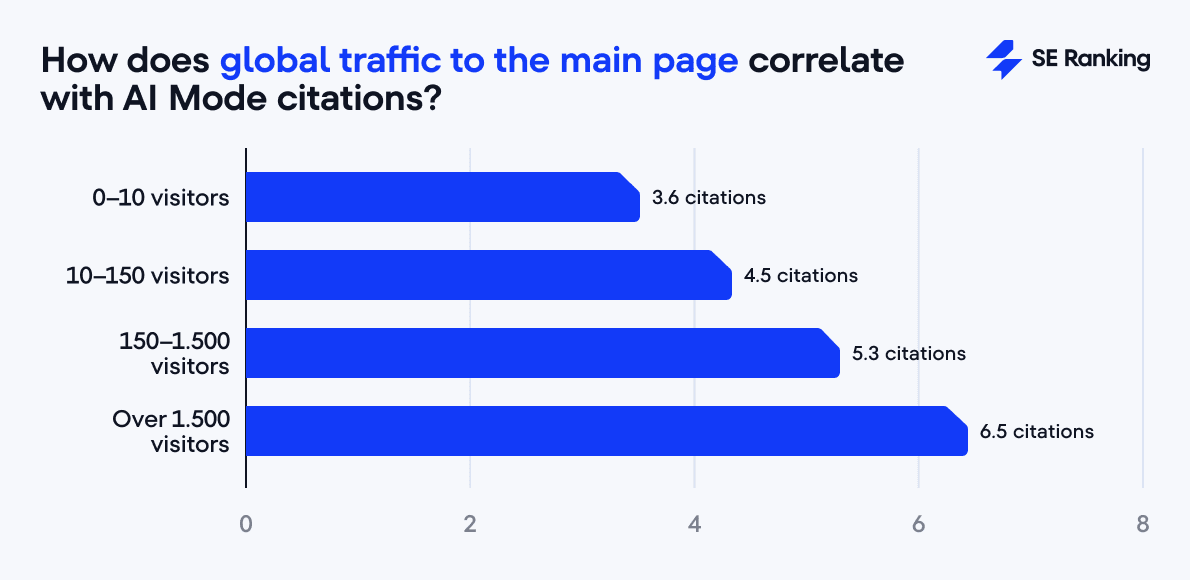
Pages with very low traffic (up to 10 visitors) average 3.6 citations, while high-traffic homepages (over 1.5K visitors) reach around 6.5 citations. The almost twofold difference in citations highlights that page-level traffic (especially to the homepage) is a major factor.
-
Websites with stronger authority are much more likely to be cited.
Sites that have over 24K referring domains average about 6.8 citations, while those with fewer than 300 get only 2.5. The same pattern appears at the page level: URLs with a low Page Trust score (below 7) earn around 2.7 citations, while high-trust pages (above 24) get about 6.2. This means high-authority domains are ~2.5x more likely to be cited.
-
Brand search volume is a reliable authority signal, up to a point.
Domains with up to 800 monthly brand searches earn about 4 citations, while those exceeding 240K searches average 5.3 citations (a 33% increase). At the same time, brand search volumes above this level only boost citations when combined with strong content and other authority signals.
-
Active engagement on Quora and Reddit correlates with more citations.
At around 3.8K brand mentions on Quora, pages average 5.3 citations, while 35K+ brand mentions on Reddit push that number to 5.5 citations. This is roughly a 50–75% uplift over pages with minimal mentions on these platforms.
-
In-depth content (1,500+ words) earns more citations than short posts.
Articles under 500 words get about 4.1 citations, while long-form pages over 2,300 words reach 5.1 citations. The sweet spot starts from around 1.5K words depending on your content type.
-
Regular content updates signal relevance to AI Mode.
Pages updated within the last two months average 5.0 citations, compared to 3.9 for those untouched for over two years. Refreshing content every 2–3 months helps maintain strong visibility.
-
Clear content structure improves how AI interprets your page.
Sections of 100–150 words between headings earn about 4.7 citations. Longer sections over 150 words see a small drop to 4.6, likely because dense blocks are harder for AI to parse.
-
FAQ sections within the main content and question-styled headings increase citation chances.
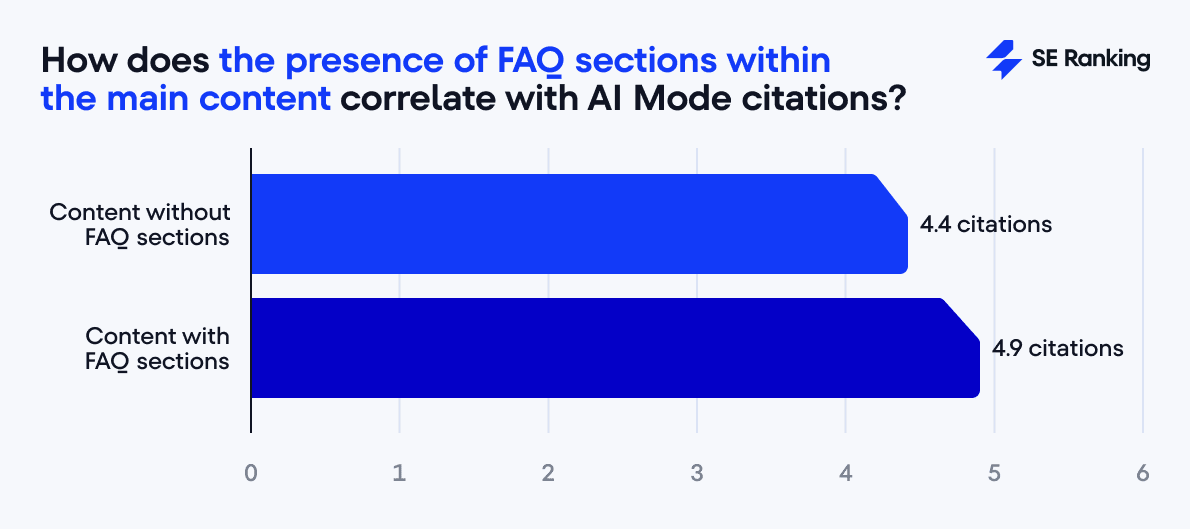
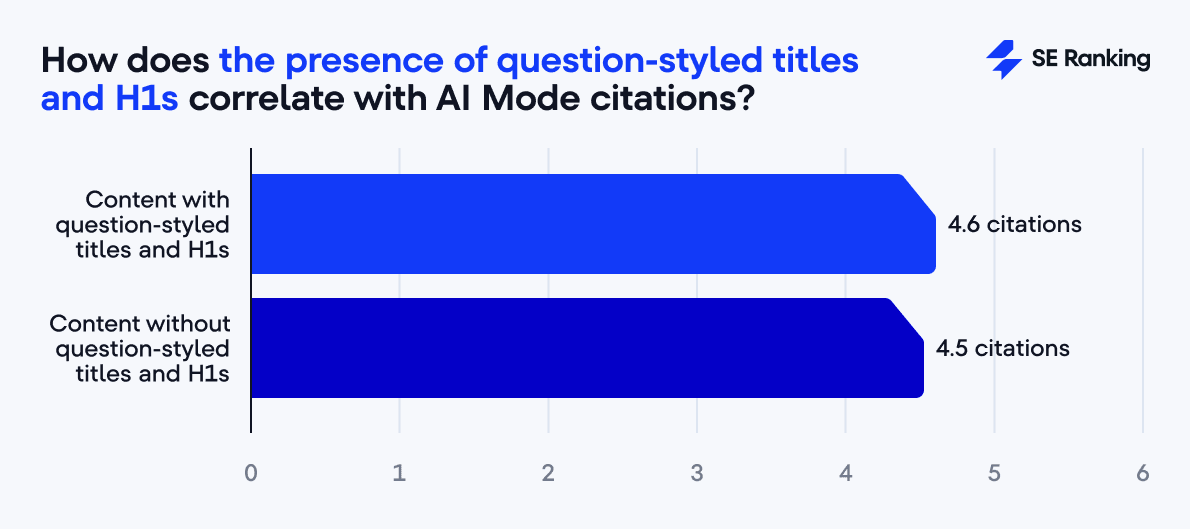
Pages featuring FAQ blocks in the main content average 4.9 citations versus 4.4 without them. Similarly, question-formatted titles or H1s lift citations from 4.5 to 4.6. Including these elements helps AI Mode quickly identify clear answers, which makes your content more likely to be cited.
-
Yet, including the actual FAQ schema markup has no impact on AI Mode citations.
The model appears to prioritize the presence of real, well-structured answers to questions over technical SEO markup. Including Q&A blocks directly in the main content demonstrates a focus on thorough answers, which matters more than the metadata itself.
-
Readable, well-balanced text earns more trust from AI Mode.
Highly complex writing (Flesch-Kincaid Grade 11+) averages 4.0 citations, while accessible yet informative text (Grade 6–8) maintains around 4.6. AI Mode prefers content that’s easy to understand for a general audience, without being overly simplified.
-
Technical performance (INP & LCP) still matters for visibility.
Pages with moderate INP (0.59–1.07s) earn 4.8–5.6 citations, while fast LCP times (0.2–1.02s) yield about 4.9 citations. Plus, LCP times above 1.85 s can negatively affect citations.
Top 20 factors affecting AI Mode citations
Our analysis shows that Google evaluates multiple signals to decide which pages to cite in its AI Mode answers. Among the top 20 most impactful factors, domain-level authority and brand visibility dominates, followed closely by content and technical metrics.
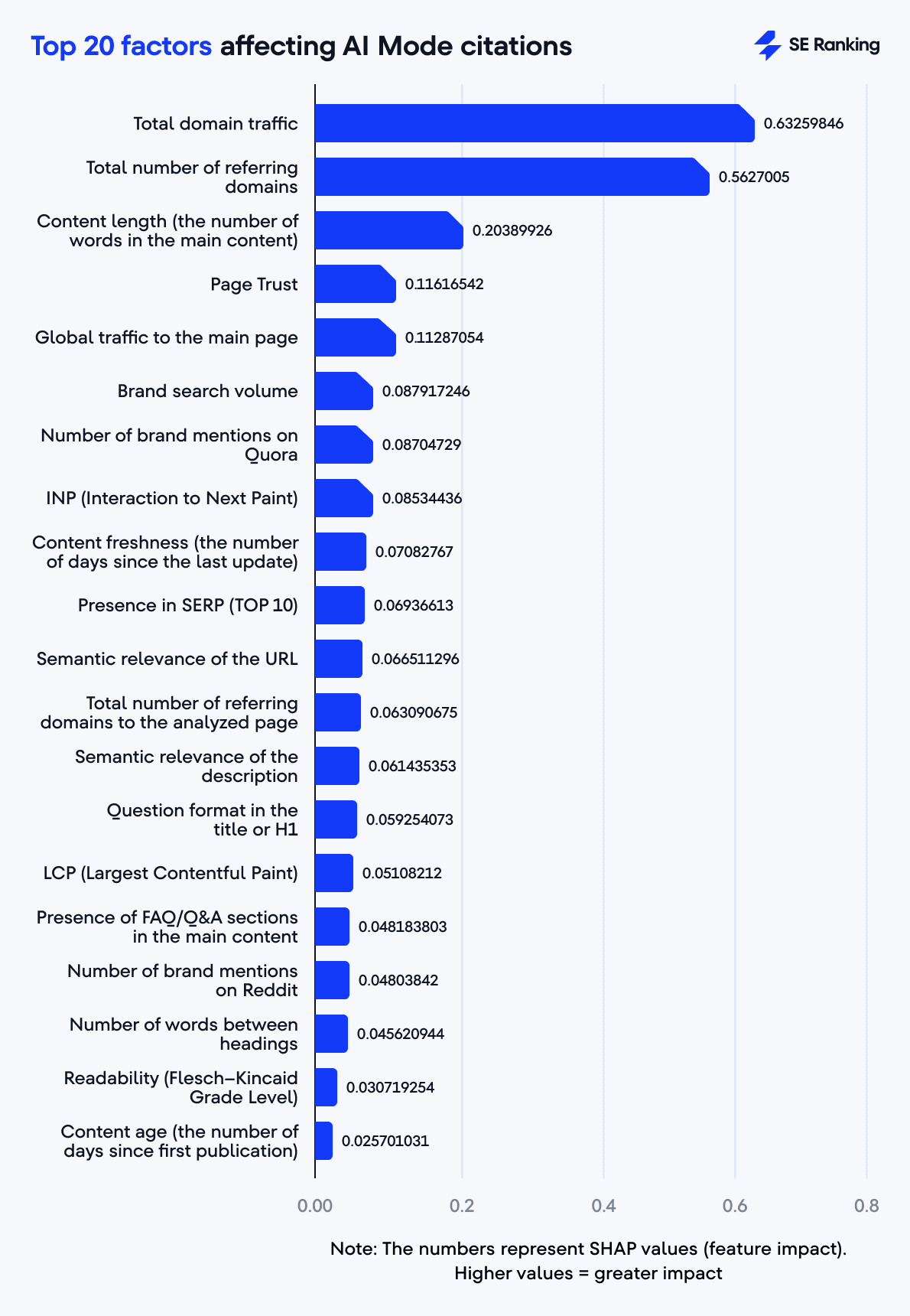
As you can see, overall domain traffic from regular Google organic is the biggest factor influencing AI Mode citations. In simple terms, websites that attract more visitors from organic channel tend to get cited more often by AI systems.
Right behind that is the number of referring domains, meaning that when lots of other sites link to you, it boosts your credibility and visibility. Next comes content length and Page Trust. AI systems seem to prefer comprehensive pages that cover a topic thoroughly and are backed by a rich set of trusted referring domains.
We also see that brand strength matters: global traffic to the main page and brand search volume suggest that the more popular or recognized a brand is, the more likely it is to be referenced by AI.
Interestingly, having a presence on social platforms like Quora and Reddit also helps. It shows that a brand is part of public conversations (something AI models pick up on as a sign of credibility and engagement).
On the technical side, factors like INP and LCP, which measure how fast and smoothly a page loads, also have an effect. Good site performance supports better visibility and accessibility, which can increase the chance of citations.
And finally, fresh, readable, well-structured content rounds out the list, which confirms that AI favors updated, clear, and comprehensive pages.
Comparing AI Mode vs. ChatGPT citation factors
While AI Mode and ChatGPT both rely on a mix of authority, content quality, technical performance, and social signals, the relative importance of these factors differs:
AI Mode weight (SHAP values)
0.63
ChatGPT weight (SHAP values)
0.62
Key differences
Both matter, slightly more important for AI Mode
AI Mode weight (SHAP values)
0.56
ChatGPT weight (SHAP values)
1.21
Key differences
Dominant for ChatGPT, secondary for AI Mode
AI Mode weight (SHAP values)
0.20
ChatGPT weight (SHAP values)
0.06
Key differences
AI Mode favors longer content more
AI Mode weight (SHAP values)
0.12
ChatGPT weight (SHAP values)
0.15
Key differences
ChatGPT weighs trust slightly higher
AI Mode weight (SHAP values)
0.06–0.07
ChatGPT weight (SHAP values)
0.018
Key differences
AI Mode emphasizes semantic relevance more
AI Mode weight (SHAP values)
0.11–0.09
ChatGPT weight (SHAP values)
0.13–0.14
Key differences
Both matter, AI Mode slightly more on recognition, ChatGPT more on traffic
AI Mode weight (SHAP values)
INP 0.085, LCP 0.051
ChatGPT weight (SHAP values)
INP 0.199, FCP 0.066, LCP 0.064, Speed Index 0.025
Key differences
ChatGPT uses broader technical metrics
AI Mode weight (SHAP values)
0.087, 0.048
ChatGPT weight (SHAP values)
0.085, 0.033
Key differences
AI Mode slightly more influenced by social presence
AI Mode weight (SHAP values)
0.071, 0.026
ChatGPT weight (SHAP values)
0.018
Key differences
AI Mode favors more recently updated content
0.63
0.62
Both matter, slightly more important for AI Mode
0.56
1.21
Dominant for ChatGPT, secondary for AI Mode
0.20
0.06
AI Mode favors longer content more
0.12
0.15
ChatGPT weighs trust slightly higher
0.06–0.07
0.018
AI Mode emphasizes semantic relevance more
0.11–0.09
0.13–0.14
Both matter, AI Mode slightly more on recognition, ChatGPT more on traffic
INP 0.085, LCP 0.051
INP 0.199, FCP 0.066, LCP 0.064, Speed Index 0.025
ChatGPT uses broader technical metrics
0.087, 0.048
0.085, 0.033
AI Mode slightly more influenced by social presence
0.071, 0.026
0.018
AI Mode favors more recently updated content
AI Mode leans more heavily on domain traffic, brand recognition, and semantic relevance, while ChatGPT prioritizes referring domains, domain trust, and overall authority. Both value technical performance and structured, readable content, but AI Mode seems to incorporate public engagement signals (Quora, Reddit) more strongly.
Key tactics to improve your AI Mode visibility
Now that we know which factors have the biggest impact on AI Mode citations, let’s outline some key best practices for brands that want to improve their visibility and rankings within this AI system.
Disclaimer: The research shows that AI Mode citations are driven by several intertwined factors. This is why focusing too heavily on one while ignoring the others can weaken your chances of being chosen as a source in AI answers.
- To analyze these patterns, we use the number of times a domain was cited as our target variable. Since citation counts vary widely (some sites get just 1 citation, while others receive thousands), we apply a logarithmic transformation. The log transformation helps the model better detect patterns across this broad range.
- So, when mentioning that, for example, “citations increased from 1.6 to 8,” we are referring to log-transformed values. In reality, this corresponds to exponential growth in actual citation counts (from roughly 5 citations to over 3,000).
- At the same time, this analysis does not account for query fan-out (the extent to which an initial query expands into related sub-queries), which may limit the completeness of our results.
Boost your visibility in Google search
If there’s one thing that really grabs AI Mode’s attention, it’s how much traffic from Google your site already gets.
Our analysis found that sites with under 2,700 visitors usually earn about 2.4 citations, while the giants pulling in over 1.16 million visitors reach 6.4 citations. That means high-traffic domains are almost 3 times more likely to be cited.
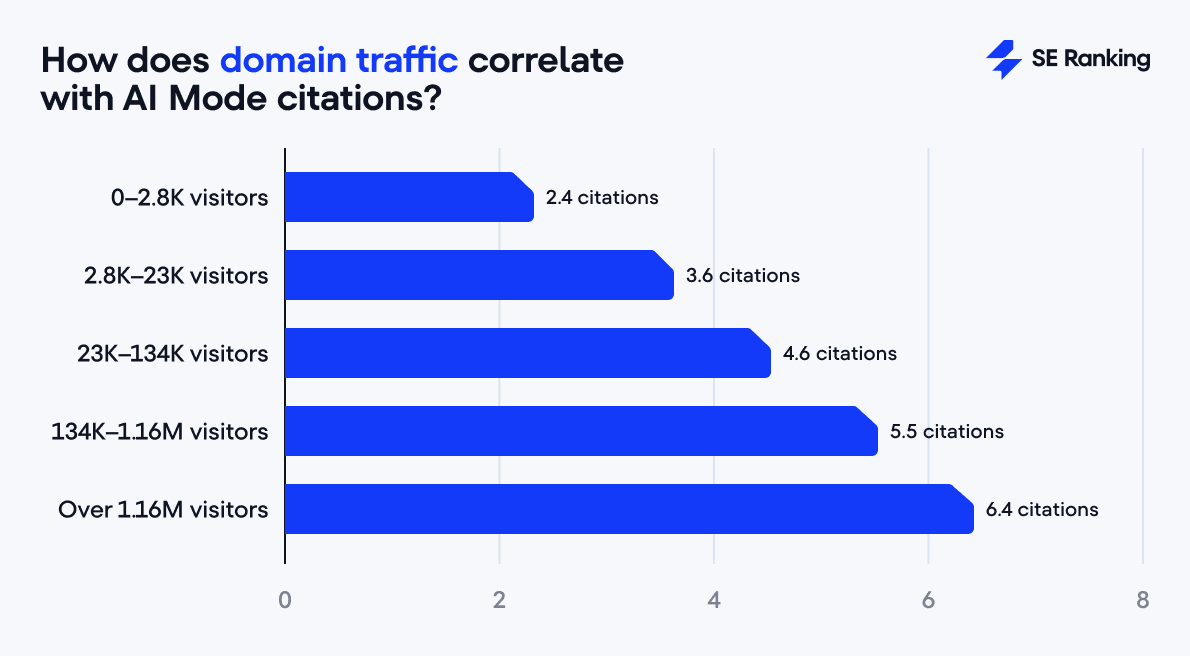
Each subsequent traffic level roughly adds one extra citation, which makes traffic one of the most reliable and consistent factors for boosting AI Mode citations.
Global traffic to your main page matters, too. Sites with very low traffic (up to 10 visitors) average about 3.6 citations, while high-traffic leaders (over 1,500 visitors) reach around 6.5 citations. This shows that traffic to key pages (including homepage traffic, which typically reflects brand strength) plays a significant role in increasing AI Mode citations.
But traffic alone isn’t the whole story. Another key factor is how well your pages rank in Google’s top 10 organic search results.
We decided to test this after noticing in our previous AIM study that the overlap between sources cited by AI Mode and Google’s top 10 results was much higher than the overlap with, let’s say, the top 20. This led us to hypothesize that pages ranking higher in Google have a better chance of being cited by AI Mode.
The concept of query fan-out makes this even more logical. Pages that consistently rank in the top 10 tend to appear across more different variations of the same query, which increases their overall visibility. Naturally, this gives them a better chance of being picked up and cited by systems like AI Mode.
Our research supports this idea by showing a noticeable correlation: pages that already perform well in Google’s top 10 positions tend to have a higher chance of being referenced by AI Mode.
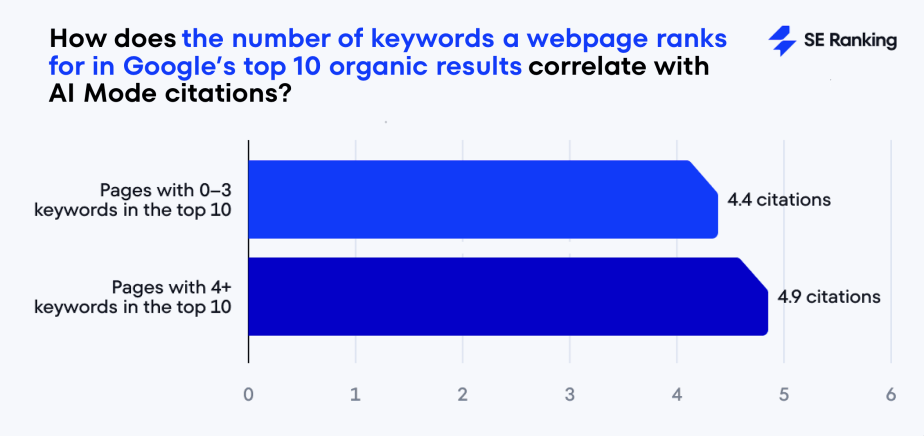
What this means in practice is that SEO and AI search optimization don’t need to be separate efforts. By focusing on improving your organic search rankings (through keyword targeting, content structure, internal linking, and backlink building) you also increase the likelihood of being cited by AI Mode.
Essentially, the more visible and authoritative your site is in Google search, the more likely AI Mode will notice and reference it.
Strengthen your domain and page authority
Backlinks are the second most impactful factor for AI Mode citations.
Our analysis shows that domains with fewer than 300 referring domains average about 2.5 citations, while highly linked websites with over 24,000 referring domains reach 6.8 citations.
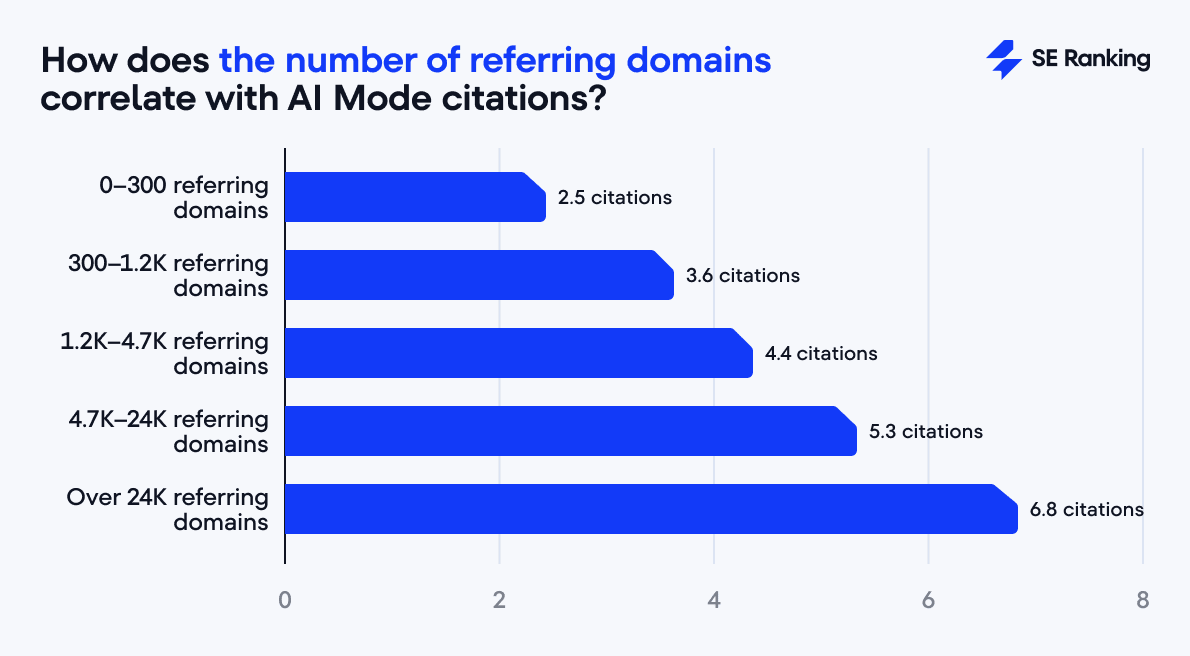
It’s safe to say that AI Mode treats links from diverse, trustworthy domains as a signal of credibility. Still, it’s not just about the total number of links but about the breadth and quality of the connections pointing to your domain. More referring domains generally mean more independent validation that your content is trustworthy and valuable.
At the same time, domain-level authority isn’t the only path to gaining citations. Page-level trust offers a way to boost visibility even on smaller domains.
In fact, pages scoring with a low Page Trust (up to 7) average 2.7 citations, while highly trusted pages (score of 24 or higher) hit 6.2 citations on average.
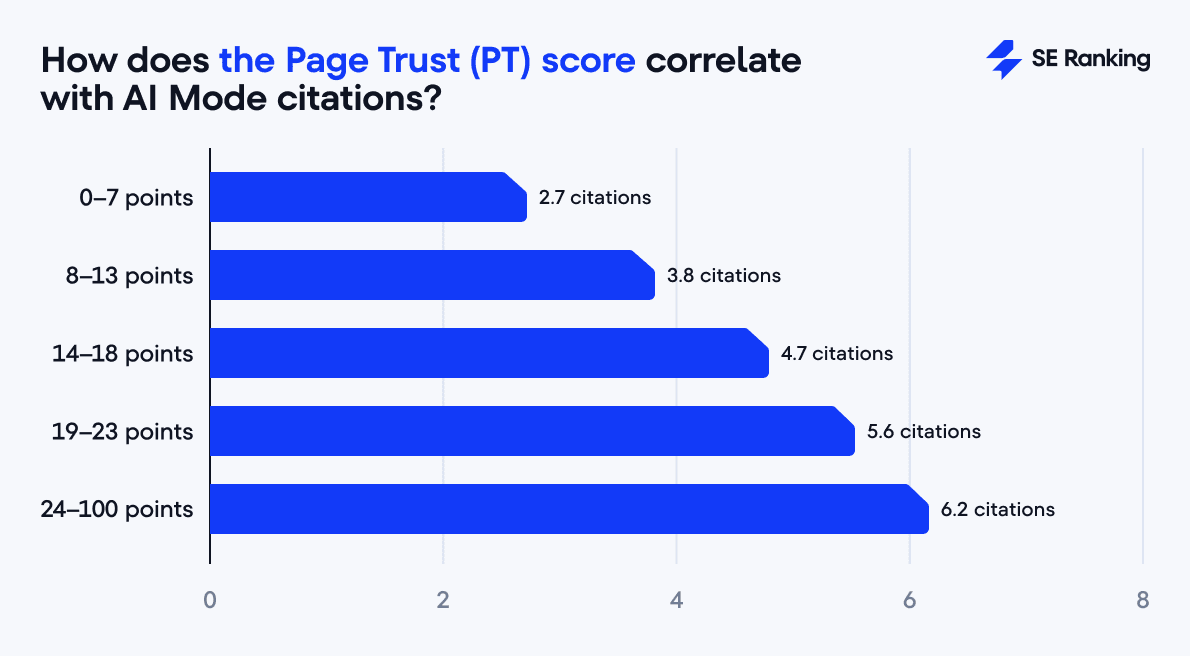
Although any rise in PT score is associated with improved citation probability in AI Mode, the critical threshold is around 19–23 points. Beyond this point, pages tend to have the highest chances of being cited by AI Mode.
To sum it all up, building strong backlinks at both the domain and page level (through quantity, quality, and trustworthiness) contributes to your site’s authority and maximizes your chances of being cited by AI Mode.
Increase brand search volume
Brand search volume is another strong signal of authority for AI Mode. In general, the more people search for your brand, the higher the chances your content will be cited.
- The lowest number of brand searches (0–10) leads to around 3.5 citations.
- Over 240,000 searches hit about 5.3 citations.
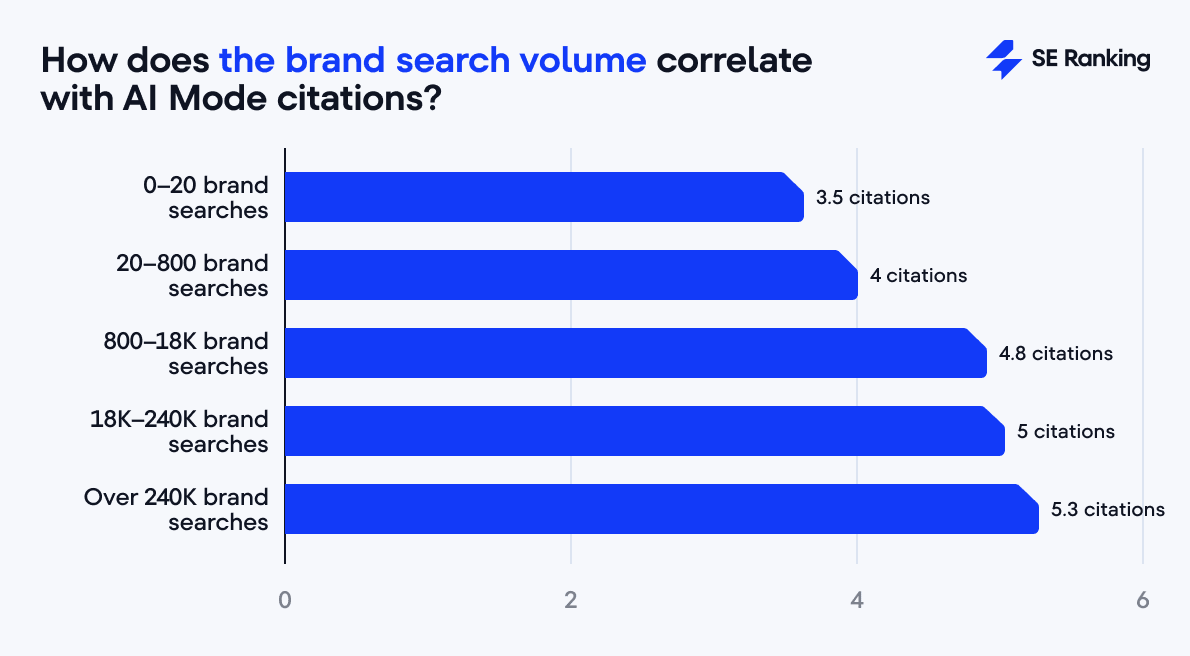
However, there’s an interesting nuance: extremely high brand search volumes (over 240,000 queries) don’t necessarily give extra credit on their own. While these pages often have the highest number of citations, it’s usually other factors (like backlinks, traffic, and content quality) driving that success, not just the huge brand search numbers.
In short, growing your brand’s search visibility helps, but it works best in combination with solid SEO foundations rather than relying on brand recognition alone.
Build a strong presence on Quora and Reddit
Social visibility matters more than you might think when it comes to AI Mode citations. The model treats mentions and activity on platforms like Quora and Reddit as signals of expertise and authority.
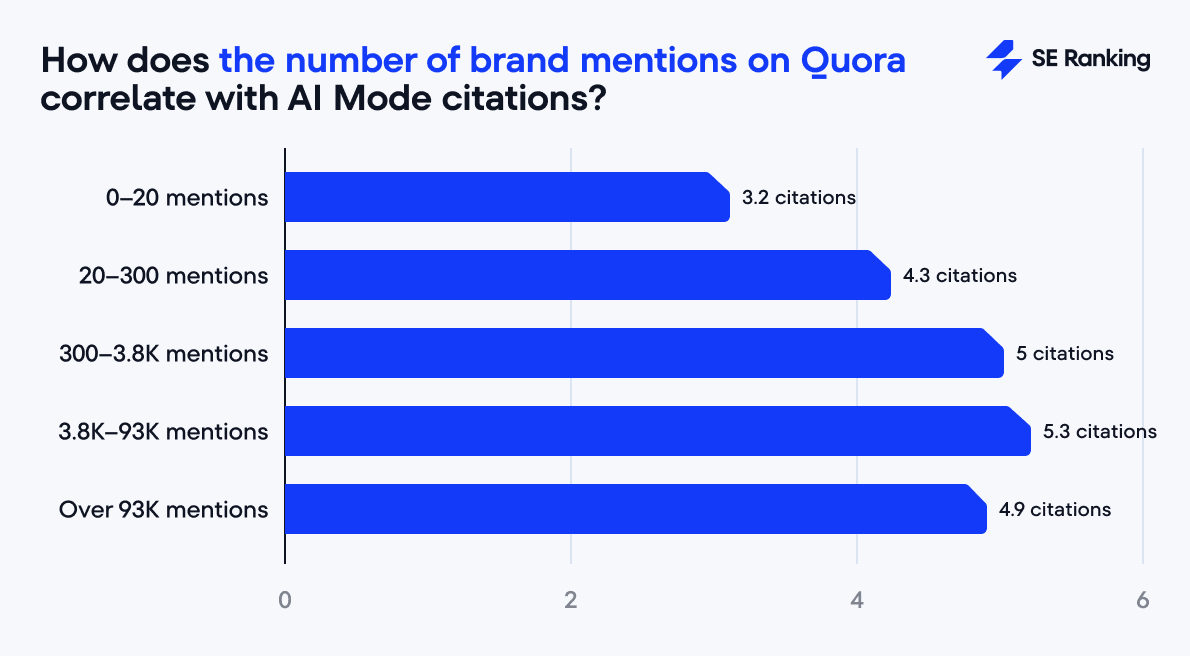
Quora:
- Minimal mentions (<20) → 3.2 citations
- Optimal mentions (>3,800-93,000) → 5.3 citations
- Excessive mentions (>93,000) → slight drop to 4.9 citations
Reddit:
- Minimal mentions (<200) → 3.1 citations
- Optimal mentions (35,000–718,000) → 5.5 citations
- Excessive mentions (>718,000) → slight drop to 4.9 citations
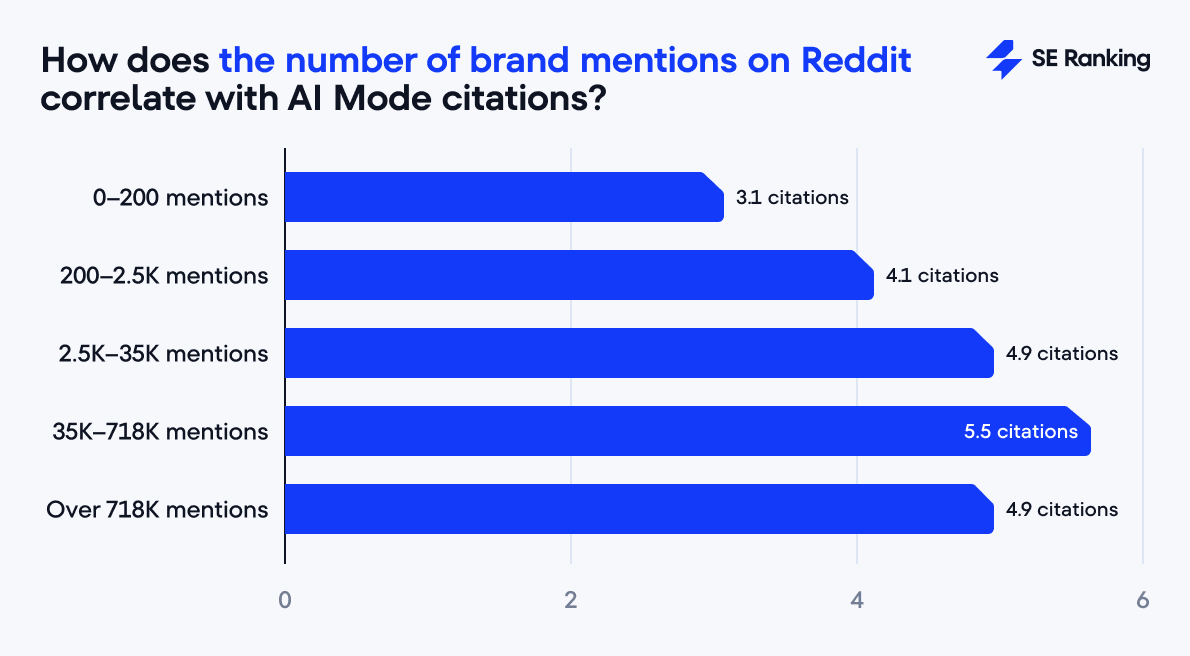
As you can see, too few mentions don’t help much, but too many can actually backfire a little. The sweet spot is somewhere in the middle (enough visibility to signal relevance, without appearing excessive).
So, every genuine interaction (whether it’s a detailed Quora answer or a Reddit comment) adds to your brand’s reputation. Over time, these social signals can subtly but meaningfully boost your chances of being cited by AI Mode.
Create in-depth content (1,500+ words)
Content length might seem like a simple metric, but it’s surprisingly influential for AI Mode. The model rewards pages that thoroughly explore a topic.
Short articles under 500 words earn roughly 4.1 citations, while long-form content exceeding 2,300 words reaches 5.1 citations. That’s a noticeable boost simply from covering your topic more thoroughly.
Here’s the breakdown:
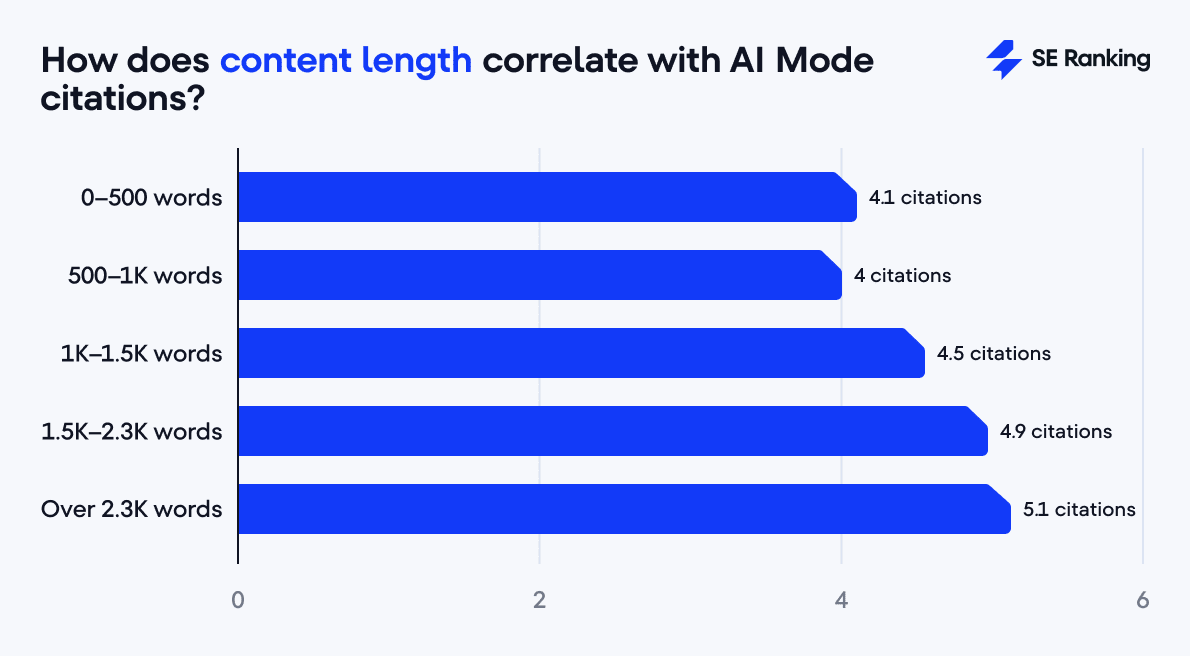
The sweet spot is around 1,500 words. Beyond this, content tends to cover multiple subtopics and provide comprehensive answers, which AI Mode sees as more authoritative.
For smaller domains, this is particularly useful. The thing is, long, detailed content can partially compensate for weaker traffic or fewer backlinks.
Maintain content freshness with regular updates
Apart from in-depth, comprehensive content, AI Mode also rewards fresh, regularly updated pages.
Particularly, our research shows that articles updated within the past two months average 5.0 citations, while content untouched for over two years drops to 3.9.
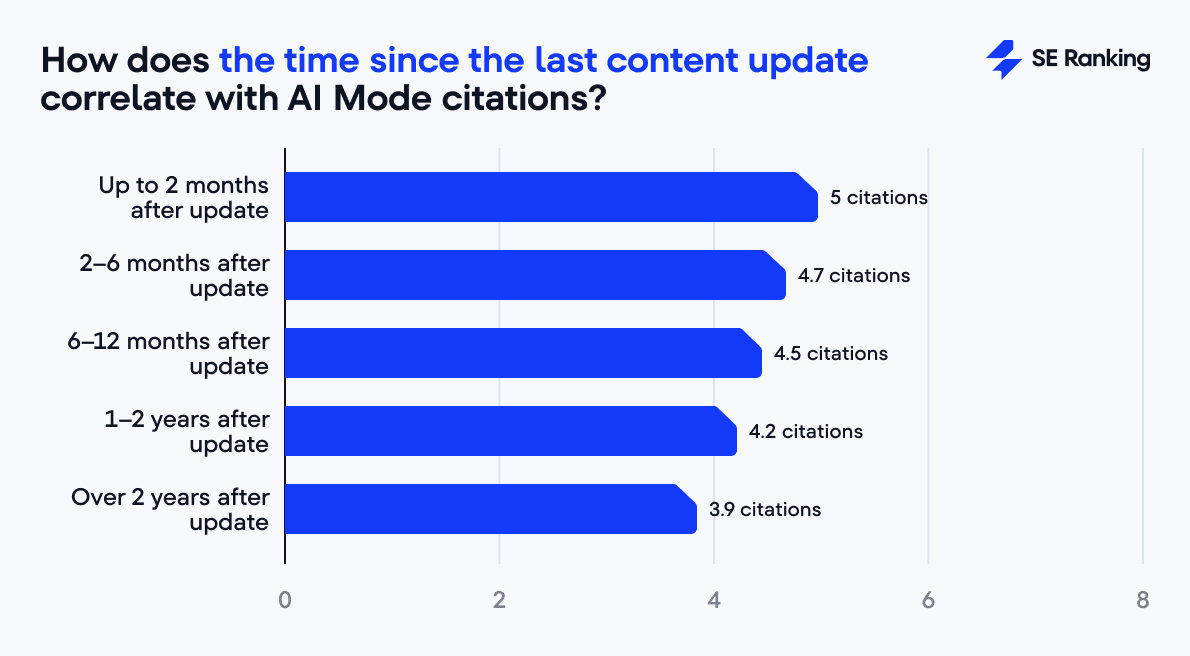
Even older articles can get a second wind if you add new insights, statistics, or expand sections with more details. The model interprets these updates as a signal of relevance and information currency. So, make sure to perform regular content audits and update key pages every 2–3 months.
Structure content for topical clarity
AI Mode likes content that’s organized and easy to parse. To increase your chances of being cited by this system, each section’s length (the number of words between headings) should stay within an optimal range.
Based on our findings, very short content sections between headings (up to 35 words) tend to earn only about 4.3 citations, likely because they don’t give AI Mode enough context to fully understand the topic. The sweet spot is 100–150 words per section, which boosts citations to around 4.7.
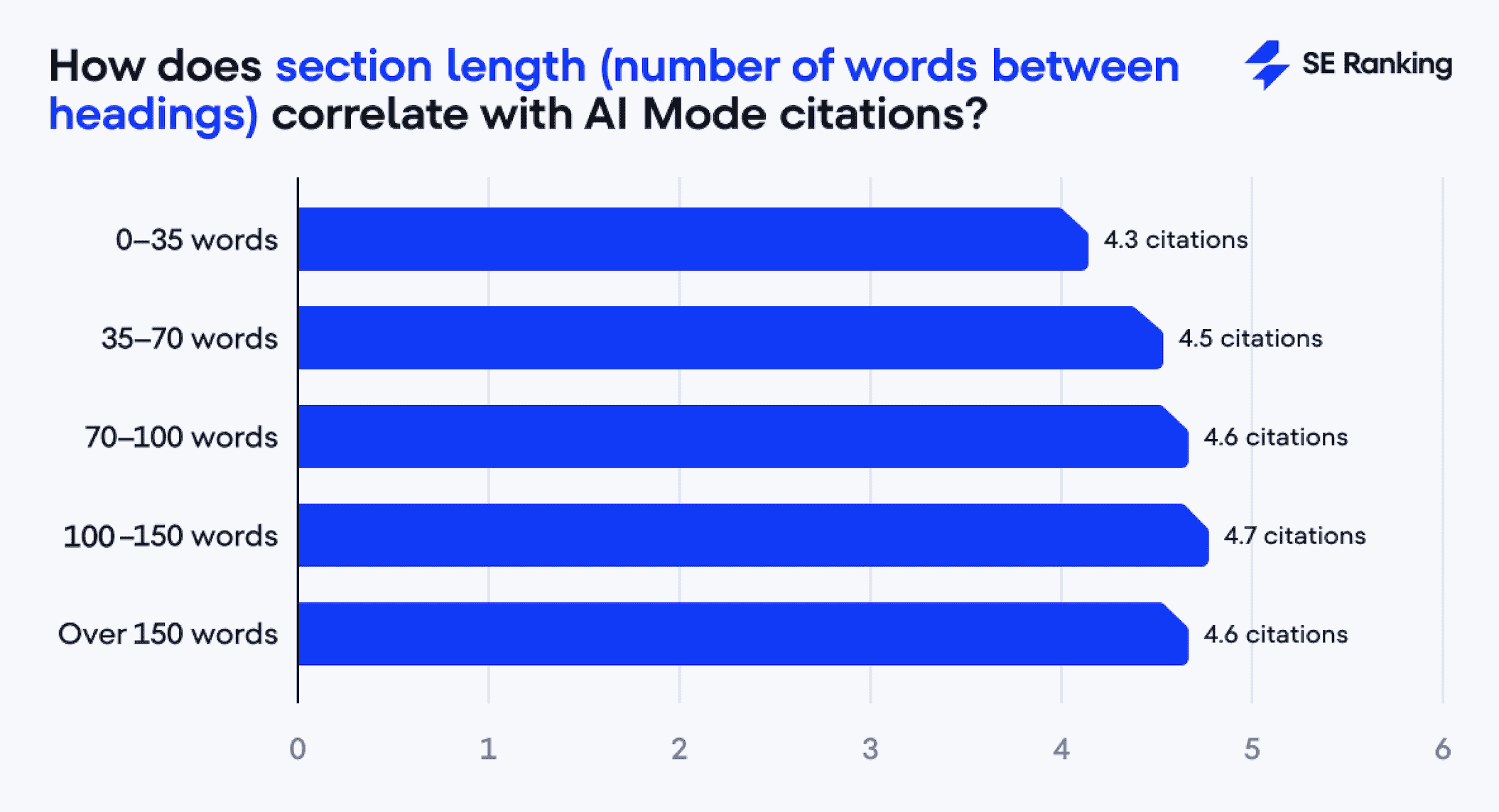
Interestingly, sections that are too long (over 150 words) see a slight drop back to 4.6 citations, probably because overly dense blocks make it harder for the model to parse the content efficiently.
So, this is what you need to do to get higher probability of AI Mode citations:
- Cover all the relevant subtopics within your article
- Use meaningful subheadings to separate subtopics
- Keep sections neither too short nor too long (70-150 words)
- Finally, include bullet points or numbered lists for complex information
Add FAQ sections and question-formatted titles
Some SEO and content experts recommend adding FAQ sections, as they make it easier for AI models like AI Mode to identify clear answers and potentially cite your content.
To see if this really matters, we looked for typical patterns that signal FAQ content (headings such as “FAQ,” “Frequently Asked Questions,” “Q&A,” “Questions and Answers,” “Common Questions,” and “Popular Questions”).
We didn’t stop there. We also checked pages with question-style titles or headings, since these often provide direct, concise answers that both readers and AI love. For this part of the analysis, we focused on both the page title and the H1 heading to see how AI Mode responds to content framed as a question.
And our findings clearly show that both FAQ sections featured within the main content and question-formatted headings can help you increase AI Mode citations.
- Pages with FAQ sections featured within their content receive 4.9 citations on average, versus 4.4 for pages without.
- Pages that phrase titles or H1 headings as questions average 4.6 citations, compared to 4.5 for pages without.
The best part is that this approach works for both small and large domains. Unlike backlinks or traffic, it doesn’t require extensive resources. Anyone can implement it with minimal effort and see a measurable improvement in AI Mode citations.
When it comes to FAQ schema markup, we didn’t see any meaningful impact on AI Mode citations. Its effect is actually about three times weaker than simply having real FAQ sections in your content. So, it seems like AI Mode cares about the content itself. It values structured answers that show you’re providing comprehensive information, not just technical metadata.
If you have the resources to add schema markup, it’s still worth doing for Google and other search engines where it clearly helps. But don’t rely on it to boost AI Mode citations. Your focus should be on creating high-quality content and FAQ sections with genuinely useful answers.
We’ve also looked at how other types of schema affect AI Mode rankings, so stay tuned to our blog for insights from our upcoming research.
Use clear, semantically relevant URLs and meta descriptions
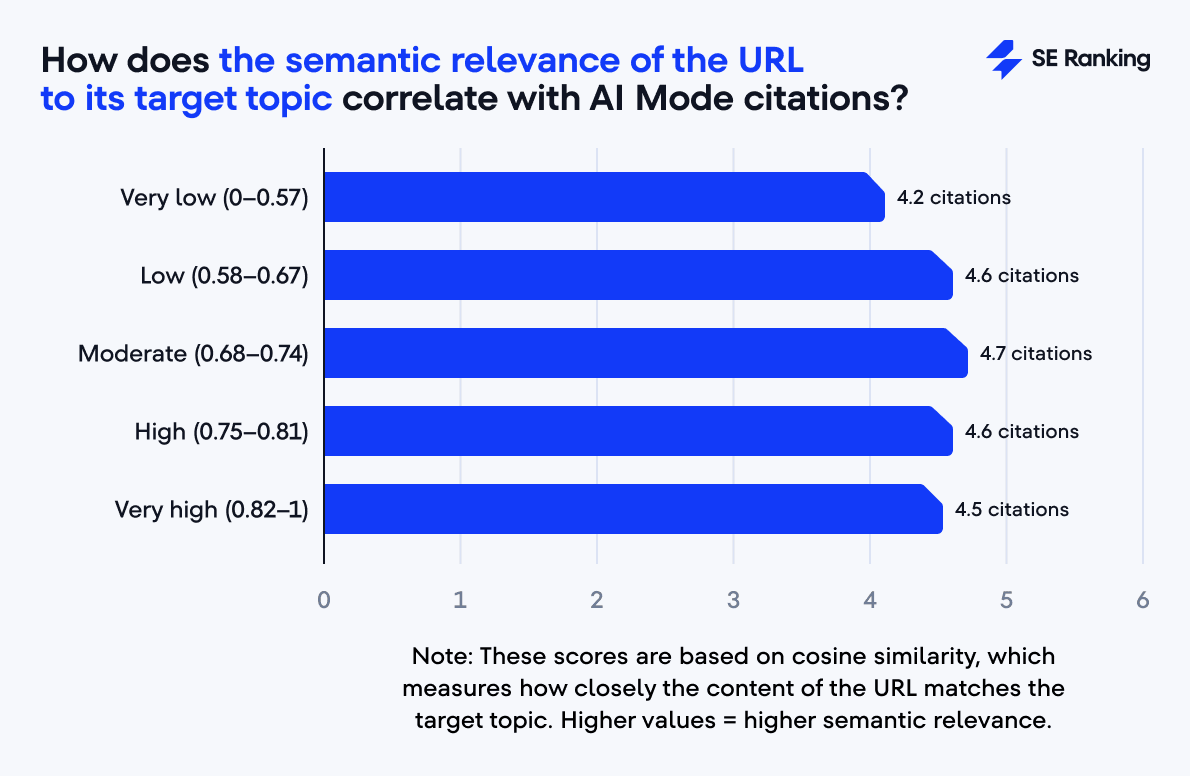
Now, for this part of our research, we decided to calculate the cosine similarity between the query (keyword) and the actual URL and meta description. This is because we wanted to see whether higher semantic alignment increases the likelihood of being cited by AI Mode.
And in general, our analysis shows that semantic relevance of URLs and meta descriptions plays a subtle but important role.
Let’s start with URLs.
Pages with broad, descriptive URLs covering the topic naturally get more citations. Too generic or too tightly focused URLs? They can actually underperform.
Now, meta descriptions. Here, the pattern is more straightforward: the better your description matches the topic, the higher your citations. Low-relevance descriptions (0.00–0.48) land 4.1 citations, while higher ranges steadily climb:
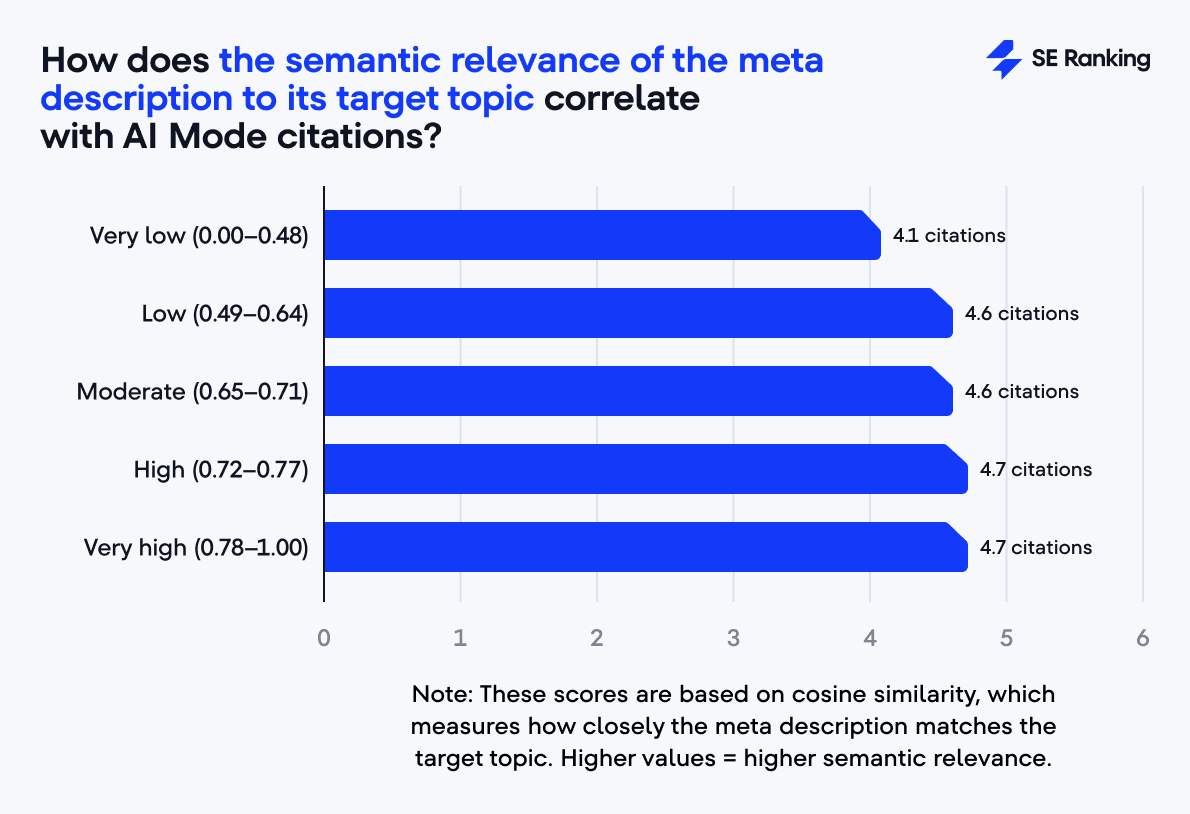
To sum it up, make URLs and meta descriptions clear, descriptive, and relevant to the topic as a whole. This helps AI Mode understand your content and boosts your chance of being cited.
Enhance text readability (Flesch-Kincaid level)
Finally, the last content-related factor that plays a subtle yet still meaningful role for AI Mode citations is text readability. Our research shows that AI Mode favors content that’s easy to understand but still informative (not too simplistic, yet not overly complex).
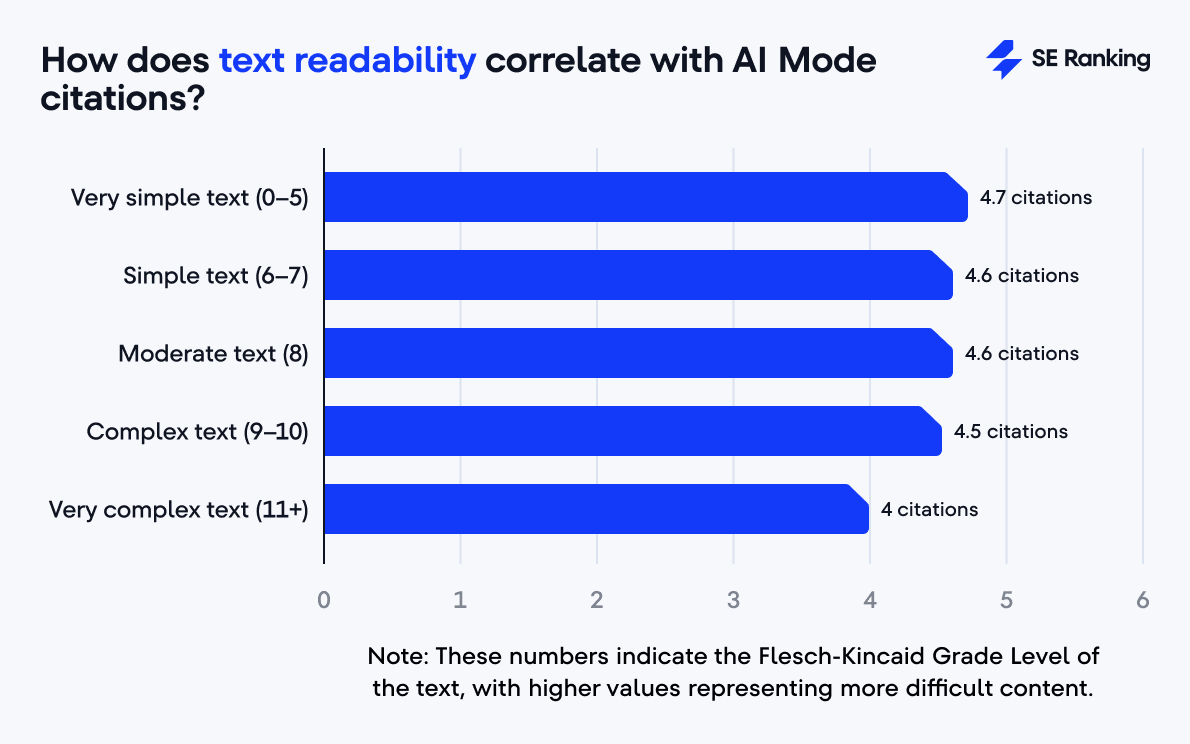
This tells us that writing clearly pays off. Highly technical jargon or long, convoluted sentences can actually reduce your chances of being cited, even if the content is accurate. Striking the right balance (accessible but authoritative) is key for boosting AI Mode visibility.
Optimize Core Web Vitals (INP, LCP)
Technical performance might not be as influential as domain authority or content quality, but it still matters for AI Mode citations. Let’s break down the two key metrics.
Interaction to Next Paint (INP):
- Very fast pages (up to 0.43s) → 2.8 citations
- Moderate speed pages (0.59–1.07s) → 4.8–5.3 citations
- Slower pages (>1.08s) → 5.6 citations
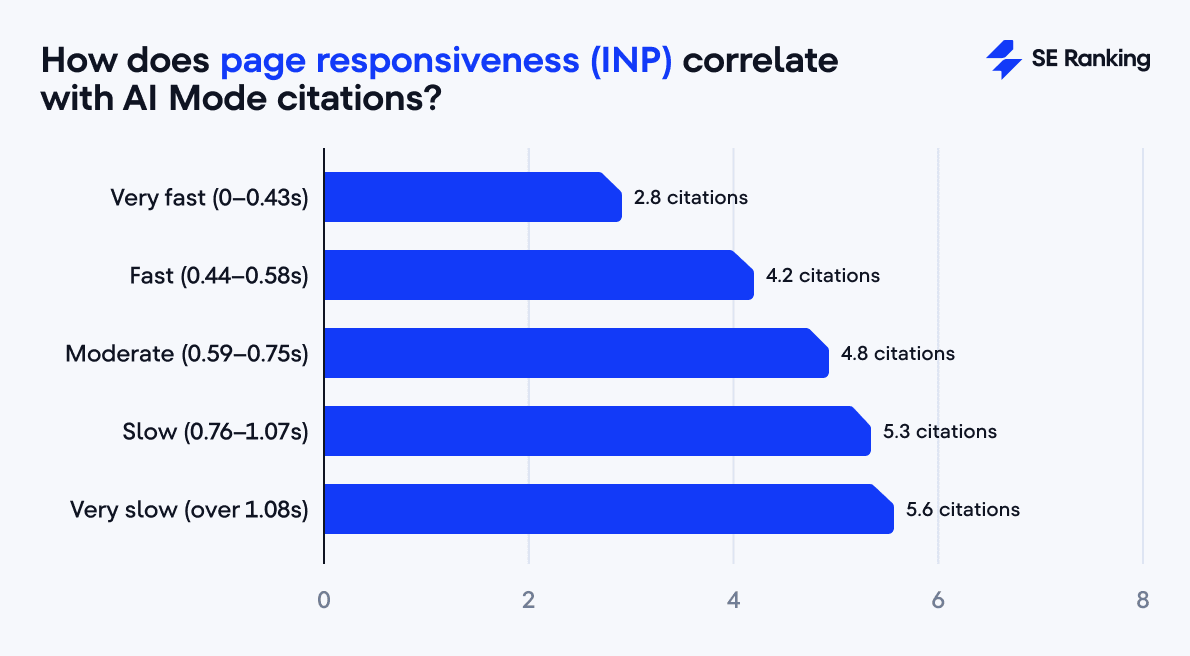
Interestingly, pages with slightly higher INP (meaning more interactive or complex content) tend to get cited more. Super-fast pages sometimes indicate very simple, static content, which the model may not see as authoritative.
Largest Contentful Paint (LCP):
- Fast-loading pages (0.2–1.02s) → 4.9 citations
- Very slow pages (>2.65s) → 4.4 citations
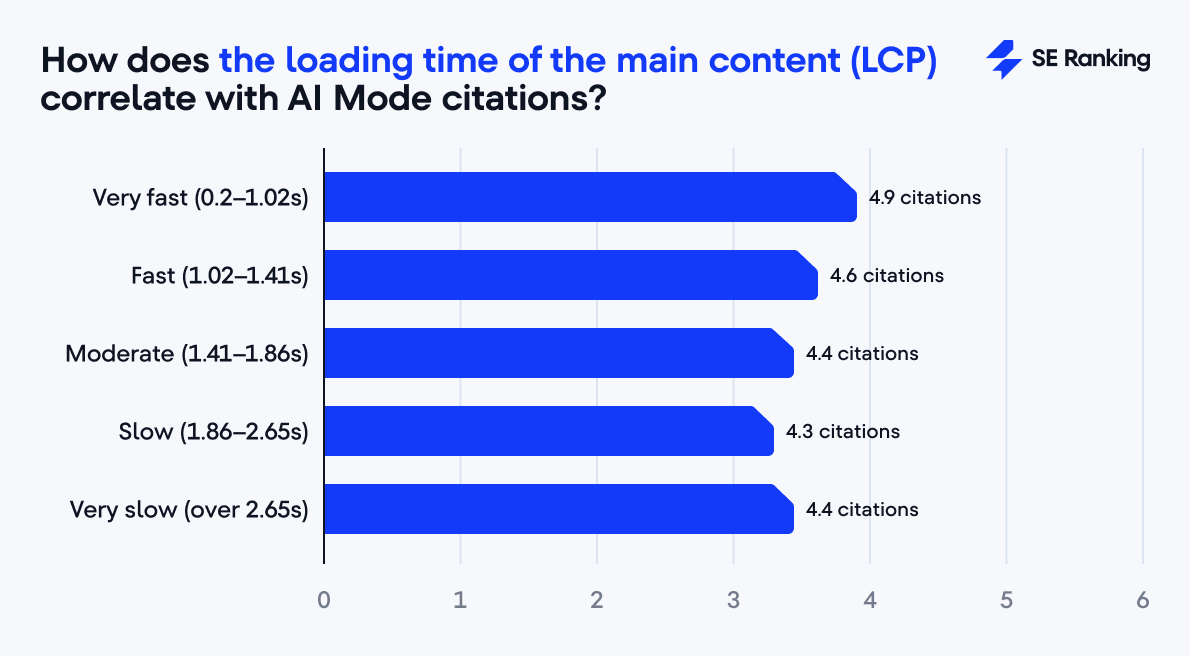
Unlike INP, LCP shows a more straightforward trend: the faster the main content loads, the better for citations. Extremely slow pages hurt visibility, so avoiding load times above 1.85s is important.
Other technical metrics: CLS, TBT, Speed Index, FCP, and TTFB
Now, let’s talk about some of the other technical metrics. On their own, metrics like Cumulative Layout Shift (CLS), Total Blocking Time (TBT), Speed Index, First Contentful Paint (FCP), and Time to First Byte (TTFB) are outside the top 20 in influence. So, individually, their impact is modest. But that doesn’t mean you can ignore them.
Together, they shape the overall technical impression of your site. For example, optimal TBT consistently grows citations from 4 to 5.2. CLS shows a similar effect, with citations rising up to 4.5 at best values. Speed Index also works predictably: from 4.7 citations at 201 – 1088 ms to 4.5 at over 2673 ms.
Once you’ve optimized your main factors, working on TBT, CLS, and Speed Index can give your site an extra boost. These metrics collectively signal a technically solid website, which can help move a domain to the next level.
For sites with lower authority, improving technical performance across all these metrics can partially compensate and increase citations.
Research methodology
The goal behind this research study was to examine the factors that affect whether AI Mode uses websites as sources in its responses.
For this research, we analyzed 2,328,533 pages from 295,485 unique domains across 20 distinct niches to ensure both diversity and representativeness.
For each domain, we collected extensive data covering several categories:
- Domain authority and credibility: Metrics included the number of referring domains, Domain Trust and Page Trust scores, the presence of trusted domains (such as .gov or .edu), keyword-domain alignment, media mentions, and the authoritativeness of external links.
- Brand visibility and social footprint: We tracked mentions of brands on platforms like Reddit and Quora, global and U.S. search volumes for the brand, presence on review platforms, and average review ratings.
- Content quality and semantic relevance: Factors included semantic relevance across various content segments (first 100 characters, first paragraph, first three paragraphs, full text, meta title, meta description, H1, URL, and “fraggles”), the positioning of fraggles, content type, length metrics (content, sentences, paragraphs, sections, fraggles), readability scores (Flesch Reading Ease, Flesch-Kincaid Grade Level), content freshness (initial publication and updates), and the presence of statistics, quotes, tables, lists, definitions, quick summaries (e.g., key takeaways), FAQs/Q&A sections, structured data, and question-based headings or titles.
- Technical performance: We evaluated Core Web Vitals (CLS, FCP, LCP, Speed Index, INP, TBT, TTFB, TTI), indexability checks (canonical tags, noindex), HTTP status codes, structured data, and the presence of LLMs.txt files.
- SEO visibility and traffic metrics: Metrics included domain and URL traffic (global and U.S.), main page traffic, search engine results page (SERP) positions on Google and Bing, Top-10 rankings, and average organic URL positions.
To examine how these factors relate to the likelihood of a website being cited, we used an XGBoost regression model. The dependent variable was the number of citations a domain received in AI Mode responses, based on our dataset of over 500,000 prompts. This approach allowed us to determine which factors were the strongest predictors of citation frequency.
To better understand the influence of individual factors, we applied SHAP (SHapley Additive exPlanations) analysis, a game-theory-based method that quantifies the contribution of each feature to the model’s predictions. Our findings highlight the top 20 factors ranked by their impact on citation probability.
Disclaimer: The interpretations presented here aim to be objective, but alternative analyses and perspectives may also be valid.
Conclusion
Our research shows that optimizing for AI Mode requires a triad of authority, content, and technical performance:
- Authority first – traffic, backlinks, and Page Trust.
- Content second – long, structured, readable content with FAQs and semantic alignment.
- Technical third – Core Web Vitals and general site performance.
For new domains, content and technical factors can compensate for lower authority. For established domains, authority dominates, but content quality ensures continued visibility.