How to make AI search engines mention your brand? (With data, not luck)
Are we visible in AI search? Why isn’t ChatGPT mentioning us? Do we show up in AI Overviews at all?
If you’re an in-house SEO, you’re hearing these questions from your stakeholders. If you’re on the agency side, they’re coming from clients. These are fair questions, though they’re tough to answer because building AI visibility takes time and depends on having the right data and tools.
But your stakeholders and clients need to see something now. They want proof that things are moving and early wins that show the budget and effort are worth it.
Good news: those early wins exist. And there’s a practical way to show progress while your longer-term AI search strategy develops.
I’ll walk you through a practical approach using SE Ranking’s new Sources feature inside our AI visibility tools. It’ll help you find the pages AI systems already trust and give you clear paths to getting your brand mentioned.
-
SE Ranking’s Sources feature reveals which sources AI platforms rely on. Use this information to get your brand mentioned in the right places.
-
Brand mentions matter even when your website isn’t directly cited. They increase the chances your brand gets mentioned in related prompts.
-
Sites listing your competitors are low-hanging fruit. Outreach with the right positioning to be added to roundups, comparison pages, and resource lists AI already trust.
-
Create feature-specific content on your site. AI rarely cites brand sites for general product information but might reference pages answering detailed questions about specific features.
-
AI source preferences shift over time. Track which pages get cited and monitor when your brand appears in them.
What the Sources feature shows you
AI systems pull from a network of pages they trust. You can see these sources when you run a prompt in AI Overviews, ChatGPT, and similar tools.
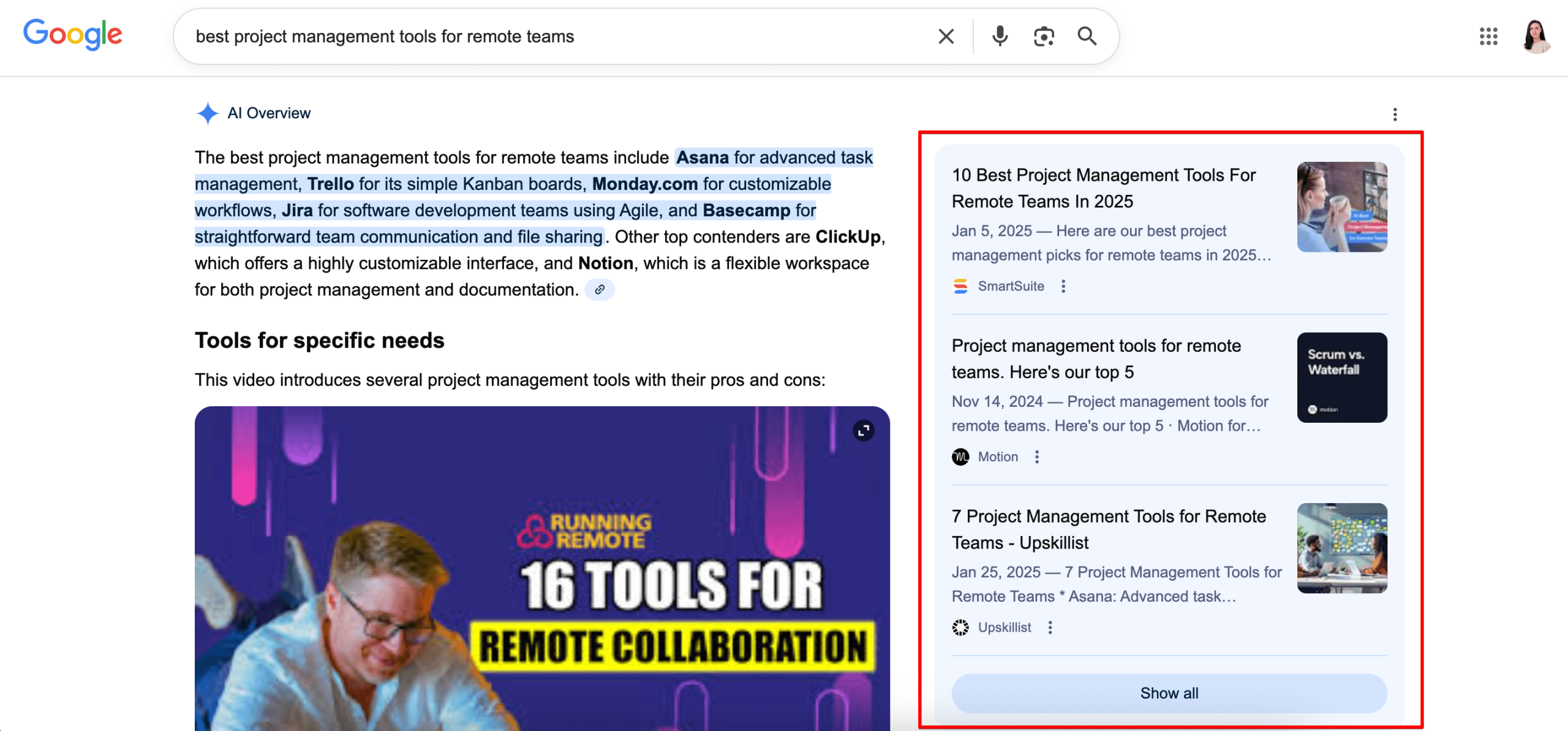
Checking whether you’re cited as a source for your target prompts manually can take days given that AI Overviews alone have 6-14 links on average. The deeper work like analyzing whether AI’s sources mention your brand anywhere in content, takes even longer. But it’s worth doing. When your brand appears in the pages AI engines trust, it’s more likely to become visible and get cited in related answers.
SE Ranking’s new Sources feature changes that.
It shows you exactly which pages and domains AI platforms are relying on when they answer the prompts you’re tracking. Think of it as a map of the AI knowledge base for your specific niche.
3 steps to see top-cited sources in AI answers
The process is super simple:
- Select the right prompts.
Not all prompts are equal when it comes to brand visibility. A query like best project management tools for remote teams naturally invites brand mentions. Something like how does agile methodology work probably doesn’t. Focus on high-stakes prompts where AI already lists brands. It’s easier to join an existing list than to be the first brand mentioned in a brand-free answer.
- Select platforms.
Choose which AI engines matter most to your audience: Google AI Overviews, AI Mode, Gemini, ChatGPT, or Perplexity. You can analyze specific ones or select all platforms.
- Set your time window.
Use a 14-30 day window to spot stable citation patterns, not just one-off mentions. AI source preferences are volatile, so tracking over weeks helps you identify sources that show up consistently over weeks. These matter way more than random citations.
And here they are, your opportunities, right at the top of the screen.
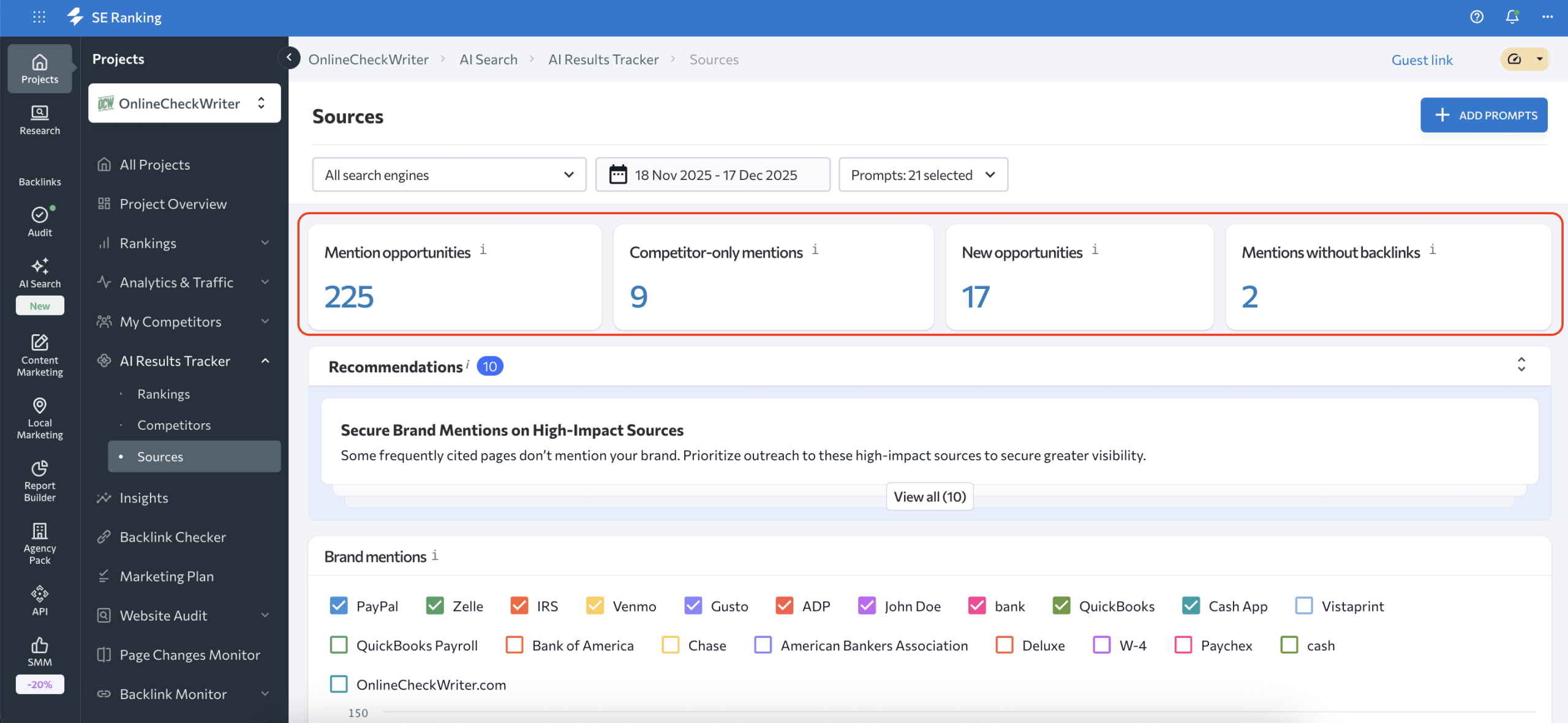
The tool immediately shows you:
- Mention opportunities: These are sources that mention other brands but not yours.
- Competitor-only mentions: These sources mention your tracked competitors, but not your brand.
- New opportunities: These are newly found sources that don’t mention your brand.
- Mentions without backlinks: These are sources that mention your brand without linking to your website.
Clicking on the numbers in will take you to the list of specific sources ranked from the most to the least important one.
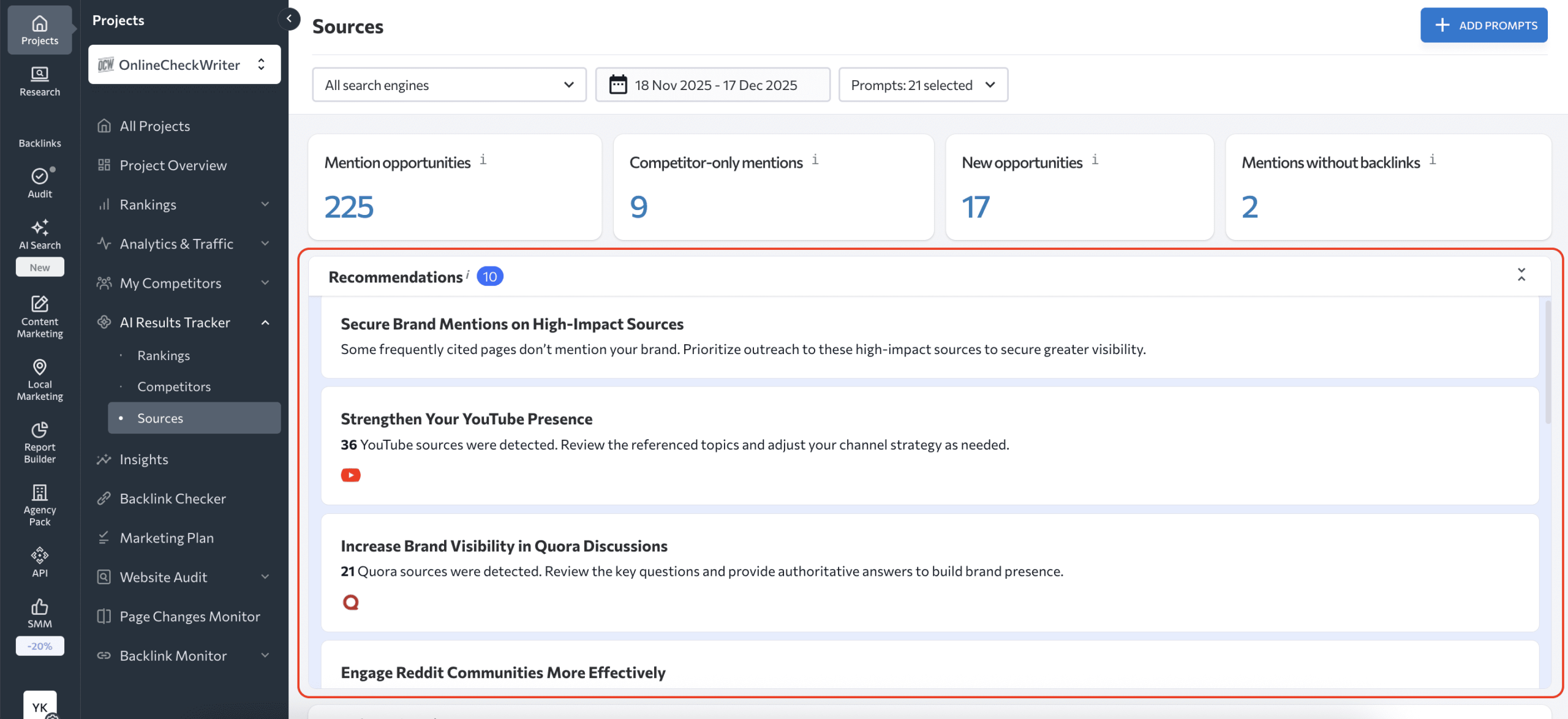
The tool also provides a list of recommendations for your specific case. It analyzes the data and highlights what you can do, like securing mentions on authoritative websites or engaging in community discussions. Click on the recommendation to see websites to focus on.
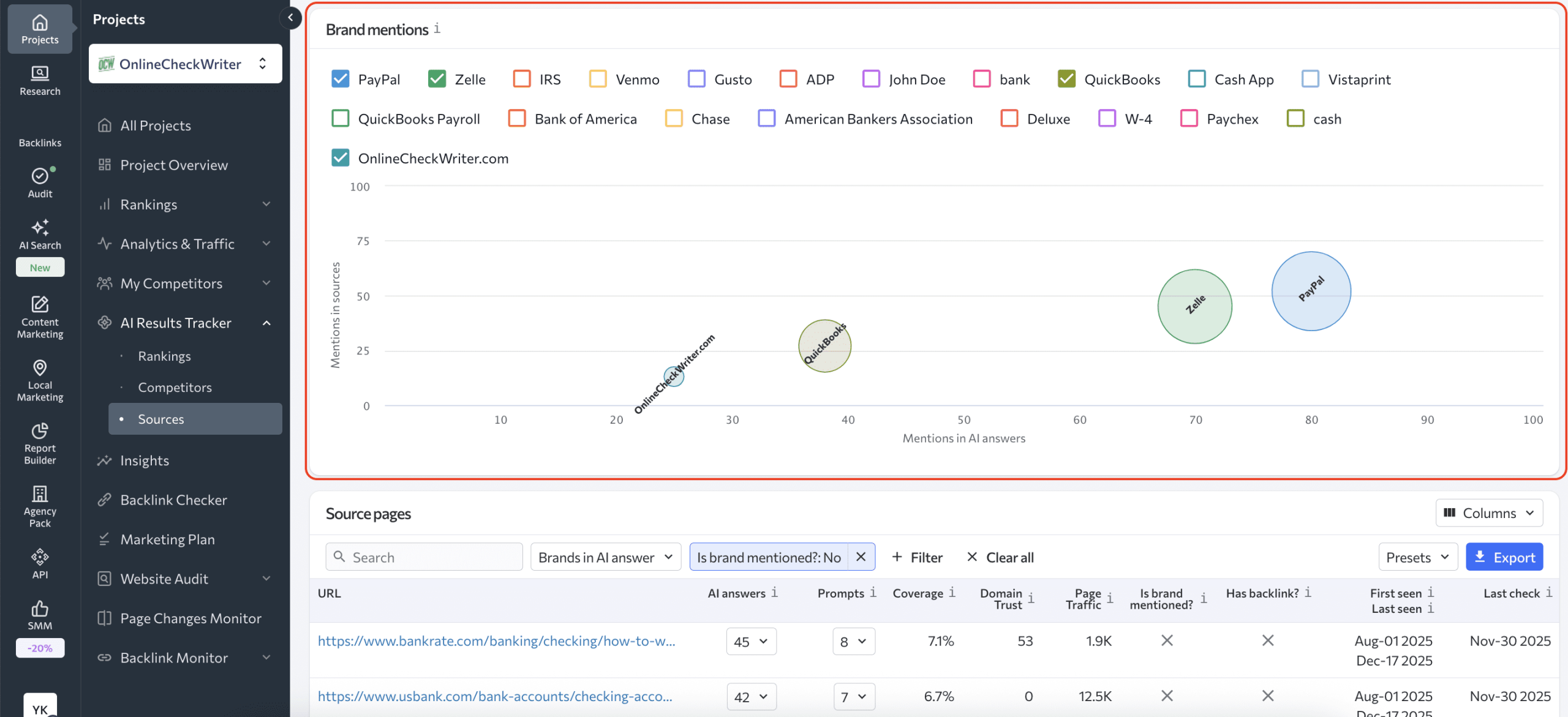
Finally, you can visualize how your brand mentions in AI sources and answers compare to your rivals. This is exactly what the bubble chart shows. Pick the competitors and your brand to see how you compare.
If you want to go deeper, there’s a whole table of sources with different filtering options. At the top of the list, you’ll see the most important sources. Each page serves as a source for several prompts on your list, and AI engines cite it consistently day after day.
Now, what’s next?
There are three main paths, and you don’t have to pick just one:
Path A: Get mentioned on existing high-performing sources
This is about earning placements on pages that AI engines already cite a lot. It’s often your fastest path to AI visibility.
Quick wins
Sites that already mention your competitors are the lowest-hanging fruit. Use the Competitor-only mentions filter from above, or apply table filters to see specific competitors.
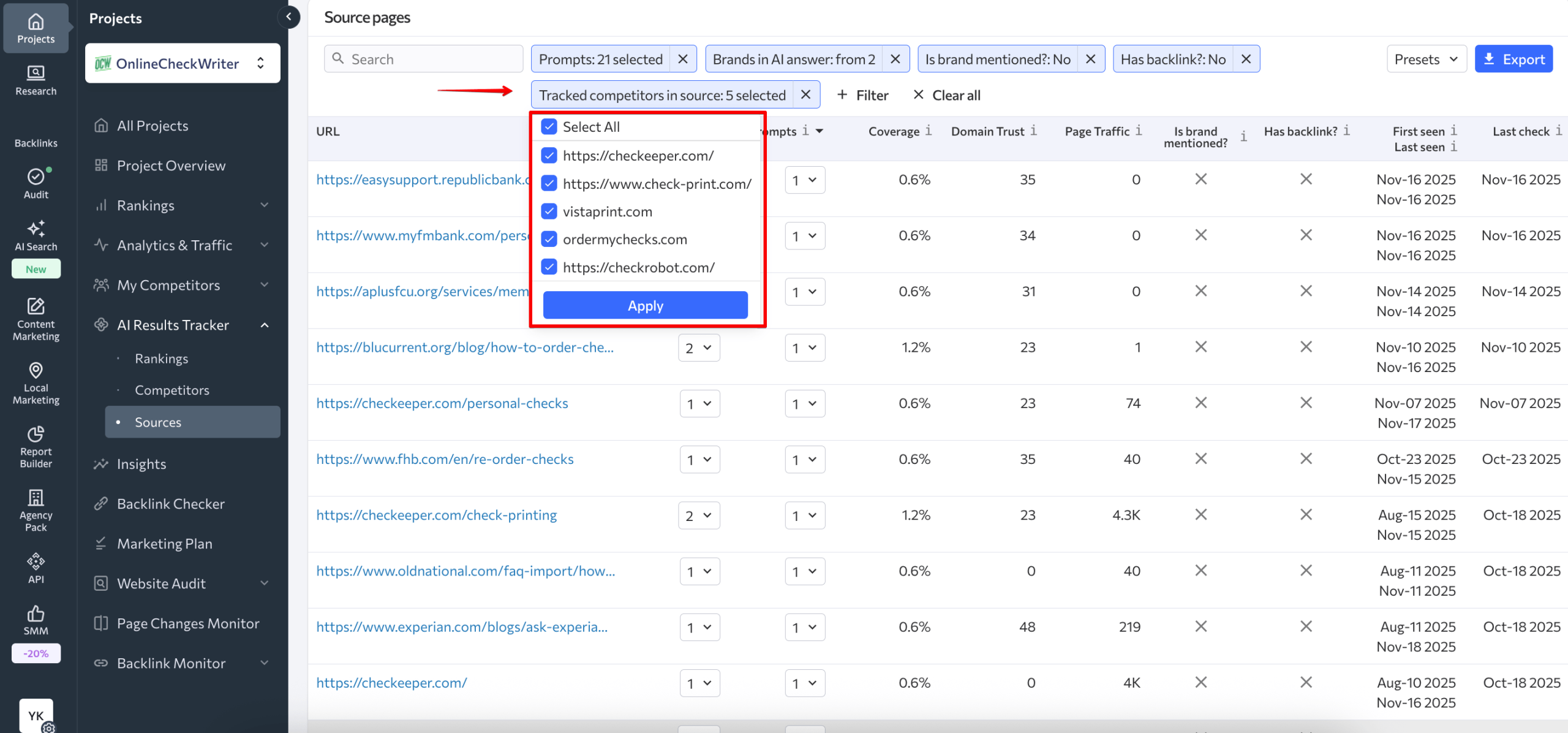
If they’re listing competitors, adding your brand is a small editorial change. Look for:
- Roundup articles (10 best [product category])
- Resource pages and link directories
- Glossary entries and definition pages
- Comparison charts and tool lists
Reach out with a compelling reason why your brand deserves inclusion alongside competitors already featured. Show you understand their content:
- Reference the specific article and why you’re reaching out (“I noticed your guide on [topic] includes [Competitor X] and [Competitor Y]…”).
- Explain what unique value your brand adds to their list (different use case, pricing tier, feature set, or audience).
- Make their job easy by providing a brief description, a relevant link, and even suggested placement text.
- Position your inclusion as keeping their resource current and comprehensive for their readers.
Partnership opportunities
You can find authoritative content creators who might want to create content about your brand. They can test your product and create a YouTube video testimonial or a LinkedIn post, which AI systems can cite.
This approach helps ensure your brand appears in the right context, so when AI engines look for tool recommendations, they find dedicated content about your product rather than just passing mentions in unrelated articles.
Path B: Make your own pages become sources
Instead of chasing mentions on other sites, this path focuses on creating content that AI engines want to cite directly. It’s a long-term strategy that usually requires many resources, so I recommend combining it with path A.
Identify content gaps: Look at topics where your brand never appears in AI answers. Use the Sources feature to reverse-engineer what AI engines cite for those topics. What angles do those pages take? What format (listicle, guide, data-driven report)? Create content built to match or exceed what AI is already citing.
Target fan-out queries. AI often decomposes one prompt into multiple smaller queries. For example, how to improve website speed may trigger image optimization techniques, CSS minification tools, server response time benchmarks, Core Web Vitals requirements, and more.
You may need content for these related queries to become eligible as a source, and that content needs to rank well organically. Our recent research supports this; for instance, pages that rank in Google’s top 10 positions for 4+ keywords have 4.9 references in AI Mode.
Create deep, comprehensive content that addresses both the main topic and related subtopics and long-tail variations. Organize your content into clear sections that semantically match the fan-out queries AI engines generate. This improves cosine similarity and makes your content easier for AI to extract and cite. Or optimize your existing content to follow this structure.
But there’s a catch.
AI systems may not always cite your website for product overviews. It may extract information about other tools from your listicles (like from the alternatives articles), but the part about your brand may come from some other site.
On your own site, it’s important to answer more specific questions about your brand and features (landing pages, blog posts, help center). For example, you want pages that can answer queries like Does [your tool] include a [specific feature]? like Does TimeTracker include a Pomodoro timer that breaks work into 25/5 intervals? These detailed, feature-specific pages help AI engines find authoritative information about your product directly from your site.
Path C: Leverage high-frequency platforms
Sometimes, the most-cited sources are UGC platforms. SE Ranking’s research studies consistently show Reddit, YouTube, and LinkedIn ranking among the top-cited domains in AI answers. If AI engines cite these platforms in your niche, become part of those platforms’ content.
- For YouTube: If video content appears in AI citations, creating videos on relevant topics puts you in the citation path. Create similar videos with a cleaner structure or updated info, include timestamps, add your brand mention in the description or visuals, and promote the video to help AI see engagement.
- For LinkedIn: If AI engines cite LinkedIn posts or articles in your space, publish thought leadership content there. LinkedIn appears frequently in business and professional AI citations.
You might also see Reddit or Quora as your top-performing sources. Even though such platforms usually ban for brand placements, you still might want to become an active community member, create threads around topics AI cites, answer questions, and establish expertise. Our recent research shows that domains with millions of brand mentions on Reddit or Quora have 4 times more chances of being cited in ChatGPT than those with minimal presence.
Local businesses should pay attention to Facebook and Instagram as AI engines cite them for location-based queries, branded searches, and local events.
The platform play works because these are high-authority, high-trust domains that AI engines already love. Building authority on your own domain takes time, so you can borrow authority from established platforms.
Which path should you take?
You can pursue all three simultaneously, but if you need to prioritize:
- Limited resources? Start with Path A (Quick wins). Getting added to existing roundups and resource pages is the fastest, least resource-intensive approach.
- Have content team capacity? Add Path B (Build sources). Creating citation-worthy content is more time-intensive but builds long-term assets.
- Platform-heavy results? Prioritize Path C (Platform presence). If your Sources data shows YouTube, LinkedIn, or other UGC platforms dominating citations, meet AI engines where they’re already looking.
Side note:
If you have original data and research, expert takes on specific questions, exclusive case studies, and unique perspectives, you can pitch high-Domain Trust publications and niche authorities. Your presence on such websites will add to your authority, though you’ll likely get cited for broader industry topics rather than product-related prompts.
Track your progress
Sources that dominate this month might be replaced next month. Our AI Mode volatility research shows that only 35% of domains repeat for the same prompt run several times. You need to keep tracking.
Export your Sources data to CSV and create an Outreach Status column. Track each opportunity through stages:
- Pitched: Initial outreach sent
- In Progress: Conversation ongoing
- Won: Placement secured
- No Response: Move to follow-up or deprioritize
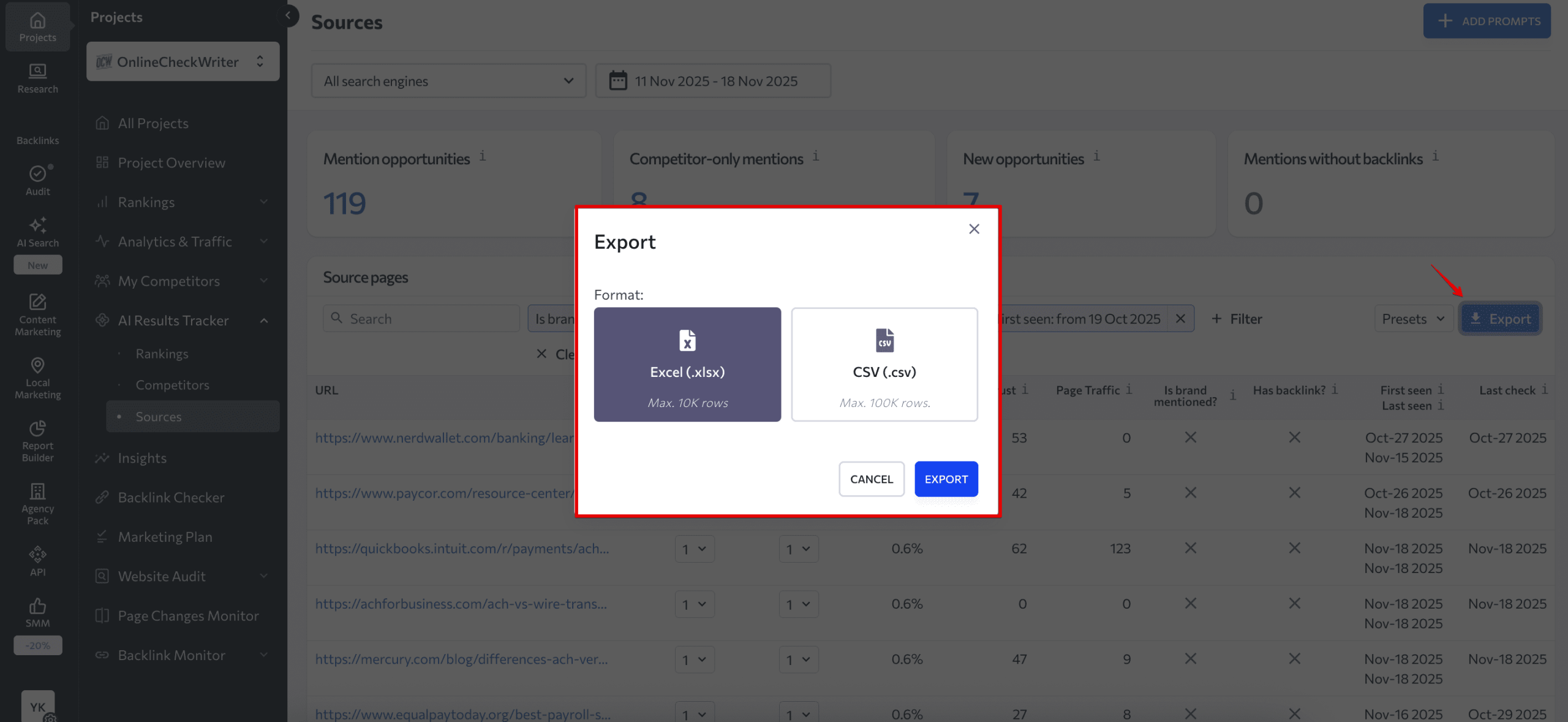
Check your Sources view regularly (weekly or bi-weekly) to spot:
- New high-value sources appearing in your niche
- Changes in which sources AI engines prefer
- Your own pages starting to appear as cited sources
- Competitive movements (if competitors are getting new placements, investigate how)
Use SE Ranking’s AI Results Tracker to monitor whether your brand starts appearing in AI-generated answers for your target prompts. Track:
- Number of prompts mentioning your brand
- Position/prominence of your mentions
- Whether mentions include links to your site
- Changes in brand mention frequency over time
Making it happen
Getting AI search engines to mention your brand is a methodical process. You identify where AI looks for information, prioritize your best opportunities, and systematically secure placements.
Start small: pick your top 5 highest-potential sources, secure those placements, and measure the impact. Then scale from there. That’s your chance to proactively earn mentions and clearly demonstrate progress to clients and stakeholders.