Health-related AI Overviews turn to YouTube 2–3x more than trusted medical sites
The Guardian’s recent investigation raised a worrying question about Google’s AI Overviews: can people safely rely on them for health advice?
In its reporting, The Guardian asked medical charities and health experts to review AI-generated summaries shown at the top of Google search results. What they found was worrying. In several cases, the AI Overviews included advice that experts described as misleading, incorrect, or even dangerous.
One example involved pancreatic cancer. Google’s AI advised patients to avoid high-fat foods. This is the guidance that specialists said was not just wrong, but potentially harmful, as it could weaken patients and reduce their ability to undergo treatment.
Another AI summary gave misleading information about liver blood test results, which experts warned could cause people with serious liver disease to falsely believe they were healthy.
Google has pushed back on these findings, saying that many of the examples were taken out of context and that the vast majority of AI Overviews are accurate and link to reputable sources.
But stepping back from individual examples, there’s a bigger question that hasn’t been discussed enough:
Where does AI-generated health advice actually come from?
To explore this, we analyzed more than 50,000 health-related searches in Germany. We chose this country because its healthcare system is strictly regulated by a combination of German and EU directives, standards, and safety regulations. If AI systems rely heavily on non-medical or non-authoritative sources even in such an environment, it suggests the issue may extend beyond any single country.
A quick spoiler: around two-thirds of the sources cited by AI Overviews don’t have strong safeguards for medical reliability.
-
YouTube is the leading source for health-related AI Overviews.
It accounts for 4.43% of all AI Overviews citations. That’s 3.5 times more than netdoktor.de, one of the largest consumer health portals, and more than twice as often as MSD Manuals, a well-established medical reference.
-
Most URLs cited by AI Overviews aren’t from trusted medical or academic sources.
While trusted medical sources account for about 34% of AI citations overall, government health institutions and academic journals represent less than 1%. At the same time, over 65% of sources come from websites that lack formal medical review or evidence-based safeguards.
-
AI Overviews favor YouTube far more than traditional organic search does.
YouTube tops the list in AI citations for health queries, yet it only ranks 11th in organic search results (excluding SERP features). This shows that AI often prioritizes video content even when more authoritative, easier-to-find sources exist.
-
Domain authority often outweighs expertise in AI Overviews.
For example, Praktischer Arzt ranks among the top five AI-cited domains, even though it is primarily a career and job platform for doctors and medical students. Its medical content is secondary to professional networking and recruitment, yet AI still treats it as a key source of health information.
-
URLs cited by AI Overviews don’t always match Google’s top links.
While 9 out of 10 domains cited by AIOs appear among Google’s most frequent search results, the specific URLs rarely align. Only 36% of AI-cited links appear in Google’s TOP 10, 54% in the TOP 20, and 74% in the TOP 100, meaning much of the content AI surfaces wouldn’t normally be discovered through a standard search.
From “Dr. Google” to “Dr. AI”
For years, people joked about consulting “Dr. Google.” That era is already ending.
Today, users no longer rely on a list of websites and decide what to read. Increasingly, they see one confident, AI-generated answer at the very top of the page.
In Germany, this shift is measurable and widespread. Surveys show that:
- 55% of chatbot users trust AI for health advice.
- About 50% say AI helps them understand symptoms better than a Google search.
- For 30%, an AI response feels like a second medical opinion.
- Shockingly, 16% have ignored a doctor’s advice because AI said otherwise.
In this context, AI Overviews are no longer just another search feature. They function as a primary health information layer, especially for sensitive YMYL topics.
Our own research on AI Overviews and YMYL topics makes this even clearer. In fact, we found that more than 82% of health-related searches in Germany trigger AI Overviews. In other words, health is one of the areas where users are most likely to receive a generated answer instead of a list of links.
So, for health publishers and institutions, the key question is no longer just where you rank organically, but whether you appear in AI answers. And tools like AI Overviews Tracker can help you track which queries trigger Google’s AI answers, which sources are cited, and how your presence inside these AI answers change over time (so that you can spot patterns and adjust your tactics accordingly).
Top sources cited by AI Overviews for health queries
When we looked at which sources Google’s AI Overviews rely on most often for health-related answers, one result stood out immediately.
The single most cited domain is YouTube.
Across our dataset, YouTube accounted for 4.43% of all AI Overview citations (20,621 out of 465,823). No hospital network, government health portal, medical association, or academic institution comes close to that number.
- The next most cited source is ndr.de, with 14,158 citations (3.04%). NDR is a respected public broadcaster and part of Germany’s ARD network. It produces health-related content (but alongside news, documentaries, and entertainment). Health is only one part of its editorial mission.
- In third place comes msdmanuals.com, with 9,711 citations (2.08%). MSD Manuals are a long-established medical reference, published by Merck & Co. They are evidence-based, non-commercial, and written specifically for medical and patient education.
- Fourth is netdoktor.de (7,519 citations; 1.61%), Germany’s largest consumer health portal, with physician-reviewed content and recognized quality certifications.
- Fifth place goes to praktischarzt.de (7,145 citations; 1.53%). This is not a medical institution or health authority, but a career and job platform for doctors. While it publishes health-related articles, its primary purpose is professional networking and recruitment.
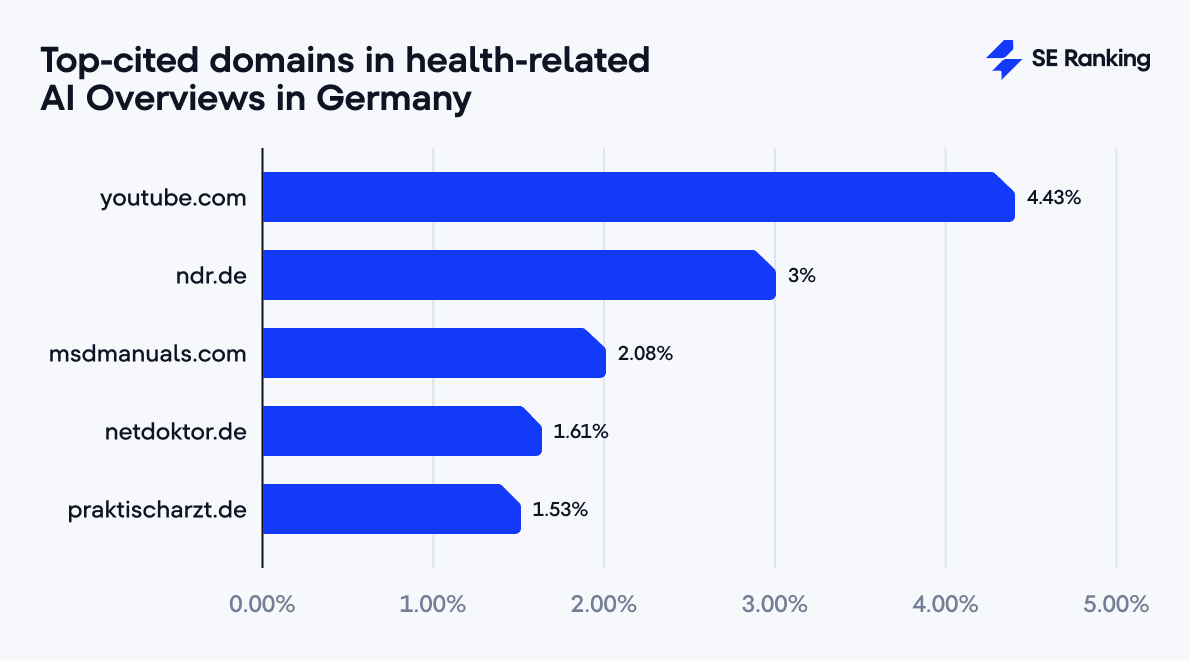
To put it all into perspective:
AI Overviews cite YouTube 3.5 times more often than netdoktor.de (Germany’s largest consumer health portal) and more than twice as often as established medical sources like MSD Manuals.
This matters because YouTube is not a medical publisher. It is a general-purpose video platform. Anyone can upload content there (e.g., board-certified physicians, hospital channels, but also wellness influencers, life coaches, and creators with no medical training at all). From the AI’s point of view, all of this content exists in the same pool.
At this scale, the signal is hard to ignore:
Video content from an open platform is treated as a core source of medical information in German AI Overviews.
We also looked at the 25 YouTube videos that were cited most often in our dataset. Most of them (24 out of 25) come from medical-related channels like hospitals, clinics, and health organizations. On top of that, 21 of the 25 videos clearly note that the content was created by a licensed or trusted source.
So at first glance, it looks pretty reassuring. But it’s important to remember that these 25 videos are just a tiny slice (less than 1% of all YouTube links AI Overviews actually cite). With the rest of the videos, the situation could be very different.
The rest of the top 10 includes:
- herzstiftung.de (German Heart Foundation): 1.52% (7,061 citations)
- stiftung-gesundheitswissen.de (health literacy foundation): 1.47% (6,831 citations)
- aok.de (Germany’s largest health insurer): 1.37% (6,404 citations)
- gesundheitsinformation.de (official government health portal): 1.25% (5,809 citations)
- barmer.de (second-largest health insurer): 1.24% (5,790 citations)
Within the top 10 most cited domains:
- YouTube and NDR (its closest competitor) together account for 38.1% of citations.
- In comparison, the government’s official health portal (gesundheitsinformation.de) accounts for just 6.4%.
In other words, AI Overviews are leaning way more on popular media than on official sources.
Are AI Overviews sources actually trustworthy?
To assess reliability of cited sources, we categorized all 465,823 AI Overview citations by the type of organization behind them.
We defined a group of more reliable sources, including:
- Medical Institutions (large hospitals & clinics)
- Health Insurance Providers
- NGOs / Health Associations / Foundations
- Trusted Health Information Providers (websites with certification, informational websites related to government institutions or hospitals)
- Private Medical Practices & Specialized Clinics
- Pharmacy Chains / Online Pharmacies
- Academic Research / Medical Journals
- German Government Institutions (all type of institutions)
- Other Government Institutions (international institutions, other countries governments)
Everything else (e.g., commercial sites, uncertified portals, multi-topic blogs, and platforms not designed for medical publishing), we classified as less reliable.
The result is sobering.
- Only 34.45% of all citations come from the more reliable group.
- Nearly two-thirds (65.55%) come from sources that were not designed to ensure medical accuracy or evidence-based standards.
Specifically, this is what some of the numbers for trusted medical platforms look like:
- Academic research and medical journals account for 0.48% of citations in AI Overviews.
- German government health institutions account for just 0.39%.
- International government institutions (which include the NIH, CDC or local governments from other countries) add another 0.35%.
Combined, government and academic sources make up around 1% of all AI Overview citations.
These are the institutions that define medical standards, publish clinical guidelines, and carry public accountability. Yet their presence in AI-generated health answers is barely visible.
How AI Overviews sources compare to organic search links
When we looked at the domains most frequently cited by AI Overviews and compared them to the domains that appear most often in Google’s organic search results for the same health queries, the match was surprisingly close: 9 out of 10 domains appear on both lists.
But there’s one big exception: YouTube.
YouTube comes out on top in AI citations, with 20,621 mentions, but in Google’s organic results it ranks only 11th, appearing 5,464 times. In other words, AI Overviews favor video content far more than traditional search does. This is the single largest difference in source preference between AI-generated answers and Google’s regular search results.
TOP 10 AI Overviews citations
TOP 10 organic SERP links
TOP 10 AI Overviews citations
TOP 10 organic SERP links
TOP 10 AI Overviews citations
TOP 10 organic SERP links
TOP 10 AI Overviews citations
TOP 10 organic SERP links
TOP 10 AI Overviews citations
TOP 10 organic SERP links
TOP 10 AI Overviews citations
TOP 10 organic SERP links
TOP 10 AI Overviews citations
TOP 10 organic SERP links
TOP 10 AI Overviews citations
TOP 10 organic SERP links
TOP 10 AI Overviews citations
TOP 10 organic SERP links
TOP 10 AI Overviews citations
TOP 10 organic SERP links
Note: YouTube often appears in search results as a SERP feature, but for this analysis, we focus only on regular organic links.
Now, let’s take a look at how trustworthy the nine domains most frequently cited by both organic search and AI Overviews are for health information:
Type / Focus
Health insurer
Trustworthiness
High – physician-reviewed, broad member education
Type / Focus
Public broadcaster, news & health programs
Trustworthiness
Medium – reliable general info, not specialized
Type / Focus
Consumer health portal
Trustworthiness
High – physician-reviewed, Afgis certified
Type / Focus
Cardiovascular non-profit
Trustworthiness
High – cardiologist-reviewed content
Type / Focus
Medical reference
Trustworthiness
High – evidence-based, no ads, professional-grade
Type / Focus
Health literacy non-profit
Trustworthiness
High – evidence-based, systematic reviews
Type / Focus
Government health portal (IQWiG)
Trustworthiness
Very High – strict evidence-based standards
Type / Focus
Health insurer
Trustworthiness
High – reliable, member-focused health info
Type / Focus
Physician career portal + blog
Trustworthiness
Medium – medical content varies, career info reliable
Health insurer
High – physician-reviewed, broad member education
Public broadcaster, news & health programs
Medium – reliable general info, not specialized
Consumer health portal
High – physician-reviewed, Afgis certified
Cardiovascular non-profit
High – cardiologist-reviewed content
Medical reference
High – evidence-based, no ads, professional-grade
Health literacy non-profit
High – evidence-based, systematic reviews
Government health portal (IQWiG)
Very High – strict evidence-based standards
Health insurer
High – reliable, member-focused health info
Physician career portal + blog
Medium – medical content varies, career info reliable
But domains are only part of the story. What really matters is which exact pages (URLs) AI Overviews pull from.
So we dug deeper.
In addition to comparing domains, we checked how many of the specific links cited by AI Overviews also appear in Google’s organic rankings for the same keywords/prompts.
The result was more surprising than expected.
On average:
- Only 36% of URLs cited by AI Overviews appear in Google’s TOP 10,
- 54% appear in the TOP 20,
- 74% appear somewhere in the TOP 100.
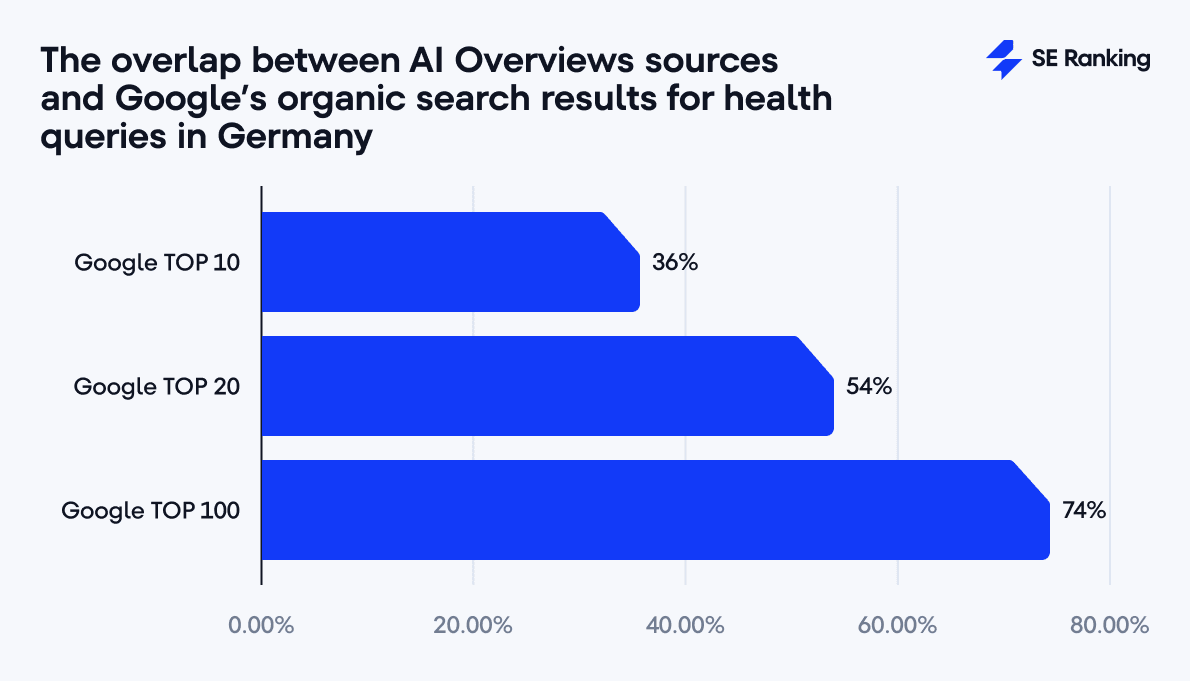
In other words:
Roughly one-third of the sources AI uses are highly visible in search results. The rest are much harder to find (or wouldn’t be seen at all by most users).
The median values closely match the averages, which tells us this isn’t skewed by a few outliers. It’s a consistent pattern.
Since AI answers often pull from a different mix of pages than organic search, AI visibility needs to be tracked separately. And our AI Search Visibility Tools make it easier to see when, where, and how LLMs like Google AI Overviews, AI Mode, ChatGPT, Gemini, and Perplexity mention your brand — and just as importantly, how your competitors show up, where they’re winning, and where there’s room to outperform them.
Research methodology
This study analyzed 50,807 healthcare-related prompts and keywords to examine which sources Google’s AI Overviews rely on when generating health-related answers.
The analysis was conducted as a one-time snapshot in December 2025, using German-language queries that reflect how users in Germany typically search for health information. All searches were performed from Germany (Berlin) to ensure geographic consistency.
Disclaimer: The findings reflect patterns observed within the defined dataset, timeframe, and methodology. AI Overviews are continuously evolving, and source selection may vary over time, across regions, or under different query formulations. As a result, alternative interpretations of the data are possible.
Conclusion
The Guardian investigation focused on specific examples of misleading advice. Our research shows a bigger problem: most AI health answers rely heavily on YouTube, commercial websites, and multi-topic blogs.
That means a large portion of AI’s health answers use content that isn’t necessarily evidence-based.
For everyday topics, this may be acceptable.
For YMYL topics like health, it is not.