Gemini 3 impact on AI Overviews: Nearly half of cited domains changed, 32% more sources per answer, and sourceless bug fixed
When Google made Gemini 3 the default model for AI Overviews on January 27, 2026, we were among the first to conduct research on its impact.
Almost right away, we noticed something weird: a lot of AI Overviews started showing up without any sources. Google later admitted it was a bug. Since the bug hit at the same time Gemini 3 was announced as the new model for AIOs, it was tricky to figure out what was really Gemini 3 doing, and what was just the glitch.
Once Google fixed the bug in early February, we ran our analysis again (this time getting a clear picture of what Gemini 3 actually changed).
We looked at three key periods:
- January 2026 (pre-Gemini 3) – baseline behavior before any changes.
- Late January 2026 (Gemini 3 + bug) – the period we covered in our original article.
- February 2026 (Gemini 3, bug fixed) – the current, clean dataset reflecting stable system behavior.
The bug lasted about 2–3 weeks, from the rollout until early February, when source blocks returned consistently.
Now that things have stabilized, we can finally separate what changes came from Gemini 3 itself from what was just the bug. Let’s see what the data shows.
-
The sourceless AI Overview bug is largely fixed, but the rate of AIOs without sources remains above pre-Gemini 3 levels.
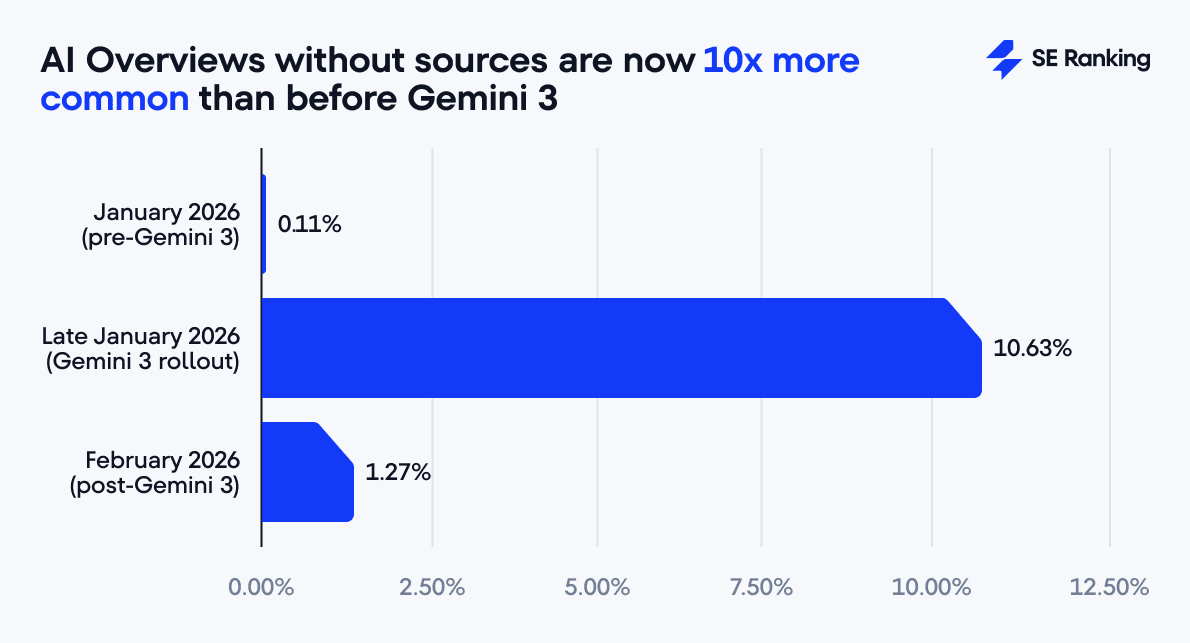
After peaking at 10.63% during the Gemini 3 rollout bug, sourceless AI Overviews have dropped to 1.27%. This seems to be a new baseline going forward (up from 0.11% pre-Gemini 3).
-
AI Overview appearance rates are nearly identical to pre-Gemini 3 levels.
Before Gemini 3, AI Overviews appeared for 60.85% of queries, compared to 59.73% now (virtually the same level). The temporary drop to 55.21% happened during the rollout bug, which means that it was caused by the technical issue, and not the model itself.
-
Gemini 3 increased the number of sources cited per AI Overview.
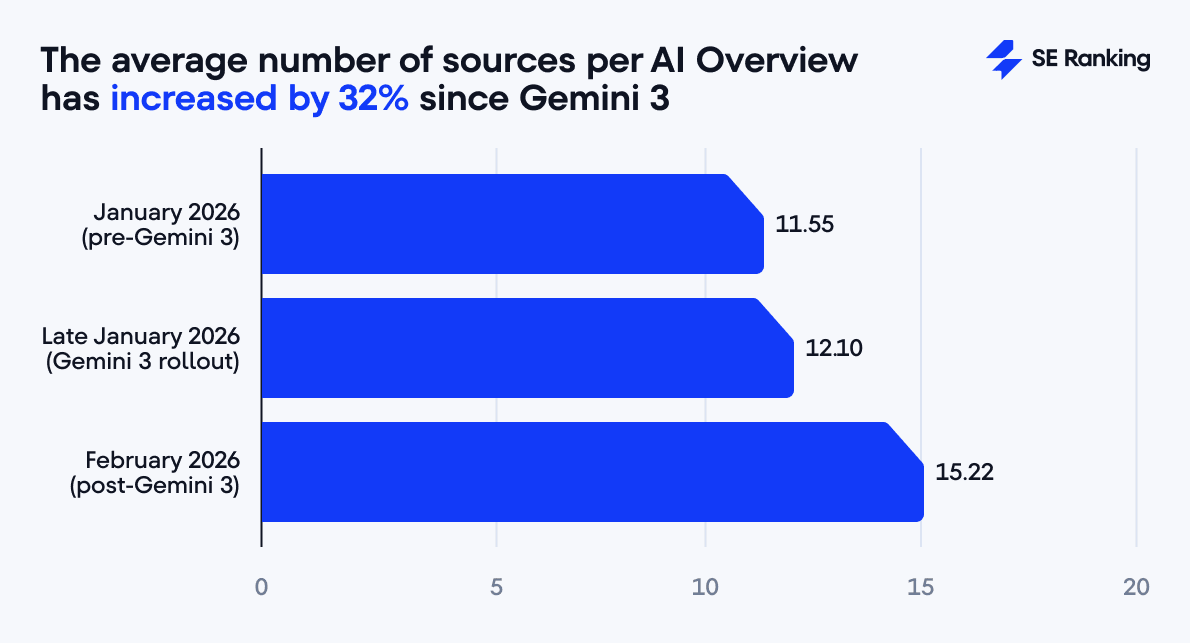
The average number of sources per AI Overview rose from 11.55 before Gemini 3 to 15.22 today. That represents a 31.8% increase.
-
The number of unique domains cited has grown.
Unique cited domains rose by 9.3% compared to the number before Gemini 3. This means Gemini 3 draws from a more diverse set of publishers and perspectives rather than shrinking its source pool.
-
Top cited domains kept their positions in AI Overviews.
Among the 500 most frequently cited domains, only one domain disappeared. In the top 10, domains remain the same before and after Gemini 3, with YouTube, Reddit, Facebook, Indeed, and Quora being at the very top.
-
Gemini 3 removed nearly half of previously cited domains, largely affecting those with low citation counts.
About 42.4% of domains cited before Gemini 3 no longer appear in AI Overviews, and this reshuffling occurred almost exclusively in the long tail. At the same time, 51.7% of new domains gained citations in AIOs after Gemini 3.
-
AI Overviews are now more likely to appear for high-difficulty keywords.
For queries with difficulty 60–70, appearance rates increased from 40.87% to 45.93%, and for difficulty 70–80, from 24.69% to 31.48%. What this means is that Gemini 3 is more confident handling competitive topics.
-
AI Overviews rarely overlap with organic search results.
Only 19% of AIO sources overlap with the top 10 search results. This highlights that being visible in AI Overviews requires strategies beyond traditional SEO.
The bug is mostly fixed, yet sourceless AIOs are still more common than before
One of the most obvious problems during the Gemini 3 rollout was the sudden appearance of AI Overviews with no sources at all.
This was highly unusual.
Before Gemini 3, sourceless answers were almost nonexistent:
- Before Gemini 3: 0.11% (essentially never)
- During the bug: 10.63% (more than 1 in 10 answers)
- Now, after the fix: 1.27%
The good news is that the worst of the problem is clearly over. The share of sourceless answers dropped dramatically (from over 10% down to just 1.27%). That’s a massive improvement and confirms that Google implemented a real fix.
But there’s an important nuance here.
Even after the bug fix, the rate of sourceless AI Overviews has stabilized at 1.27% (more than 10 times higher than the 0.11% seen before Gemini 3). This suggests that we may not fully return to the old baseline, and 1.27% could be the new norm.
The real Gemini 3 effect
Now that the bug has been largely resolved, we can separate temporary glitches from genuine changes in the system. Let’s take a closer look at how Gemini 3 itself is affecting AI Overviews.
AI Overview appearance rates have recovered
AI Overview appearance rates are back up to 59.73%, almost reaching the original levels we reported in our previous article.
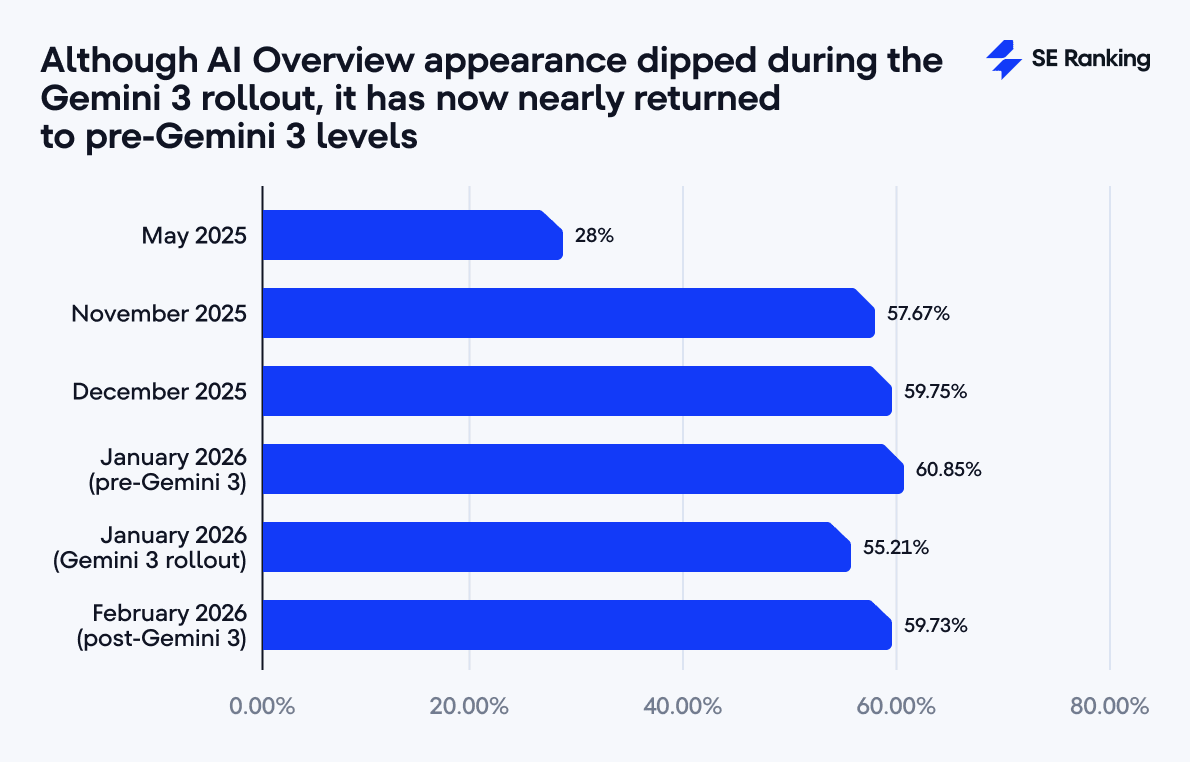
At the time, we saw a noticeable drop from 60.85% to 55.21% during Gemini rollout, which made it seem like the model was reducing how often AI Overviews appeared. Now that the bug has been fixed, the gap is small (59.73% vs. 60.85%, which is just 1.12 percentage points below where things started).
So, most likely, the entire drop we saw earlier was caused by the bug (not Gemini 3 itself).
This confirms that the long-term expansion trend remains intact. AIO appearance rates grew from about 28% in May 2025 to nearly 60% in early 2026, and Gemini 3 hasn’t reversed that trajectory.
If anything, the model seems to be continuing that expansion. Several niches now show higher AI Overview appearance rates than they did before Gemini 3.
Examples include:
- Healthcare: 60.54% → 61.92%
- Pets: 68.74% → 69.80%
- Fashion and Beauty: 36.60% → 37.65%
- Entertainment and Hobbies: 55.46% → 56.10%
January 2026 (pre-Gemini 3)
78.66%
February 2026 (post-Gemini 3)
76.49%
January 2026 (pre-Gemini 3)
75.70%
February 2026 (post-Gemini 3)
75.64%
January 2026 (pre-Gemini 3)
45.98%
February 2026 (post-Gemini 3)
45.66%
January 2026 (pre-Gemini 3)
54.90%
February 2026 (post-Gemini 3)
53.02%
January 2026 (pre-Gemini 3)
69.98%
February 2026 (post-Gemini 3)
69.38%
January 2026 (pre-Gemini 3)
55.46%
February 2026 (post-Gemini 3)
56.10%
January 2026 (pre-Gemini 3)
36.60%
February 2026 (post-Gemini 3)
37.65%
January 2026 (pre-Gemini 3)
54.16%
February 2026 (post-Gemini 3)
52.96%
January 2026 (pre-Gemini 3)
60.54%
February 2026 (post-Gemini 3)
61.92%
January 2026 (pre-Gemini 3)
66.84%
February 2026 (post-Gemini 3)
66.36%
January 2026 (pre-Gemini 3)
49.56%
February 2026 (post-Gemini 3)
48.80%
January 2026 (pre-Gemini 3)
68.74%
February 2026 (post-Gemini 3)
69.80%
January 2026 (pre-Gemini 3)
75.58%
February 2026 (post-Gemini 3)
74.06%
January 2026 (pre-Gemini 3)
78.32%
February 2026 (post-Gemini 3)
77.80%
January 2026 (pre-Gemini 3)
64.06%
February 2026 (post-Gemini 3)
62.62%
January 2026 (pre-Gemini 3)
19.08%
February 2026 (post-Gemini 3)
19.22%
January 2026 (pre-Gemini 3)
52.82%
February 2026 (post-Gemini 3)
49.98%
January 2026 (pre-Gemini 3)
77.38%
February 2026 (post-Gemini 3)
71.80%
January 2026 (pre-Gemini 3)
71.24%
February 2026 (post-Gemini 3)
66.35%
January 2026 (pre-Gemini 3)
61.46%
February 2026 (post-Gemini 3)
58.98%
78.66%
76.49%
75.70%
75.64%
45.98%
45.66%
54.90%
53.02%
69.98%
69.38%
55.46%
56.10%
36.60%
37.65%
54.16%
52.96%
60.54%
61.92%
66.84%
66.36%
49.56%
48.80%
68.74%
69.80%
75.58%
74.06%
78.32%
77.80%
64.06%
62.62%
19.08%
19.22%
52.82%
49.98%
77.38%
71.80%
71.24%
66.35%
61.46%
58.98%
These aren’t massive jumps, but they show that Gemini 3 isn’t generally reducing AIO visibility.
However, some niches remain affected:
- Sports and Exercise: 77.38% → 71.80%
- Technology: 71.24% → 66.35%
So, as you can see, Gemini 3 may be more selective in certain topics, especially fast-moving or technical ones.
Unique domains now make up a larger share of AI Overview sources
In our original analysis, we reported something concerning: the number of unique domains cited appeared to drop by 14%.
However, after fixing the issue, the real picture looks very different.
The number of unique cited domains actually increased from 89,262 to 97,574. That’s a 9.3% increase, not a decrease.
This completely reverses the original conclusion.
Rather than shrinking its pool of sources, Gemini 3 expanded it. The model is now pulling information from a wider variety of websites than before.
At the same time, citation concentration increased, even with more domains overall.
At first glance, it might sound contradictory: Gemini 3 is citing more domains than ever, yet the overall concentration of citations is increasing. How does that work?
We measured this using the Herfindahl-Hirschman Index (HHI), a standard metric that shows how concentrated a set of values is. Higher HHI means a few players are capturing a bigger slice of the pie. Here’s what we found:
- Before Gemini 3: 1.0
- During the bug: 1.22
- After the fix: 1.44
That’s a 44% jump compared to pre-Gemini 3 levels.
In plain language: the AI Overview ecosystem has expanded, with more domains being cited overall, but the top domains are now pulling in an even bigger share of citations.
And it happened in 15 out of 20 niches we analyzed.
January 2026 (pre-Gemini 3)
4.47
February 2026 (post-Gemini 3)
5.25
January 2026 (pre-Gemini 3)
4.14
February 2026 (post-Gemini 3)
4.25
January 2026 (pre-Gemini 3)
2.79
February 2026 (post-Gemini 3)
3.21
January 2026 (pre-Gemini 3)
2.52
February 2026 (post-Gemini 3)
2.8
January 2026 (pre-Gemini 3)
2.4
February 2026 (post-Gemini 3)
2.35
January 2026 (pre-Gemini 3)
2.35
February 2026 (post-Gemini 3)
2.34
January 2026 (pre-Gemini 3)
1.97
February 2026 (post-Gemini 3)
2.19
January 2026 (pre-Gemini 3)
1.86
February 2026 (post-Gemini 3)
2
January 2026 (pre-Gemini 3)
1.6
February 2026 (post-Gemini 3)
1.97
January 2026 (pre-Gemini 3)
1.53
February 2026 (post-Gemini 3)
1.89
January 2026 (pre-Gemini 3)
1.41
February 2026 (post-Gemini 3)
1.82
January 2026 (pre-Gemini 3)
1.4
February 2026 (post-Gemini 3)
1.21
January 2026 (pre-Gemini 3)
1.37
February 2026 (post-Gemini 3)
1.2
January 2026 (pre-Gemini 3)
1.12
February 2026 (post-Gemini 3)
1.2
January 2026 (pre-Gemini 3)
1.01
February 2026 (post-Gemini 3)
1.17
January 2026 (pre-Gemini 3)
0.98
February 2026 (post-Gemini 3)
1.06
January 2026 (pre-Gemini 3)
0.83
February 2026 (post-Gemini 3)
0.97
January 2026 (pre-Gemini 3)
0.81
February 2026 (post-Gemini 3)
0.97
January 2026 (pre-Gemini 3)
0.67
February 2026 (post-Gemini 3)
0.68
January 2026 (pre-Gemini 3)
0.52
February 2026 (post-Gemini 3)
0.5
4.47
5.25
4.14
4.25
2.79
3.21
2.52
2.8
2.4
2.35
2.35
2.34
1.97
2.19
1.86
2
1.6
1.97
1.53
1.89
1.41
1.82
1.4
1.21
1.37
1.2
1.12
1.2
1.01
1.17
0.98
1.06
0.83
0.97
0.81
0.97
0.67
0.68
0.52
0.5
All in all, Gemini 3 is broadening the base, but it’s also doubling down on the leaders. More sources, but more power at the top.
AI Overviews now cite far more sources
This is where things get interesting.
Before Gemini 3, the average AI Overview cited 11.55 sources per answer. Now, after the fix, that number jumped to 15.22 sources per answer. That’s a 31.8% increase.
And this wasn’t isolated to a few niches. Every single category saw an increase.
Some of the biggest jumps:
- Sports and Exercise: 9.61 → 16.9 (+75.9%)
- Healthcare: 9.95 → 14.91 (+49.8%)
- Self-Care and Wellness: 10.32 → 15.19 (+47.2%)
- Pets: 12.67 → 18.43 (+45.5%)
Even the smallest increase (Insurance) still rose by 6.1%.
January 2026 (pre-Gemini 3)
9.61
February 2026 (post-Gemini 3)
16.9
Percentage increase
75.90%
January 2026 (pre-Gemini 3)
9.95
February 2026 (post-Gemini 3)
14.91
Percentage increase
49.80%
January 2026 (pre-Gemini 3)
10.32
February 2026 (post-Gemini 3)
15.19
Percentage increase
47.20%
January 2026 (pre-Gemini 3)
12.67
February 2026 (post-Gemini 3)
18.43
Percentage increase
45.50%
January 2026 (pre-Gemini 3)
11.47
February 2026 (post-Gemini 3)
16.53
Percentage increase
44.10%
January 2026 (pre-Gemini 3)
11.11
February 2026 (post-Gemini 3)
15.7
Percentage increase
41.30%
January 2026 (pre-Gemini 3)
10.94
February 2026 (post-Gemini 3)
15.33
Percentage increase
40.10%
January 2026 (pre-Gemini 3)
10.39
February 2026 (post-Gemini 3)
14.28
Percentage increase
37.40%
January 2026 (pre-Gemini 3)
12.26
February 2026 (post-Gemini 3)
16.49
Percentage increase
34.50%
January 2026 (pre-Gemini 3)
12.67
February 2026 (post-Gemini 3)
16.42
Percentage increase
29.60%
January 2026 (pre-Gemini 3)
12.42
February 2026 (post-Gemini 3)
16.08
Percentage increase
29.50%
January 2026 (pre-Gemini 3)
9.8
February 2026 (post-Gemini 3)
12.47
Percentage increase
27.20%
January 2026 (pre-Gemini 3)
14.59
February 2026 (post-Gemini 3)
18.32
Percentage increase
25.60%
January 2026 (pre-Gemini 3)
10.68
February 2026 (post-Gemini 3)
13.26
Percentage increase
24.20%
January 2026 (pre-Gemini 3)
10.6
February 2026 (post-Gemini 3)
12.88
Percentage increase
21.50%
January 2026 (pre-Gemini 3)
12.1
February 2026 (post-Gemini 3)
14.63
Percentage increase
20.90%
January 2026 (pre-Gemini 3)
9.97
February 2026 (post-Gemini 3)
11.91
Percentage increase
19.50%
January 2026 (pre-Gemini 3)
11.92
February 2026 (post-Gemini 3)
13.93
Percentage increase
16.90%
January 2026 (pre-Gemini 3)
13.94
February 2026 (post-Gemini 3)
14.95
Percentage increase
7.20%
January 2026 (pre-Gemini 3)
13.18
February 2026 (post-Gemini 3)
13.99
Percentage increase
6.10%
9.61
16.9
75.90%
9.95
14.91
49.80%
10.32
15.19
47.20%
12.67
18.43
45.50%
11.47
16.53
44.10%
11.11
15.7
41.30%
10.94
15.33
40.10%
10.39
14.28
37.40%
12.26
16.49
34.50%
12.67
16.42
29.60%
12.42
16.08
29.50%
9.8
12.47
27.20%
14.59
18.32
25.60%
10.68
13.26
24.20%
10.6
12.88
21.50%
12.1
14.63
20.90%
9.97
11.91
19.50%
11.92
13.93
16.90%
13.94
14.95
7.20%
13.18
13.99
6.10%
This tells us something fundamental about Gemini 3’s architecture.
Gemini 3 is synthesizing answers from a broader evidence base.
Instead of relying on a smaller set of sources, it pulls from more references simultaneously.
This likely improves answer robustness, but it also makes competition for citations more intense.
Domain churn is still huge
Even though the total number of cited domains increased, there was enormous turnover beneath the surface.
When you examine which specific domains are being cited, you see that a large portion of them were replaced.
Here’s what changed at the domain level:
- 37,870 domains that were previously cited are no longer cited at all
- 46,182 entirely new domains appeared in the citation pool
- In total, more than 84,000 domains were affected by this transition
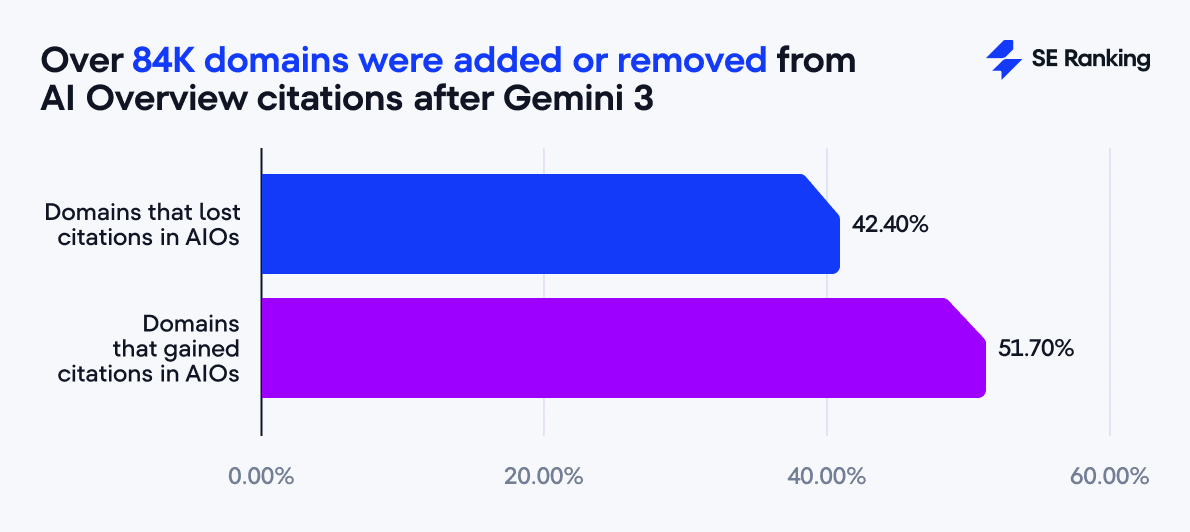
In fact, thousands of sites lost visibility, while thousands of new ones gained it.
But this disruption wasn’t evenly distributed.
Among the 500 most frequently cited domains:
- Only one domain disappeared
- Not a single new domain entered this top tier
Based on this data, we can make several important conclusions:
- First, Gemini 3 protected the established leaders.
Highly cited domains trusted by AI Overviews kept their positions as core sources in these AI answers. This tells us that Gemini 3 still relies heavily on proven signals of authority and trust. In other words, the model didn’t suddenly change its mind about who the “most reliable” sources are.
- Second, the real change happened among sites with a low number of citations.
Instead of promoting entirely new major players, Gemini 3 reshuffled the lower-cited sources. Many less frequently cited sites dropped out of the citation set, so this was mainly about refining supporting sources rather than a change in the core, highly cited domains.
This creates two very different realities:
- For sites with a large number of citations that have already gained authority in the eyes of AIOs, visibility is stable and predictable. Their authority protects their position.
- For sites with a low number of citations, visibility is much more fluid. Inclusion can change quickly as the model reassesses which sources provide the most value.
Top-10 domains remain the same, but some positions shifted
The global top 10 most-cited domains in AI Overviews didn’t change much after Gemini 3, but a few positions shuffled around.
YouTube still leads with 10.74%, followed by Reddit (4.01%), Facebook (1.85%), Indeed (1.28%), Quora (1.27%), Wikipedia (1.14%), Amazon (0.65%), NIH (0.63%), US News (0.61%), and Bankrate (0.50%).
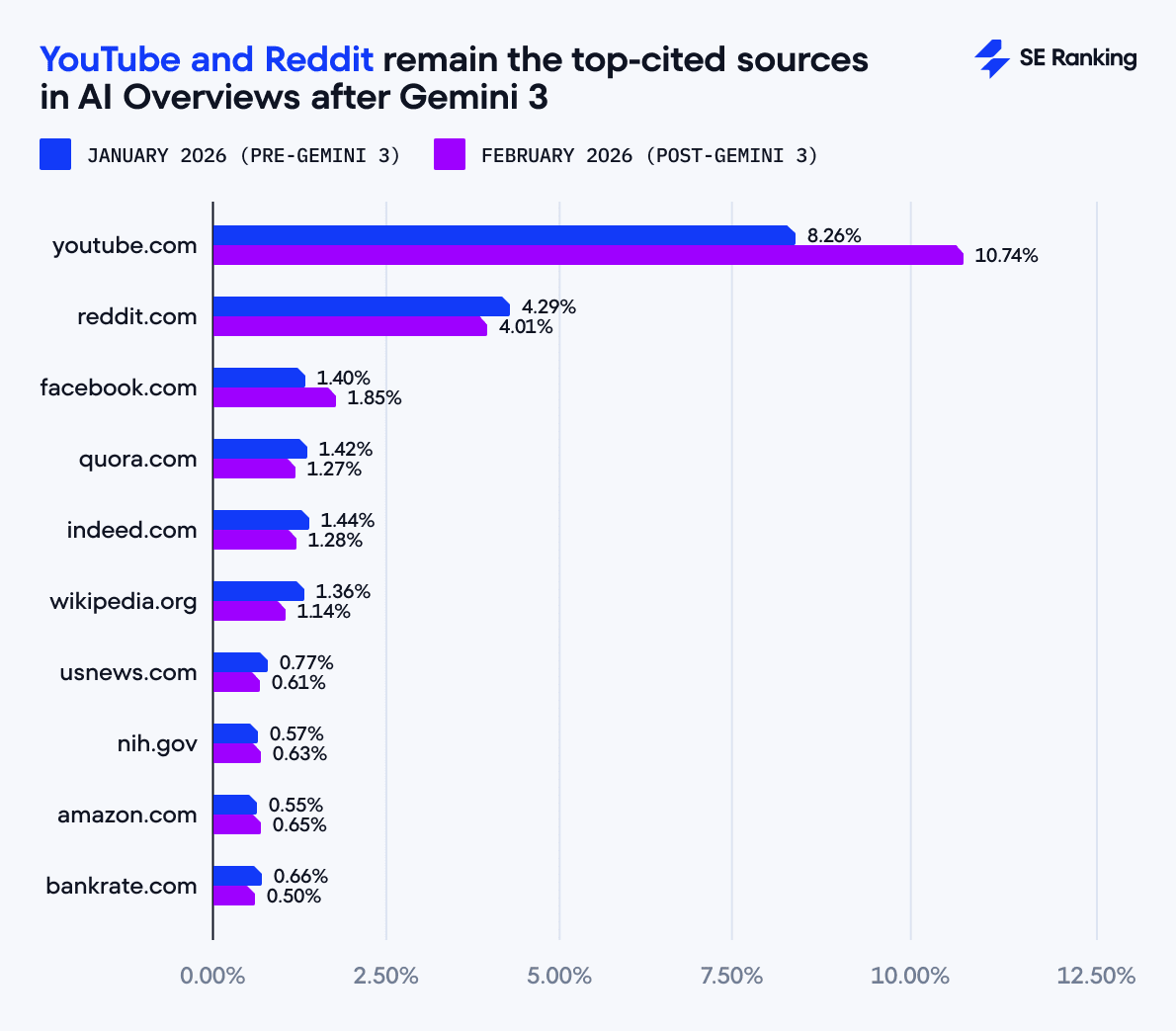
Facebook jumped from #5 to #3, Amazon moved up from #10 to #7, while US News and Bankrate slid down.
Interestingly, only YouTube and Facebook grew their share among the top platforms.
The bigger shakeups happened in niche areas. For example, Shopify (which used to be the third most-cited domain in Business) completely dropped out of the top 10. Meanwhile, the US Chamber of Commerce rose from #9 to #4, and NerdWallet made its first top 10 appearance.
So, in some cases, even well-known niche authorities aren’t safe.
Traditional media is slowly losing ground too. Media sites accounted for 2.17% of citations before Gemini 3, dipped to 2.14% during a brief bug period, and dropped further to 2.03% afterward. It’s a small shift, but the trend is clear: the media is gradually shrinking in influence.
Meanwhile, the top social/UGC platforms like YouTube, Reddit, and Facebook continue gaining influence in AI Overviews.
AI Overviews are now more likely to appear for high-difficulty keywords
Before Gemini 3, Google seemed cautious about generating AI Overviews for keywords with a high difficulty score. The model often “held back” when a keyword had a lot of competition, likely to avoid giving incomplete or less reliable answers.
Gemini 3 changed that behavior. Now, the model is more willing to tackle these challenging keywords:
- Difficulty 60–70: AIO appearance jumped from 40.87% → 45.93%
- Difficulty 70–80: AIO appearance rose from 24.69% → 31.48%
Meanwhile, AIO appearance rates for lower-difficulty keywords stayed mostly the same, meaning the model’s behavior for easier queries hasn’t changed much. The shift is really about giving more AI Overviews in areas that were previously seen as tricky or high-stakes.
AI Overviews and organic rankings barely overlap
On average, only 19% of AIO sources appear in the top 10 search results.
Put another way: for over 60% of queries, the overlap is 20% or less. That’s a huge gap. Only a tiny fraction (4.2% of queries) see more than 40% overlap.
What does this mean in practice?
- Ranking in the organic top 10 doesn’t guarantee your site will be cited in AI Overviews.
- Conversely, being cited in AI Overviews doesn’t require a top spot in search results.
In essence, AI Overviews have become their own visibility ecosystem, running parallel to traditional search. If you want to be seen here, it’s not enough to just focus on organic rankings.
Research methodology
The aim of this study was to understand how Gemini 3 has affected AI Overviews, independent of the temporary bug that occurred during its rollout.
We analyzed 100,000 keywords evenly distributed across 20 niches (5,000 keywords per niche), using data collected from the US market. Data was captured at three key points in time:
- January 2026 (pre-Gemini 3): baseline behavior before any changes.
- Late January 2026 (Gemini 3 + bug): the period covered in our initial article.
- February 2026 (Gemini 3, bug fixed): the current dataset reflecting stable, bug-free behavior.
Our analysis focused solely on sources appearing in the right-hand panel of AI Overviews; inline links were not included.
Note: There may be alternative interpretations of this data. Our findings should be considered as one perspective in an ongoing discussion about Gemini 3 and its impact.
What actually changed with Gemini 3
The early rollout period was misleading because of the bug. But now the system’s direction is much clearer.
Gemini 3 is:
- pulling from more sources
- citing more domains overall
- concentrating authority among top platforms
- reshuffling smaller sites aggressively
- and expanding coverage across competitive queries
This creates both opportunities and risks.
For large, trusted domains, Gemini 3 reinforces their position.
For smaller sites, visibility is far more volatile.