70+ AI search stats (fresh & fact-checked data)
A couple of years ago, most of us didn’t even think about AI when searching online. Yet here we are, suddenly writing, optimizing, and thinking in AI-first ways, as if it’s always been part of the process.
To show just how far AI has come, we’ve put together 70+ fresh, research-backed AI stats. This list should give you a clearer idea of how AI search works today and where to focus your efforts in 2026.
So, let’s dive in and explore the numbers.
Disclaimer: The data in this post comes from a mix of sources. Some statistics are taken directly from SE Ranking datasets, while others are based on past SE Ranking studies and surveys. We’ve also included current, reliable data from trusted sources across the web.
1. AI Overviews statistics
- About 30% of keywords trigger AI Overviews in US SERPs (SE Ranking, 2025).
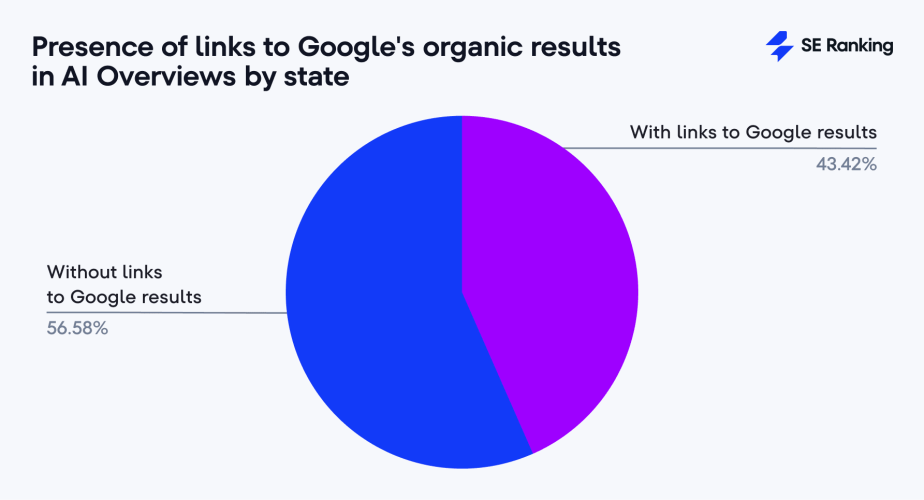
- Over 43% of AI Overview responses contain links to Google.com, which makes it the most commonly cited domain. On average, these responses feature between 4 and 6 links to Google’s organic search results (SE Ranking, 2025).
- Apart from Google, the most cited AI Overviews sources are YouTube, Reddit, Quora, and Wikipedia (SE Ranking, 2025).
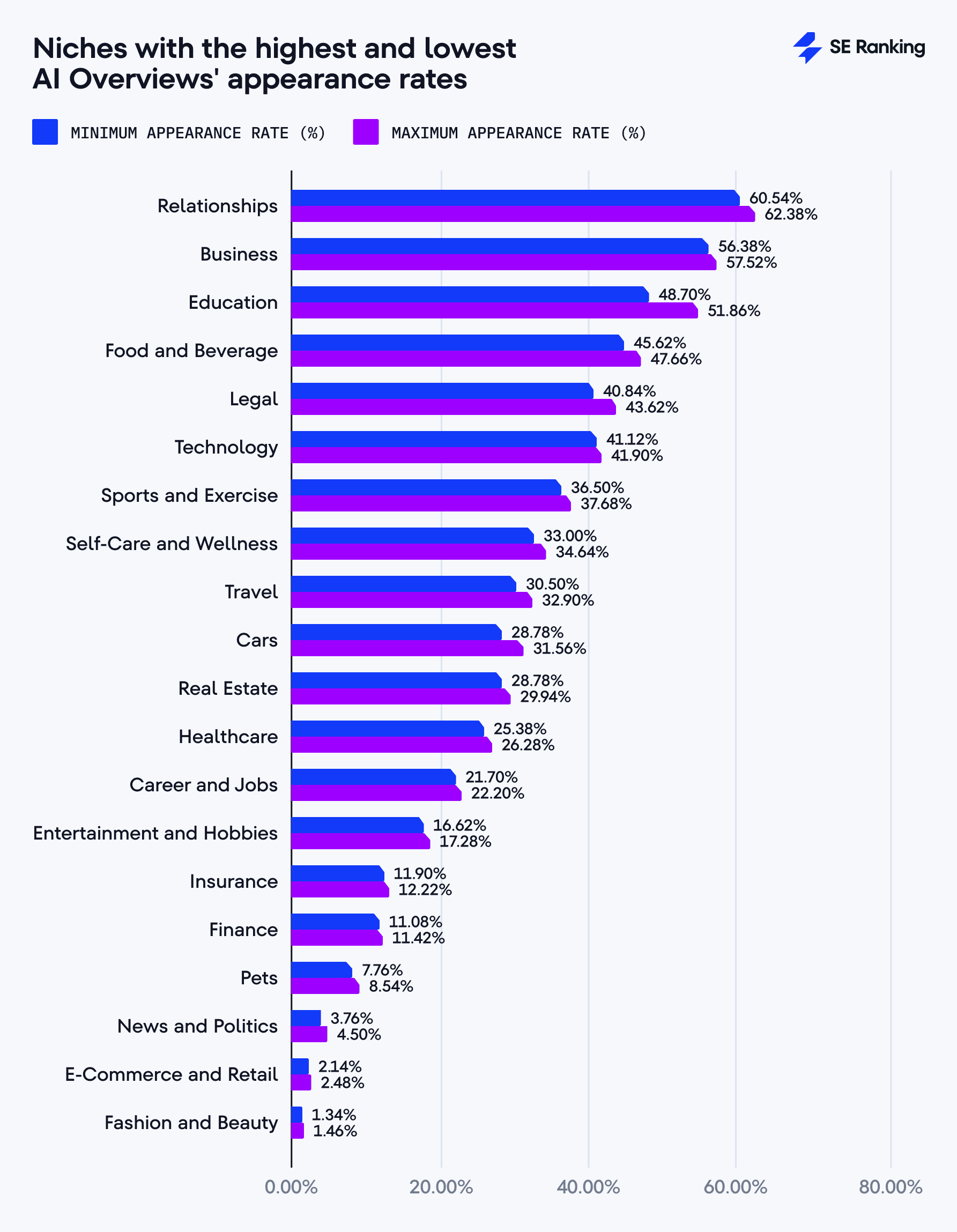
- The niches with the highest percentage of AI Overviews include Relationships (around 61%), Business (around 57%), Education (around 50%), and Food & Beverage (around 46%) (SE Ranking, 2025).
- AI Overviews with 6-14 links are most common (SE Ranking, 2025).
- The longer the AIO’s answer, the more sources it cites. On average, responses under 600 characters cite 5.31 sources. Responses over 6600 characters cite 28 sources (SE Ranking, 2025).
- AI Overviews show up for longer, more informational searches. For example, 10-word queries trigger AI Overviews over 5 times more often than single-word searches (SE Ranking, 2025).
- The average text length of AI Overviews is 1,766 characters or 254 words (SE Ranking, 2025).
- AI Overviews reduce clicks to websites by 34.5% (Ahrefs, 2025).
- In AI Overviews, 96.45% of URLs return code 200 (working correctly). Other response codes are far less common: 302 (temporary redirect) at 1.93%, 301 (permanent redirect) at 0.56%, and 404 (not found) also at 0.56% (SE Ranking, 2025).
- Since the rollout of AI Overviews, nearly 39% of marketers have seen traffic drops, with tech (44%), travel and hospitality (43%), and retail/e-commerce (35%) most affected (Fractl, 2025).
2. AI Mode statistics
- On average, each AI Mode response includes about 12 links (SE Ranking, 2025).
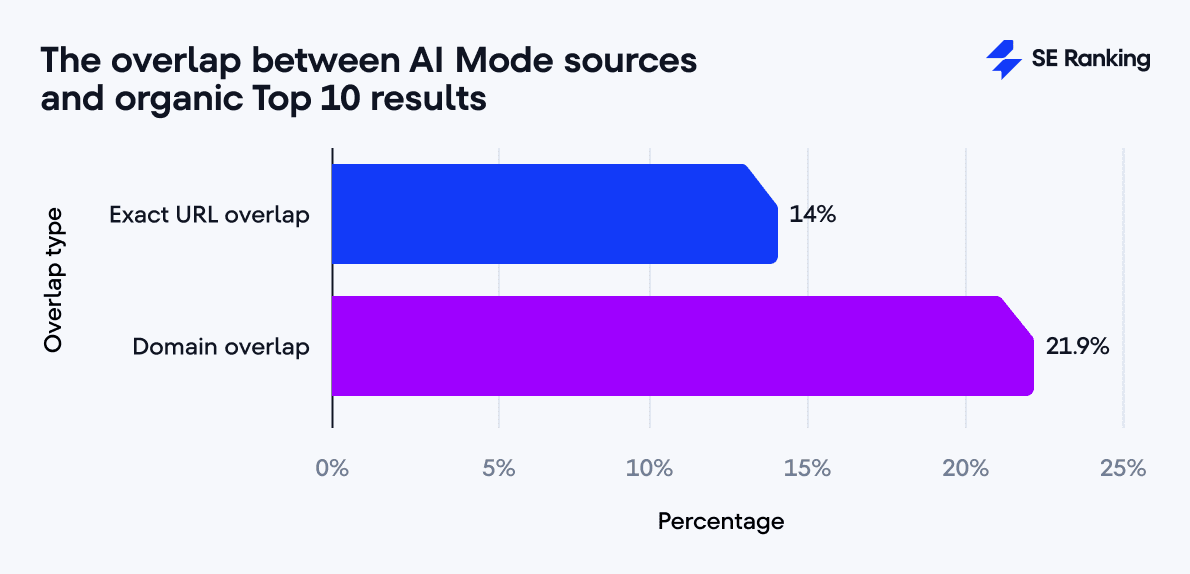
- Overlap between AI Mode and organic results is minimal: only 14% at the URL level and 21.9% at the domain level compared with the organic top 10 (SE Ranking, 2025).
- When comparing AI Mode and AI Overviews, they share a response overlap in 10.7% of URLs and 16% of domains (SE Ranking, 2025).
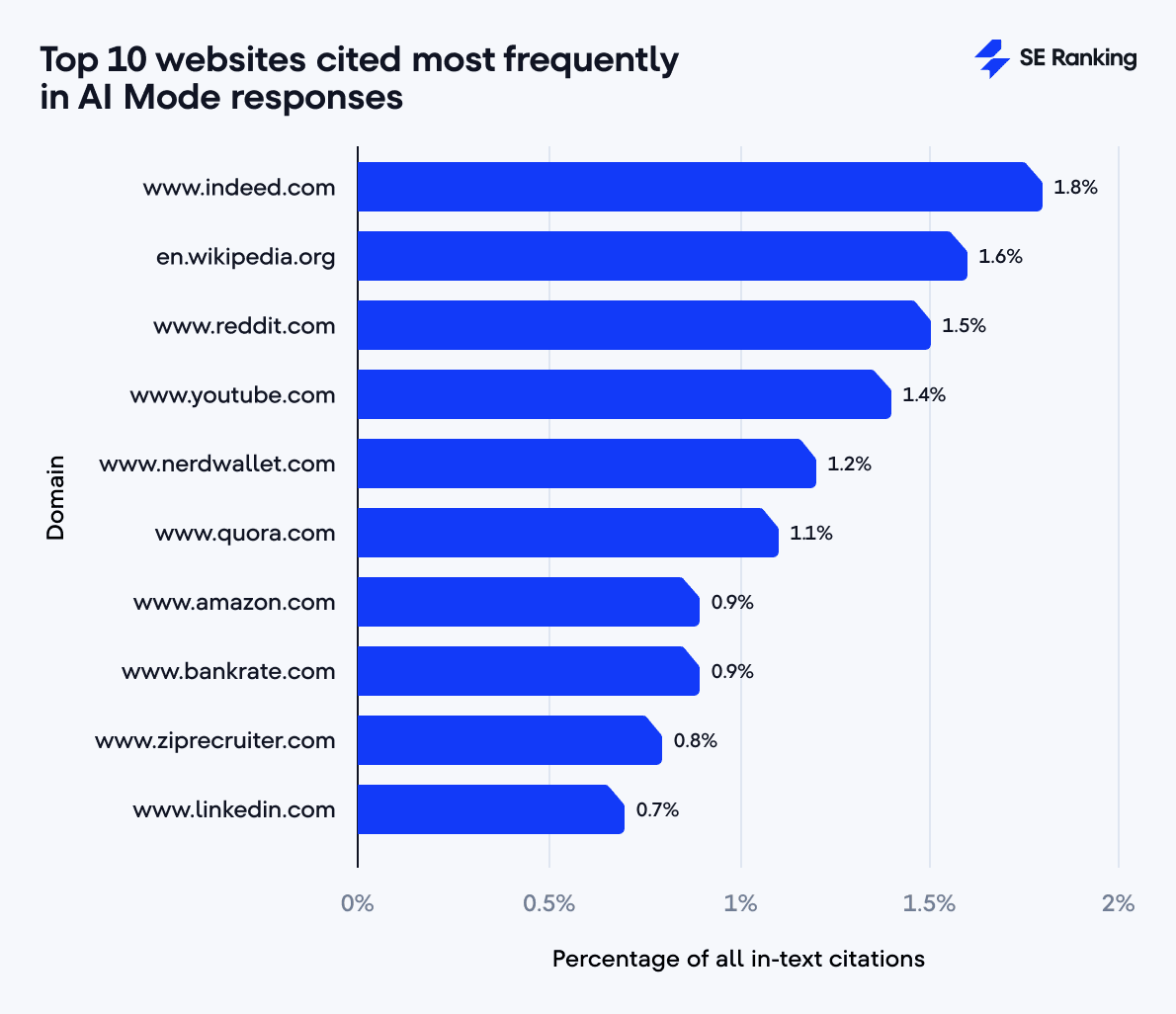
- Indeed, Wikipedia, Reddit, and YouTube are the top-cited domains within AI Mode responses (SE Ranking, 2025).
- AI Mode is highly volatile: over 60% of domains and 80% of URLs disappear between runs—even when the same user, city, and query are used (SE Ranking, 2025).
- In AI Mode responses, 93.45% of URLs return code 200 (working correctly). Permanent redirects (301) are the next most common at 2.34%, nearly double temporary redirects (302) at 2.25%. Not found errors (404) account for 0.87% of cases (SE Ranking, 2025).
- Around 91% of AI Mode citations appear in separate blocks, while 8.9% are inline text links (SE Ranking, 2025).
- 61.7% of e-commerce searches trigger the AI Mode shopping feature. This makes commercial queries 13 times more likely to include it than general searches (4.6%) (SE Ranking, 2025).
- 40% of AI Mode shopping results feature 1–10 products, while only 2.56% display more than 20 (SE Ranking, 2025).
- 86.6% of AI Mode product listings come from eBay, far ahead of Walmart (7.1%) and Best Buy (2.5%), meaning nearly 9 out of 10 products are available through eBay (SE Ranking, 2025).
- Almost 9 in 10 products shown in AI Mode have customer ratings, and 89% of those score between 4.1 and 5 stars; products rated below 3 stars appear in only 0.9% of listings (SE Ranking, 2025).
- 26% of products shown in AI Mode are discounted, mostly moderately (10–29%), with deep discounts above 50% appearing in just 6% of listings (SE Ranking, 2025).
- In AI Mode shopping results, nearly half of product cards include YouTube videos, while 62% feature Top Insights and 59% include discussion sections (SE Ranking, 2025).
- 97% of discussion sources in AI Mode shopping results come from Reddit, far exceeding Facebook (12%) and Quora (2%) (SE Ranking, 2025).
3. AI traffic statistics
- 68.94% of websites receive AI traffic (SE Ranking, 2025).
- Globally, AI platforms currently drive around 0.15% of all internet traffic (SE Ranking, 2025).
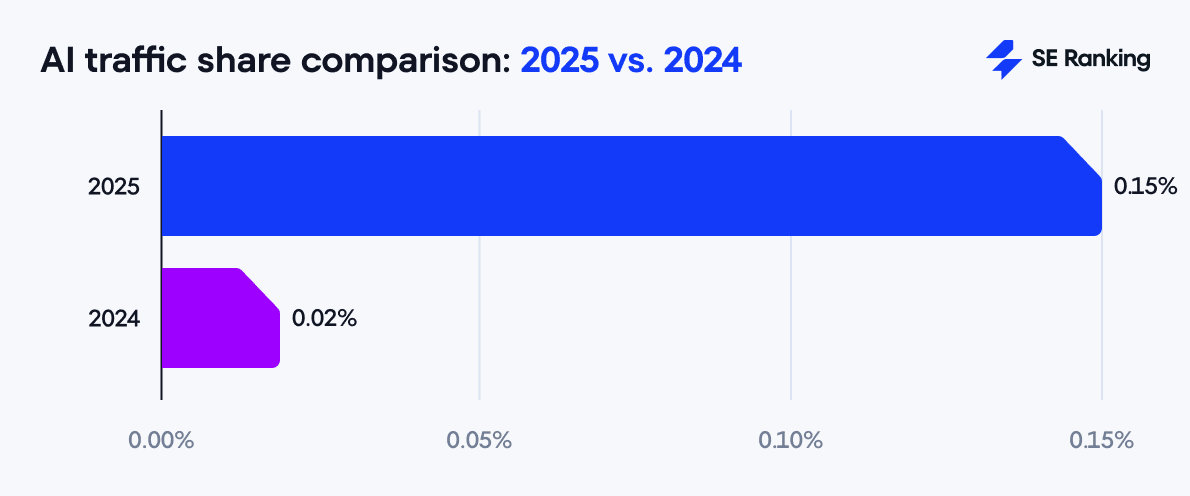
- AI traffic has increased around 8x in the past year (SE Ranking, 2025).
- On average, users click only once for every 20 AI search prompts (seoClarity, 2025).
- AI traffic is unevenly distributed across regions. For example, AI is roughly twice as likely to send traffic to US websites as it is to those in the UK (SE Ranking, 2025).
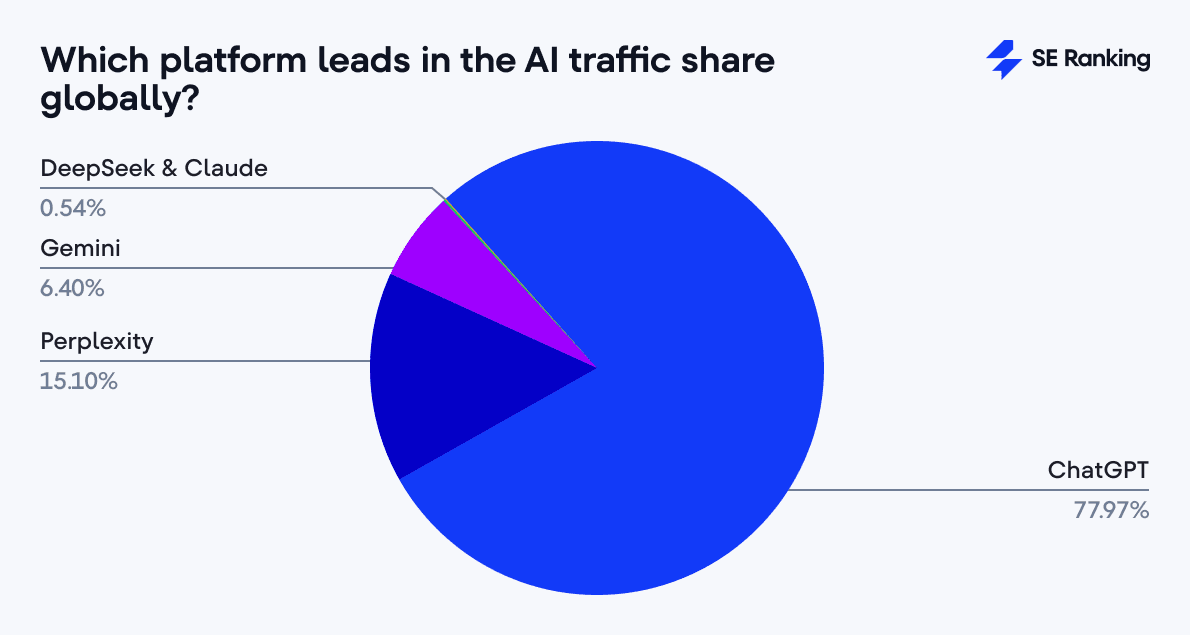
- ChatGPT leads the global AI traffic market, accounting for over 77% of all AI-driven visits (SE Ranking, 2025).
- ChatGPT prompts tend to be much longer (about 60 words on average) compared to Google’s typical 3.4-word queries. Simply put, people provide more context and detail when interacting with ChatGPT to get more personalized answers (Similarweb, 2025).
- Perplexity is the second most popular source of AI traffic, driving nearly 15% of AI visitors (SE Ranking, 2025).
- Despite Google’s dominance in search, Gemini only drives 6.4% of AI traffic (SE Ranking, 2025).
- DeepSeek holds only 0.37% of AI traffic and Claude 0.17% (SE Ranking, 2025).
- On average, visitors referred by AI platforms spend 68% more time on websites than those from traditional organic search (SE Ranking, 2025).
- Best-of content, product pages, and guides are the primary drivers of AI traffic (Ahrefs, 2025).
4. AI citation statistics
Overall website traffic
- ChatGPT: Reaching over 190K monthly visitors doubles a site’s likelihood of being selected as a source (SE Ranking, 2025).
- AI Mode: Sites with 134K+ visitors are 2.3x more likely to be picked up and cited than those with 2.8K or less (SE Ranking, 2025).
Homepage traffic
- ChatGPT: Homepages with over 7.9K organic visitors have 2x higher citation chances than those with 400 visitors or less (SE Ranking, 2025).
- AI Mode: High-traffic homepages (1.5K+ visitors) earn around double of citations compared to low-traffic homepages (less than 10 visitors) (SE Ranking, 2025).
Referring domains
- ChatGPT: Sites with 350K+ referring domains are over 5x more likely to be cited than those with 200 (SE Ranking, 2025).
- AI Mode: Sites with 24K+ referring domains have almost 3x higher chances to appear as a source in AI Mode answers than those with 300 (SE Ranking, 2025).
Brand mention on Quora & Reddit
- ChatGPT: Sites with 26K brand mentions on Quora are 3x more likely to be cited than those with little or no activity. On Reddit, it takes about 219K mentions to see the same effect (SE Ranking, 2025).
- AI Mode: Pages with a high number of brand mentions on Quora (>3.8K) are 1.7x more likely to be cited than those with low mentions (<10). On Reddit, reaching 35K brand mentions provides a similar boost (SE Ranking, 2025).
Content length
- ChatGPT: Articles over 2,900 words are 59% more likely to be chosen as a citation than those under 800 (SE Ranking, 2025).
- AI Mode: Long-form content (>2,300 words) is 25–30% more likely to be cited than short posts (<500 words) (SE Ranking, 2025).
Section length (the number of words between headings)
- ChatGPT: Pages structured into 120–180-word sections earn 70% more citations than pages with very short sections (under 50 words) (SE Ranking, 2025).
- AI Mode: Pages with 100–150 words per section have the highest possibility to be cited (SE Ranking, 2025).
Content updates
- ChatGPT: Content updated within the past 3 months is twice as likely to be cited as older, outdated pages (SE Ranking, 2025).
- AI Mode: Pages updated within 2 months are around 28% more likely to be cited than pages untouched for over 2 years (SE Ranking, 2025).
Technical performance
- ChatGPT: Pages with FCP <0.4s are 3x more likely to be cited than those with FCP >1.13s. Also, pages with INP scores of 0.4-0.5s have 1.6x higher chances to appear as a source than those with over 1s (SE Ranking, 2025).
- AI Mode: Pages with LCP score >1.85s have the lowest chances to be chosen as a citation (SE Ranking, 2025).
5. AI e-commerce statistics
- 89% of retailers report either actively using AI in their operations or running pilot programs (NVIDIA, 2025).
- 64% of AI-driven sales come from new shoppers (Rep AI, 2025).
- 77% of consumers worldwide desire virtual try-ons when shopping online, and 76% expect AI-powered shopping assistants (Statista, 2025).
- AI chats increase conversion rates by 4 times. On average, 12.3% of shoppers who engage with AI chat make a purchase compared to 3.1% for those who don’t (Rep AI, 2025).
- When assisted by AI, shoppers complete their purchases in just 8 minutes, compared to 15 minutes without AI. This is 47% faster (Rep AI, 2025).
- 34% of consumers are willing to let AI assistants make purchases on their behalf (Omnisend, 2025).
- 66% of consumers think AI will replace search in the next 5 years (Search Engine Land, 2025).
- Within retail-related AI conversations, Target and Walmart appear most often (mentioned in over half of AI responses), followed by Amazon, Best Buy, and Costco (Similarweb, 2025).
- 87% of retailers report AI having a positive impact on their annual revenue, and 97% plan to increase their AI spending in the next fiscal year (NVIDIA, 2025).
- 53% of senior executives believe that generative AI significantly boosts team productivity and efficiency (Adobe, 2025).
- The global AI-enabled e-commerce market was valued at $7.25 billion in 2024 and is expected to reach $64.03 billion by 2034 (Precedence Research, 2025).
6. AI adoption statistics
- Nearly 40% of marketers use AI tools every day, and an additional 17% report using them at least once a week. Just 7% say they have never used AI tools (Planable, 2025).
- Among 18–24-year-olds, 66% use ChatGPT to find information, which is nearly as many as the 69% who use Google (Fractl, 2025).
- While 71% of young adults report having moderate to high AI knowledge, only 33% of older adults say the same (Melbourne Business School, 2025).
- Over 37% of ChatGPT interactions have a new “generative” intent, where users request a specific output, such as “create X,” “draft Y,” or “do Z” (Profound, 2025).
- 66% of people trust AI-generated content without verifying its accuracy (KPMG, 2025).
- 45% of marketing directors believe AI tools make employees more productive (Statista, 2025).
- Around 48% of marketers claim AI helps them save at least 4-10 hours per week and more (Fractl, 2025).
- 39% of organizations have begun experimenting with AI agents (McKinsey & Company, 2025).
- On average, companies spend just $188 per month on AI tools (Ahrefs, 2025).
- The AI market reached over $244 billion in 2025, up nearly $50 billion from 2023. This rapid growth is expected to continue, with the market set to pass $1 trillion by 2031 (Statista, 2025).
Conclusion
Looking at these 70+ stats, it’s clear that AI search isn’t what it used to be. But with the right decisions based on these facts, you are sure to be better prepared for what’s ahead in 2026.