Is Google stealing your clicks in AI Mode? (1.3M+ citations analyzed)
For a while now, the SEO community has been talking about Google.com popping up in AI Overviews answers. And we were actually one of the first to call this out in our research last year, when Google self-referenced in over 43% of AI Overview responses across the US.
Fast forward to today, and the conversation hasn’t slowed down. People are still noticing links redirecting users to Google’s own properties.
For example, in the X post below, Wil Reynolds reports 15 out of 17 AI Overview links running an additional Google search.
That’s a huge share, but it makes sense for Google to keep users inside its ecosystem. This way, people engage with other Google services (Google Images, YouTube, Maps), see more sponsored content, and, as a result, interact with more monetized results.
But hardly anyone is talking about AI Mode responses. Not long ago, AI Mode also started referencing Google.com in much the same way as AI Overviews.
That’s why we decided to dig deeper and take a closer look at how AI Mode is using Google.com as a source.
What we found is that, in many cases, AI Mode actually sends users back to another Google search or a Google-owned property. So if it feels like AI Mode keeps looping you into Google’s ecosystem, that’s because it kind of does.
-
Google.com is by far the most cited domain in AI Mode responses.
It accounts for 17.42% of all citations, which is more than the next six domains combined (YouTube, Facebook, Reddit, Amazon, Indeed, and Zillow).
-
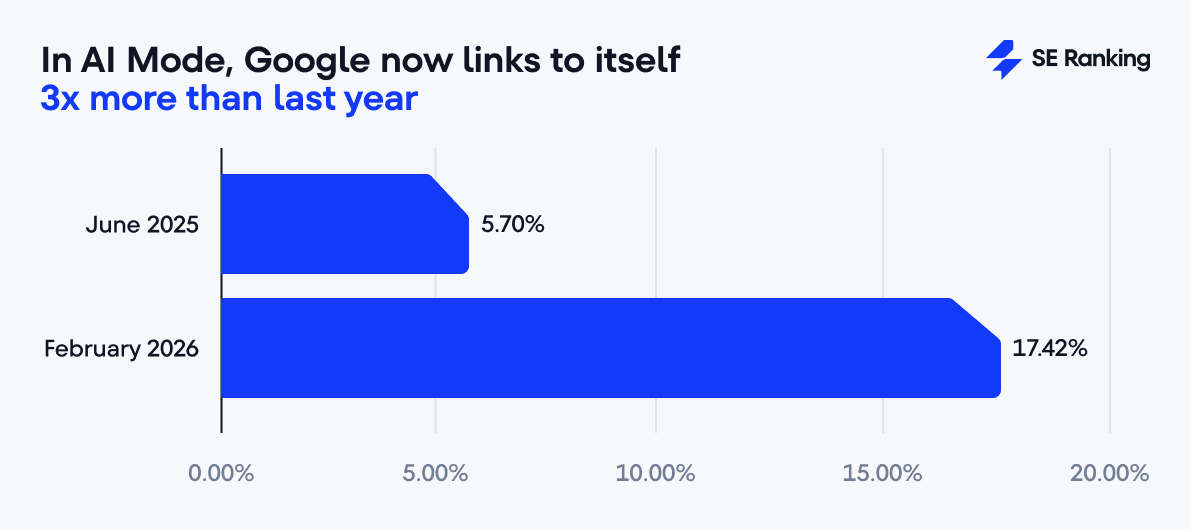
Google’s self-citation rate in AI Mode has tripled in less than a year.
It jumped from 5.7% in June 2025 to 17.42% today. The result is that users are more likely to stay inside Google’s ecosystem.
-
Google.com is now pointing more to organic search results than GBPs.
Back in 2025, 97.9% of Google links in AI Mode led to Google Business Profiles, with no references to traditional search results. Today, that’s changing: only 36.1% still reference GBPs. In turn, 59% of Google citations show organic SERPs on the right-hand-side panel of AIM answers.
-
Google.com ranks as the top-cited source in 19 of the 20 niches analyzed.
Even in specialized sectors like Finance (5.13%) and Insurance (6.48%), Google is cited the most. The only exception is Career and Jobs, where Google.com ranks second.
What are the top cited domains in AI Mode responses?
Let’s start with the big picture: when it comes to sources in AI Mode, Google.com dominates like no other.
Our analysis shows that Google.com is the #1 cited domain in AI Mode, with 17.42% of all citations. To give you perspective, it is cited more than the next six domains combined (YouTube, Facebook, Reddit, Amazon, Indeed, and Zillow).
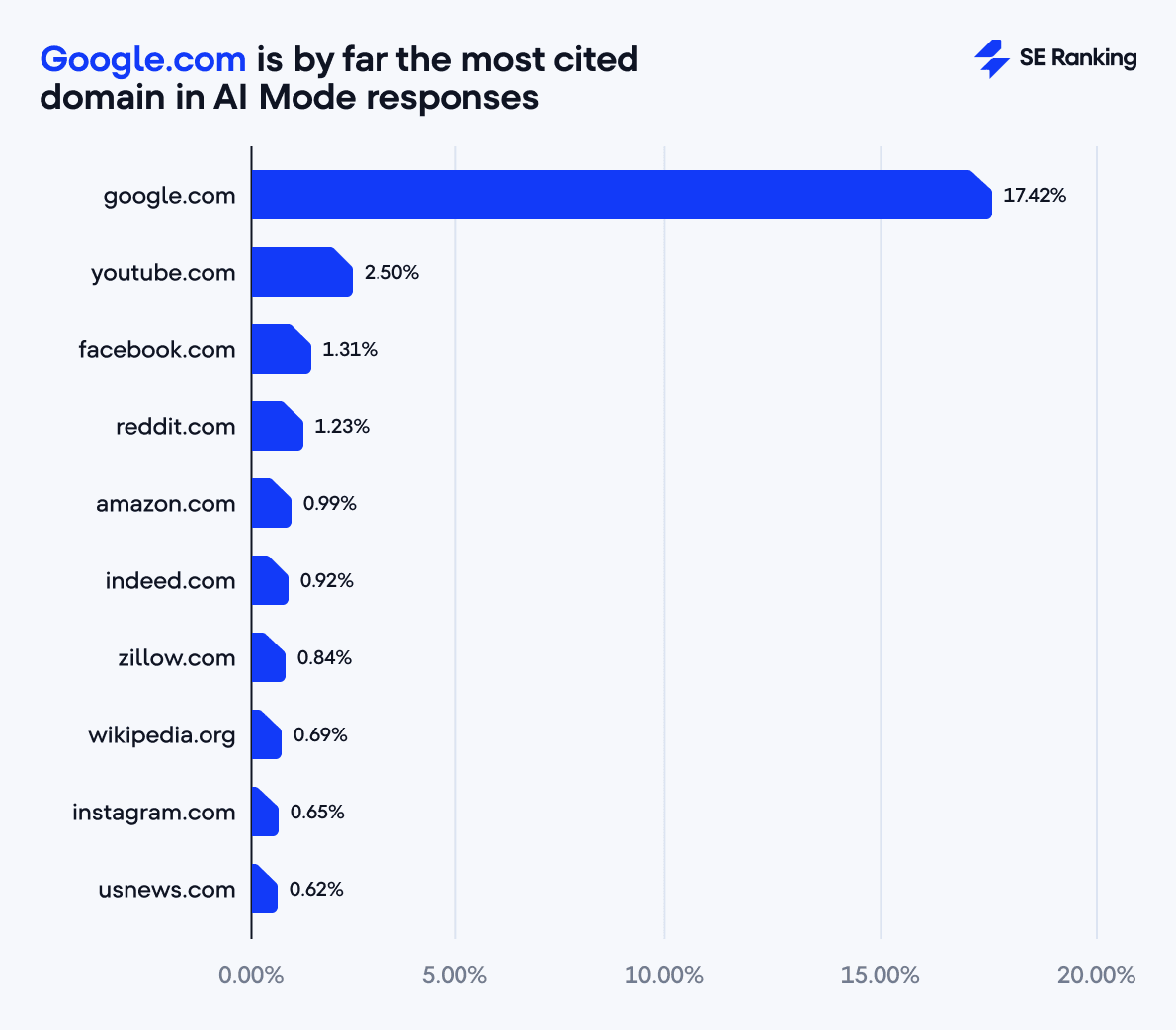
Nearly 1 in 5 citations comes from Google, and when you include YouTube, the company controls around 20% of all sources. That’s an enormous influence over how AI presents information.
Azeem Ahmad, strategy director at Reflect Digital, puts this into perspective:

This dominance hasn’t happened overnight. In June 2025, Google’s self-citation rate was only 5.7%. Less than a year later, that figure is now 3x higher.
As a result of this increase, AI answers naturally steer users toward Google’s own content.
Alex Wright, digital marketer and managing SEO partner at dentsu, explains what these changes mean for publishers and brands:

Users end up exploring more of Google (watching videos, reading reviews, or seeing ads). Each click keeps them inside Google’s ecosystem, which makes it more likely they’ll stay, click around, and come back again. In a way, AI Mode is one of the tools Google uses to guide people through its services without leaving.
Himani Kankaria, founder at Missive Digital, highlights the next challenge for SEOs and businesses:

Google’s self-referencing now goes far beyond GBP
If you take a closer look at the type of content AI Mode cites, there’s a clear shift happening.
Our research on AI Mode from June 2025 showed that 97.9% of Google.com links pointed to Google Business Profiles.
There were no direct links to traditional organic search results.
Now, things are changing.
Our data shows that 59% of Google citations in AI Mode point directly to Google SERPs on the right-hand-side panel, while 36.1% still cite GBPs. The rest is allocated to other Google assets, including 1.7% to Google Support, 0.1% to Google Flights, and 3.1% to other Google properties.
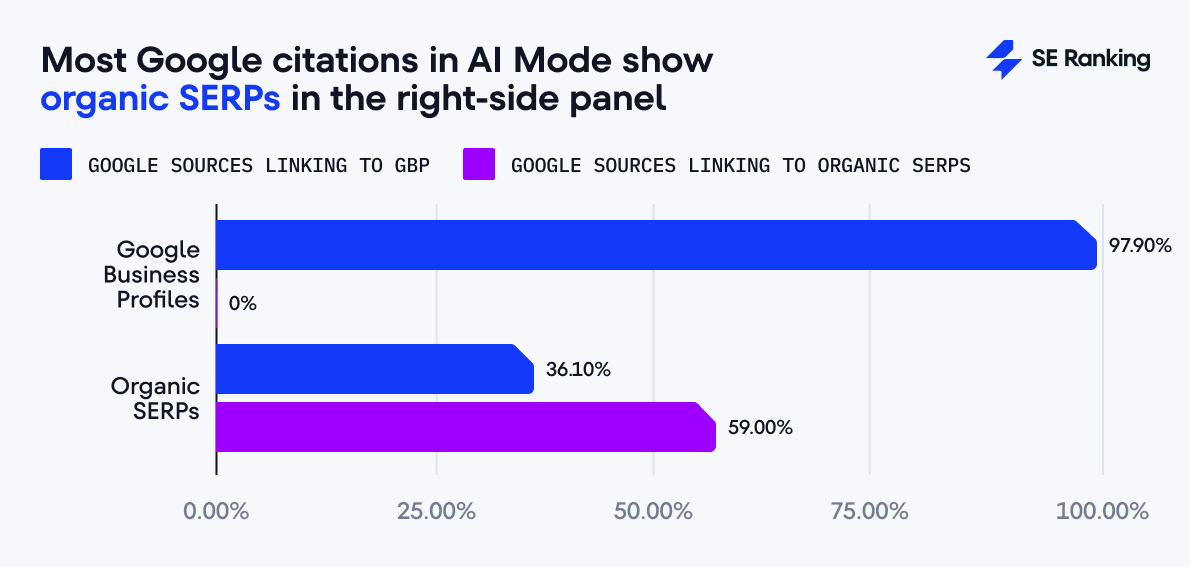
So, in the majority of cases where Google links are included in an AI Mode response, you’ll see typical search results in the citation panel on the right (which, by the way, proves that traditional SEO still matters).
Which niches rely most on Google.com in AI Mode?
When we break down AI Mode citations by niche, Google.com shows up as a clear leader almost everywhere. It ranks as the top-cited source in 19 of the 20 niches we analyzed.
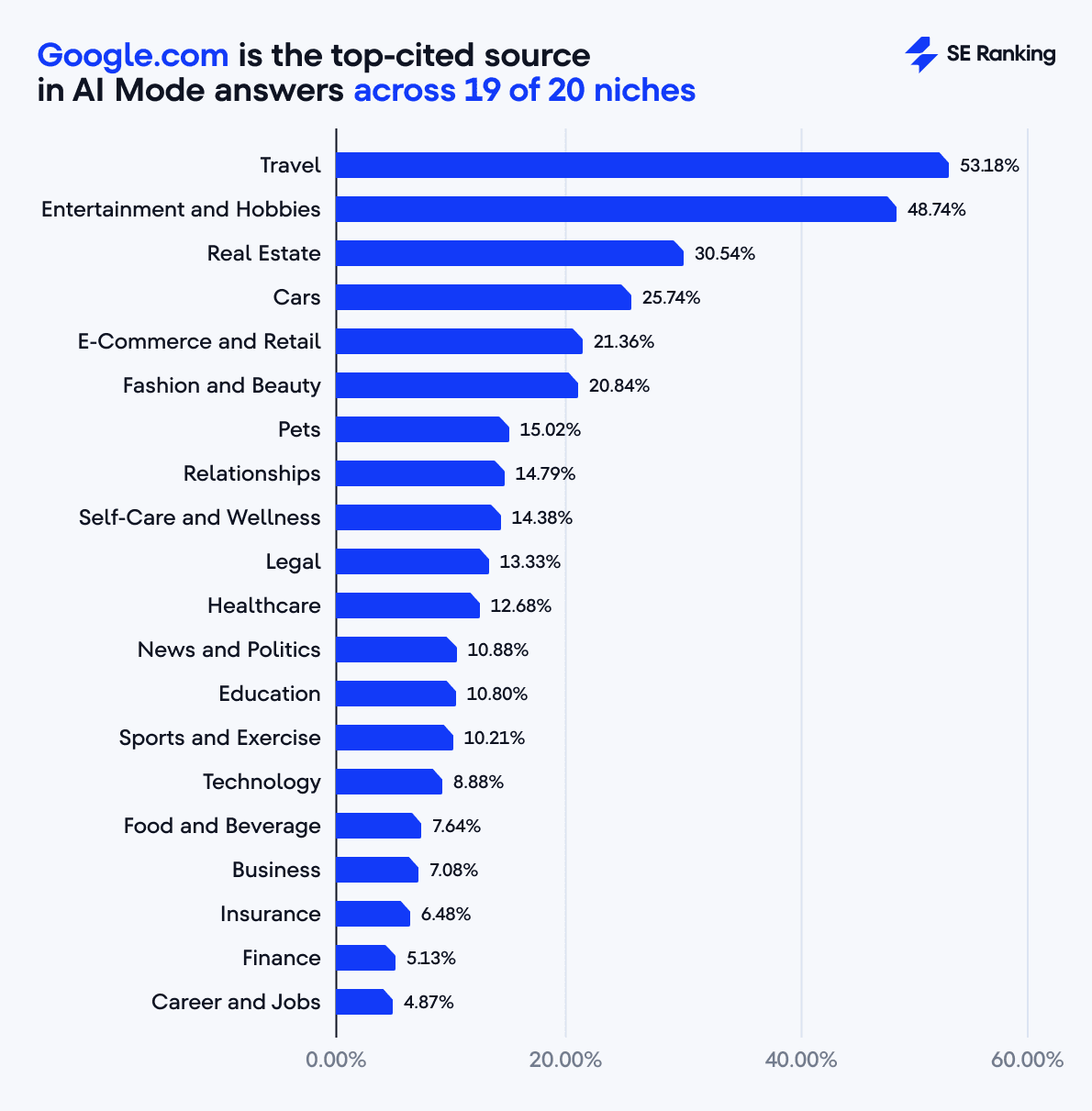
But in some categories, its lead is especially significant.
- Travel: More than half of all citations (53.18%) point to Google.
- Entertainment & Hobbies: Nearly half (48.74%) come from Google.
- Real Estate: About one in three citations (30.54%) lead back to Google.
There’s only one niche where Google doesn’t hold the top spot: Career and Jobs. Here, Indeed.com dominates, cited 3.1x more than Google, and LinkedIn also plays a strong supporting role.
Omi Sido, senior technical SEO specialist at Canon Europe, shares his insight on these patterns:

Interestingly, even in niches like Finance and Insurance, where specialized sources are important, Google still holds a significant presence (5.13% and 6.48% respectively).
What this means in practice (and what you should do about it)
With Google increasingly linking to its own search results inside AI Mode responses, the traditional value of being cited with a direct website link is starting to decline. In many cases, users are now sent to Google’s SERPs rather than directly to external sites.
As a result, visibility inside the AI response itself is becoming more important than the link that may (or may not) follow. If your brand is mentioned as a source, recommendation, or example, you’re still gaining exposure, regardless of whether users visit your site directly.
So here’s how to adapt your strategy:
1. Invest in brand visibility, even without clearly-attributed traffic.
In AI Mode, brand mentions matter even more than clickable citations. Your brand can appear in answers without a direct link, yet it still builds awareness and trust with users. This is basically how visibility works in the zero-click search era.
That’s why tracking visibility inside AI responses is essential. Tools like SE Ranking’s AI Mode Tracker help you monitor when and where your brand appears in AI answers, including both linked and unlinked mentions. This allows you to understand your real presence in AI search, even when traffic attribution isn’t obvious.
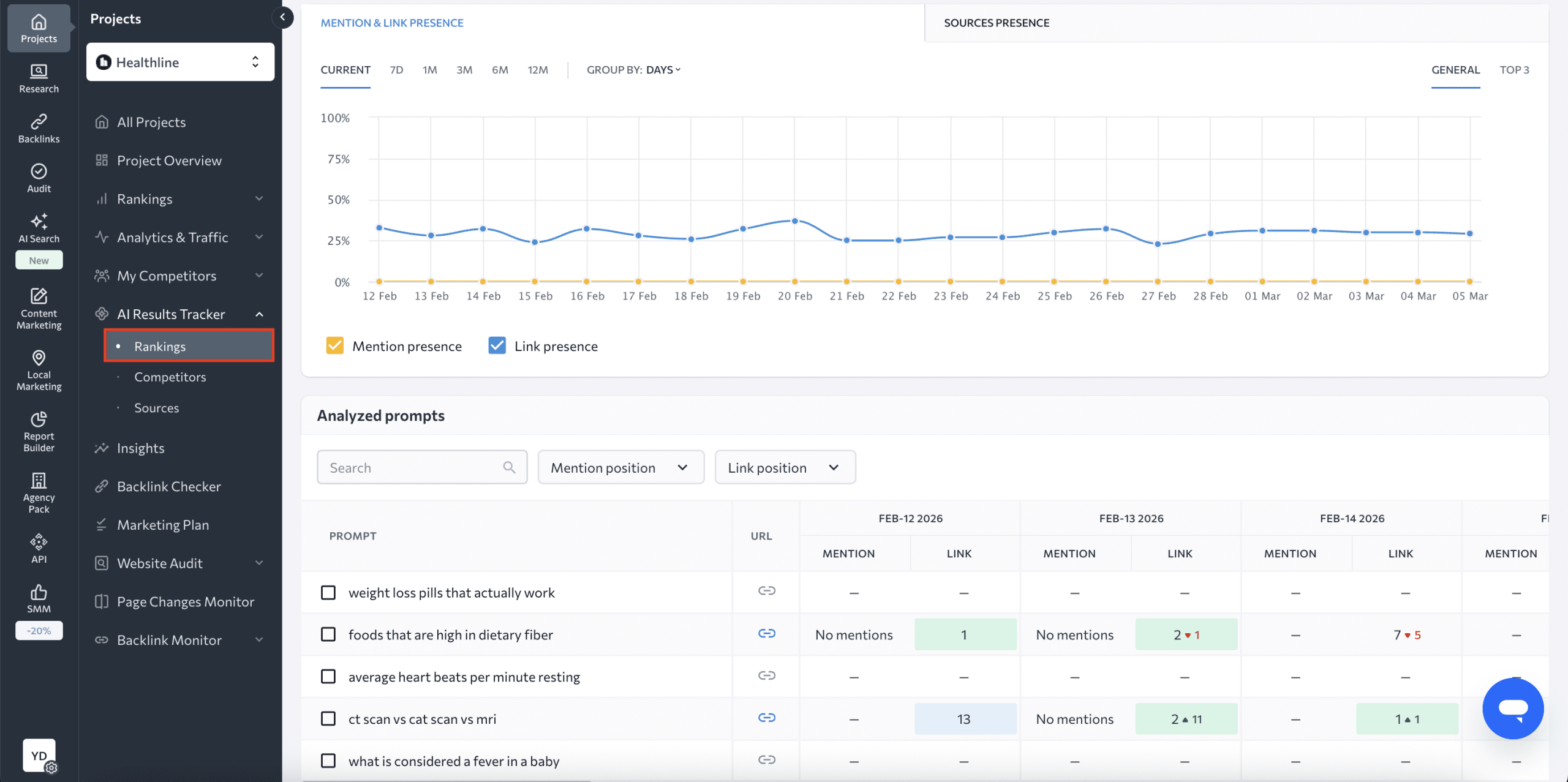
2. Monitor the key sources in your niche and build your strategy around them.
Different industries rely on different authority sources. After Google itself, AI Mode often pulls information from a set of recurring platforms within each niche.
By analyzing the Sources data in SE Ranking’s AI Mode Tracker, you can identify which domains AI Mode relies on most in your topic cluster and see whether your content is cited there.
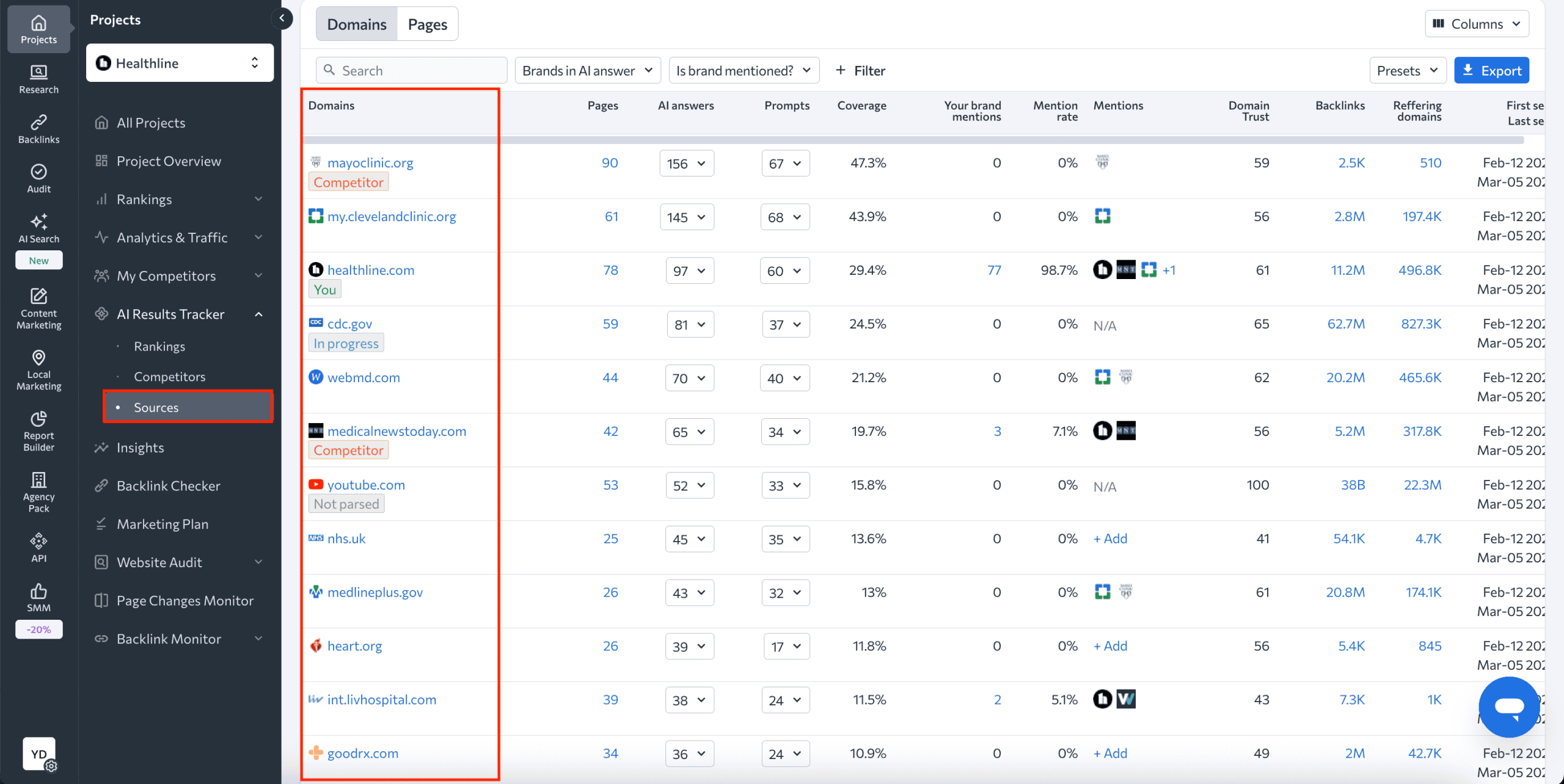
This helps you understand where authority is concentrated and whether your brand is already present on those platforms, or where you may need to expand your presence.
3. Treat Google Business Profiles as strategic assets.
Even though the share of Google Business Profile links has decreased, 36.1% of Google citations still reference them. For local businesses especially, your profile remains a potential AI citation source.
Make sure your business information is complete and consistent, actively encourage customers to leave reviews, and continue investing in local SEO. A well-optimized Google Business Profile increases the chances of your brand appearing in both traditional search and AI responses.
Summing up the trends, Yagmur Simsek, co-founder of Global Cyber Security Network, explains how brands should respond:

Research methodology
To examine Google.com’s role in AI Mode answers, we analyzed 68,313 keywords across 20 niches on February 12, 2026. From these queries, we collected 1,321,398 citations.
We specifically looked at the type of Google links cited (traditional SERP, Google Business Profiles, Support, Flights, etc.), to understand how AI Mode prioritizes different types of content from Google.
All data was gathered using SE Ranking tools:
- Keyword Research Tool: To prepare our keyword list.
- AI Mode Tracker: To collect AI Mode data.
Disclaimer: We aim to provide the most objective interpretation of the data, but we acknowledge other perspectives may also be valid.
Conclusion
Our findings show that Google is everywhere in AI Mode. Its presence has tripled in less than a year, and it’s the top source in almost every niche, from Travel and Entertainment to Real Estate. Even in areas where you’d expect specialized sites to dominate, Google still holds a solid share.
We’ll keep tracking these trends and share updates as things evolve. And while we wait to see how this all plays out next, check out our AI Mode Tracker. With its help, you can spot your top-cited pages, track brand mentions, compare your AI visibility against competitors, and more.