Google December 2025 Core Update: 15% of TOP 10 pages disappeared from the results
Google’s December 2025 core update has officially rolled out, and as always, websites are seeing major ranking shifts.
To understand exactly what changed and who got affected the most, we decided to compare organic results before the update (November 10, 2025) and after the update (January 5, 2026) across 100,000 keywords in 20 niches.
And yes, there was a lot of movement, but also a lot that felt oddly familiar. Here’s what the data tells us.
Insight #1: Nearly 15% of TOP 10 pages fell out of the TOP 100
Let’s start with the most uncomfortable truth.
About 15% of pages that ranked in the TOP 10 before the update disappeared entirely from the TOP 100. That’s almost 1 in 7 pages.
Think about that for a second. Pages you worked hard to optimize, that were performing well, suddenly aren’t visible at all for their primary keywords. This isn’t unusual with Google core updates, but it’s a reminder that no ranking is guaranteed.
If your page stops being the best answer (or Google believes someone else now is), you can lose everything overnight.
Insight #2: 13% of TOP 3 URLs were previously outside the TOP 20
On the flip side, the update created new opportunities. About 13% of URLs in the TOP 3 were previously outside the TOP 20 for the same keyword. In other words, Google is still willing to reward relevance and quality in the first place.
This is exciting for smaller or mid-tier sites that have been grinding away: if your content better satisfies searcher intent, you can leapfrog older competitors (even those who have dominated for a long time).
Insight #3: Domains 15+ years old still rule the TOP 10
Now for the part that won’t surprise anyone who’s been in SEO long enough.
Despite all this movement, SERPs are still dominated by older domains. After the update, the average age of TOP 10 domains barely moved and remains firmly in the 15+ year range. New domains (0–2 years old) account for less than 2% of TOP 10 rankings.
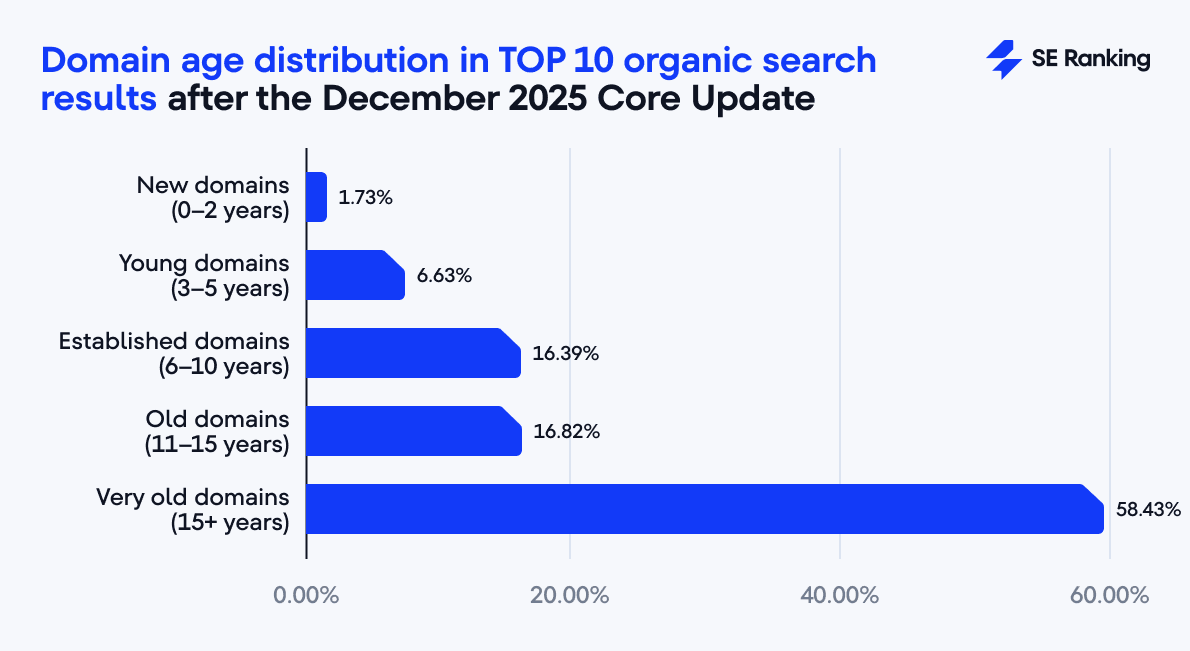
So yes, new domains can break through, but trust and authority are still major ranking factors. The “old guard” of domains surely benefits from years of accumulated credibility and backlinks.
Insight #4: The higher you rank, the more stable you are in terms of the updates
Here’s one of the most important structural insights from this update: stability lives at the top.
Pages in the TOP 3 were far more likely to keep their exact positions than anything below them.
- TOP 3 URLs: 33% remained in the same position after the update.
- TOP 10 URLs: 16.9% stayed stable.
- TOP 20 URLs: 10.16% kept the same position.
- TOP 100 URLs: Just 3% of URLs remained stable after the update, which shows the intense reshuffling happening further down the rankings.
Note: To assess ranking stability, we tracked the positions of individual URLs for the same keyword before and after the update. Any change in ranking—whether a small shift (e.g., from 2 to 3) or a larger drop out of the top positions—was considered a sign of instability.
So, it’s safe to say that Google treats rankings like layers of confidence. The higher you are, the more certain the algorithm is about you. Mid-tier pages (those hovering between positions 4 and 20) are constantly being tested, replaced, and reconsidered. That’s where lots of the chaos happens.
Insight #5: Not all niches felt this update the same way
One of the clearest patterns in the data is how niche-dependent this update was. For example:
- In the E-Commerce & Retail category, over 23% of TOP 3 URLs were new entries, the highest share across all niches.
- In contrast, Healthcare saw only around 8% of TOP 3 URLs replaced, almost 3x less volatility than E-Commerce.
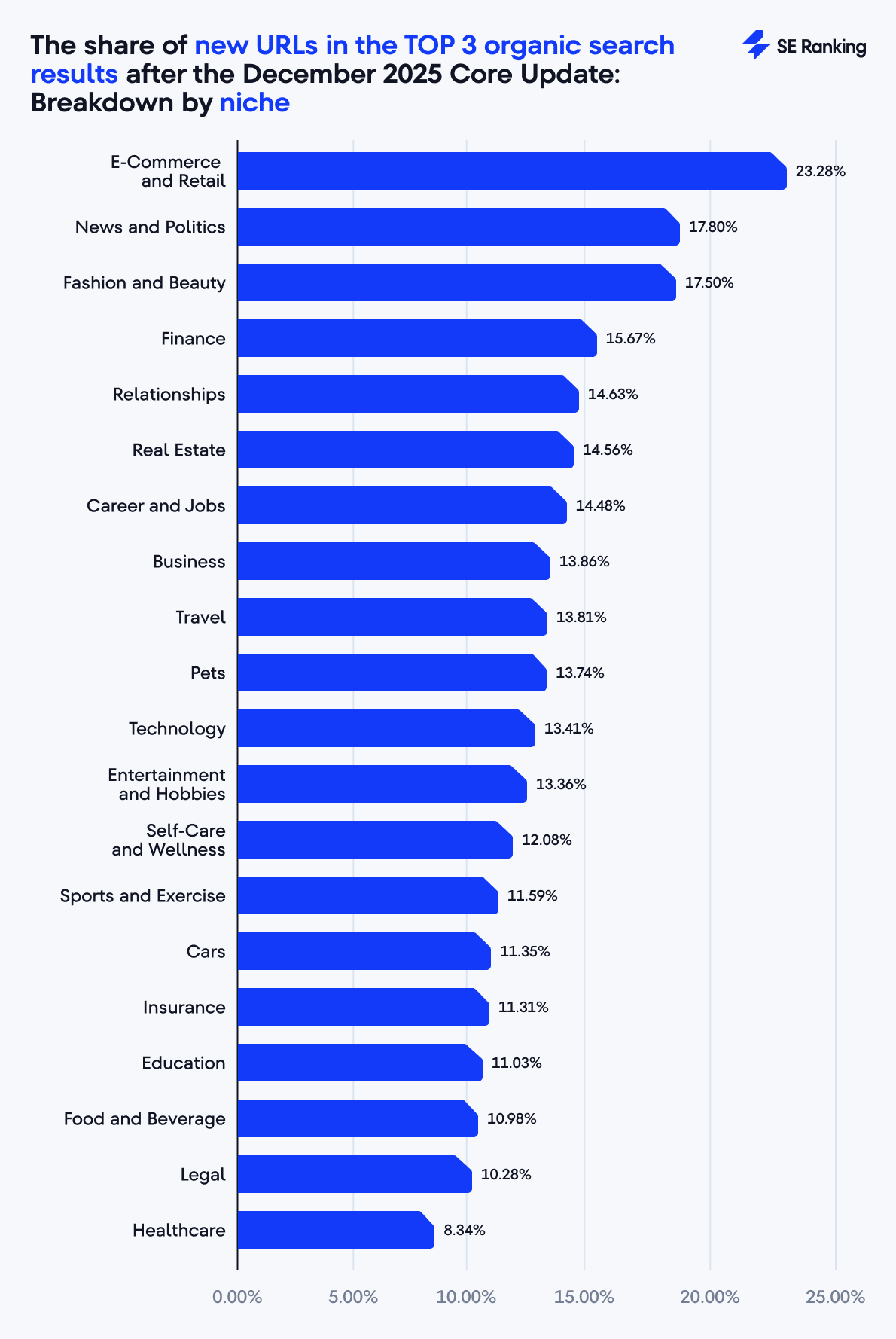
This gap isn’t accidental. Fast-moving, trend-driven industries give Google more room to experiment with relevance, freshness, and format. Highly regulated or YMYL niches, on the other hand, remain anchored to long-established, authoritative domains.
Research methodology
To understand the real impact of Google’s December 2025 core update, we analyzed organic search results before and after the rollout using the same dataset and consistent conditions.
- Location: New York, USA
- Dates analyzed: November 10, 2025 (before update) and January 5, 2026 (after update).
- Keywords analyzed: 100,000
- Scope: 20 distinct niches (Business, Career & Jobs, Cars, E-Commerce & Retail, Education, Entertainment & Hobbies, Fashion & Beauty, Food & Beverage, Healthcare, Insurance, News & Politics, Pets, Relationships, Finance, Legal, Real Estate, Self-Care & Wellness, Sports & Exercise, Technology, and Travel).
This approach allowed us to isolate the effects of the core update itself and identify patterns across both the overall SERP and individual industries.
Final thoughts
If your rankings dropped after the December update, it doesn’t automatically mean something is “wrong.” In many cases, it means Google is simply testing alternatives.
The right response to this update would be not to panic but perform analysis. Look at who replaced you. Look at how intent may have shifted. Then improve with purpose.
Core updates are not one-off events. They’re constantly happening. And long-term visibility belongs to sites that keep adapting.