Sites are now getting 2x more AI traffic from Gemini. How long until it becomes a major traffic source like ChatGPT?
In our research on AI traffic last year, we found that ChatGPT accounted for the largest share of AI-driven visits to websites. No surprise there. It still does.
But as we continued tracking how AI platforms drive visitors to websites, we noticed a clear shift over the past few months. The number of visits coming from Gemini has been growing significantly. And when we say “significantly,” we actually mean it: about +47% growth per month. What’s more, this growth is happening while ChatGPT continues its recent decline of roughly -8% per month.
But will this trend last long enough for Gemini to become the new leader in global AI traffic by the end of this year? Our data shows it might be possible, though a lot would need to happen for that scenario to play out.
-
Between November 2025 and January 2026, the number of website visits coming from Gemini more than doubled.
Visits from Gemini grew +51.5% in December and +42.0% in January (a total increase of about +115% over two months).
-
This growth started right after the rollout of Google’s Gemini 3 models.
The spike in visits began in December 2025, shortly after Google deployed Gemini 3 across its ecosystem.
-
Meanwhile, the number of website visits coming from ChatGPT dropped by more than 22% over the same period.
It fell by 8.5% in November and another 18.6% in December 2025, with only a small recovery in January 2026.
-
Gemini has now also overtaken Perplexity as a source of website visits.
In January 2026, Gemini sent 29% more visitors to websites than Perplexity. Just five months earlier, in August 2025, the situation was the opposite: Perplexity was sending nearly 3x more visitors than Gemini.
Global AI traffic overview
Let’s start with the broader context.
Even with all the attention AI platforms are getting these days, they still account for only a tiny fraction of total web traffic.
According to our data, AI platforms make up around 0.24% of global internet traffic. That may not sound like much, but the growth trend tells a different story.
In 2025, AI referral traffic was 0.15%, which means that by January 2026, it had already grown 1.6x. We can only imagine how much this number might increase by the end of the year.
And out of all this growing AI traffic, ChatGPT unsurprisingly takes the top spot.
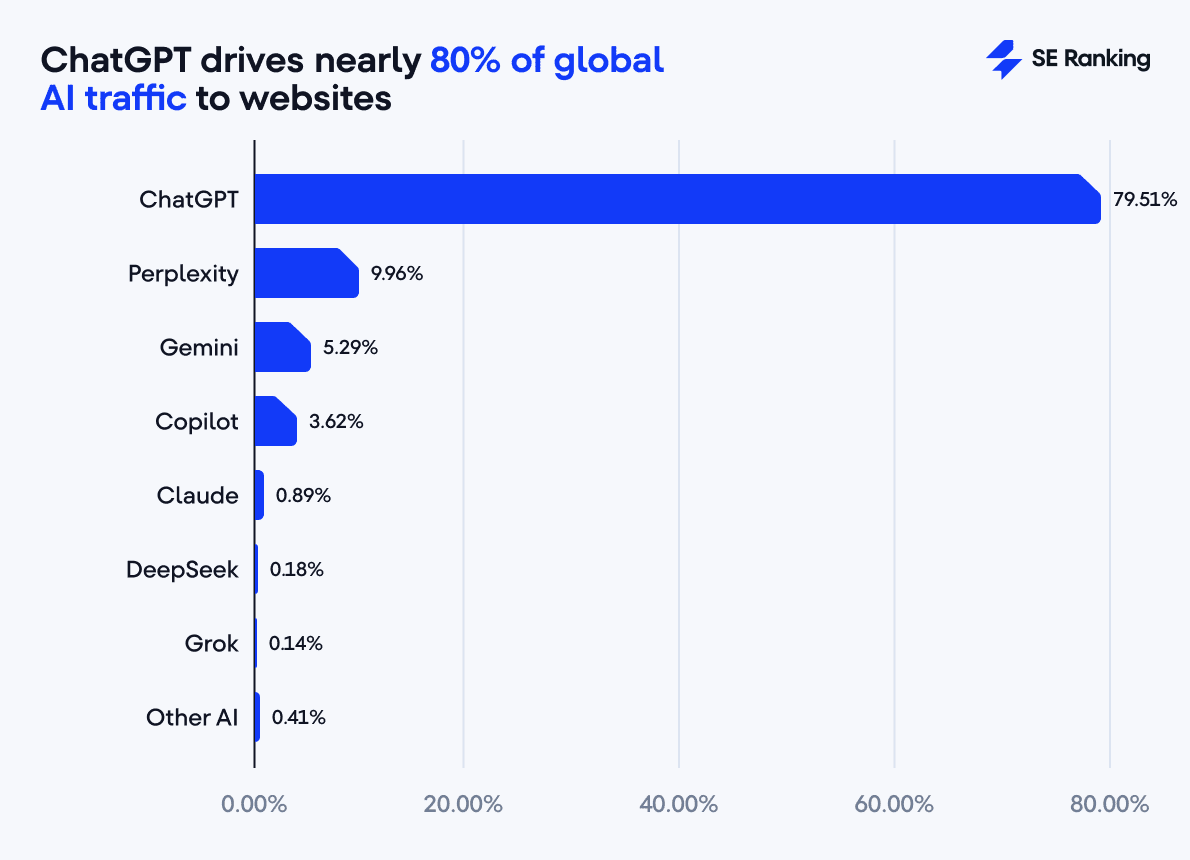
As you can see, nearly 4 out of 5 AI visits come from ChatGPT. Its dominance is so strong that it generates around 8x more traffic than the next-largest AI platform.
But over the past couple of months, Gemini has started closing the gap with ChatGPT. And the story gets more interesting when we look at the details month by month.
ChatGPT vs. Gemini: Monthly shifts in AI traffic
Here’s a timeline showing how web traffic from ChatGPT and Gemini has changed recently.
The first half of 2025: Gemini stays flat
For most of the first eight months of 2025, Gemini’s traffic was practically flat. Its share of global web traffic hovered between 0.0083% and 0.0105%. There was no clear growth trend.
Meanwhile, ChatGPT was doing the opposite. Between January and August, its share of global traffic more than doubled, from 0.0799% to 0.1801%. By August, ChatGPT was sending 21.7x more traffic to websites than Gemini.
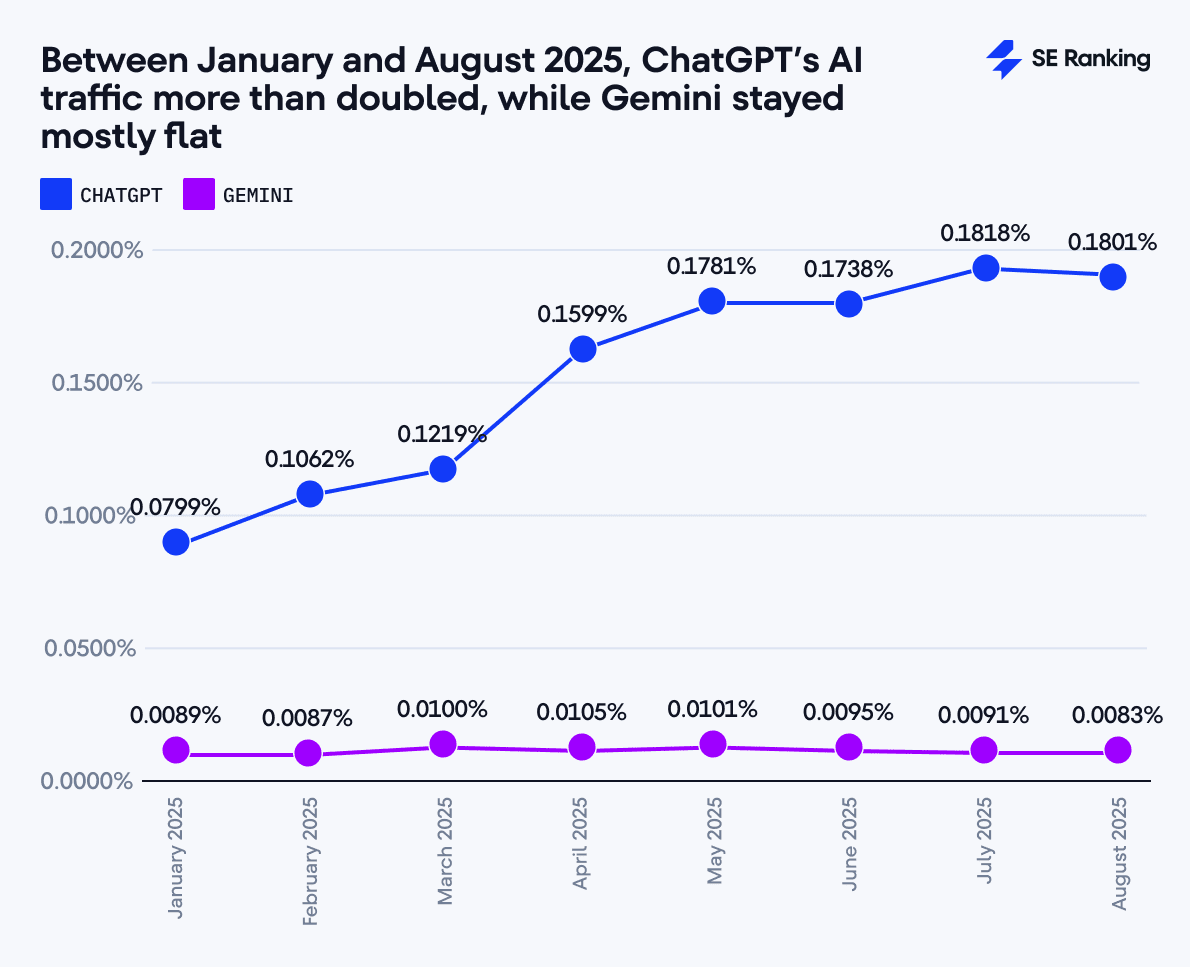
At that moment, the gap between the two platforms looked almost impossible to close.
September 2025: AI traffic surges everywhere
Then, in September, something interesting happened. Every major AI platform saw a spike in referral traffic.
ChatGPT jumped +53.8%, while Gemini grew even faster at +63.9%.
The likely catalyst for ChatGPT’s growth was the launch of GPT-5 on August 7, which expanded free-tier capabilities and pushed ChatGPT to roughly 700 million weekly active users.
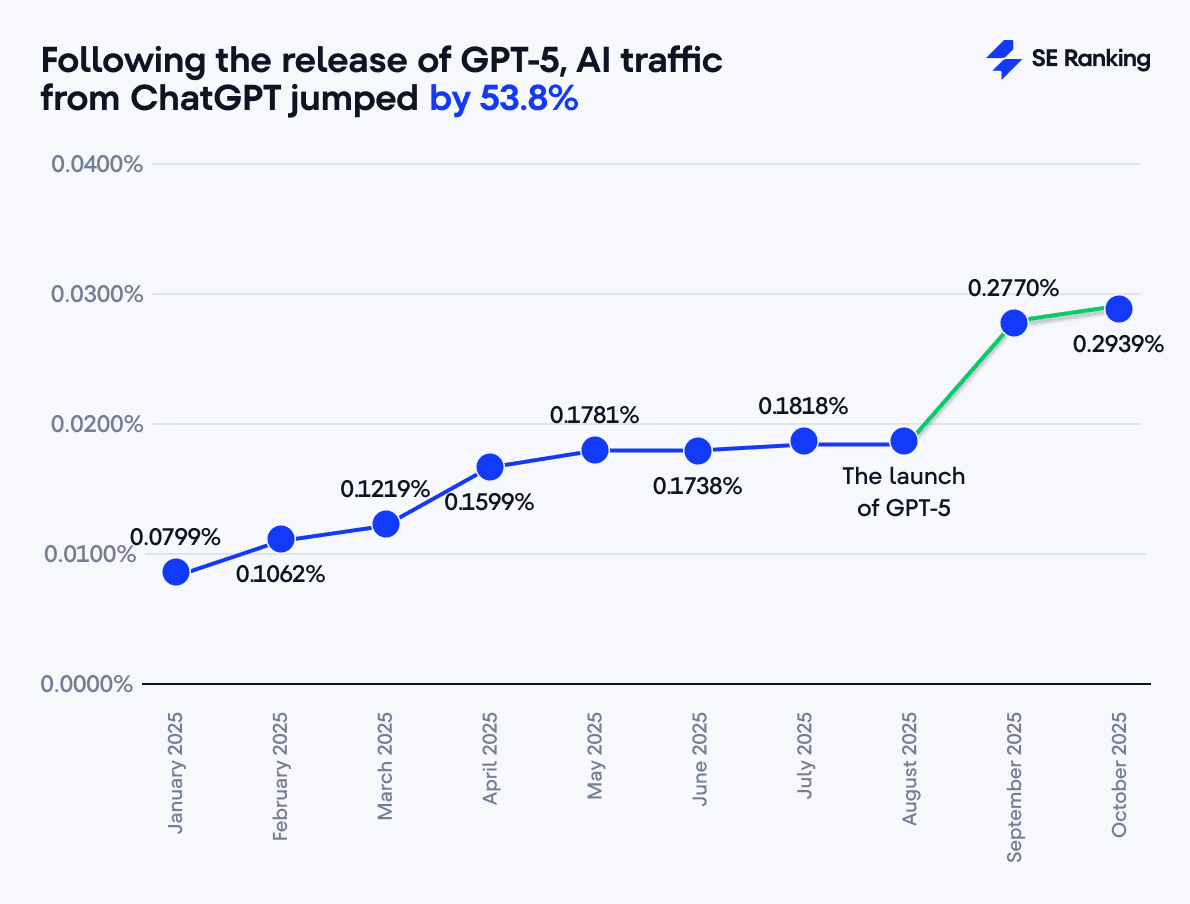
What’s notable here is that, for the first time, Gemini grew faster than ChatGPT, even if the absolute numbers were still far apart. This was the first hint that Gemini could start closing the gap.
October 2025: ChatGPT hits its peak
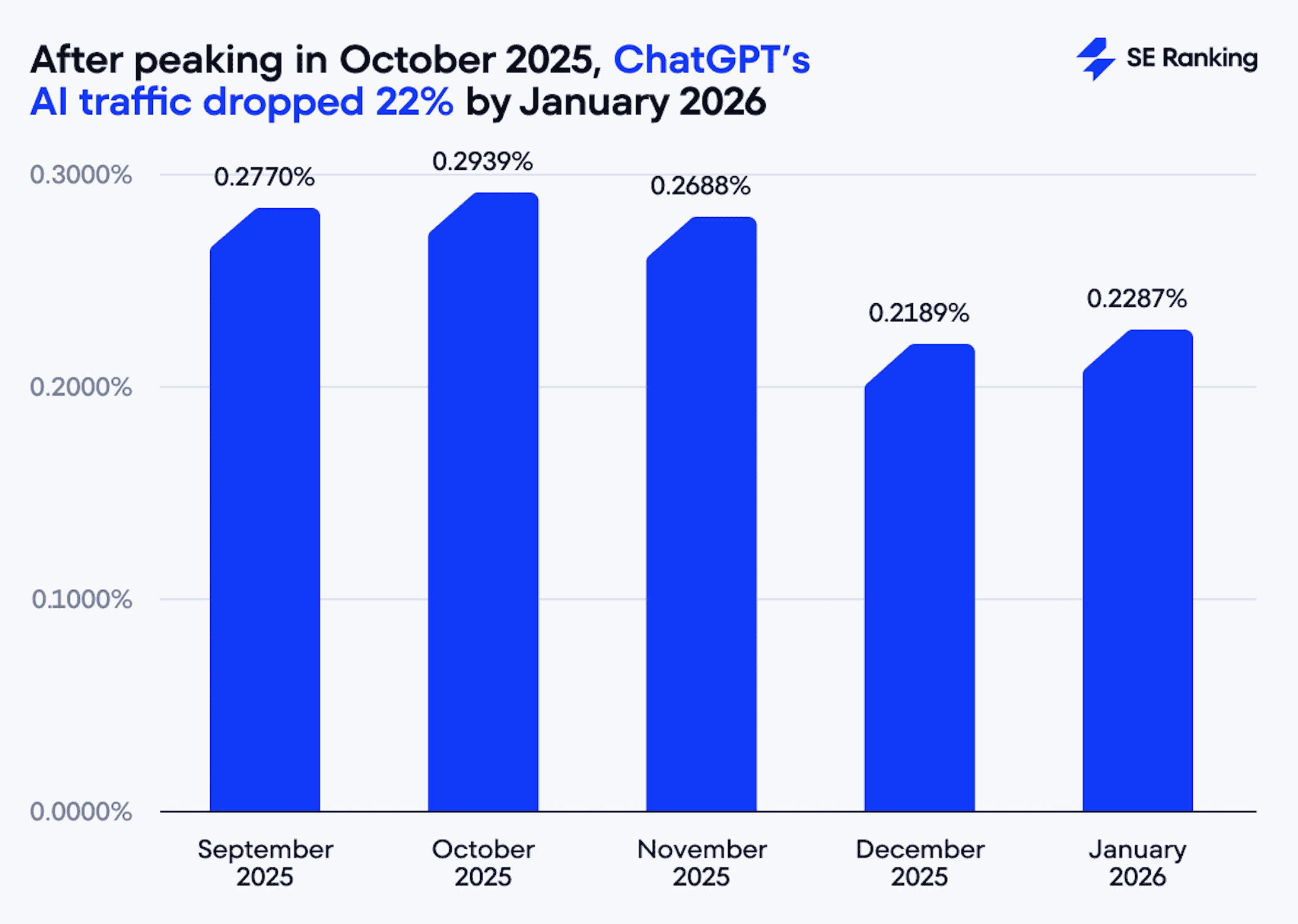
ChatGPT hit its highest point in our dataset in October 2025, accounting for 0.2939% of all global web traffic. But that peak didn’t last long:
- November 2025: 0.2688% (−8.5%)
- December 2025: 0.2189% (−18.6%)
- January 2026: 0.2287% (partial recovery)
Even after the slight recovery in January, ChatGPT was still 22% below its October peak.
December 2025: Gemini suddenly takes off
While ChatGPT was declining, Gemini finally started growing. And fast.
For most of 2025, Gemini had grown at a modest ~4% per month. Then, over December 2025 and January 2026, things changed dramatically:
- November 2025 → December 2025: +51.5%
- December 2025 → January 2026: +42.0%
In just two months, Gemini more than doubled its traffic (+115%), which is around 12x faster than its previous growth period (January-October 2025).
The timing isn’t a coincidence. This surge lines up almost perfectly with the rollout of Google’s Gemini 3 models:
- Nov 18, 2025: Gemini 3 Pro
- Dec 4, 2025: Gemini 3 Deep Think
- Dec 17, 2025: Gemini 3 Flash
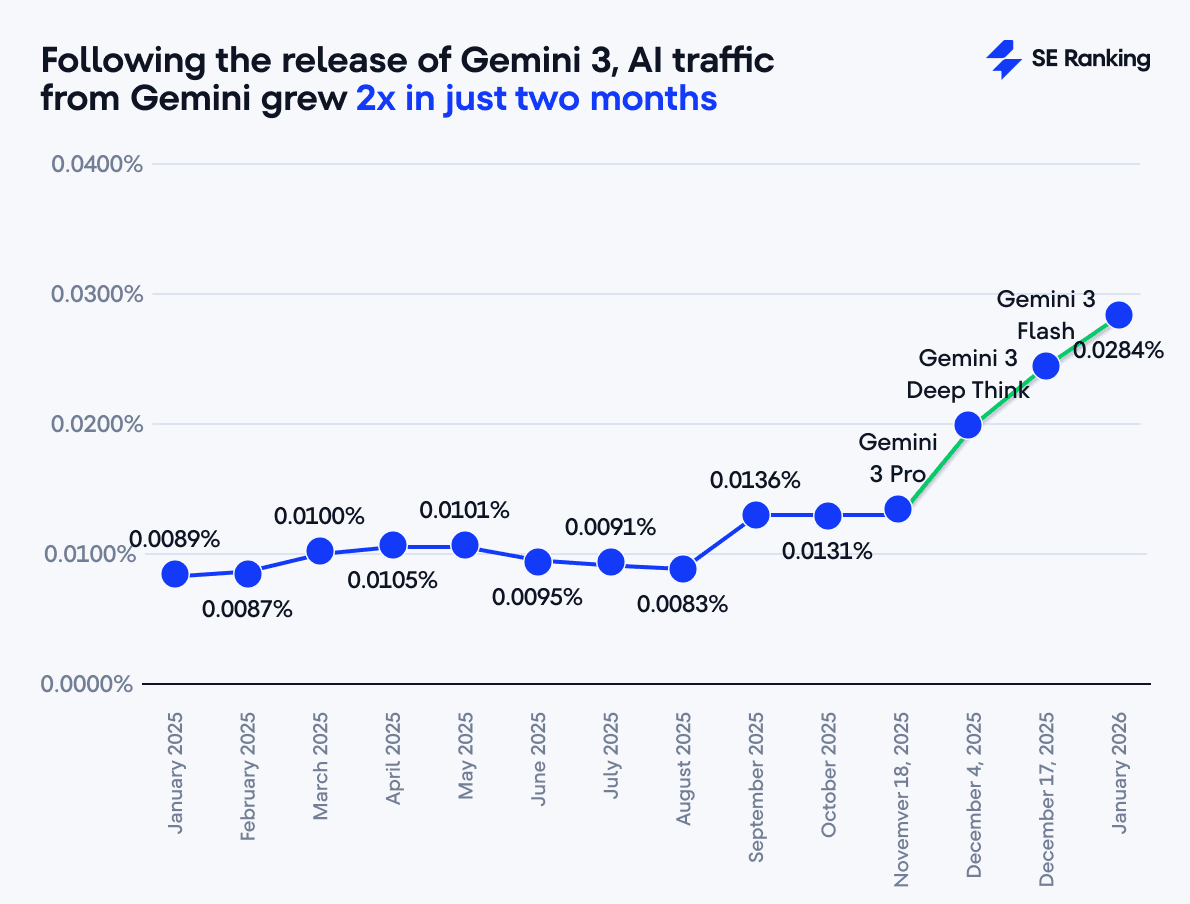
The key moment was Gemini 3 Flash becoming the default model across both the Gemini app and Google’s AI-powered search. Once this model started powering more of Google’s AI interfaces, traffic began climbing almost immediately.
January 2026: Gemini overtakes Perplexity
By January 2026, Gemini hit another milestone: for the first time, it surpassed Perplexity in global AI traffic.
- Gemini: 0.0284%
- Perplexity: 0.0221%
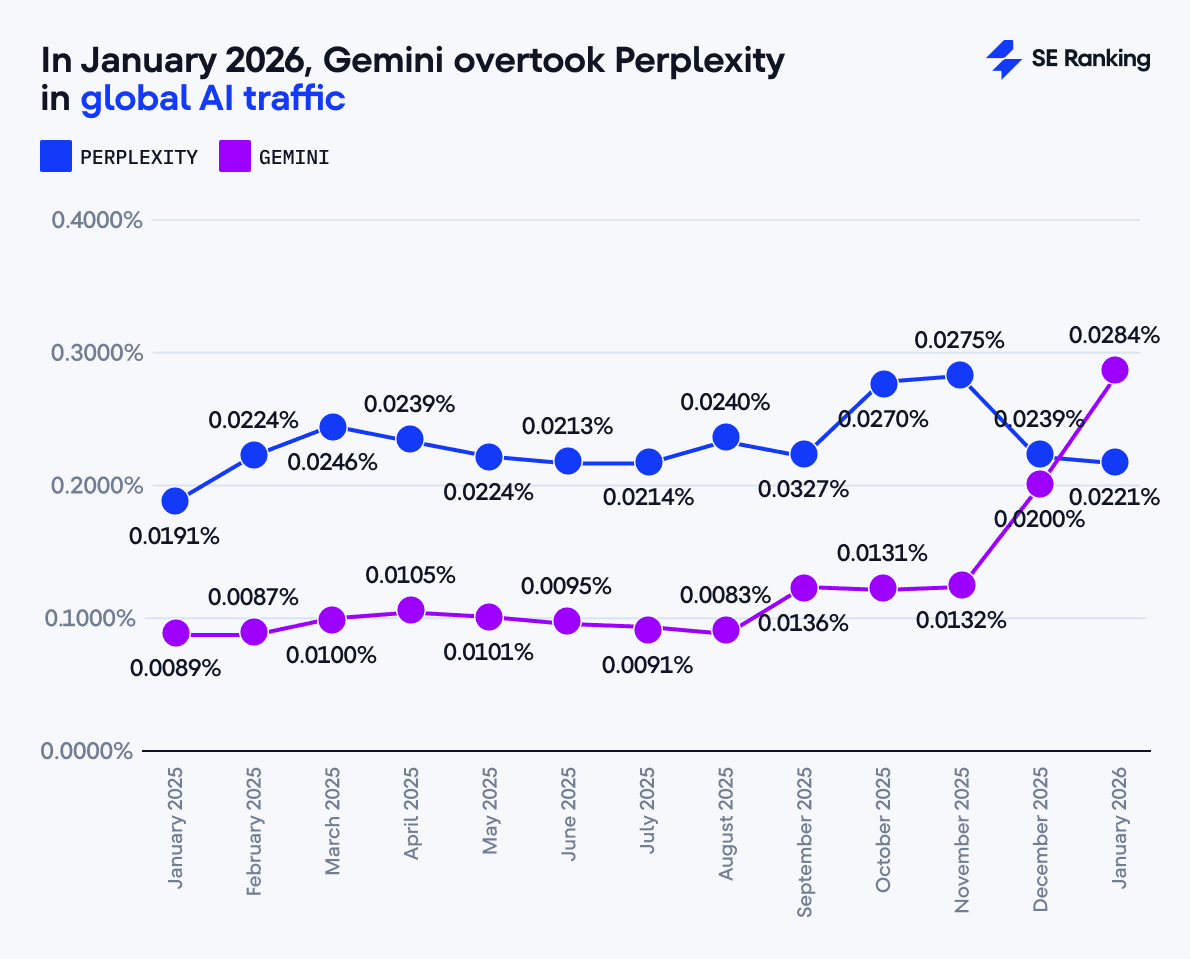
That’s 29% ahead globally.
To put it in perspective, just five months earlier, in August 2025, Perplexity had been sending 2.9x more traffic than Gemini.
Specifically in the U.S., Gemini’s rise was even more pronounced compared to Perplexity.
Here, Gemini’s January 2026 traffic reached 0.0242%, compared to 0.0172% for Perplexity, which means Gemini now leads by 41% in the U.S., significantly more than its 29% global advantage.
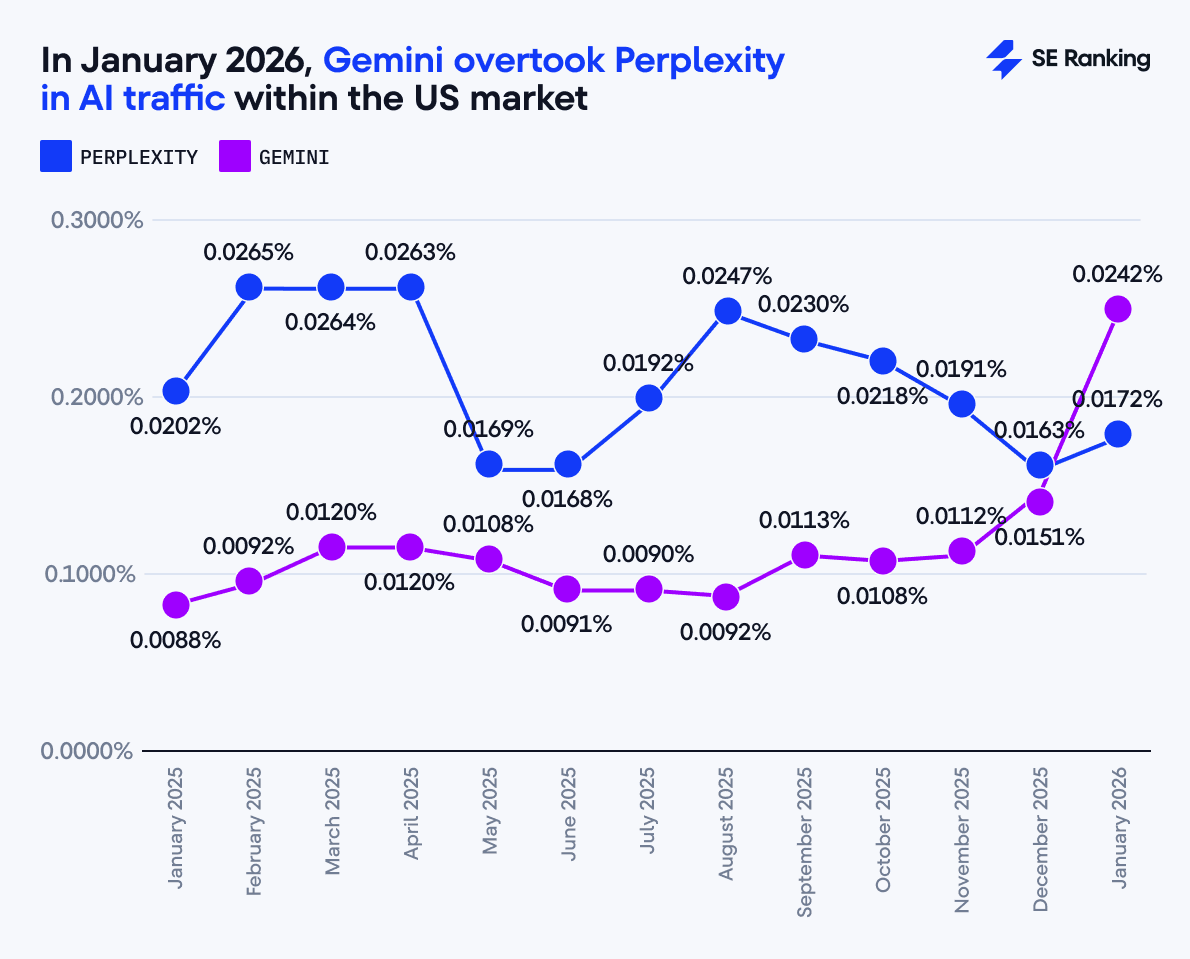
In other words, Gemini is gaining momentum particularly quickly in the US, a market that often sets trends for AI adoption worldwide.
Current state between ChatGPT and Gemini
Even though ChatGPT still dominates, the gap between the two platforms has narrowed noticeably.
Back in October 2025, the AI traffic ChatGPT was sending to websites was more than 22x bigger than Gemini’s. By January 2026, that gap had shrunk to 8x (a 29% reduction in just three months).
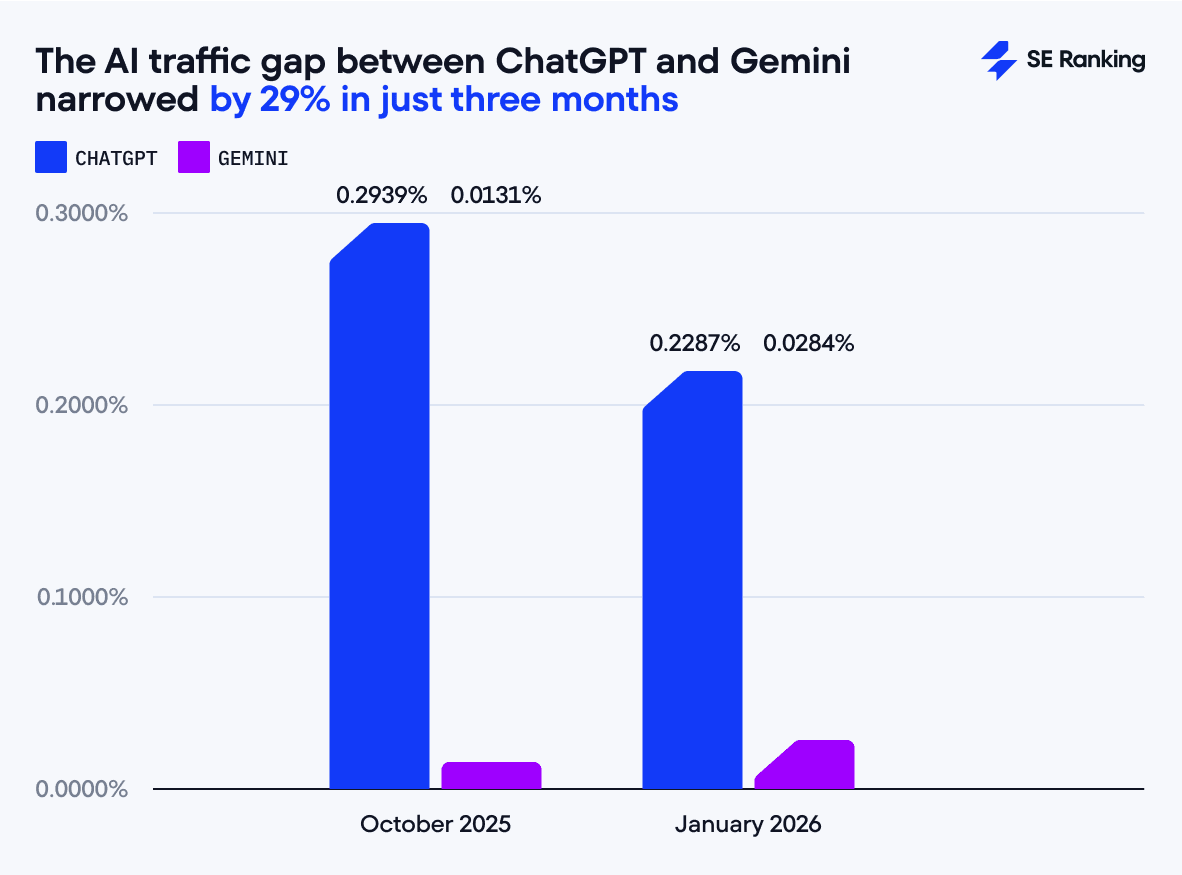
Of course, 8x is still a huge difference. ChatGPT clearly remains the dominant platform, driving far more AI visitors to websites.
At the same time, this shift shows that the market isn’t as set in stone as many might have thought.
Gemini isn’t catching up overnight, but it’s starting to find traction. If this trend continues, it could carve out its own space and gradually chip away at ChatGPT’s dominance.
The big question: Could Gemini catch ChatGPT?
This is the question you likely have after seeing the change in AI traffic trends.
The honest answer is: it really depends on what happens next in 2026. Gemini’s growth has been impressive, but traffic spikes like this rarely continue indefinitely. A lot of the recent surge was driven by the rollout of Gemini 3, which temporarily boosted traffic across apps and Google’s AI interfaces.
Once the initial excitement settles, growth could slow down (or stabilize at a more modest pace). Similarly, ChatGPT’s recent dip might level off, or it could rebound with new model updates, features, or integrations.
Let’s break it down into two scenarios.
- Scenario 1: Current trends continue
If Gemini continues growing at roughly 47% per month (like it happened in December 2025 and January 2026), and ChatGPT keeps declining at about 8% per month, then a crossover could happen as soon as June 2026. That would be a remarkable turnaround and would signal a serious shift in the AI traffic dynamics.
- Scenario 2: Growth moderates
A more conservative view is that Gemini’s recent spike slows down to something closer to its longer-term growth rate (September 2025 – January 2026), and that ChatGPT stabilizes. In this scenario, the crossover would happen closer to October 2026.
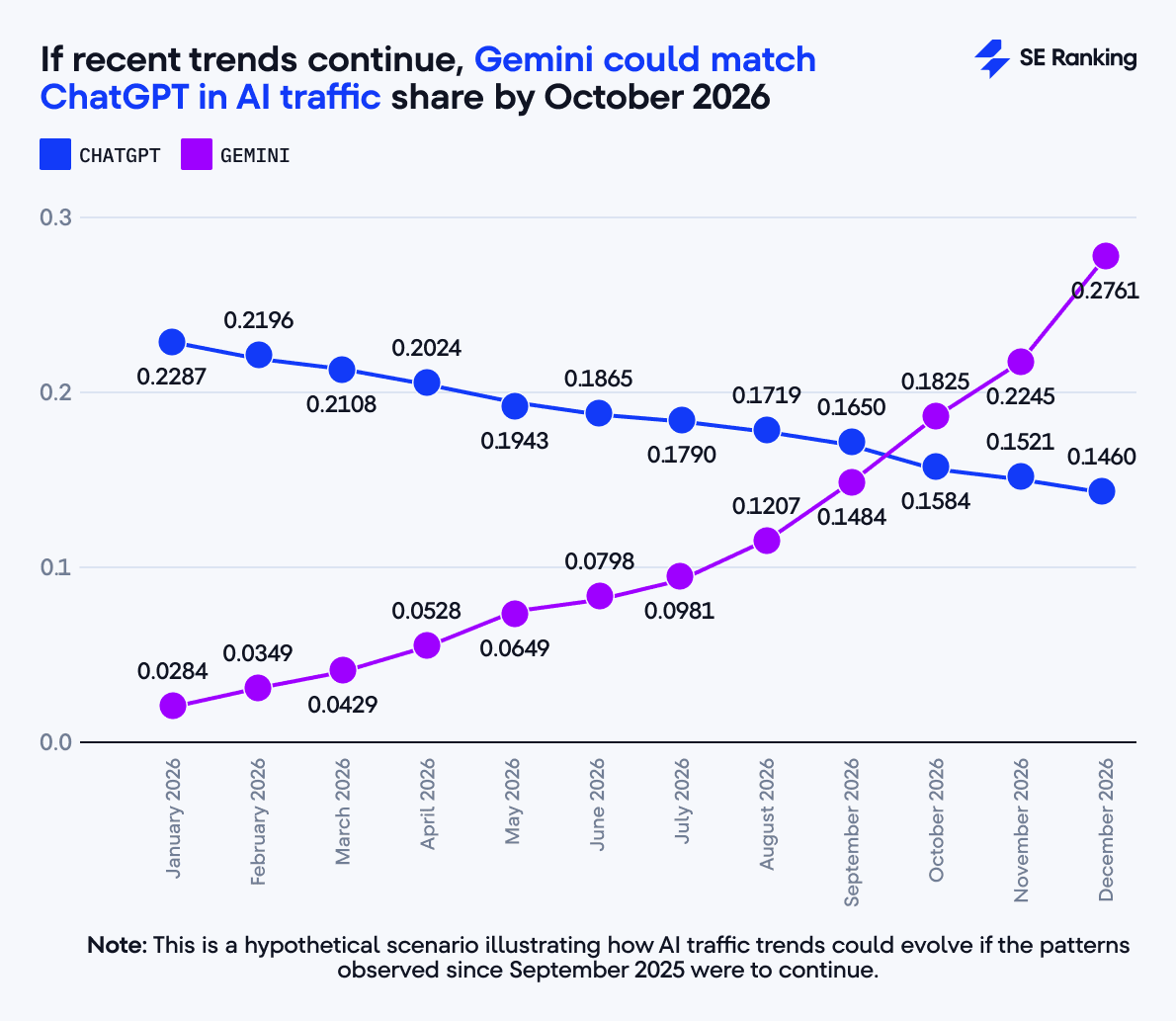
The truth is, Gemini will only match ChatGPT if its current surge lasts long enough. It’s a big “if,” because growth spikes usually taper off. Success will depend not just on maintaining momentum, but on what comes next: new models, unique features, integrations with apps or search, and how users respond.
In other words, the story isn’t written yet. Gemini is on the rise, but whether it truly challenges ChatGPT will depend on the next few months. And we will, of course, keep monitoring the situation going forward.
What this means for you
So, what should you take away from all of this?
The rise of Gemini (and the continued dominance of ChatGPT) shows that relying on a single AI platform is becoming risky. If you focus only on optimizing for market leaders like ChatGPT, you could miss out on traffic from other AI sources. The smarter approach is to broaden your strategy and consider all major LLMs, even those that currently send only a small share of AI traffic.
Here are three practical steps we recommend following based on what our research found:
1. Track AI traffic across multiple platforms and see how it converts. Don’t rely solely on ChatGPT as a source. Make sure to track traffic from Perplexity, Gemini, and other major LLMs. This will give you a better picture of your AI visibility.
2. Monitor brand visibility as the core metric beyond traffic. Use AI Search Visibility Tracker to measure it across AI Overviews, AI Mode, ChatGPT, Gemini, and Perplexity. The tool lets you monitor both linked and unlinked brand mentions across all these platforms, see which domains and URLs are being cited, compare your presence with competitors, get actionable tips to improve your AI visibility, and much more.
And then, to see the complete picture, you can combine this with traffic data from GA4, which you can integrate directly into SE Ranking. This gives you two layers of insight: brand visibility and actual traffic. By looking at both together, you can spot real correlations — for example, which gains in AI visibility are driving more visits, or which shifts in traffic point to changes in your brand presence.
This ecosystem-level view helps you make smarter decisions, even when AI traffic trends are unpredictable.
3. Prepare for volatility and be ready to switch your strategy for AI visibility optimization. Traffic spikes like Gemini’s recent surge are exciting, but they rarely last forever. A platform that’s growing today could stabilize or even decline tomorrow, while another platform could suddenly gain traction.
All in all, it’s important to monitor trends consistently and adjust your strategy when needed. For example, if a new LLM update, like Gemini 3 rollout, suddenly drives more traffic through Google’s AI search, you’ll want to make sure your brand is visible there. Or, if ChatGPT regains its share of AI traffic, you’ll want to be ready to maintain or increase your visibility there so you don’t miss out on that rebound.
Research methodology
Our analysis included 101,574 websites across 250 geographic markets, all of which have Google Analytics installed in accordance with SE Ranking’s Terms of Service.
All insights in this article are derived from historical data and anonymized information, and represent our interpretation of these datasets.
As part of the analysis, we examined referral traffic from the following LLMs: ChatGPT, Perplexity, Gemini, Copilot, Claude, DeepSeek, and Grok, as well as smaller platforms like Mistral, Qwen, iAsk.Ai, Venice.ai, and WRTN.ai.
The data covers the period from January 2025 to January 2026.
Note: While we strive to provide the most accurate and unbiased insights, we acknowledge that alternative interpretations of the data may exist.
Final thoughts
Predictions are always uncertain. Yet the direction of the trend is clear.
- ChatGPT still dominates AI traffic.
- Gemini is now the fastest-growing AI platform.
- The gap between them is shrinking.
But even if Gemini doesn’t overtake ChatGPT in AI traffic this year, the lesson we all need to learn is not to put all the eggs in one basket. Monitor multiple LLMs, pay attention to updates, and adapt your strategy as needed.
We’ll also continue to keep a close eye on the situation and track how traffic shifts across ChatGPT, Gemini, and other major AI platforms throughout 2026.